Minnesota State Capitol artwork
The Minnesota State Capitol opened in 1905 with roughly 60 artworks that totaled $300,000, or 7% of the $4.5-million project budget. Over the years artworks would be added to the Capitol, totaling nearly 150 by 2017.[1]
Much of the art was allegorical, as expressed through murals, and in their names and content they reflect the perspectives of their time.
History
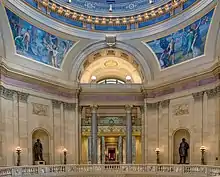
In the planning of the Capitol building from 1896 to 1905, its architect Cass Gilbert had envisioned marble and bronze statuary on the exterior and numerous artworks in the interior.[2]
Gilbert sought out many of the finest artists of the period, such as Kenyon Cox, Elmer Garnsey, Edwin Howland Blashfield, Henry Oliver Walker, Edward Emerson Simmons, John La Farge, Douglas Volk, Francis D. Millet, Howard Pyle, and Rufus Fairchild Zogbaum.
In the 1901 architect report, Gilbert noted his vision for the art:
Nothing will give the building greater distinction or lend more to its educational value and to the evidence of the advancement of civilization and intelligence of the State than the recognition of the arts as represented by the great painters and sculptors of the present day, and I unhesitatingly and strongly recommend that ample provision be made to decorate the building with mural painting and sculpture...[1]
Much of the art planned for the Capitol was allegorical, as expressed through murals but as work continued after 1900 on the interior multiple groups, notably American Civil War veterans and the Minnesota Historical Society along with politicians demanded that the artwork in the Capitol illustrate historic events of Minnesota’s past. The current ornate look of the Governors Reception Room was partly a response to Minnesotans’ suggestions for pictures from their own history which gave Gilbert the opportunity to upscale his plans for the room and to include six large paintings that span 200 years of the area’s history.
Over the years, additional art has been added inside the premises. In 1944 governor portraits custom of displaying in the public corridors was initiated.
In 1971 Capitol Area Architectural Planning Board and the Minnesota Historical Society were entrusted to approve design, structural composition and location of all works of art. [3][4]
Quadriga and the Virtues
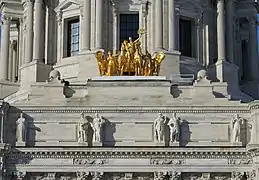
Above the southern entrance to the building is a gilded quadriga called "The Progress of the State" which was sculpted by Daniel Chester French and Edward Clark Potter a specialist in animal sculpture who teamed up with French to create the four horses in the monument. It was completed and raised to the roof of the capitol in 1906. The four horses represent the power of nature: earth, wind, fire and water. The women leading the horses symbolize civilization, and the man on the chariot represents prosperity.[5] French also supplied single figures in plaster, and executed in marble that are immediately below the quadriga.
The sculpture group underwent re-gilding in 1949 and again in 1979. In 1994/1995, the statues underwent a year-long restoration procedure which involved replacing the corroded steel supports inside each statue and included replacing the gold leaf on the figures. The golden sphere perched on the lantern above the capitol dome had similar treatment. In 2014 the figure of the charioteer was removed and lowered to the ground to allow repairs to corrosion to the top surface of the chariot and was reinstalled in 2015.[6][7]
Virtues
The six marble figures on the facade located just under the Quadriga represent "the six virtues that support and assist the progress of the state - the underlying virtues of good citizenship," as explained in the 1907 official guide to the State Capitol endorsed by Gilbert. The four female and two male figures represent Wisdom, Courage, Bounty, Truth, Integrity, Prudence.[8]
According to custom in the turn-of-the-nineteenth-century, French did not carve the statues himself but rather modeled them in clay at half-size, then skilled stone cutters worked, shaped, and carved them in marble on the grounds of the Capitol.
The original marble statues, which had deteriorated from the effects of weather and pollution The were replaced by marble replicas carved in the 1970s.[9]
Original plaster models of Virtues
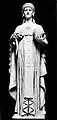 Wisdom
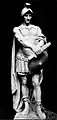 Courage
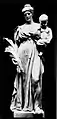 Bounty
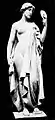 Truth
Truth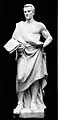 Integrity
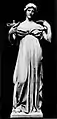 Prudence
Rotunda Artwork
The Four Civil War Alcove Monuments
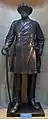
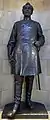
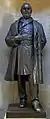
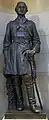
In alcoves on the second floor of the Capitol rotunda stand the larger-than-life statues of Civil War heroes John B. Sanborn, Alexander Wilkin, William Colvill, and James Shields. All four were prominent figures in 19th century Minnesota.
Minnesota sculptor John K. Daniels did both the Alexander Wilkin and John B. Sanborn statues. These were the first of several statues he did at the Capitol including three on the Capitol grounds, Knute Nelson in 1928, Leif Erikson in 1949, and the Earthbound Monument in 1956.[10]
The statue of James Shields by Chicago artist Frederick Cleveland Hibbard is a second casting with the original at the Carroll County Courthouse, Carrollton, Missouri. Because the original design work had been paid for by a state appropriation of $10,000 from the Missouri Legislature, Minnesota veteran groups were able to get a second casting from Daniels for $1,450 for placement in the Capitol rotunda.[11][12]
The Col. William Colville [sic] Monument Commission was appointed by Governor Johnson in 1907. At a meeting in St. Paul, the commission asked the opinion of Chicago sculptor, Laredo Taft, who was in the city at the time. While he did not recommend any of the models, he thought the model by Catherine Backus had points in its favor. They selected Backus' model to execute in full-size bronze. Other models were presented were by John K. Daniels and the P. N. Peterson Granite Company. The appropriation for the monument was $10,000.[13][14] Backus had met Colvill in Red Wing, Minnesota and had the occasion to draw him. After his death she later made a death mask of his head and face.[15]
Gilbert was not pleased with any of the four immense bronze Civil War statues that stand on the second floor of the building and he was least satisfied with the work of Minneapolis artist Catherine Backus, whose rendered the memorial to William Colvill he called a "damned bad statue."[16]
Gilbert wanted a sculptor of international repute to do Colvill’s statue. When the citizens’ group that commissioned Backus ignored that wish, he wrote to the group: "You now have before you models for this important work by persons who are naturally ambitious but who, so far as I can ascertain, utterly lack the training and experience to execute the work."[17]
Biographer Egerton Swartwout described Gilbert as "purposely impressive in manner and rather pompous at times." As architect of the Minnesota Capitol, he was driven to control its every detail, including the monuments that would stand inside.[18]
Despite Gilbert’s evaluation, the work by Backus was placed in the Capitol, and many other memorials without Gilbert’s blessing followed.[17] Backus also went on to design a bas relief bronze memorial plaque to the First Minnesota Volunteer Infantry, which is mounted on a wall on the Capitol's first floor. In 1928 President Coolidge dedicated a second casting of Backus' William Colvill statue in Cannon Falls, Minnesota, Colvill's hometown[16]
Major General James Shields
Shields the best-known of the group due to his dueling with Abraham Lincoln. Shields was brigadier general in the Army of the Potomac during the civil war. Fighting in the Shenandoah Valley in March 1862, Shields delivered Stonewall Jackson's only defeat at the Battle of Kernstown and was gravely wounded in the process. Later he went on to become the only man to serve as a senator in three states — Illinois, Minnesota, and Missouri. He also was the governor of the Oregon Territory.[19]
General Alexander Wilkin
Of the four Civil War veterans cast in bronze at the Capitol, only Gen. Alexander Wilkin died in battle. He was the highest ranking Minnesota officer to perish in the Civil War. He died while he was supposed to be in reserve in Tupelo, Mississippi. Confederate officer Nathan Bedford Forrest was raiding heavily in middle Tennessee at the time. Wilkin was among those Gen. William Sherman thought could stop Forrest. Union casualties near Tupelo were slight in the ensuing battle, but Wilkin was among them.
Wilkin founded St. Paul Fire and Marine Insurance Company before the war. Like Shields, was not averse to a duel. Wilkin shot and killed a fellow officer who challenged him during the Mexican War. In 1868, Minnesota’s Wilkin County was named after him.[20]
Colonel William Colvill
Colonel William J. Colvill led the First Minnesota Regiment at Gettysburg in Pennsylvania, the bloodiest battle ever fought on American soil. The First Minnesota suffered more than 80 percent casualties in July 1863, and Colvill was wounded during the second day of the three-day battle. He returned to Minnesota weak from his wounds, but survived to age 75. In 1905, Colvill was the first man to lie in state in the present Capitol.[21]
Brevet Major John B. Sanborn
Sanborn was Minnesota’s adjutant general when the Civil War began. Commander of the Fourth Minnesota volunteer infantry, he was one of two brigade commanders in charge of Vicksburg, Mississippi after Gen. Ulysses S. Grant took the city. Sanborn was a lawyer and both a state senator and representative. He eventually became president of the Minnesota Historical Society and was a member of the society for 48 years.
Civilization of the Northwest
Roughly twenty-eight feet long and thirteen feet in height and over ninety feet from the rotunda floor the four-panel set titled "Civilization of the Northwest: The American Genius" on the rotunda walls is the largest of all the murals in the Capitol. The murals were completed by Edward Simmons, an American Impressionist painter, a member of the Ten American Painters, who, as a group, seceded from the Society of American Artists.[22] The commission to paint the murals was both a surprise to Simmons as well as one of the largest undertakings he ever did. In a romantic manner, it demonstrates an idealized turn-of-the-19th century chronicle of Minnesota's evolution. The first panel represents the young man leaving home; the second, the cleaning up of the land; the third, breaking the soil, which he does by lifting a great stone out of a hole from which issues a young girl bearing maize; and in the last panel, the young man is crowned and sends the four winds to the four quarters of the globe bearing the gifts of Minnesota. In every panel he is accompanied by Hope and in all but the last panel he is accompanied by Minerva (Wisdom). In the last panel having acquired Wisdom, Minerva is now gone and her shield is at his feet.[23]
While the allegorical symbolism used in the paintings would have been more widely understanding during the time they were painted, objects can hold not one, but many meanings and it appeared to be a challenge for some as Simmons accounted in this 1922 biography,
- "There were several guides in the Capitol employed to show the visitors around and explain the sights to them. I thought it would be splendid for me to give them special instructions about my work, so that they would not make the usual ludicrous mistakes. But guides seem to be a different breed of animal chosen for the wide range of their imaginations. I supposed everything was going all right, when one day a particularly loquacious one came to me and showed me a miniature palette in his buttonhole, telling me he was an artist himself and belonged to a club of artists. He knew all about the ladies in my decoration—the one veiled in chiffon (which I had made for Hope) he called Sin, entirely neglecting the nude woman in the foreground (Sin) clinging to a grizzly (Savagery). He had probably received his early education in and about a Burlesque show."[23]
On a 94 degree day in 1912, one of the panels separated from the wall and fell to the floor of the rotunda and had to be re-glued in place.[24]
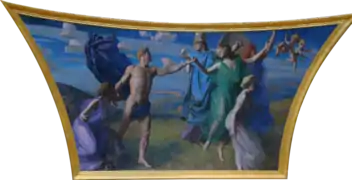 Panel 1
(Southeast Corner)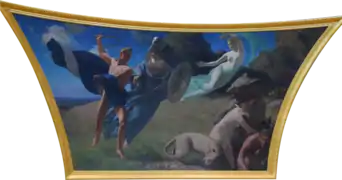 Panel 2
(Southwest Corner)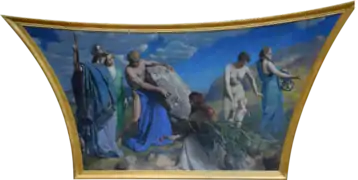 Panel 3
(Northwest Corner) Panel 4
(Northeast Corner)
Governor's Reception Room Artwork
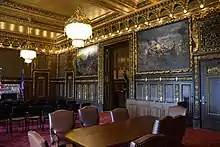
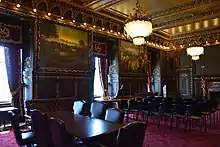
In 1905, Gilbert advised the Board on a series of Civil War paintings for the room including their placement, subject matter and recommended the artists, of which he critiqued their work from first contact to final installation.
Gilbert prided himself in handling colors, materials, and spaces and in directing the work of decorators and designers, to create the aesthetic unity he envisioned.[25]
Gilbert rebuffed a self-appointed committee sought to commission its own painting of the Battle of Gettysburg for the room, in the name of artistic integrity and maintaining the cohesion of his designs. He worked quickly to arrange historical paintings for all the available spaces in the room stating, "It seems to me that if the Board does not cover the vacant spaces that somebody will get in their deadly political work later on and make that room a chamber of horrors in the name of patriotism."[26]
Rufus F. Zogbaum, a well-known painter and illustrator of Army and Navy battle scenes he was selected by Gilbert and commissioned by the Board to paint "The Battle of Gettysburg."
Francis D. Millet was commissioned to do two paintings for the room, "The Fourth Minnesota Entering Vicksburg" and "The Treaty of Traverse des Sioux". Millet at age fifteen, participated in American Civil War with the Massachusetts regiment, first as a drummer boy and then a surgical assistant.
Douglas Volk was also commissioned to do two paintings, "The Second Minnesota at Mission Ridge" and "Father Hennepin at St. Anthony Falls".
Howard Pyle, was disappointed when he did not receive the commission to do the battle of Missionary Ridge, but was commissioned and created the most widely known painting of the six, "The Battle of Nashville."[26]
Later additions
Adjacent is the Governor's Ante Room which display two paintings commissioned and placed after the building of the Capitol. The Third Minnesota Entering Little Rock, placed in 1910 was painting by artist, Stanley M. Arthurs who was a student of Howard Pyle and an assistant of his on larger commissions.
On the wall opposite is the painting The Fifth Minnesota at Corinth by Edwin H. Blashfield which was placed in 1912. Blashfield's painting focuses the eye on a Confederate officer, standing unarmed against the Regiment’s charge which was a conviction at the time that bravery could be found on both sides of the conflict.[3]
Reception
While the reception to the paintings was positive, Civl War veterans critiqued the accuracy of the paintings. Arthurs remarked while hanging his painting, "Soldiers who took part in the event are not pleased with the painting in many respects. It is said that the blankets are not properly arranged."[3]
William Watts Folwell the University of Minnesota's first president and the president of the Minnesota Historical Society from 1924 to 1927 was not in favor of such memorials for the American Civil War and offered cautionary words, "...such memorials of a war between sister states in the American Union are not in good taste. The Roman custom of preserving no memorials of a civil war is one that America, now united forever, may properly follow." [3]
Removal
As restoration of the works of fine art occurred during the Capitol renovation from 2013 to 2017, discussions occurred over some paintings in the building that featured controversial depictions of American Indians. A series of public input meetings were held around the state to gather feedback and consider options for new policies regarding art in the renovated building.
Two of the paintings in the Governor's Reception Room, Volk's Father Hennepin Discovering the Falls of St. Anthony, and Millet's Treaty of Traverse des Sioux, were called out for relocation following public input by the art subcommittee of the Capitol Preservation Commission because of the paintings long-criticized, inaccurate portrayals of American Indians and due to their prominent placement in a room where they served as a backdrop during state events and press conferences. In 2016 the decision was to relocate the two paintings to a new space on the Capitol's 3rd floor where expanded interpretation could be given.[27][28][29][30]


In addition to the two paintings in the Governor's Reception Room, two other paintings located elsewhere in the Capitol, criticized for their portrayals of American Indians, Attack on New Ulm by Anton Gag and the Eighth Minnesota at the Battle of Ta-Ha-Kouty (Killdeer Mountain) by Carl L. Boeckman, were removed from the Capitol altogether as they were acquired after the capitol was constructed and were not original to the building.[29][30][31]

%20in%20the%20Battle%20of%20Ta-Ha-Kouty%20(Killdeer%20Mountain).jpg)
Paintings in Governor’s Reception Room and Anteroom
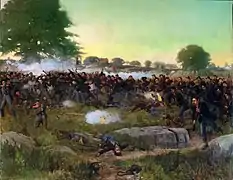 The Battle of Gettysburg by Fairchild Zogbaum
 The Second Minnesota Regiment at Missionary Ridge, by Douglas Volk
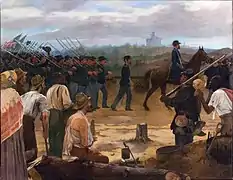 The Fourth Minnesota Entering Vicksburg, by Francis D. Millet
 The Fifth Minnesota at Corinth, by Edwin H. Blashfield
 The Battle of Nashville, by Howard Pyle
 The Third Minnesota Entering Little Rock by Stanley M. Arthurs
Grand Staircase Lunettes
.jpg.webp)
In a common division of labor for turn-of-the-19th century mural projects the grant staircase lunettes were designed by Elmer Garnsey and painted by his assistant Arthur R. Willett. Each of the twelve smaller lunettes at the base of the skylight vault on either side of the east and west grand staircases depicts an occupation or industry found in early Minnesota. The lunettes above the east grand staircase illustrate images reflecting Commerce, Animal Husbandry (Winnowing), Stonecutting, Navigation, Mining, and Milling. The lunettes above the west grand staircase illustrate images reflecting Logging, Horticulture, Hunting, Fur trading, Agriculture, and Dairy Farming.[32][33]
Wikimedia Commons has media related to Minnesota State Capitol-lunettes
Contemplative Spirit of the East
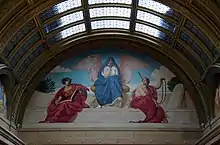
At the end of the skylight over east grand staircase leading into the Supreme Court chambers is the mural Contemplative Spirit of the East, the theme of the mural prepares the visitor for the Supreme Court chambers just beyond it. Kenyon Cox painted "The Contemplative Spirit of the East" as a trio of women in classical draperies. "The composition as a whole is meant to form a fitting introduction to the decorations of the Supreme Court, which depict the development of Law," the artist wrote. The figures sit on a bench painted to match the color and lines of the Kasota stone beam below. State Capitol historian Thomas O'Sullivan writes, "His winged central figure is angel, madonna, and Thinker all in one." To her right sits "Letters," with an open book. The figure of "Law," is at her left, holding a bridle and staff, symbols of restraint. She sits next to two blank stone tablets suggesting LaFarge's mural of Moses in the Supreme Court chamber.[34]
Studies for the Contemplative Spirit of the East
.jpg.webp) Drawing, Study for Lunette, "Justice Enthroned Between Law and Order" (1st version)
Drawing, Study for Lunette, "Justice Enthroned Between Law and Order" (1st version).jpg.webp) Study Drawing for Lunette, Justice Enthroned Between Law and Order (2nd or Alternate Version)
Study Drawing for Lunette, Justice Enthroned Between Law and Order (2nd or Alternate Version).jpg.webp) Drawing, Study for Lunette, "Justice Enthroned Between Law and Order" (3rd or final version)
Drawing, Study for Lunette, "Justice Enthroned Between Law and Order" (3rd or final version) Drawing, Contemplation, Study for "Contemplative Spirit of the East,"
The Sacred Flame (Yesterday, Today and Tomorrow)
-after_restoration.jpg.webp)
In the west grand staircase is Henry Walker's mural, The Sacred Flame (Yesterday, Today and Tomorrow). The painting has a Triple Goddess - maiden, mother, crone motif, with an elderly woman on the right maintaining a fire, a central female figure passing a torch to a young woman who is holding a lamp on the left. The figures are titled with their Latin names, Cras (yesterday), Hodie (today), and Hera (tomorrow). Gilbert described the mural to the Commissioners: "A figure of Old Age bending over and conserving the embers of the fire of knowledge, passes the flame on to Maturity who in turn ignites or lights the torch of Youth, illustrating poetically the idea of the progress that is supposed to be typical of the West gaining knowledge from the past and transmitting it to the future."[35][36]
In a comprehensive restoration of the Capitol and its artwork in 2013-2017 it was discovered that there were multiple alterations to mural obscuring the original painting of the figures.[36]
Changes to the mural
 Sacred Flame in 1906-07 showing original condition
 Detail of figure with UV light showing modification.
Supreme Court Chamber Murals
Similar to the other murals in the Capitol, the four murals painted by John La Farge in the Supreme Court Chambers are allegorical, however, La Farge differs significantly from the other murals in the Capitol in that his subject matter is selected to illustrate four key moments in the history of law. The first lunette directly over the judges’ bench, The Moral and Divine Law, depicts Moses on Mount Sinai and represents human conscience and divine law: the lunette above the entrance to the courtroom, titled The Relation of the Individual to the State, illustrates a moment in Plato’s Republic where Socrates is at the home of Cephalus, debating concepts of justice. The south mural, titled The Adjustment of the Conflicting Interests, shows Raymond, the Count of Toulouse taking a oath before the bishop and magistrate of his city. reflects on the importance of the citizen, the church, and the state. The north mural, The Recording of the Precedents, shows Confucius collating and transcribing documents to emphasize the importance of the past and of precedents.
In The Recording of the Precedents La Farge got his assistant Okakura to help him inscribe in Chinese characters on one of the scrolls, ‘First the white, and then the color on the top’ this may have been a mischievous statement to other muralists on when an artist should begin color studies for a mural, before or after the completion of the black and white cartoon for the composition. It also seems possible that the comment may have been directed at Board of Commissioners for holding back a paycheck when there was a disagreement on the artist’s process and whether milestones were achieved.[37]
The mural Moral and Divine Law was modified probably in the 1930s. A doorway around which the lunette had been installed was enclosed and the mural was then painted to blend into the new composition.[38]
 Moral and Divine Law
 The Relation of the Individual to the State
 The Adjustment of Conflicting Interests
 The Recording of Precedents
Minnesota House Chamber

The arch above the Speaker of the House originally held a spectators' gallery but in 1938 it was walled off and made into offices and committee rooms. Carlo Brioschi, an Italian immigrant to St. Paul, and his son Amerigo where commissioned to create a sculpture on the surface facing the House Chambers. Brioschi created the painted plaster sculpture, Minnesota Spirit of Government. The sculpture consists of an arrangement with a woman on a pedestal bearing the state seal. To the right are Sacagawea and an American Indian Chief; to the left is Meriwether Lewis and William Clark. Below are the words "The Trail of the Pioneer Bore the Foot prints of Liberty." The wall behind the sculpture reads, "Vox populorum est vox Dei," or "The voice of the people is the voice of God." Making the changes obscured the allegorical figures of History and Records, painted by W. A. Mackay painted on either side of the arch.
Amerigo Brioschi, explained meaning behind the artwork.
...the plan was to portray the origin of the 'North Star State' and the subjects or persons that were basically responsible for the happening.
The main central figure represents the North Star State brought about by the exploration of Lewis and Clark which are shown at the right of the central figure as the explorer and the voyager. On the opposite side stands the Indian Chief that guided Lewis and Clark. The Indian maiden represents Sacagawea, the maiden that provided good feeling among the different tribes that were confronted by Lewis and Clark as well as food and health care when needed by the expedition. This basic group made up the fundamental characters that made possible the establishing of the territory and the 'North Star State'.[39]
Murals covered up in House of Representatives
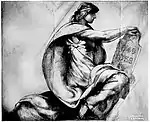 Cartoon for History-Minnesota State Capitol
 Cartoon for Records mural-Minnesota State Capitol
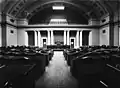 Minnesota House Chamber showing spectators' gallery.
Minnesota Senate Chamber
Two large thirty-two foot wide murals preside on either side of the senate chamber. Both painted by Edwin Blashfield who settled for his particular mix of history and allegory. Blashfield, who In 1903 the Minneapolis Journal called Blashfield the "father of municipal art." Blashfield was a prolific writer and spokesperson for the mural movement and had written that "...the sculptor and painter must believe in the architect as commander in-chief."[40][41][42]
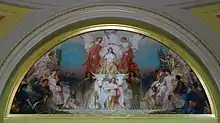
In both murals Blashfield represented a central symbolic figure. In the north lunette, "Minnesota: Granary of the World" shows Minnesota as breadbasket and a leader in agriculture. In the center, riding on the top of a cart filled with corn and wheat and pulled by oxen is a seated woman representing Minnesota who was modeled after a popular actress of the time, Mary Anderson.[43] Civil War soldiers on the right side of the mural communicate the state's contribution to preserving the Union. On the left side of the mural is a seated male figure on what was a modern tractor for the time, demonstrating the transition to mechanization. In a move reminiscent to the European practice of artists portraying their patrons in their works, Blashfield added profiles of the Capitol’s architect, Cass Gilbert and the vice president of the Board of Capitol Commissioners, Channing Seabury.[44][45]

In the south lunette "Discoverers and Civilizers Led to the Source of the Mississippi," a mural that historian capitol Denis Gardner describes as, "among the most explicitly Eurocentric paintings in the capitol. Manitou or Great Spirit begins the flow of the Mississippi River by pouring water from an urn. It is a romanticized depiction of American Indians that minimalizes their contributions to Minnesota history."[46]
The painting depicts an American Indian man and woman in front of the spirit Manitou in the center at the Mississippi’s headwaters. They are surrounded on one side by "discoverers" on the right and "civilizers" on the left who are guided from above by angelic beings signifying divine manifest destiny. On the left guided by the "Spirit of Civilization" a priest "offers salvation in the form of a crucifix."[47] Behind the priest squats a man restraining two irate dogs. On the right are the explorers, led by the "Spirit of Discovery", who holds a compass.[43][47] The painting has been controversial and has been described as both "offensive and a false representation of customs."[48][49]
Zodiacs

Additional paintings included the twelve zodiac lunettes decorating the interior of the dome. All were designed by Elmer Garnsey and painted by his assistant Arthur Willett.[50] In 2010 the half of the Gemini mural broke free. Because of work going on to the dome its fall to the floor was interrupted by a tarp. The mural was later restored during the renovation of the Capitol 2013 to 2017.[51][2]
Wikimedia Commons has media related to Minnesota State Capitol Zodiacs
See also
External links
References
- Gardner, Denis (2017). Our Minnesota State Capitol. Minnesota Historical Society Press. p. 36. ISBN 978-1-68134-041-8.
- Minnesota State Capitol: Overview of the Fine Art (PDF). Minnesota Office of Administration: State of Minnesota. 2015. p. 50.
- O'Sullivan, Thomas (1994). North Star Statehouse: An Armchair Guide to the Minnesota State Capitol. Pogo Press. pp. 80–85. ISBN 1-880654-07-5.
- "Minnesota State Capitol: Overview of the Fine Art 2015" (PDF). Minnesota Department of Administration. Retrieved 2021-03-21.
- "Progress of the State (Quadriga)". Minnesota Historical Society. Retrieved 26 October 2018.
- Salisbury, Bill (September 23, 2014). "State Capitol temporarily loses charioteer of the golden Quadriga". Pioneer Press. Retrieved 2021-01-29.
- Cameron, Linda (March 3, 2019). "Quadriga: "The Progress of the State"". MNOpedia. Retrieved 2021-01-29.
- Christen, Barbara S. (2001). Cass Gilbert, Life and Work: Architect of the Public Domain. W. W. Norton & Company. p. 92. ISBN 0393730654.
- O'Sullivan, Thomas (1994). North Star Statehouse: An Armchair Guide to the Minnesota State Capitol. Pogo Press. p. 13. ISBN 1-880654-07-5.
- "Mall; Memorials & Monuments / Minnesota.gov". Minnesota.gov. Retrieved 2021-03-14.
- "Missouri's General Shields Memorial". Monumental News. Chicago: American Monumental Association. 27: 20. January 1915 – via Google Books.
- "Report of the Council of Administration". Journal of Proceedings of the Forty-ninth Annual Encampment of the Department of Minnesota, Grand Army of the Republic. Minneapolis, Minnesota: Grand Army of the Republic. Department of Minnesota. 49: 73–74. June 10–11, 1915 – via Google Books.
- "Among the Sculptors". Monumental News a Journal of Monumental Art. 20: 440. January 1908 – via Google Books.
- "Minneapolis Art Wins. Colville Commission Selects Mrs. Backus Design Over St. Paul's". Duluth Evening Herald. April 29, 1908. Retrieved 2021-03-14.
- "Statue of William Colvill, (sculpture)". siris-artinventories.si.edu. Retrieved 2021-04-03.
- Roethke, Leigh (2005). Minnesota's Capitol - A Centennial Story. Afton Historical Society Press. pp. 68–69. ISBN 1-890434-67-1.
- O'Sullivan, Thomas (1994). North Star Statehouse: An Armchair Guide to the Minnesota State Capitol. Pogo Press. pp. 31–32. ISBN 1-880654-07-5.
- Thompson, Neil B. (2005). Minnesota's State Capitol: The Art and Politics of a Public Building. Minnesota Historical Society Press. p. 20. ISBN 0-87351-085-2.
- "Brigadier General James Shields". www.wdl.org. 1861. Retrieved 2021-03-11.
- "Wilkin, Alexander (1819–1864) | MNopedia". www.mnopedia.org. Retrieved 2021-03-11.
- "Colvill, William (1830–1905) | MNopedia". www.mnopedia.org. Retrieved 2021-03-11.
- One or more of the preceding sentences incorporates text from a publication now in the public domain: Chisholm, Hugh, ed. (1911). "Simmons, Edward Emerson". Encyclopædia Britannica. 25 (11th ed.). Cambridge University Press. p. 123.
- "The Project Gutenberg eBook of From Seven to Seventy, by Edward Simmons". www.gutenberg.org. Retrieved 2021-03-09.
- O'Sullivan, Thomas (1994). North Star Statehouse: An Armchair Guide to the Minnesota State Capitol. Pogo Press. p. 27. ISBN 1-880654-07-5.
- Christen, Barbara S.; Flanders, Steven, eds. (November 17, 2001). Cass Gilbert, Life and Work: Architect of the Public Domain. W. W. Norton & Company. p. 92. ISBN 0393730654.
- O'Sullivan, Thomas (1994). North Star Statehouse: An Armchair Guide to the Minnesota State Capitol. Pogo Press. pp. 78–83. ISBN 1-880654-07-5.
- "Controversial MN Capitol art resurfaces in new exhibit". MPR News. Retrieved 2021-03-06.
- Gardner, Denis (2017). Our Minnesota State Capitol. Minnesota Historical Society Press. pp. 78–80. ISBN 978-1-68134-041-8.
- "Reconciling History". Minnesota Historical Society. Retrieved 2021-02-27.
- "Reconciling history: Views on two Minnesota paintings". The Circle. August 7, 2017. Retrieved 2021-02-28.
- "Inventory of Art in the Minnesota State Capitol" (PDF). Minnesota Department of Administration. December 2015. Retrieved 2021-02-28.
- Thompson, Neil B. (2005). Minnesota's State Capitol: The Art and Politics of a Public Building. Minnesota Historical Society Press. ISBN 0-87351-085-2.
- Gardner, Denis (2017). Our Minnesota State Capitol. Minnesota Historical Society Press. ISBN 978-1-68134-041-8.
- O'Sullivan, Thomas (1994). North Star Statehouse: An Armchair Guide to the Minnesota State Capitol. Pogo Press. p. 28. ISBN 1-880654-07-5.
- O'Sullivan, Thomas (1994). North Star Statehouse: An Armchair Guide to the Minnesota State Capitol. Pogo Press. pp. 28–29. ISBN 1-880654-07-5.
- Gardner, Denis (2017). Our Minnesota State Capitol. Minnesota Historical Society Press. pp. 36–37. ISBN 978-1-68134-041-8.
- Thompson, Neil B. (2005). Minnesota's State Capitol: The Art and Politics of a Public Building. Minnesota Historical Society Press. pp. 89–91. ISBN 0-87351-085-2.
- O'Sullivan, Thomas (1994). North Star Statehouse: An Armchair Guide to the Minnesota State Capitol. Pogo Press. pp. 40–41. ISBN 1-880654-07-5.
- Laycock, Ron (August 1996). "Lewis and Clark in Minnesota? YES and Sacagawea too!" (PDF). We Proceeded on - Lewis and Clark Trail Heritage Foundation. 22 (3): 27.
- Thompson, Neil B. (2005). Minnesota's State Capitol: The Art and Politics of a Public Building. Minnesota Historical Society Press. p. 83. ISBN 0-87351-085-2.
- O'Sullivan, Thomas (1994). North Star Statehouse: An Armchair Guide to the Minnesota State Capitol. Pogo Press. p. 22. ISBN 1-880654-07-5.
- Christen, Barbara S.; Flanders, Steven, eds. (November 17, 2001). Cass Gilbert, Life and Work: Architect of the Public Domain. W. W. Norton & Company. p. 113. ISBN 0393730654.
- Thompson, Neil B. (2005). Minnesota's State Capitol: The Art and Politics of a Public Building. Minnesota Historical Society Press. p. 89. ISBN 0-87351-085-2.
- Christen, Barbara S.; Flanders, Steven, eds. (November 17, 2001). Cass Gilbert, Life and Work: Architect of the Public Domain. W. W. Norton & Company. p. 120. ISBN 0393730654.
- O'Sullivan, Thomas (1994). North Star Statehouse: An Armchair Guide to the Minnesota State Capitol. Pogo Press. p. 47. ISBN 1-880654-07-5.
- Gardner, Denis (2017). Our Minnesota State Capitol. Minnesota Historical Society Press. pp. 38–39. ISBN 978-1-68134-041-8.
- Gauthier, Julie C. (1912). The Minnesota Capitol Official Guide and History (3rd ed.). St. Paul, Minnesota: The Pioneer Company Printers. p. 40.
- "The other debate at the state Capitol: What to do with the building's most controversial art?". MinnPost. 2015-04-06. Retrieved 2021-03-10.
- catwhipple (November 3, 2015). "Art glorifying the conquest of Indians needs to leave state capitol". The Circle News. Retrieved 2021-03-10.
- Gardner, Denis (2017). Our Minnesota State Capitol. Minnesota Historical Society Press. pp. 39–40. ISBN 978-1-68134-041-8.
- Gardner, Denis (2017). Our Minnesota State Capitol. Minnesota Historical Society Press. p. 65. ISBN 978-1-68134-041-8.