Mitsuharu Inoue
Mitsuharu Inoue (井上光晴, Inoue Mitsuharu, May 15, 1926 – May 30, 1992) was a Japanese writer of novels, short stories, poetry and essays,[1] who has been associated with Japanese postwar literature and the Atomic bomb literature genre.[2]
Mitsuharu Inoue | |
|---|---|
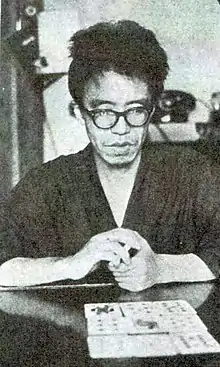 Mitsuharu Inoue in 1964 | |
| Born | May 15, 1926 |
| Died | May 30, 1992 (aged 66) Tokyo, Japan |
| Occupation | Writer |
| Nationality | Japanese |
| Spouse | Ikuko Inoue |
| Children | Kōya Inoue |
Biography
Inoue was born in 1926[1] as the son of a pottery manufacturer.[3][4] While Inoue asserted that he was born in Lüshun, China, other sources name Kurume in Fukuoka Prefecture as the actual place of birth.[lower-alpha 1] After his mother had left the family, he and his sister were raised by their grandmother.[4] As a youth, he worked in a steel factory in Amagasaki and a coal mine in Nagasaki, before graduating from the Army Radio Weapon Technology Training Center.[1] In 1946, he joined the Japanese Communist Party (JCP), but after facing criticism for his short story Kakarezaru isshō (lit. "An Unwritten Chapter", 1950) and his critical attitude towards Stalinism, he left the JCP in 1953.[1][7]
Inoue's writings deal extensively with social and political issues, such as the living conditions of mining workers, Koreans in Japan and the Burakumin, the Korean War, and the effect of the atomic bomb.[1] His most acknowledged works include Kyokō no kurēn (lit. "Fictitious Crane", 1960) and Chi no mure (lit. "People of the Land", 1963).[1][5] In the Kenzaburō Ōe edited anthology The Crazy Iris and Other Stories of the Atomic Aftermath, Inoue was attested to "capture the tension of post-war Japan in a unique and distinguished style". In 1970, he established and edited the literary magazine Henkyō.[7]
Inoue died of cancer in 1992. His last years living with his illness were documented in Kazuo Hara's film A Dedicated Life (Zenshin shosetsuka).[8]
Selected works
- 1950: Kakarezaru isshō
- 1953: Nagagutsu jima
- 1960: The House of Hands (Te no ie)
- 1960: Kyokō no kurēn
- 1963: Chi no mure
- 1963–64: Kōhai no natsu
- 1965: Takoku no shi
- 1966: Kuroi shinrin
- 1966: Akai temari
- 1973: Kokoro yasashiki hangyakusha
- 1976: Maruyama Ransuiro no yujotachi
- 1982: Ashita
Translations
- Inoue, Mitsuharu (1985). "The House of Hands". In Ōe, Kenzaburō (ed.). The Crazy Iris and Other Stories of the Atomic Aftermath. New York: Grove Press.
Film adaptations
- 1970: Apart from Life (Chi no mure), directed by Kei Kumai[9]
- 1988: Tomorrow (Tomorrow – Ashita), directed by Kazuo Kuroki[10]
Notes
- J. Scott Miller gives Fukuoka Prefecture as Inoue's actual place of birth,[5] as does the entry for Inoue at the NHK website[6] and statements by relatives in the documentary film A Dedicated Life.[4]
References
- "井上光晴 (Inoue Mitsuharu)". Kotobank (in Japanese). Retrieved August 31, 2021.
- "原爆文学 (Atomic bomb literature)". Kotobank (in Japanese). Retrieved August 28, 2021.
- Berndt, Jürgen, ed. (1975). Träume aus zehn Nächten. Moderne japanische Erzählungen. Berlin und Weimar: Aufbau Verlag.
- Hara, Kazuo (director) (1994). A Dedicated Life (Motion picture). Japan: Hara, Kazuo.
- Miller, J. Scott (2009). Historical Dictionary of Modern Japanese Literature and Theater. Lanham, MD: Scarecrow Press. ISBN 978-0-8108-6319-4.
- "井上光晴 (Inoue Mitsuharu)". NHK (in Japanese). Retrieved September 1, 2021.
- Ōe, Kenzaburō, ed. (1985). The Crazy Iris and Other Stories of the Atomic Aftermath. New York: Grove Press. pp. 203–204.
- "全身小説家 (Zenshin shosetsuka)". Kinenote (in Japanese). Retrieved August 31, 2021.
- "地の群れ (Chi no mure)". Kinenote (in Japanese). Retrieved August 31, 2021.
- "TOMORROW 明日 (Tomorrow – Ashita)". Kinenote (in Japanese). Retrieved August 31, 2021.
Authority control  | |
|---|---|
| General | |
| National libraries | |
| Scientific databases | |
| Other | |