Mizuhanome
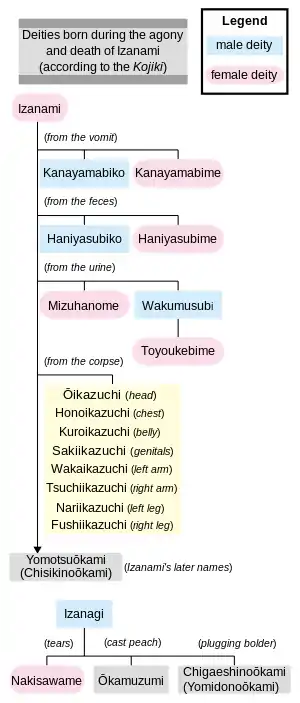
Mizuhanome (彌都波能売神[1] or みつはのめのかみ[2]) is a God in Japanese mythology. She is a kami of water. She was born from the urine of Izanami.[3]
Worship
She is enshrined at Atago Shrine.[4]
Ashiya Shrine is also dedicated to the goddess.[5]
The Niukawakami Shrine is dedicated to Mitsuhanome.[6]
Names
She is also referred to as Mizuhanome[2] or Itsu no Mitsuhanome no kami.[3] In romaji her name is read as Mitsuhanomenokami.[2]
The mitsu or mizu in her name means water and me is a feminine suffix.[3] Her name is explained as water snake woman or water dragon woman.[7]
Summary
In Kojiki, she is referred to as Mitsuha-no-me-no-kami, and in Nihon Shoki, she is referred to as Mitsuha-no-me-no-kami. In the Nihonshoki, she is referred to as Mitsuha-no-me-no-kami. [In the Kojiki, he is called Mitsuha-no-me-kami.
In the Godbirth section of the Kojiki, he is said to have been born together with Wakumusubi from the urine of Izanami, who was suffering from a burn on her pubic region after giving birth to Kagutsuchi. In the second book of the Nihon Shoki (Chronicles of Japan), it is said that when Izanami was about to die, she gave birth to the goddess Hanyamahime and the goddess of swine, and that Wakumusubi was born between Hanyamahime and Kagutsuchi.
Description
In Niukawakami Shrine (Nara PrefectureYoshino-gun) and other shrines, he is enshrined together with 淤神神, and is also enshrined as a deity in other shrines throughout Japan. In the Okada Shrine, the main shrine of Otaki Shrine (Fukui PrefectureEchizen City), there is a legend that Mizuhanome taught the villagers how to make paper.
In popular culture
According to director Makoto Shinkai the name for the character Mitsuha Miyamizu from the movie Your Name is said to come from the goddess.[6]
Related items
References
- "Mizuhanome • A History of Japan - 日本歴史". A History of Japan - 日本歴史. Retrieved 2021-09-16.
- "弥都波能売神 – 國學院大學 古事記学センターウェブサイト". kojiki.kokugakuin.ac.jp. Retrieved 2021-09-16.
- "Encyclopedia of Shinto詳細". 國學院大學デジタルミュージアム (in Japanese). Retrieved 2021-09-16.
- "愛宕神社について | 愛宕神社". www.atago-jinja.com. Retrieved 2021-09-16.
- "彌都波能売神". 芦屋神社-公式サイト- (in Japanese). Retrieved 2021-09-16.
- "映画『君の名は。』のヒロインのモチーフ。雨乞い・雨止めの神様とは?(ダイヤモンド・オンライン)". Yahoo!ニュース (in Japanese). Retrieved 2021-09-16.
- Eder, Matthias (1957). "Review of The Mother-Son Complex in Japanese Religion and Folklore". Folklore Studies. 16: 297–299. doi:10.2307/1177369. ISSN 0388-0370. JSTOR 1177369.