Mochalyshche
Mochalyshche (Ukrainian: Мочалище) is a village in Nizhyn Raion of Chernihiv Oblast, Ukraine, and part of the Nova Basan rural hromada.[4]
Mochalyshche
Мочалище | |
|---|---|
Village | |
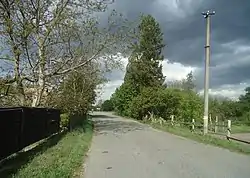 A road exiting Mochalyshche | |
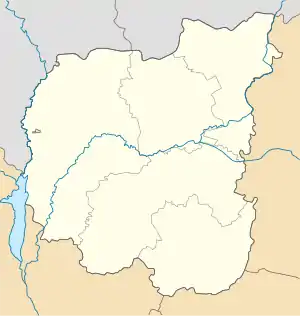  Mochalyshche | |
| Coordinates: 50°33′59″N 31°19′25″E | |
| Country | Ukraine |
| Region | Chernihiv Oblast |
| District | Nizhyn Raion |
| Hromada | Nova Basan rural hromada |
| KOATUU | 7420687404 |
| Founded | c. 1800 |
| Burnt down | 18 December 1942 |
| Resettled | 1980s |
| Administrative centre | Nova Basan |
| Area | |
| • Total | 0.808 km2 (0.312 sq mi) |
| Elevation | 116 m (381 ft) |
| Population (2012)[1] | |
| • Total | 141 |
| • Density | 170/km2 (450/sq mi) |
| Native language (2001) | |
| • Ukrainian | 97.16% |
| • Russian | 2.84% |
| Postal code | 17454 |
| Area code(s) | +380 4632 |
History
Mochalyshche was founded c. 1800.[1] Its first recorded appearance in a map in a location matching its modern coordinates was in the Russian Empire's Stolistovaya karta ("Capital map") in 1804.[5] As part of the Russian Empire, Mochalyshche was in the third Stan of Kozeletsky Uyezd; in Yaroslavl Volost.[6][7]
The village was recorded in the 1866 Russian Empire's list of settlements.[6] It was documented to have 22 homesteads, that housed a population of 181, whose water supply came from local wells.[6] Mochalyshche was subsequently logged in the list of inhabited places of the Chernigov Governorate in 1902,[7] where, in addition to recurring information from 1866, it mentioned that the village's population had grown to 538.[7]
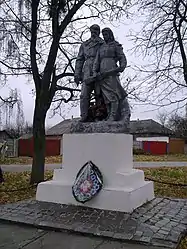
On 18 December 1942, Mochalyshche was burnt down in a Nazi punitive expedition against local partisan activity, killing 267.[8] The village resurfaced on maps in 1987, presumably resettled near that time, it was documented in the Soviet General Staff map of the area surrounding Baryshivka.[9] Mochalyshche was then listed in the 1989 Soviet census, and recorded to have 145 inhabitants.[10]
Mochalyshche was under the local administration of Sokolivka rural council in Bobrovytsia Raion until 12 June 2020,[1][11] when administrative reforms in Chernihiv Oblast merged Sokolivka rural council with the rural councils of Nova Basan, Bilotserkivtsi, Vepryk, Voronky, and Novyi Bykiv, to form the Nova Basan rural hromada.[12] Under subsequent national administrative reform, on 19 July, Bobrovytsia Raion was merged into the newly formed Nizhyn Raion.[13]
Demographics
According to demographic statistics published by the Verkhovna Rada of Ukraine, as of 2012, Mochalyshche has a population of 141 people,[1] growing by 0.7% (1 resident) from the 2001 Ukrainian population census,[14] but declining by 2.76% (4 residents) from 1989.[10]
Language
In the 2001 population census, 97.16% of the population (136 residents) indicated their native language was Ukrainian, while the remaining 2.84% (4 residents) indicated it was Russian.[3]
Notable people
- Anatoliy Pogrebnoy, a Ukrainian politician, writer, and philologist.[15][16]
- Stepan Maximovich Shuplik, a Ukrainian poet,[17][18] Soviet partisan,[19] and former agent of the All-Ukrainian Extraordinary Commission.[20][21]
References
- "Облікова картка: село Мочалище - Чернігівська область, Бобровицький район" [Account card: Mochalyshche village - Chernihiv Oblast, Bobrovytsia Raion]. Verkhovna Rada of Ukraine. 4 December 2012. Retrieved 27 January 2019.
- "Mochalyshche". Mapcarta. Retrieved 20 March 2018.
- "Table: 19A050501_02_074. Distribution of the population by native language, Chernihivska oblast (1,2,3,4)". database.ukrcensus.gov.ua. Retrieved 20 March 2018.
- "2.2 Адміністративно-територіальний устрій Чернігівської області: 3. Населені пункти Чернігівської області. Райони" [2.2 Administrative-territorial structure of the Chernihiv region: 3. Settlements of Chernihiv region. Raions]. Verkhovna Rada of Ukraine (in Ukrainian). Retrieved 16 August 2018.
- Depot of maps of the Russian Empire (1804). Подробная карта Российской империи и близлежащих заграничных владений [Detailed map of the Russian Empire and neighboring foreign holdings] (Map). 1:840000 (in Russian). Russia. Retrieved 9 July 2018.
- Списки населенных мест Российской империи [Lists of settlements of the Russian Empire] (in Russian). Saint Petersburg: the Central Statistical Committee of the Ministry of Internal Affairs of the Russian Empire. 1866. p. 65. Retrieved 16 July 2018 – via State Historic Public Library of Russia.
- Список населенных мест Черниговской губернии, имеющих не менее 10 жителей, по данным за 1901 год [List of inhabited places of the Chernigov governorate, with at least 10 people, according to data from 1901] (in Russian). Chernihiv: Chernihiv Provincial Statistical Committee. 1902. p. 107. Retrieved 16 August 2018 – via State Historic Public Library of Russia.
- Butko SV, Lisenko OV, Pilavec RI, et al. (2013). Спалені села і селища Чернігівщини в 1941–1943 роках: злочини проти цивільного населення – Збірник документів і матеріалів [Burned villages and settlements of Chernihiv in 1941–1943: crimes against civilians – a collection of documents and materials] (PDF) (in Ukrainian). Chernihiv: Desna Polygraph. p. 28. ISBN 9789662646436. Retrieved 22 July 2018.
- General Staff of the Soviet Armed Forces (1987). Карта генштаба. Квадрат М-36-51 [Map of the General Staff. Square M-36-51] (Map). 1:100000 (in Russian). Chernihiv Oblast. Retrieved 9 July 2018.
- "Table: 19A0501_061_074. Number of actual and permanent population in rural areas, Chernihivska oblast (1,2,3,4)". database.ukrcensus.gov.ua. Retrieved 16 March 2018.
- "СОКОЛІВСЬКА СІЛЬСЬКА РАДА – Бобровицький район, Чернігівська область" [Sokolivka rural council – Bobrovytsia Raion, Chernihiv Oblast]. rada.info (in Ukrainian). Retrieved 4 April 2021.
- "Про визначення адміністративних центрів та затвердження територій територіальних громад Чернігівської області" [On defining administrative centres and approving territories of hromadas in Chernihiv Oblast]. Regulation No. 730-р Ind. 82 of 12 June 2020 (in Ukrainian). Cabinet of Ministers of Ukraine. p. 3.
- "Про утворення та ліквідацію районів" [On formation and liquidation of Raions]. Ordinance No. 807-IX of 17 July 2020 (in Ukrainian). Verkhovna Rada of Ukraine.
- "Table: 19A0501_07_074. Number of actual population in rural areas, Chernihivska oblast (1,2,3,4)". database.ukrcensus.gov.ua. Retrieved 20 March 2018.
- Kudrin, Oleg (3 January 2017). ""Якби ми вчились так, як треба"... Пламенем Погребного" ["If we learned as necessary"... The flame of Pogrebnoy] (in Russian). Kiev. Ukrinform. Retrieved 21 July 2018.
- Tumanova, Tony (3 October 2011). "Комітет ВР пропонує відзначити на держрівні 70-річчя з дня народження публіциста А.Погрібного" [Verkhovna Rada committee proposes to mark the 70th anniversary of the birthday of the publicist A. Pogrebnoy at the state level.]. UNN (in Ukrainian). Retrieved 16 August 2018.
- Shuplik, Stepan (1945). Пісні партизана діда Степана. 1941–1943 [Partisan songs by grandfather Stepan. 1941–1943] (in Ukrainian). Kiev: Ukrainian State Publishing House. p. 3. Retrieved 19 August 2018 – via eScriptorium.
- Konechna, Olena (2014). "Літературна Чернігівщина: від сивої минувшини до наших днів" [Literature of Chernihiv: From the ancient past to the present day] (PDF). Sobornist (in Ukrainian). No. 1–2. Israel: Union of Ukrainian Writers of Israel. p. 13. ISSN 1565-6837. Retrieved 4 April 2021 – via Diasporiana.
- Fedorov, Oleksiy (1952). The Underground Committee Carries On. Moscow: Foreign Languages Publishing House. pp. 202–204. Retrieved 16 August 2018 – via Internet Archive.
- Holovko, Dmytro (December 2011). "Слово про рідну землю" [The word of the native land] (PDF). Otchyi Porog (in Ukrainian). 12 (120). Kiev. p. 16. Retrieved 6 March 2019.
- Yasenchuk, Oleksandr (28 February 2011). "Лівобережні повстанці Київщини і Чернігівщини: їх порівнювали з Махном" [Left-bank rebels of Keiv and Chernihiv Oblasts: Their comparability to Makhno]. Istorychna Pravda (in Ukrainian). Ukrayinska Pravda. Retrieved 6 March 2019.

External links
- Weather in Mochalyshche
- Mochalyshche in the First French Empire's "Carte de la Russie Européenne en LXXVII feuilles exécutée au Depôt general de la Guerre" [Map of European Russia in 77 sheets carried out by the Depôt General de la Guerre] (1812)
- Mochalyshche in Ivan Afanasievich Strelbitsky's map of European Russia (1871)
- Mochalyshche in the Kiev Governorate's "Karta Shuberta" [Map of Schubert] (1893)
- Mochalyshche in a topographic military map of the Red Army (1941)