Modular lambda function
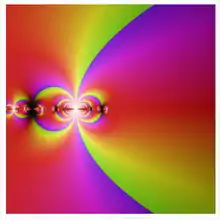
In mathematics, the modular lambda function λ(τ) is a highly symmetric holomorphic function on the complex upper half-plane. It is invariant under the fractional linear action of the congruence group Γ(2), and generates the function field of the corresponding quotient, i.e., it is a Hauptmodul for the modular curve X(2). Over any point τ, its value can be described as a cross ratio of the branch points of a ramified double cover of the projective line by the elliptic curve , where the map is defined as the quotient by the [−1] involution.

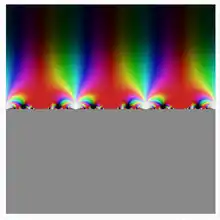
The q-expansion, where is the nome, is given by:


By symmetrizing the lambda function under the canonical action of the symmetric group S3 on X(2), and then normalizing suitably, one obtains a function on the upper half-plane that is invariant under the full modular group , and it is in fact Klein's modular j-invariant.

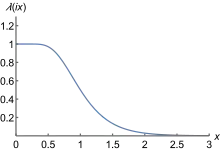
Modular properties
The function is invariant under the group generated by[1]


The generators of the modular group act by[2]
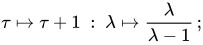
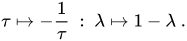
Consequently, the action of the modular group on is that of the anharmonic group, giving the six values of the cross-ratio:[3]

Relations to other functions
It is the square of the elliptic modulus,[4] that is, . In terms of the Dedekind eta function and theta functions,[4]
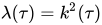


and,

where[5]
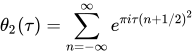
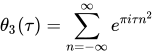
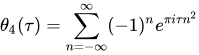
In terms of the half-periods of Weierstrass's elliptic functions, let be a fundamental pair of periods with .



we have[4]
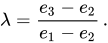
Since the three half-period values are distinct, this shows that λ does not take the value 0 or 1.[4]
The relation to the j-invariant is[6][7]

which is the j-invariant of the elliptic curve of Legendre form

Elliptic modulus
Definition and computation of lambda-star
The function λ*(x) gives the value of the elliptic modulus k, for which the complete elliptic integral of the first kind and its complementary counterpart are related by following expression:

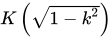
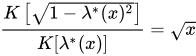
The values of λ*(x) can be computed as follows:
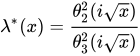


The functions λ* and λ are related to each other in this way:
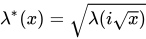
Properties of lambda-star
Every λ*-value of a positive rational number is a positive algebraic number:

Elliptic integrals of the first and second kind of these special λ*-values can be expressed in terms of the gamma function, as Selberg and Chowla proved in 1949.[8][9]
Following expression is valid for all n ∈ :


In this formula, dn is the Jacobi elliptic function delta amplitudinis.
By knowing one λ*-value, this formula can be used to compute related λ*-values:

In that formula, sn is the Jacobi elliptic function sinus amplitudinis. That formula works for all natural numbers.
Further relations:








Ramanujan's class invariants
Ramanujan's class invariants and are defined as[10]




where .

These are the relations between lambda-star and Ramanujan's class invariants:



Special Values
Lambda-star-values of integer numbers of 4n-3-type:













Lambda-star-values of integer numbers of 4n-2-type:
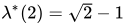













Lambda-star-values of integer numbers of 4n-1-type:
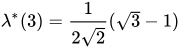
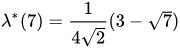







Lambda-star-values of integer numbers of 4n-type:








Lambda-star-values of rational fractions:
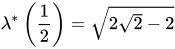
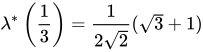

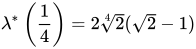





Other appearances
Little Picard theorem
The lambda function is used in the original proof of the Little Picard theorem, that an entire non-constant function on the complex plane cannot omit more than one value. This theorem was proved by Picard in 1879.[11] Suppose if possible that f is entire and does not take the values 0 and 1. Since λ is holomorphic, it has a local holomorphic inverse ω defined away from 0,1,∞. Consider the function z → ω(f(z)). By the Monodromy theorem this is holomorphic and maps the complex plane C to the upper half plane. From this it is easy to construct a holomorphic function from C to the unit disc, which by Liouville's theorem must be constant.[12]
Moonshine
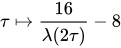
The function is the normalized Hauptmodul for the group , and its q-expansion , OEIS: A007248 where , is the graded character of any element in conjugacy class 4C of the monster group acting on the monster vertex algebra.



Footnotes
- Chandrasekharan (1985) p.115
- Chandrasekharan (1985) p.109
- Chandrasekharan (1985) p.110
- Chandrasekharan (1985) p.108
- Chandrasekharan (1985) p.63
- Chandrasekharan (1985) p.117
- Rankin (1977) pp.226–228
- Chowla, S.; Selberg, A. "On Epstein's Zeta Function (I)". Semantic Scholar. p. 373.
- Chowla, S.; Selberg, A. "On Epstein's Zeta-Function". EuDML. p. 86–110.
- Zhang, Liang-Cheng "Ramanujan's class invariants, Kronecker's limit formula and modular equations (III)"
- Chandrasekharan (1985) p.121
- Chandrasekharan (1985) p.118
References
- Abramowitz, Milton; Stegun, Irene A., eds. (1972), Handbook of Mathematical Functions with Formulas, Graphs, and Mathematical Tables, New York: Dover Publications, ISBN 978-0-486-61272-0, Zbl 0543.33001
- Chandrasekharan, K. (1985), Elliptic Functions, Grundlehren der mathematischen Wissenschaften, 281, Springer-Verlag, pp. 108–121, ISBN 3-540-15295-4, Zbl 0575.33001
- Conway, John Horton; Norton, Simon (1979), "Monstrous moonshine", Bulletin of the London Mathematical Society, 11 (3): 308–339, doi:10.1112/blms/11.3.308, MR 0554399, Zbl 0424.20010
- Rankin, Robert A. (1977), Modular Forms and Functions, Cambridge University Press, ISBN 0-521-21212-X, Zbl 0376.10020
- Reinhardt, W. P.; Walker, P. L. (2010), "Elliptic Modular Function", in Olver, Frank W. J.; Lozier, Daniel M.; Boisvert, Ronald F.; Clark, Charles W. (eds.), NIST Handbook of Mathematical Functions, Cambridge University Press, ISBN 978-0-521-19225-5, MR 2723248
- Borwein, J. M. and Borwein, P. B. Pi & the AGM: A Study in Analytic Number Theory and Computational Complexity. New York: Wiley, pp. 139 and 298, 1987.
- Conway, J. H. and Norton, S. P. "Monstrous Moonshine." Bull. London Math. Soc. 11, 308-339, 1979.
- Selberg, A. and Chowla, S. "On Epstein's Zeta-Function." J. reine angew. Math. 227, 86-110, 1967.