Mojo (African-American culture)
Mojo /ˈmoʊdʒoʊ/, in the African-American folk belief called hoodoo, is an amulet consisting of a flannel bag containing one or more magical items. It is a "prayer in a bag", or a spell that can be carried with or on the host's body. Alternative American names for the mojo bag include gris-gris bag,[1] hand, mojo hand, conjure hand, lucky hand, conjure bag, trick bag, root bag, toby and jomo.[2]
| Part of a series on |
| African Americans |
|---|
 |
|
History and Ideology
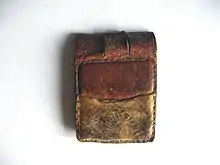
West and Central Africans all practiced the spiritual art of creating conjure bags for protection, healing and to communicate with spirits. The gris-gris originated in Dagomba in Ghana and was associated with Islamic traditions.[3] Originally the gris-gris was adorned with Islamic scripture and was used to ward off evil spirits (evil djinn) or bad luck.[3] Historians of the time noted that they were frequently worn by non-believers and believers alike, and were also found attached to buildings.[3] The practice of using gris-gris, though originating in Africa, came to the United States with enslaved Africans and was quickly adopted by practitioners of Louisiana Voodoo and Hoodoo in the United States, and Vodou in Haiti.[4][5] During the Trans-Atlantic slave trade, a few enslaved Africans were able to conceal their conjure bags when they boarded slave ships heading to the Americas. For example, Gullah Jack was an African from Angola who carried a conjure bag (mojo bag) onto a slave ship leaving Angola for the United States. Gullah Jack was known to carry a conjure bag with him at all times for his spiritual protection.[6][7] The Mandigo (Mandinka) were the first Muslim ethnic group imported from Sierra Leone in West Africa to the Americas. Mandingo people were known for their powerful conjure bags called gris-gris (later called mojo bags in the United States). Some of the Mandingo people were able to carry their gris-gris bags with them when they boarded slave ships heading to the Americas bringing the practice to the United States. Enslaved people went to enslaved black Muslims for conjure services requesting them to make gris-gris bags (mojo bags) for protection against their enslavers.[8] In West-Central Africa, Bakongo and Yoruba people created medicine bags using leather or cloth and placed feathers, animal parts, roots, herbs and other ingredients for protection. When Yoruba and Bakongo people were enslaved in the United States, the practice of using feathers, animal parts, animal and human bones, and other ingredients to create mojo bags continued in African-American communities in the tradition of Hoodoo.[9]
%252C_World_Museum_Liverpool.JPG.webp)
There is also a Central African influence of the mojo bag in African-American Hoodoo. For example, the minkisi and nkisi are spirit containers made by hand from a root doctor. These spirits are contained in a bag, gourd, shells and other containers. The Bakongo people's Nkisi Nkubulu looks similar to the mojo bags in Hoodoo.[11][12] In addition, archeologists in New York discovered continued West-Central African burial practices in a section of Lower Manhattan, New York City which is now the location of the African Burial Ground National Monument. Historians and archeologists found Kongo related artifacts at the African Burial Ground such as minkisi and nkisi conjure bundles buried with African remains. These nkisi and minkisi bundles became the conjure bags in Hoodoo.[13][14]
According to scholars, the origin of the word hoodoo and other words associated with the practice were traced to the Bight of Benin and Senegambia. For example, in West Africa the word gris-gris (a conjure bag) is a Mande word. The word wanga (another word for mojo bag) comes from the Kikongo language.[15] The word mojo comes from the West African word mojuba.[16] The most common synonym for the word mojo is gris-gris, which literally means "fetish" or "charm"; thus a gris-gris bag is a charm bag.[17] In the Caribbean, an almost identical African-derived bag is called a wanga or oanga bag, but that term is uncommon in the United States. The word conjure is an ancient alternative to "hoodoo", which is a direct variation of African-American folklore. Because of this, a conjure hand is also considered a hoodoo bag, usually made by a respected community conjure doctor.[18]
The word hand in this context is defined as a combination of ingredients. The term may derive from the use of finger and hand bones from the dead in mojo bags, or from ingredients such as the lucky hand root (favored by gamblers). The latter suggests an analogy between the varied bag ingredients and the several cards that make up a hand in card games.[1] Mojo reaches as far back as West African culture, where it is said to drive away evil spirits, keep good luck in the household, manipulate a fortune, and lure and persuade lovers. The ideology of the ancestors and the descendants of the mojo hand used this "prayer in a bag" based on their belief of spiritual inheritance, by which the omniscient forefathers of their families would provide protection and favor, especially when they used the mojo. Through this, a strong belief was placed in the idealism of whomever used mojo, creating a spiritual trust in the magic itself.[19]
Making a Mojo
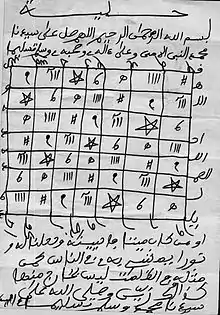
Although most Southern-style conjure bags are made of red flannel material. The contents of each bag vary directly with the aim of the conjurer. For example, a mojo carried for love-drawing will contain different ingredients than one for gambling luck or magical protection.[21] Ingredients can include graveyard dirt, roots, herbs, animal parts, minerals, coins, crystals, good luck tokens, and carved amulets. The more personalized objects are used to add extra power because of their symbolic value.[22] Some mojo bags were made to cause harm and bad luck for slaveholders, and other mojo bags were for protection depending on the ingredients used by the root worker.[23] Also, African-American quilt makers sewed mojo hands into quilts for protection. This practice originates among West African people as they sewed Adinkra and Nsibidi symbols as protective charms into their fabrics. The Ejagham women of Cameroon and Yoruba women in Nigeria make cloths with sacred symbols on them. During the Trans-Atlantic slave trade, many West African people were taken to the United States and enslaved on plantations and continued to practice their traditions by sewing mojo hands into their quilts.[24]
The creation of mojo bags in Hoodoo is a West and Central African practice brought to the United States by enslaved Africans. In Africa, petition papers with Quranic verses along with herbs, roots and other ingredients are placed inside a leather bag and concealed by wearing them under the clothes. A few enslaved Africans brought their conjure bags (mojo bags) with them from Africa when they boarded slave ships heading to North America. On slave plantations in the United States, the creators of gris-gris (mojos) became the root workers, conjure doctors, and Hoodoo doctors in enslaved and free African American communities. Enslaved and free black root workers created mojo bags and placed Bible verses, petition papers, roots, herbs, animal parts, graveyard dirt, and other ingredients to conjure a negative or positive effect. They used either Christian or Islamic prayers to spirituality charge the mojo bag. During slavery, many of the mojo bags created were for protection against a harsh slaveholder. The petition papers placed inside a mojo bag can have either a Bible verse, a Quranic verse, symbols, and other characters to conjure a positive or negative magical result. In the United States, enslaved African Americans called mojo bags "voodoo bags." After the Civil War, mojo bags were created in Black American communities for protection from law enforcement, to attract love, protection, money, employment, or to communicate with spirits. Traditionally, a client consulted with a root worker to know what kind of mojo he or she needed as not all mojos are the same, as one mojo can not work for everyone. Each person needs a different mojo. In traditional Hoodoo, if there are several people needing love, the root worker or conjurer created different mojos for each of their clients. One mojo created the same can not work for everyone. By the twentieth century, Hoodoo was culturally appropriated by outsiders to African-American culture to make a profit. Spiritual shops began to sell the same mojo for everyone. In traditional Hoodoo, certain songs, prayers, symbols, and ingredients are used to conjure or manifest results. However, when Hoodoo was appropriated by white spiritual merchants, the same mojo was sold to consumers.[25][26]
Maintenance
Fixing and feeding a mojo hand
There is a process to fixing a proper mojo. A ritual must be put in place in order to successfully prepare a mojo by being filled and awakened to life. This can be done by smoking incense and candles, or it may be breathed upon to bring it to life. Prayers may be said, and other methods may be used to accomplish this essential step. Once prepared, the mojo is "dressed" or "fed" with a liquid such as alcohol, perfume, water, or bodily fluids.[27] The reason it is said to feed the mojo to keep it working is that it is alive with spirit. One story from the work entitled From My People describes a slave who went out and sought a mojo conjurer that gave him a mojo to run away from home. The story describes the slave's mojo as fixing him into many formations, and he ultimately dies because he misuses its power.[28] Had he fixed and believed in the specific mojo himself, he might have escaped the plantation alive.
Hiding the mojo
Mojos are traditionally made for an individual and so must be concealed on the person at all times. Men usually keep the trinkets hidden in the pants pocket, while women are more prone to clip it to the bra. They are also commonly pinned to clothes below the waist. Depending on the type of mojo, the hiding place will be crucial to its success, as those who make conjure bags to carry love spells sometimes specify that the mojo must be worn next to the skin.[21] A story from the book From My People described the story of Moses and the task he went through to bring his people out of slavery. It described how "Hoodoo Lost his Hand", as Moses's mojo was hidden through his staff. When he turned it into a snake, the pharaoh made his soothsayers and magicians create the same effect. As a result, the Pharaoh's snake was killed by Moses's snake, and that is how Hoodoo lost his hand.[29]
References
- Bradley, Jude; Coen, Cheré Dastugue (2010). Magic's in the Bag: Creating Spellbinding Gris Gris and Sachets. Woodbury, Minnesota: Llewellyn.
- Hazzard-Donald, Katrina (2013). Mojo Workin' The Old African American Hoodoo System. University of Illinois Press. ISBN 9780252094460.
- Handloff, Robert E. (Jun–Sep 1982). "Prayers, Amulets, and Charms: Health and Social Control". African Studies Review. African Studies Association. 25 (2/3): 185–194. doi:10.2307/524216. JSTOR 524216. PMID 11614145.
- Diouf (November 1998). Servants of Allah African Muslims Enslaved in the Americas. New York University Press. p. 130. ISBN 9780814719053.
- "Folk Figures". Western Folklore. Western States Folklore Society. 7 (4): 392. Oct 1948. JSTOR 1497852.
- "Gullah Jack". The National Park Service. Retrieved 31 October 2021.
- Kelly, Joseph; Bodek, Richard (2020). Maroons and the Marooned Runaways and Castaways in the Americas. University Press of Mississippi. p. 37. ISBN 9781496827234.
- Diouf (November 1998). Servants of Allah African Muslims Enslaved in the Americas. New York University Press. p. 130. ISBN 9780814719053.
- Hazzard-Donald, Katrina (2013). Mojo Workin' The Old African American Hoodoo System. University of Illinois Press. p. 41, 65-66. ISBN 9780252094460.
- Wilson, Khonsura. "Nkisi west-central African lore". Encyclopedia Britannica. Encyclopedia Britannica.
- University Staff. "Kongo, Louisiana, & the Black South" (PDF). Duke University. Duke University. Retrieved 31 October 2021.
- Davies, Owen (2013). America Bewitched: The Story of Witchcraft After Salem. Oxford University Press. p. 82. ISBN 978-0-19-162514-5.
- Frohne, Andrea (2015). The African Burial Ground in New York City Memory, Spirituality, and Space. Syracuse University Press. pp. 17–19, 24, 43, 130, 140–142, 167–171. ISBN 9780815634300.
- Jackson, Cole (2009). "The New York African Burial Ground Unearthing the African Presence in Colonial New York" (PDF). The New York African Burial Ground: Unearthing the African Presence in Colonial New York. 5: 7, 47, 57, 85–91, 95, 99–100, 102.
- Anderson (30 October 2008). Hoodoo, Voodoo, and Conjure. ABC-CLIO. pp. 41–43, 132. ISBN 9780313342226.
- Jaynes, Gerald D. (2005). Encyclopedia of African American Society. Sage Publications. pp. 551–552. ISBN 9780761927648.
- Knight, Jan (1980). A-Z of ghosts and supernatural. Pepper Press. p. 46. ISBN 0-560-74509-5.
- Anderson (30 October 2008). Hoodoo, Voodoo, and Conjure. ABC-CLIO. pp. 41–43, 132. ISBN 9780313342226.
- Anderson, Jeffrey (2015). The Voodoo Encyclopedia Magic, Ritual, and Religion. ABC-CLIO. p. 114. ISBN 9781610692090.
- Yvonne, Chireau (2006). Black Magic Religion and the African American Conjuring Tradition. University of California Press. pp. 35, 47–49. ISBN 9780520249882.
- Whitten, Norman E., Jr. (1962). "Contemporary Patterns of Malign Occultism among Negroes in North Carolina." Journal of American Folklore 75.298: 312–318.
- Puckett, Newbell N. (1926). Folk beliefs of the southern Negro. The University of North Carolina Press. pp. 234–236, 384.
- Kelly, Joseph; Bodek, Richard (2020). Maroons and the Marooned Runaways and Castaways in the Americas. University Press of Mississippi. pp. 37–38. ISBN 9781496827234.
- Farrington, Lisa (2005). Creating Their Own Image The History of African-American Women Artists. Oxford University Press. pp. 30–31. ISBN 9780195167214.
- Yvonne, Chireau (2006). Black Magic Religion and the African American Conjuring Tradition. University of California Press. pp. 35, 45–51. ISBN 9780520249882.
- Hazzard-Donald, Katrina (2013). Mojo Workin' The Old African American Hoodoo System. University of Illinois Press. pp. 41, 65–67, 107, 207–208. ISBN 9780252094460.
- Alvarado, D. (2011). The Voodoo Hoodoo Spellbook. San Francisco: Weiser Books.
- Brewer, Richard M. (1958). "The Mojo." From My People: 400 Years of African American Folklore. New York: Indiana University Press, 2002. pp. 47–48. Print.
- Brewer, Richard M. (1958). "How Hoodoo Lost His hand." From My People: 400 Years of African American Folklore. New York: Indiana University Press, 2002. pp. 63–64.
| Magic and concepts |  | |
|---|---|---|
| Stories | ||
| Practices | ||
 Gullah category Gullah category | ||
Gullah people topics | ||||||||||||||
|---|---|---|---|---|---|---|---|---|---|---|---|---|---|---|
| Culture |
|   | ||||||||||||
| History |
| |||||||||||||
| Category | ||||||||||||||