Monoecy
Monoecy is a sexual system in seed plants where separate male and female cones or flowers are present on the same plant.[1] It is a monomorphic sexual system alongside gynomonoecy, andromonoecy and trimonoecy.[2]
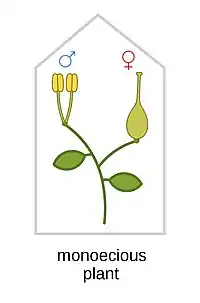
Monoecy is connected to anemophily.[1] It can prevent pollination for a flower but can’t prevent a plant from self fertilization.[3]: 32
Monoecy in angiosperms has been an interest for evolutionary biologists since Charles Darwin.[4]
Terminology
Monoecious comes from the Greek words for one house.[5]
History
The term monoecy was first introduced in 1735 by Carl Linnaeus.[1] Darwin noted that the flowers of monoecious species sometimes showed traces of the opposite sex function.[6] Monoecious hemp was first reported in 1929.[7]
Occurrence
Monoecy is most common in temperate climates[8] and is often associated with inefficient pollinators or wind-pollinated plants.[9][10] It may be beneficial to reducing pollen-stigma interference, thus increasing seed production.[11]
Around 10% of all seed plant species are monoecious.[8] It is present in 7% of angiosperms.[12] Most Cucurbitaceae are monoecious[13] including most watermelon cultivars.[14] It is prevalent in Euphorbiaceae.[15][16] Dioecy is replaced by monoecy in the polyploid subspecies of Empetrum nigrum, E. nigrum ssp. hermaphroditum and polyploid populations of Mercurialis annua.[17]
Evolution
The evolution of monoecy has received little attention.[6] Male and female flowers evolve from hermaphroditic flowers[18] via andromonoecy or gynomonoecy.[19]: 148
In Amaranths monoecy may have evolved from hermaphroditism through various processes caused by male sterility genes and female fertility genes.[19]: 150
Monoecy can also evolve from dioecy. According to John Avise, the evolution from dioecy to monoecy probably involves disruptive selection on floral sex ratios.[20]: 65
Monoecy is also considered to be a step in the evolutionary pathway from hermaphroditism towards dioecy.[21] Some authors even argue monoecy and dioecy are related.[1]
See also
References
- Batygina, T. B. (2019-04-23). Embryology of Flowering Plants: Terminology and Concepts, Vol. 3: Reproductive Systems. CRC Press. p. 43. ISBN 978-1-4398-4436-6.
- Torices, Rubén; Méndez, Marcos; Gómez, José María (2011). "Where do monomorphic sexual systems fit in the evolution of dioecy? Insights from the largest family of angiosperms". New Phytologist. 190 (1): 234–248. doi:10.1111/j.1469-8137.2010.03609.x. ISSN 1469-8137. PMID 21219336.
- Karasawa, Marines Marli Gniech (2015-11-23). Reproductive Diversity of Plants: An Evolutionary Perspective and Genetic Basis. Springer. ISBN 978-3-319-21254-8.
- Nozaki, Hisayoshi; Mahakham, Wuttipong; Heman, Wirawan; Matsuzaki, Ryo; Kawachi, Masanobu (2020-07-02). "A new preferentially outcrossing monoicous species of Volvox sect. Volvox (Chlorophyta) from Thailand". PLOS ONE. 15 (7): e0235622. doi:10.1371/journal.pone.0235622. ISSN 1932-6203. PMC 7332039. PMID 32614898.
- Purves, William K.; Sadava, David E.; Orians, Gordon H.; Heller, H. Craig (2001). Life: The Science of Biology. Macmillan. p. 192. ISBN 978-0-7167-3873-2.
- Pedersen, Roger A.; Schatten, Gerald P. (1998-02-03). Current Topics in Developmental Biology. Academic Press. p. 180. ISBN 978-0-08-058461-4.
- Rowell, Roger M.; Rowell, Judith (1996-10-15). Paper and Composites from Agro-Based Resources. CRC Press. p. 49. ISBN 978-1-56670-235-5.
- Willmer, Pat (2011-07-05). Pollination and Floral Ecology. Princeton University Press. p. 85. ISBN 978-1-4008-3894-3.
- Glover, Beverley (February 2014). Understanding Flowers and Flowering Second Edition. Oxford University Press. p. 139. ISBN 978-0-19-966159-6.
- Friedman, Janice; Barrett, Spencer C. H. (January 2009). "The Consequences of Monoecy and Protogyny for Mating in Wind-Pollinated Carex". The New Phytologist. 181 (2): 489–497. doi:10.1111/j.1469-8137.2008.02664.x. JSTOR 30224692. PMID 19121043.
- Patiny, Sébastien (2011-12-08). Evolution of Plant-Pollinator Relationships. Cambridge University Press. p. 33. ISBN 978-1-139-50407-2.
- Karasawa, Marines Marli Gniech (2015-11-23). Reproductive Diversity of Plants: An Evolutionary Perspective and Genetic Basis. Springer. p. 28. ISBN 978-3-319-21254-8.
- Pessarakli, Mohammad (2016-02-22). Handbook of Cucurbits: Growth, Cultural Practices, and Physiology. CRC Press. p. 171. ISBN 978-1-4822-3459-6.
- Prohens-Tomás, Jaime; Nuez, Fernando (2007-12-06). Vegetables I: Asteraceae, Brassicaceae, Chenopodicaceae, and Cucurbitaceae. Springer Science & Business Media. p. 390. ISBN 978-0-387-30443-4.
- Webster, G. L. (2014). "Euphorbiaceae". In Kubitzki, Klaus (ed.). The Families and Genera of Vascular Plants - Volume XI - Flowering Plants, Eudicots - Malpighiales. Heidelberg: Springer. pp. 51–216/x+331. ISBN 978-3-642-39416-4. OCLC 868922400. ISBN 978-3-642-39417-1. ISBN 3642394167.
- Bahadur, Bir; Sujatha, Mulpuri; Carels, Nicolas (2012-12-14). Jatropha, Challenges for a New Energy Crop: Volume 2: Genetic Improvement and Biotechnology. Springer Science & Business Media. p. 27. ISBN 978-1-4614-4915-7.
- Volz, Stefanie M.; Renner, Susanne S. (2008). "Hybridization, polyploidy and evolutionary transitions between monoecy and dioecy in Bryonia (Cucurbitaceae)". American Journal of Botany. 95 (10): 1297–1306. doi:10.3732/ajb.0800187. PMID 21632334.
- Núñez-Farfán, Juan; Valverde, Pedro Luis (2020-07-30). Evolutionary Ecology of Plant-Herbivore Interaction. Springer Nature. p. 177. ISBN 978-3-030-46012-9.
- Das, Saubhik (2016-07-25). Amaranthus: A Promising Crop of Future. Springer. ISBN 978-981-10-1469-7.
- Avise, John (2011-03-15). Hermaphroditism: A Primer on the Biology, Ecology, and Evolution of Dual Sexuality. Columbia University Press. ISBN 978-0-231-15386-7.
- Leonard, Janet L. (2019-05-21). Transitions Between Sexual Systems: Understanding the Mechanisms of, and Pathways Between, Dioecy, Hermaphroditism and Other Sexual Systems. Springer. p. 91. ISBN 978-3-319-94139-4.