Moran Sarkar
Moran Sarkar (Punjabi: موراں سرکار) was a Punjabi Muslim who is said to have married Sandhawalia Jat sikh ruler Maharaja Ranjit Singh of Punjab in 1806.[2] She was a nautch girl before she became a queen. Maharaja was tied to slings by Akali Phula Singh for marrying with her.[3] Mai Moran was sent to live in Pathankot district, in 1811.[4][5]
Moran Sarkar | |
|---|---|
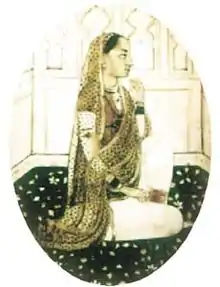 A miniature painting of Moran. | |
| Born | 1781 |
| Died | 1862 [1] |
| Burial place | Miani Sahib Graveyard, Lahore[1] |
Life
Mai Moran was born in a Muslim family in Makhan Windi, near Amritsar[1] She later married Maharaja Ranjit Singh, a year after he became the maharaja of Lahore at the age of 21 and was officially given a name as Maharani Sahiba. She was a nautch girl. Maharaja Ranjit Singh used to meet her in the Punjab region of India and Pakistan. She used to dance for him at the Baradari of Maharaja Ranjit Singh halfway between Amritsar and Lahore. The place was since called Pul Kanjri but now its name has been changed to 'Pul Moran'.[6] She later married Maharaja Ranjit Singh, a year after he became the maharaja of Lahore at the age of 21 and was officially given a name as Maharani Sahiba. She outraged Muslims when she spent one of her first nights with Ranjit Singh on top of the minaret of Wazir Khan Mosque. This outraged the Muslim community because in Islam, the Mosque was considered to be a holy place and doing any sexual or lustful acts in the premises of a mosque was considered blasphemy according to Islamic laws. After this incident, an alleged curse saw the Maharaja become very ill and all the Hindu pandits, Sikh granthis and Muslim mullahs of Lahore collected and declared that the curse of Muslim saint Syed Muhammad Ishaq Guzrani, known popularly as Hazrat Miran Shah, whose grave is within the mosque premises, was upon them both. Mohran Bai immediately became religious, renamed herself Mai Mohran, and built a mosque next to her ‘haveli’ in Pappar Mandi off Shahalami Gate as a sign of repentance. Amazingly, when she died she was buried next to the grave of Hazrat Tahir Bandagi in Miani Sahib, just near where Rani Gulbahar Begum was finally to be buried. The maharajah, from that point onwards, for as long as he lived, offered every Thursday free food to the poor at this place in repentance.[7][8] He struck a coin in the name of Rani Moran.[9] Because of this the people of Lahore began to address her as Moran Sarkar.[10]
She was considered to be very learned in arts and letters. She was known for her philanthropic[11] acts and in bringing Maharaja's attention to many problems.
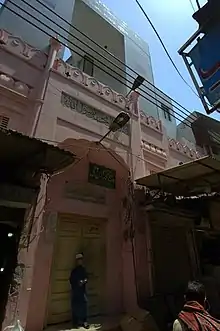
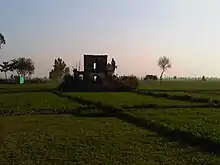
The Maharaja at Moran's request, built a mosque called as Masjid-e-Tawaifan, which was renamed in 1998 as Mai Moran Masjid in Lahore.[12] This is located in Lahore's bazaar now called Pappar Mandi near Shah Almi Gate.[3]
[12] Play
Her life story with Maharaja Ranjit Singh was made into a play by Manveen Sandhu and directed by Kewal Dhaliwal.[13]
See also
External links
References
- "Mosque of Moraan Tawaif — built by the beloved wife of Maharaja Ranjeet Singh - Daily Times Pakistan". 9 June 2018.
- The Sikh Review. Sikh Cultural Centre. 1998.
- "HARKING BACK: Mai Moran and ever-changing face of Pappar Mandi". 26 June 2016. Retrieved 17 January 2020.
- Kapūra, Prithīpāla Siṅgha; Singh, Dharam (2001). Maharaja Ranjit Singh: Commemoration Volume on the Bicentenary of His Coronation, 1801-2001. Publication Bureau, Punjabi University. ISBN 978-81-7380-728-2.
- The Sikh Review. Sikh Cultural Centre. 1993.
- "Memories of a Dancing Peacock - Indian Express". 28 August 2011.
- "HARKING BACK: Dazzling Rani of Punjab that was Gulbahar Begum". 5 February 2017.
- "The man with 20 wives". Telegraph India. Retrieved 27 January 2012.
- "Two emperors in the same mould". Tribune India. Retrieved 27 January 2012.
- "Mosque of Moraan Tawaif — built by the beloved wife of Maharaja Ranjeet Singh - Daily Times Pakistan". 9 June 2018. Retrieved 17 January 2020.
- "Fame and infamy". Business Line. Retrieved 28 January 2012.
- "Maharaja-Moran relationship in new light". Tribune India. Retrieved 27 January 2012.
- "The Sunday Tribune - Spectrum".