Morro d'Oro
Morro d'Oro is a town and comune in Teramo province in the Abruzzo region of eastern Italy.Morro d'Oro is an Italian town of 3 586 inhabitants in the province of Teramo in Abruzzo, part of the union of the Colline del Medio Vomano municipalities.
Morro d'Oro | |
|---|---|
| Comune di Morro d'Oro | |
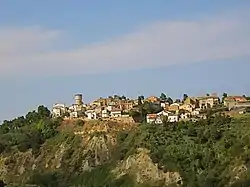 | |
Location of Morro d'Oro 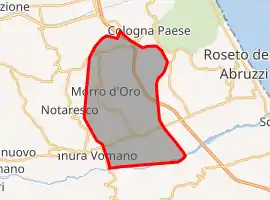
| |
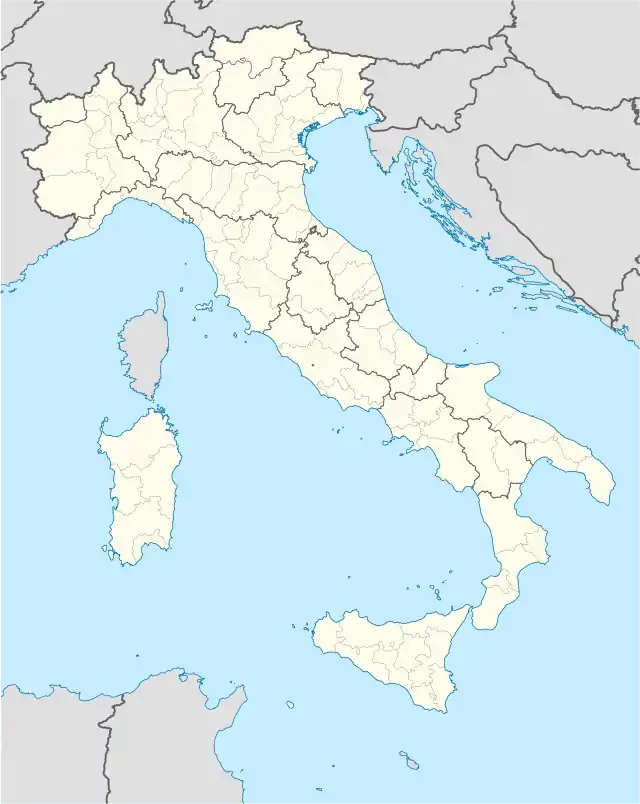  Morro d'Oro Location of Morro d'Oro in Italy 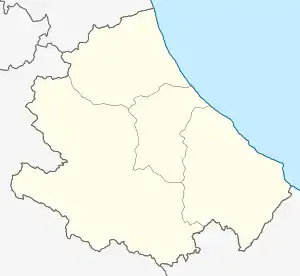 Morro d'Oro Morro d'Oro (Abruzzo) | |
| Coordinates: 42°40′N 13°55′E | |
| Country | Italy |
| Region | Abruzzo |
| Province | Teramo (TE) |
| Frazioni | Case di Bonaventura, Case Merluzzi, Acquasanta, Razzano, San Pietro, Torrenera, Sant'Antonio, Trapannara, Case Sacchetti, Capo le Coste, Case di Pasquale, Case Cavicchi, Piano Cesare, Cancrini, Colle di Mezzo, Case Romani, Propezzano, Colle della Croce, Pagliare Vecchia, Pagliare |
| Government | |
| • Mayor | Romina Sulpizii (Uniti per Morro d'Oro) |
| Area | |
| • Total | 28 km2 (11 sq mi) |
| Elevation | 210 m (690 ft) |
| Population (30 September 2019)[2] | |
| • Total | 3,586 |
| • Density | 130/km2 (330/sq mi) |
| Demonym(s) | Morresi |
| Time zone | UTC+1 (CET) |
| • Summer (DST) | UTC+2 (CEST) |
| Postal code | 64020 |
| Dialing code | 085 |
| ISTAT code | 067029 |
| Patron saint | San Nicola da Myra |
| Saint day | 6 December |
It is a small town in the province of Teramo, from which it is 28 km away, located between the Tordino and Vomano valleys. Its territory extends for 28.18 km²; the inhabitants at the census of 21 October 1991 were 3,015 units; at 31 December 1995 there were 3,190; a sign that the municipality, after a twenty-year phase of depopulation (from 3,215 in 1961 to 2,758 in 1981) is continuously growing in population.
All this thanks to its strategic location (12 km from the sea and 40 from the mountains) and its changed economic conditions: from an exclusively agricultural economy - and mainly sharecropping - to a more integrated agricultural-artisanal-industrial one. Therefore, its economy is based, on the one hand, on agriculture, but of an advanced type and on selected crops (vegetables and orchards), as well as traditional ones: cereals in general; on the other, on the tertiary sector (construction crafts and, to a lesser extent, trade); but there is also an adequate industrial development, which absorbs a workforce of about 300 units.
History
The origins of Morro d'Oro date back to the Middle Ages: probably linked to the era of the fortifications (VIII - X century); however, evidence of its existence is not available before a document of 1021, which speaks of a donation made by Adelberto De Aprutio in favor of the Monastery of Montecassino and in which the estate of Muro appears and there is mention of a Castello Veccio. Other documents from 1101 and 1128, in which the term Murum (or Morrum) appears, further testify to its existence.
In the 12th century the territory was given a fief to Trasmondo di Castelvecchio; but after 1200 also Morro entered the area of influence of the Acquaviva, as, moreover, had happened, or happened later, for the other neighboring towns, from Atri to the Tronto river. In the following centuries the fortunes of Morro, of course, were identified with those of the Acquaviva family, under whose jurisdiction it remained until the early eighteenth century. Throughout 1807, the community of Morro was administratively aggregated to Notaresco; with the government of the King of Naples, Gioacchino Murat, in that year it was temporarily aggregated to Montepagano; however, already in 1808 it was made autonomous again, in principle in the current territorial configuration.
The toponym Morro d'Oro, whose origins, as we have seen, are indefinite (Murus, Murrum, Morrum, then Moro appears in 1567, Murro in 1601 and Morra in 1703) has its definitive name in the current one, right Royal Decree 13 December 1863, n. 1616 and on the basis of the Council resolution of October 18, which read as follows: "... considering that the Municipality for the fertility of the land has always been abundant, considering that from ancient times it has always been given the epithet of Morro d 'Oro he decided the added word [of gold] should be written with the apostrophe ... ".
Monuments and places of interest
- Abbey of Santa Maria di Propezzano: its existence is ascertained in the years between 930 and 960, but a consolidated tradition, not probative and with sometimes imaginative features, traces it back to 10 May 715 AD. It is an abbey complex in Romanesque-Gothic style, with the typical layout of Benedictine monasteries, perfectly preserved in the original structure, as even the few restorations to which it was subject were carried out with perfect adherence to the origin, including also the material used.
- Church of SS. Salvatore and San Nicola, located in the capital: after recent recovery and restoration works [5] traces of the first Romanesque church have come to light within the current reconstruction which dates back to 1331, the work of Gentile da Ripatransone. Inside the monument there are wooden altars from the 1500s and 1600s, as well as paintings by Ragazzini (from 1600) and a statue of the Madonna in terracotta from the Atrian school of 1500, now perfectly restored. In the underground part, through an archaeological path, the graves and grains pits discovered during the consolidation of the foundations of the central piles are visible and can be visited. The layout of the building is very similar to that of Propezzano (except for a small difference in the width of the lateral naves) and all the details of the columns and capitals are also identical.
- Convent of Sant'Antonio Abate, about 2 km west of the capital, a Romanesque church that no longer exists (only the main wall towards the convent, recovered by a private individual, remains; certain news of its existence dates back to 1260 and legend has it that it is was visited by St. Francis of Assisi, who was in Abruzzo at least three times, in 1215, in 1220 (or 1222) and in 1225. Definitely suppressed by order of Giuseppe Bonaparte and subsequently of Gioacchino Murat, both King of Naples, was not From recent studies [6], it appears that the first church, no longer existing today, was built by the Benedictines around the ninth century; the ground floor of the conventual part is contemporary and the cloister is the same size as that of Santa Maria of Propezzano, the first floor is probably an elevation that can be traced back to the expansion of the 13th century. Kept in neglect for about three centuries, it was discreetly recovered by the current owner, so that now it is possible to admire the original external structure and some internal parts.
- In the immediate vicinity of the convent of Sant'Antonio Abate, recently (2008-2010), in the area called Piana dei Cesari, after complex land improvement works, mighty wall structures have come to light ( opus caementicium ' ') of the productive part of a large Italic-Roman company, extended for over 4 hectares, for the production of oil, wine and' '[garum]]' ', from the third century BC and the third century AD .. The residential part (nearby) is still to be discovered. The finds are visible in the Romualdi Archaeological Museum of Notaresco.
Hamlet
Pagliare
The hamlet of Pagliare rises near the Vomano river, and is crossed by the SS150 state road. Its name probably derives from the presence of the typical two-storey houses called Pagliara which had on the ground floor a stable for the beasts with relative mangers, perimeter tanks on the walls where hay (straw in fact) was placed. On the upper floor of these houses instead lived the peasants.
Currently Pagliare is a small flat town which grew considerably in the eighties thanks to the urbanization (which led to the death of Morro D'Oro capital and other districts) of the flat areas crossed by the state road 150 which goes from Roseto degli Abruzzi to Montorio al Vomano
Sports
The local football team, the Morro d'Oro Sports Association, played in the 2004-2005 season in Serie C2 (later Lega Pro Second Division, now integrated into Serie C). It was an important milestone for a country of only 3,468 inhabitants, as it was a national professional championship.
References
- "Superficie di Comuni Province e Regioni italiane al 9 ottobre 2011". Italian National Institute of Statistics. Retrieved 16 March 2019.
- All demographics and other statistics from the Italian statistical institute (Istat)

Authority control  |
|---|