Mother's Little Helper
"Mother's Little Helper" is a song by the English rock band the Rolling Stones. It first appeared as the opening track to the United Kingdom version of their 1966 album Aftermath. It was released as a single in the United States and peaked at number eight on the Billboard Hot 100 singles chart in 1966.
| "Mother's Little Helper" | ||||
|---|---|---|---|---|
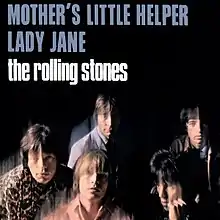 US picture sleeve | ||||
| Single by the Rolling Stones | ||||
| from the album Aftermath (UK release) | ||||
| B-side | "Lady Jane" (US) | |||
| Released |
| |||
| Recorded | 8–10 December 1965 | |||
| Studio | RCA, Hollywood | |||
| Genre | ||||
| Length | 2:45 | |||
| Label | ||||
| Songwriter(s) | Jagger/Richards | |||
| Producer(s) | Andrew Loog Oldham | |||
| The Rolling Stones US singles chronology | ||||
| ||||
The song deals with the popularity of prescribed tranquilizers among housewives, and the potential hazards of overdose or addiction.[4] The drug in question is variously assumed to be meprobamate (Miltown)[5] or diazepam (Valium).[6]
Writing and recording
Keith Richards likely composed "Mother's Little Helper" around September–December 1965, during the Rolling Stones' sixth British tour and fourth North American tour. Mick Jagger wrote the song's lyrics, and it is credited to the Jagger–Richards songwriting partnership. The Rolling Stones recorded "Mother's Little Helper" at RCA studios in Hollywood, California, from 8 through 10 December 1965.[2]
Authors Philippe Margotin and Jean-Michel Guesdon count the song as an exception to the misogynistic lyrics heard throughout Aftermath, interpreting the song as showing compassion for a housewife reliant on pharmaceutical drugs to cope with her daily life, while also connecting modern society to feelings of unhappiness.[7] By contrast, authors Nicholas Schaffner and Sean Egan each see the song as critiquing the hypocrisy of suburban housewives who rant about teenage drug abuse while requiring drugs of their own to get through the day.[8][9] Journalist Stephen Davis similarly sees the song as a "blatant attack on motherhood", directly addressing "tranquilised suburban housewives".[10]
The song is based around folksy chords and an eastern-flavoured guitar riff sounding like a sitar, but is a dual-slide riff played on two electric 12-string guitars by Brian Jones and Keith Richards.[11] Keith Richards has noted that the ending of the song was the idea of Bill Wyman, who also contributed a powerful and distinctive bass riff.[12]
Mick Jagger sings lead with Keith Richards on backing vocal; a previously unreleased (and presumably bootleg recording) mix features Keith more prominently on vocals.
Reception and legacy
Having been omitted from the US version of Aftermath, London Records released "Mother's Little Helper" as a single in the US on 2 July 1966.[13] The single peaked at number eight on the Billboard Hot 100 chart,[13] while its B-side, "Lady Jane", reached number 24.[14][15]
Of the song's mainstream impact, Jason Mendelsohn of PopMatters writes that, "In pointing out the hypocrisy of a culture that tut-tuts rockers for recreational drug use while actively endorsing and prescribing mind-altering drugs to housewives, the Rolling Stones effectively cemented their reputation as a subversive cultural force."[16]
In 2005, American singer-songwriter Liz Phair covered "Mother's Little Helper" for the soundtrack album Music from and Inspired by Desperate Housewives.
Personnel
According to authors Philippe Margotin and Jean-Michel Guesdon,[11] except where noted:
- Mick Jagger – doubled-tracked lead vocals
- Keith Richards – backing vocals, twelve-string electric slide guitar, acoustic guitar
- Brian Jones – twelve-string electric slide guitar
- Bill Wyman – bass, fuzz bass[17]
- Charlie Watts – drums
Charts and certifications
Weekly charts
|
Year-end charts
|
References
Citations
- Luhrssen & Larson 2017, p. 305.
- Margotin & Guesdon 2016, p. 142.
- Covach 2019, p. 12.
- Brown, Nancy (17 July 1966). "Top Records Of The Week". The La Crosse Tribune. p. 34. Retrieved 9 May 2021.
- Esther Inglis-Arkell. "This Is The Drug In The Rolling Stones' Song "Mother's Little Helper"". Io9.gizmodo.com. Retrieved 29 September 2016.
- U.S. News and World Report, Vol. 127, p. 58 (1999): "A song on the 1967 Rolling Stones album Flowers was entitled 'Mother's Little Helper,' a tongue-in-cheek ode to a housewife coping with bratty kids and a demanding husband, thanks to Valium ..."
- Margotin & Guesdon 2016, p. 138.
- Schaffner 1982, p. 69.
- Egan 2006, pp. 162, 165.
- Davis 2001, pp. 161–62.
- Margotin & Guesdon 2016, pp. 142–143.
- Ian McPherson. "Mother's Little Helper". Timeisonourside.com. Retrieved 29 September 2016.
- Margotin & Guesdon 2016, p. 143.
- Margotin & Guesdon 2016, p. 146.
- Joel Whitburn (1985), The Billboard Book of Top 40 Hits, ISBN 0-8230-7518-4
- Mendelsohn, Jason; Klinger, Eric (19 April 2013). "Counterbalance No. 125: The Rolling Stones' 'Aftermath'". PopMatters. Retrieved 28 March 2020.
- Margotin & Guesdon 2016, pp. 142–143: Wyman on bass, distortion beginning at 1:22 caused by either Fuzz-Tone on bass or another electric guitar; Everett 2009, p. 33: fuzz bass.
- "The Rolling Stones – Mother's Little Helper" (in French). Ultratop 50. Retrieved 6 October 2021.
- "Top RPM Singles: Issue 5789." RPM. Library and Archives Canada. Retrieved 6 October 2021.
- "Cash Box Top 100 Singles: August 13, 1966". Cashbox. Archived from the original on 28 February 2013. Retrieved 6 October 2021.
- "The Rolling Stones Chart History (Hot 100)". Billboard. Retrieved 17 June 2016.
- "Offiziellecharts.de – The Rolling Stone – Mother's Little Helper". GfK Entertainment charts. Retrieved 6 October 2021.
- "Cash Box Year-End Charts: Top 100 Pop Singles, December 24, 1966". Archived from the original on 23 November 2021. Retrieved 29 November 2021.
Sources
- Covach, John (2019). "The Rolling Stones: Albums and Singles, 1963–1974". In Coelho, Victor; Covach, John (eds.). The Cambridge Companion to the Rolling Stones. Cambridge, United Kingdom: Cambridge University Press. pp. 3–17. ISBN 978-1-107-65111-1.
- Davis, Stephen (2001). Old Gods Almost Dead: The 40-Year Odyssey of the Rolling Stones. Crown/Archetype. ISBN 0-7679-0956-9.
- Egan, Sean (2006). The Rough Guide to the Rolling Stones. New York: Rough Guides. ISBN 978-1-84353-719-9.
- Everett, Walter (2009). The Foundations of Rock: From "Blue Suede Shoes" to "Suite: Judy Blue Eyes". Oxford: Oxford University Press. ISBN 978-0-19-531024-5.
- Luhrssen, David; Larson, Michael (2017). Encyclopedia of Classic Rock. ABC-CLIO. ISBN 978-1-4408-3514-8.
- Margotin, Philippe; Guesdon, Jean-Michel (2016). The Rolling Stones All the Songs: The Story Behind Every Track. New York: Black Dog & Leventhal Publishers. ISBN 978-0-316-31774-0.
- Schaffner, Nicholas (1982). The British Invasion: From the First Wave to the New Wave. McGraw-Hill. ISBN 0-07-055089-1.


Authority control  |
|---|