Moussa B. H. Youdim
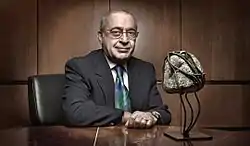
Moussa B. H. Youdim is an Iranian/Israeli neuroscientist-neuropharmacologist who works on aminergic neurotransmitter metabolism and function and iron metabolism in brain function. He was among the first to purify mitochondrial monoamine oxidase, demonstrate that the enzyme contained a covalently bound flavin cofactor and provide evidence that they are two forms of the enzyme in the liver and brain. He is co-discoverer of the anti Parkinson monoamine oxidase B inhibitor, Selegiline, with Peter Riederer and discovered the second monoamine oxidase B inhibitor, AGN-1135, co-developed with John Feinberg as anti-Parkinson drug, rasagiline (Azilect) and the multi target drug , Ladostigil, for Alzheimer's disease.[1][2].His other major original contributions are his studies on brain iron metabolism. Either nutritional iron deficiency that results in learning disability in rats, as it had been shown in children with nutritional iron deficiency and excess accumulation in the brain in neurodegenerative diseases, which can initiate oxidative stress in Parkinson's and Alzheimer's diseases. These studies led him to develop multi target drugs with iron chelating, monoamine oxidase and cholinesterase inhibitory activities for these disorders as neuroprotective and neurorestorative drugs, such as M30.
Early life
Youdim was born in Teheran, Iran in 1940 and is one of five children of Elihoo and Faranggis Youdim. From 1952 until 1959 he studied at Aryeh House School (Brighton), Sherardwoods School (Weylyn Garden City) and Borough Polytechnic, London in England. He completed his B.Sc. (1962) at McGill and M.Sc.(1964) and Ph.D. in the Department of Biochemistry at Allan Memorial Institute McGill University with Theodore L Sourkes in 1966.
Academic career
- 1966–1971. Post-doctoral fellow at University of London Post Graduate School, Queen Charlotte Maternity Hospital in Merton Sandler's laboratory
- 1971. Department of Biochemistry Cambridge University in K.F. Tipton's laboratory
- 1972. Wellcome Trust Fellow at College de France in Paris at Jacques Glowinski's laboratory
- 1973–1977. Oxford University,MRC Unit of Clinical Pharmacology and Faculty of Medicine
- 1977–1995. Technion-Israel Institute of Technology Medical School, Professor and Chairman
- 1983-2010. Finkelstein Professor of Life sciences, Technion-Israel Institute of Technology
- 1991–1999. International Scholar in Residence at NIH Fogarty International Center for Advanced Study in Human Health Sciences, Bethesda
- 1997–2012. Directors of Eve Top Center of Excellence for Neurodegenerative Diseases Research and Teaching and USA National Parkinson Disease Center of Excellence, Technion Faculty of Medicine
- 2006-2008 Distinguished Scientific Professor at Honk Kong Polytechnic University and Department of Anatomy Hong Kong University
- 2008–2013. Distinguished Professor of Neurobiology at Yonsei World Class University Programme, Seoul, South Korea.
He holds Honorary Professorships at Armed Forces University Medical School in Bethesda, MD , USA; and in China Janin University, Materia Medica Shanghai University of Chinese Traditional Medicine; Ruijin Medical school Shanghai and Qingdao University.
Industry involvement
Youdim served as consultant to Roche, TEVA Pharmaceuticals Ltd; Ciba Geigy, and Continental Pharmaceuticals,Brussels. He is president and CSO of Youdim Pharmaceutical. He is a discoverer of the anti-Parkinson drugs selelgiline (l-deprenyl) and developer of monoamine oxidase B inhibitor rasagiline (Azilect), which was considered to be the first disease modifying drug used for Parkinson's disease and TVP 3326, ladostigil, for Alzheimer's disease.[1][2] Experts have recently questioned whether rasagiline actually has significant disease modifying properties.[3]
Honors and Awards
- 1974. Anna Monika International Prize, Basel, Switzerland.
- 1974. British Migraine Association Special Gold Medal, London, UK.
- 1978. The Homayoon (Royal) Medal from the Shah, Teheran, Iran.
- 1980. National Israel Psychobiology Institute Prize, Jerusalem, Israel.
- 1986. Michael Landau Research Prize, Tel Aviv, Israel.
- 1984. United States Department of Commerce, Inventor's Award, Isolation and cuLture of Adrenal Meduallry Endothelial Cells Producing Blood Clotting Factor 8.
- 1990. Senator Burda International Prize for Parkinson's disease, Vienna, Austria.
- 1991. Claudius Galenus Gold Medal Prize Drug of the year l-Deprenyl (selegiline), Berlin, Germany.
- 1991. Deutscher Neuropharmakologie (AGNP) Prize, Nuremberg, Germany.
- 1991. Eli lilly Prize for Neuropharmacology, Indianapolis, USA.
- 1993. The New England Prize of Excellence in Science, Boston, USA.
- 1994 and 1977. Henning Andersen Prize, Stockholm, Sweden.
- 1997. "Honoris Causa" Honorary Doctor of Philosophy, Semmelweiss University Medical School, Hungary.
- 1998. "Honoris Causa" Honorary Doctor Of Philosophy University of Pisa and Ecole Superior Nationale, Pisa, Italy.
- 2006. Henry Taub Prize for Excellence in Research, Technion-Israel Institute of Technology, Haifa, Israel.
- 2006. Nathan Shock Lecture, NIH Institute of Ageing, Bethesda, USA.
- 2007. Melvin Yahr Lecture, Mount Sinai School of Medicine, New York, USA.
- 2007. World Federation of Neurology 17th International Congress of Parkinson's disease Award for Contribution to Parkinson's disease, Amsterdam, Netherland.
- 2008. Thomas Schkeler Lecture, Ohio State University, Columbud, USA.
- 2009. Shanghai Baiyulan Award, Ruijin Medical School. Shanghai, China.
- 2010. Elected Member of Leopoldina German Academy of Sciences, Halle Germany.
- 2011. Theodore l. Sourkes lecture, Parkinson's disease, McGill University, Mntyreal, Canada.
- 2011. European College of Neuropsychopharmacology (ECNP) Life Time Achievement Prize in Neuropsychopharmacology, Amasterdam, Netherland.
- 2011. EMET Prize for Brain Science, Jerusalem, Israel.
- 2012. Giant Pioneer of Catecholamine Research Prize, 11th International Catecholmaine Congress, Asilom,ar, USA.
- 2012. CINP (International College of Neuropsyhcopharmacology) Pioneering Neuropsychopharmacology Prize, with Arvid Carlsson Medal, Stockholm, Sweden.
- 2013. Elected Honorary Member of Israel Neuroscience Society.
Editorial boards
On the editorial boards of 40 journals, including British Journal of Pharamcology, Journal of Neurochemistry, Journal of Neural Transmission, Experimental Neurology, International Neurochemistry, Psychopharmacology. International Journal of Neuropsychopharmacology,Archives of Pharmacology, Frontiers in Pharmacology, European Journal of Pharmacology, Biogenic Amines, Neuropsychobiology, Neurochemical Research; Brain Research, CNS Drug Review, Future Drugs, Drugs of Today, and Neurotherapeutics.
Publications
- Youdim, Moussa B H; Bakhle, Y S (2006). "Monoamine oxidase: isoforms and inhibitors in Parkinson's disease and depressive illness". British Journal of Pharmacology. 147 (S1): S287–S296. doi:10.1038/sj.bjp.0706464. ISSN 0007-1188.
- Zecca, Luigi; Youdim, Moussa B. H.; Riederer, Peter; Connor, James R.; Crichton, Robert R. (November 2004). "Iron, brain ageing and neurodegenerative disorders". Nature Reviews Neuroscience. 5 (11): 863–873. doi:10.1038/nrn1537. ISSN 1471-003X.
- Youdim, Moussa B. H.; Edmondson, Dale; Tipton, Keith F. (April 2006). "The therapeutic potential of monoamine oxidase inhibitors". Nature Reviews Neuroscience. 7 (4): 295–309. doi:10.1038/nrn1883. ISSN 1471-003X.
- Weinreb, Orly; Amit, Tamar; Mandel, Silvia; Kupershmidt, Lana; Youdim, Moussa B.H. (2010-09-15). "Neuroprotective Multifunctional Iron Chelators: From Redox-Sensitive Process to Novel Therapeutic Opportunities". Antioxidants & Redox Signaling. 13 (6): 919–949. doi:10.1089/ars.2009.2929. ISSN 1523-0864.
References
- Youdim, M.B. (November 2003). "Rasagiline: an anti-Parkinson drug with neuroprotective activity". Expert Review of Neurotherapeutics. 3 (6): 737–49. doi:10.1586/14737175.3.6.737. PMID 19810877. S2CID 23857497.
- Naoi, M.; Maruyama, W.; Youdim, M.B.; Yu, P.; Boulton, A.A. (2003). "Anti-apoptotic function of propargylamine inhibitors of type-B monoamine oxidase". Inflammopharmacology. 11 (2): 175–81. doi:10.1163/156856003765764344. PMID 15035819. S2CID 60465.
- Young, Donna. "Panel: Teva's Azilect Data Close, but No Cigar for Parkinson's Delay Claim". michaeljfox.org. FoxFeed Blog. Retrieved 21 February 2016.
External links
- "Bio". www.avphar.com. Retrieved 2021-11-02.
- "Kenes Bio" (PDF).
- Leichman, Abigail Klein (2012-02-15). "Parkinson's pioneer". ISRAEL21c. Retrieved 2021-11-02.
Authority control  | |
|---|---|
| General | |
| National libraries | |