Mr. Bingle
Mr. Bingle is a fictional character marketed and sold by department store Dillard's during the holiday season. Originating as a mascot of the Maison Blanche department store in New Orleans, Louisiana, the rights to the character would be given to Mercantile Stores, Goudchaux's, Lowenstein's, and Dillard's following acquisitions by said competing stores. Ever since his debut in 1948, Mr. Bingle has become an important part of the popular culture of the Greater New Orleans area.[1]
| Mr. Bingle | |
|---|---|
| Snowman character | |
 Theme song
| |
| Created by | Emile Alline |
| Designed by | Emile Alline |
| Portrayed by | Edwin "Oscar" Isentrout (1948-1985) |
| Voiced by | Edwin "Oscar" Isentrout (1948-1985) |
| In-universe information | |
| Aliases | Snow Doll |
| Species | Snowman |
| Gender | Male |
| Title | Mister |
| Affiliation | Santa Claus, Santa's elves |
| Weapon | Candy Cane |
| Home | The North Pole, Santa's workshop |
History
Mr. Bingle was originally conceived by Emile Alline, an employee of Maison Blanche, in 1947. He worked as a display manager and became aware that other department stores had mascots around Christmastime, such as Montgomery Ward's Rudolph, the Red-Nosed Reindeer, and pitched the concept of a similar mascot to Maison Blanche executives Lewis and Herbert Schuartz. Originally referred to as "Snow Doll," his name would quickly be changed to Mr. Bingle following a naming contest held among the employees of Maison Blanche, with the name being chosen by Lewis as it shared the initials of the store. Mr. Bingle shared the initials of his home, "M.B.", as the store was often called, and this similarity was used heavily in marketing the character, even being referenced in his theme song.[2]
The rights to the character would shift hands along with it's parent company, being bought out by Goudchaux's, Inc. of Baton Rouge, owned by Hans and Josef Sternberg, and becoming known as Goudchaux/Maison Blanche. This company would continue to operate under the original Maison Blanche name before eventually being bought by department store giant Dillard's in 1998, who continue to promote and sell merchandise of the character as of 2021.[3] Mr. Bingle continues to be incredibly popular in New Orleans, with a dedicated community of followers.[1] The character of Mr. Bingle also made appearances outside of the commercial setting for charitable purposes, visiting sick children at the Children's Hospital of New Orleans and even visiting the White House.
Appearance
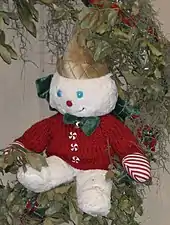
The design of Mr. Bingle is that of an anthropomorphic snowman. Unlike traditional snowmen, there is no coal attached to his body, and his facial features are represented by small blue and red buttons with a small black line for a mouth. He is always shown wearing a sugar ice cream cone on his head, representing a hat, and traditionally holds a peppermint candy cane in his right hand. Traditionally, he doesn't wear clothing, aside from red ribbon with bells at the tips tied around his neck, but much of his merchandise features him in costume, differing in design based on the year he is sold. His last defining traits are holly wings that come out of his back, and the year of sale stitched on his left foot. A tag featuring his story is usually attached to his wings or one of his hands, and some designs do not feature a mouth.[4]
Puppet Shows
Mr. Bingle became best known in puppet (or marionette) form at the Canal Street Maison Blanche, puppeteered by New York puppeteer Edwin "Oscar" Isentrout (who also played the voice of Mr. Bingle). He had previously done puppetry not far from the store, on Bourbon Street, where he would do shows with vaudeville marionettes performing striptease in-between performances from exotic dancers. Isentrout often travelled around the United States of America with a marionette troop before buying a bus ticket to New Orleans, although he maintained his nightclub engagement, making it hard to perform the puppet shows at Maison Blanche. He would seek the assistance of two teenagers named Ray Frederick and Harry J. Ory, who had achieved some local success with their own marionette act. The three created many characters that would accompany Mr. Bingle and Santa Claus, such as a bear aptly named "Bingle Bear" and a rabbit named "Bingle Bunny," but neither would achieve the same level of success as the snowman. Isentrout portrayed Bingle as a childlike character, making him get into all sorts of hijinks and forcing Santa Claus to help him get out of whatever situation he was in. [5] These puppet shows occurred each day for the few weeks leading up to Christmas for about 15 minutes at a time, and were a favorite of local children, with adults even coming by to watch the shows. Mr. Bingle would sometimes be forced to break the fourth wall and tell the adults to move so that the children could get a good look at the show. Mr. Bingle also appeared in musical radio and television commercials, many of which were fully animated. The puppet shows ended in 1985 when Isentrout died.[3]
Television Show
The character would appear on television on the New Orleans channel WDSU, where he would be accompanied by real actors in his puppet form, similar to Sesame Street. This show would air from Thanksgiving to the night before Christmas.
Merchandise
Stuffed Dolls
Mr. Bingle-related merchandise, especially plush toys, were sold by Maison Blanche and manufactured in China starting in 1948. The character has undergone many design changes, with the earlier dolls having chrome eyes and red mittens, and later dolls switching to the traditional blue eyes with red and white mittens. Some dolls even have a black nose and eyes, although these were manufacturers defects and were ordered to be destroyed, with the remaining dolls becoming rare. Other manufacturers defects among the dolls include hats that veer too far in either direction and oddly placed facial features. With the rise of social media platforms such as Facebook, communities have been formed dedicated to the buying and reselling of the dolls, and many listings have appeared on sites such as eBay.
Papier-Mâché Figure
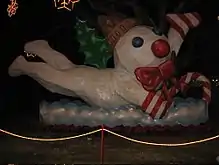
Mr. Bingle was also displayed as a large papier-mâché figure on the front of the flagship Maison Blanche store on Canal Street, first standing next to Santa Claus and later in a flying form. The flying figure was displayed at the Metairie, Louisiana Maison Blanche Store and later at a Dillard's Metairie location when the Canal Street store was closed.[3] By 2004 the Mr. Bingle figure was in such poor condition that it could not be displayed, although Dillard's continued to market small replicas.[6] This figure has since become the most iconic of all Mr. Bingles, with most of the non-plush toy merchandise featuring the character in the exact same pose as the papier-mâché figure. By 2011 the Mr. Bingle figure was again reported to be in need of repairs.[7]
Novels
A 2004 novel entitled Saving Mr. Bingle became a local success in New Orleans and Memphis;[8] proceeds from the book were later used to buy a gravestone for Isentrout's unmarked grave at Hebrew Rest No. 3 Cemetery in New Orleans.[9] When Hurricane Katrina hit New Orleans in August 2005, a levee collapsed near the warehouse where Mr. Bingle was stored, and the neighboring buildings were destroyed but Mr. Bingle survived. Spurred by this discovery, funds were raised to refurbish the display and it became a centerpiece of the Christmas 2005 "Celebration in the Oaks" light display at New Orleans City Park.[10]
| External media | |
|---|---|
| Media related to Mr. Bingle | |
| Images | |
 Collection of on-line photos of Mr. Bingle, as seen in a Flickr group, Mr. Bingle Lives! Collection of on-line photos of Mr. Bingle, as seen in a Flickr group, Mr. Bingle Lives! | |
| Video | |
 The Story of Mr. Bingle, as seen on YouTube The Story of Mr. Bingle, as seen on YouTube |
Mr. Bingle Outside of New Orleans
Mr. Bingle also appeared in Memphis, Tennessee, at the department store Lowenstein's, which was also owned by Mercantile Stores[11] Mercantile acquired MB a few years before itself being acquired by Dillard's. The Mercantile chain used Mr. Bingle in Christmas advertising nationwide at various regional department stores owned by Mercantile. As of November 2014, Mr. Bingle merchandise was still widely available.[4]
See also
- Al Shea
- Companions of Saint Nicholas
- Saving Mr. Bingle, by Sean Patrick Doles, New Orleans Stories, 2004. (A work of fiction.) ISBN 0-9758996-0-0
- Canal Street: New Orleans' Great Wide Way, by Peggy Scott Laborde & John Magill, Pelican Publishing Company, 2006. ISBN 978-1-58980-337-4
- New Orleans Television, by Dominic Massa, Arcadia Publishing, 2008. ISBN 978-0-7385-5404-4
- Maison Blanche Department Stores, by Edward J. Branley, Arcadia Publishing, 2011. ISBN 978-0-7385-8817-9
References
- Times-Picayune staff writers (October 1, 2011). "1897: Maison Blanche department store 'grand opening'". David Francis, publisher. New Orleans Times-Picayune. Retrieved December 17, 2016.
- Hans J. Sternberg, We Were Merchants: The Sternberg Family and the Story of Goudchaux's and Maison Blanche Department Stores (LSU Press, 2009), ISBN 978-0807134498, p. 95. Excerpts available at Google Books.
- Branley, Edward. "NOLA History: Here Comes Mr. Bingle". GoNOLA.com. New Orleans Tourism Marketing Corporation. Retrieved December 24, 2016.
- Myers-Boone, Leanne. "Here Comes Mr. Bingle". Country Roads Magazine. James Fox-Smith, publisher. Retrieved December 27, 2016.
- Peggy Scott Laborde & John Magill, Christmas in New Orleans (Pelican Publishing Company, 2009), ISBN 978-1455602179, pp. 16ff. Excerpts available at Google Books.
- Sean P. Doles, "In Search of Mr. Bingle", Gambit, December 21, 2004.
- "No Jingle, No Jangle: Mr. Bingle To Miss Holiday Parade", WDSU, December 1, 2011.
- "Book About Store's Christmas Pitchman Becomes Big Easy Hit", Associated Press in The Harlan Daily Enterprise, December 24, 2004.
- ""Mr. Bingle" animator gets tombstone", The Advocate (Baton Rouge), December 16, 2005 (pay site).
- Scott Gold, "Mr. Bingle Helps Save Christmas in New Orleans: The beloved mascot is back, anchoring the holiday light festival as the city tries to recover from Katrina." Los Angeles Times, December 25, 2005.
- Christine Arpe Gang, "Holiday Memories / Beloved Mr. Bingle -- Snowman is a treasured memory of days gone by", The Commercial Appeal, December 25, 2009. Available here – via HighBeam Research (subscription required) .


