Thierry Mugler
Manfred Thierry Mugler (French pronunciation: [tjɛʁi myɡlɛʁ]; born 21 December 1948) is a French fashion designer.
Thierry Mugler | |
|---|---|
 Mugler in 2014 | |
| Born | Manfred Thierry Mugler 21 December 1948 Strasbourg, France |
| Occupation | Fashion designer |
| Known for | Angel fragrance, perfumes, Demi Moore's dress from Indecent Proposal |
Early life and education
Mugler was born in Strasbourg, France. His passion led him to focus more on drawing than on school, and at the age of 9, he began to study classical dance.[1] By 14, he joined the ballet corps for the Rhin Opera (Opéra national du Rhin).[2]
At the same time, Mugler began formal interior design training at the Strasbourg School of Decorative Arts.[3]
Career
In 1971, in his early twenties, Mugler began designing clothes for Karim,[4] already showing the broad-shouldered, 1940s-derived looks he would become famous for in later years.[5] At the age of 24, Mugler moved to Paris. He began designing clothes for Parisian boutique, Gudule. At 26, Mugler, who was working as a freelance designer, began to design for a variety of large ready-to-wear fashion houses in Paris, Milan, London and Barcelona.[3]
In 1973, Mugler created his first personal collection called "Café de Paris". The style of the collection was both sophisticated and urban. Melka Tréanton, a powerful fashion editor, helped to launch his career. In 1976, she asked him to show his work in Tokyo for an event organized by Shiseido.[6] In 1978, he opened his first Paris boutique at the Place des Victoires in the 1er Arrondissement and rapidly gained attention as among the most extreme of the Fall 1978 broad-shoulder brigade of designers, with a penchant for mid-20th-century sci-fi themes and exaggerated 1940s-50s-style glamour marked by sharply constructed tailoring[7][8][9][10] At the same time, Thierry Mugler launched a fashion collection for men. He would continue into the following decade with his 1940s-style shoulders on 1950s-tailored suits[11] amid retrograde Wagnerian showmanship.[12]
During the 1980s and 1990s, Thierry Mugler became an internationally recognized designer, often grouped with Claude Montana and Azzedine Alaïa[13][14][15] but known especially for his shapely suits,[16] and his collections garnered much commercial success. Except for a couple of sedate salon presentations in the late eighties[17][18] (when he also reduced his shoulder padding),[19] his fashion shows were extravagant affairs held in arena-like environments[20][21] and the collections associated with them had themes,[22] sci-fi themes in the late seventies,[23] an Africa theme one season,[24] a vampire-devil theme the next,[25] an aquatic theme the next.[26] At the request of the Chambre Syndicale de la Haute Couture, he completed his first haute couture collection in 1992.[27]
He designed the dresses of Viktor Lazlo for Hosting Eurovision 1987Throwback Thursday: 1987.
He created the black dress worn by Demi Moore in the 1993 movie, Indecent Proposal.
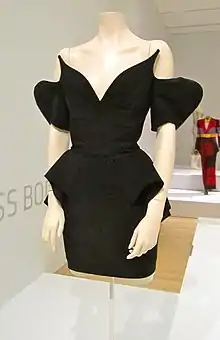
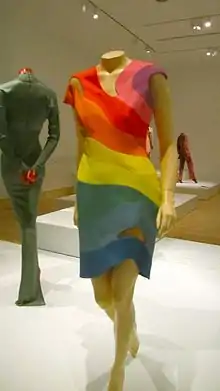
Mugler published his first photography book in 1988, Thierry Mugler: Photographer.[28] This was followed by a monograph in 1999 entitled, Fashion Fetish Fantasy which assembles photos of his creations.[29]
Mugler also directs short films, advertising films and video clips. He regularly designs costumes for musical comedies, concerts, operas and the theatre (including Macbeth for the Comédie Française). He has worked with Robert Altman and George Michael (he directed the video for Michael's "Too Funky" in 1992). He also directed the first advertising film for one of his fragrances, Alien.
Clarins has held the rights to his name Thierry Mugler since 1997.[30]
Retirement from fashion
Clarins shuttered the ready-to-wear component of Mugler's brand in 2003, due to financial losses; however, they kept the perfume division open as it was profitable.[31] Mugler left fashion in 2002.[32] When asked about the subject he has said: "Fashion is beautiful, 3-D art on a human being. But it wasn't enough, which is why I went on to create in other ways. For me, it wasn't the right tool anymore. But perfume still interests me".[33]
In 2002 Mugler collaborated with the Cirque du Soleil. He directed "Extravaganza", one of the scenes of Zumanity, and also created all of the costumes and the identity of the characters in the show.
In 2008 the Mugler brand launched Thierry Mugler Beauty, a high-end line of cosmetics.
In 2009, Mugler worked as artistic advisor to singer Beyoncé.[34] He created the costumes for her "I Am... World Tour".[2]
In September 2010, Nicola Formichetti was announced to be the Creative Director of the Thierry Mugler brand. He changed the brand name to MUGLER, removing the first name, and in January 2011, he launched the revival of the brand's menswear collection in collaboration with Romain Kremer.[35]
An April 2010 New York Times story discussed Mugler's cosmetic transformation. "[Mugler has] taken to calling himself Manfred and transformed his body...into what is apparently a 240-pound spectacle of muscle and nipple and tattoo..."[30]
With over two years of being the creative director of MUGLER, Formichetti announced in April 2013 that he and the fashion house will be parting ways. Formichetti left MUGLER to work for the Italian brand Diesel.
In December 2013, House of Mugler announced David Koma as the artistic director.[36]
In 2016, Mugler created and directed the music video and staging for San Marino's Eurovision Song Contest entry I Didn't Know performed by Turkish singer Serhat.[37]
Despite retiring from his brand in 2003, he made the exception to design under his name "House of Mugler" for the Met gala in 2019, and for a dear friend of his, Kim Kardashian. Getting his inspiration from Sophia Loren in Boy on a Dolphin, Mugler envisioned a wet California girl; hence the creation of the "wet couture dress".[38][39]
Fragrances
.jpg.webp)
Mugler's first perfume appeared in 1992 and was called Angel. "Angel" contains a combination of praline and chocolate mixed with a strong accord of patchouli. It would be a part of a new fragrance type called gourmand. The Angel bottle, a design in the shape of a faceted star, was created by the Brosse Master Glassmakers. Fans of the fragrance include Diana Ross, Barbara Walters, Eva Mendes, and Hillary Clinton.[40]
In 1996 Mugler followed up Angel with a male version named Angel Men or A*Men. This fragrance includes notes of caramel, coffee, vanilla, patchouli, and honey.
In 2005, Alien was created, the second major Thierry Mugler fragrance. Also in 2005, Thierry Mugler launched the Thierry Mugler Perfume Workshops", which are open to the general public and led by specialists of the perfumery and oenology world.
Angel and Alien together produce about $280 million in sales annually.[41]
In 2010, the fragrance Womanity was released by the house of Mugler.[42]
Mugler's newest fragrance, Angel Muse, was released in 2015 and Angel Nova was released in June 2020. In 2006, Thierry Mugler completed a project for the launch of Tom Tykwer's film "Perfume". In collaboration with the IFF company, Thierry Mugler created a box set of fifteen compositions.
During 2007, still following the metamorphosis theme, Mugler launched Mirror, Mirror, a collection of five fragrances, created as "perfume-trickery" to "enhance one's presence".
Personal life
Mugler is openly gay, and is a longtime bodybuilder.[43] Since his departure from fashion he has become notably reclusive. During this time he began going by his first name, Manfred, and began extensive bodybuilding. He felt 'Thierry Mugler' was a label, a brand. He wanted to move on to other things."[32]
References
- Menkes, Suzy (16 July 2019). "Manfred Thierry Mugler: Back in Fashion". British Vogue. Retrieved 16 October 2019.
- "Mugler Joins the Cirque". WWD. Retrieved 16 October 2019.
- Shardlow, Phoebe (11 February 2019). "Exploring Thierry Mugler's Everlasting Impact on Fashion". Elle.
- Mulvagh, Jane (1988). "1971". Vogue History of 20th Century Fashion. London, England: Viking, the Penguin Group. p. 319. ISBN 0-670-80172-0.
Thierry Mugler (for Karim) velvet jersey, bias-cut skirt and blouse.
- Mulvagh, Jane (1988). "1971". Vogue History of 20th Century Fashion. London, England: Viking, the Penguin Group. p. 322. ISBN 0-670-80172-0.
Thierry Mugler showed his first collection in Paris, which concentrated on an angular, wide-shouldered cut reminiscent of the forties.
- "Window Display Exhibition in Paris to Commemorate the 30th Anniversary of Shiseido Cosmetics Sales in France" (PDF) (Press release). 19 August 2010. Retrieved 16 October 2019.
- Morris, Bernadine (9 April 1979). "Paris Fashions Unveiled in Super Bowl Style". The New York Times: D8. Retrieved 8 December 2021.
Montana and Mugler both pioneered the giant shoulder‐pad movement last year [1978]...
- Duka, John (13 November 1978). "Paris is Yesterday". New York. 11 (46): 111–112. Retrieved 11 December 2021.
[I]f [Paris designers] have their way, American women will be wearing big, big, big padded shoulders...On the Flash Gordon side of French ready-to-wear Retro are such designers as Claude Montana, Thierry Mugler, and France Andrevie....At Mugler,...[it took the form of] a big-shouldered Flash Gordon jacket...
- Russell, Mary (8 April 1979). "Fashion/Beauty Fallout from Paris". The New York Times: SM19. Retrieved 13 December 2021.
The Paris avant‐garde designers Thierry Mugler and Claude Montana continue taking fashion risks and making headlines with futuristic leathers and knits....Thierry Mugler loves the Krypton scenes from Superman, but his futuristic clothes are real...
- "Fashion View". The New York Times: SM6. 30 December 1979. Retrieved 10 December 2021.
...Thierry Mugler's Star Trekesque gigantic shoulders....
- Morris, Bernadine (27 February 1983). "The Directions of the Innovators". The New York Times: 132. Retrieved 15 December 2021.
Today's avant-garde designers -including the Frenchmen Claude Montana, Thierry Mugler, Jean-Paul Gaultier and Azzedine Alaia - strike out in many directions. But, while some seem radical, they are actually reworking themes from the past, borrowing from periods before the 1960's.
- Mulvagh, Jane (1988). "1976-1986". Vogue History of 20th Century Fashion. London, England: Viking, the Penguin Group. p. 345. ISBN 0-670-80172-0.
Mugler...present[ed] plastic breastplates, space suits, three-foot-wide shoulders, molded nipples, cinched torsos and tottering high heels.
- Morris, Bernadine (1 November 1985). "Provocative is the Word for Spring". The New York Times: A22. Retrieved 14 December 2021.
[Alaïa] went on to influence the cut of the clothes of his friends Claude Montana and Thierry Mugler.
- Morris, Bernadine (21 September 1982). "Notes on Fashion". The New York Times: B1. Retrieved 13 December 2021.
...[H]ow explain the resurgence of short, tight skirts, body-cupping knitted dresses, spindly heels and other constricting clothes...[f]avored by...such designers as Azzedine Alaia, Thierry Mugler and Claude Montana[?]...
- Mulvagh, Jane (1988). "1976-1986". Vogue History of 20th Century Fashion. London, England: Viking, the Penguin Group. p. 345. ISBN 0-670-80172-0.
Like Gaultier and Montana, Mugler married couture traditions with cult dressing....The overt sexuality of Mugler's clothes was upstaged by his close friend Azzedine Alaïa...
- Cunningham, Bill (1 March 1989). "Designers of the World, Unite!". Details: 304.
...[B]uyers and clients recognized–and ordered–[Mugler's] wonderfully tailored suits.
- Cunningham, Bill (1 March 1988). "Fashionating Rhythm". Details: 120.
For the last year [1987], Mugler had successfully retreated to intimate showroom presentations...
- Cunningham, Bill (1 March 1987). "The Collections Spring Forward". Details: 104.
Thierry Mugler...chang[ed] the location of his show to the intimacy of a small 150-seat salon, rather than mounting his customary spectacle for 2500-5000 viewers...
- Cunningham, Bill (1 March 1987). "The Collections Spring Forward": 102, 120.
...Mugler broke away from his heroic silhouette to a softer proportioned one....moving away from his heavily padded goddesses...in soft, delicate dresses and transparent gowns...with demure puffed sleeves.
Cite journal requires|journal=(help) - McColl, Patricia (18 March 1984). "Fashion Preview". The New York Times: 79. Retrieved 14 December 2021.
Instead of a classic runway exhibition, Mugler has taken over the Salle du Zenith (a pop-music concert hall) and sold tickets for 4,000 of the 6,000 seats because, as he has always claimed, 'fashion is a spectacle'.
- Cunningham, Bill (1 March 1988). "Fashionating Rhythm". Details: 120.
Mugler...returned to a grand-scale theatrical production....Like previous Mugler spectacles, the production dwarfed many of the designs. There is no denying the entertainment value of Mugler's show...
- Cunningham, Bill (1 March 1989). "Designers of the World, Unite!". Detailis: 303.
Mugler...has always built his collections around a theme, often a tightrope walk between the magical and the ridiculous.
- Russell, Mary (2 April 1978). "Fall Fashion Preview". The New York Times: SM19. Retrieved 13 December 2021.
Thierry Mugler goes sci‐fi with Flash Gordon, and walks on the wild side with shiny leather jackets and epauleted cadets.
- Cunningham, Bill (1 March 1988). "Fashionating Rhythm". Details: 120.
The theme was African, a sort of stereotype of the Frenchman's fantasy of colonial Africa.
- Cunningham, Bill (1 September 1988). "The Collections". Details: 191, 283.
Mugler blended vampires with Paris high fashion....Thierry Mugler unleashed a sinister parade of vampires and bedeviled goddesses.
- Cunningham, Bill (1 March 1989). "Designers of the World, Unite!". Details: 199, 303–307.
Thierry Mugler went underwater in search of sea goddesses....From Thierry Mugler's...underwater-inspired collection, a lamé mermaid gown with fish-gill slashes on the hips and thighs that opened and closed as the model moved. Sea monster dresses....This year's...clothes have been constructed with fins down the shoulders,...suit pockets cut out like the toothy jaws of a shark,...fin-shaped earrings,...[and] suit jacket[s]...in shades of blue water.
- "Turbulence Continues off High Fashion's Runways : Mugler Sets Couture Line". The New York Times International Edition. 4 February 1992. Retrieved 16 October 2019.
- Thierry Mugler: Photographer
- Thierry Mugler: Fashion Fetish Fantasy
- Wilson, Eric (30 April 2010). "Thierry Mugler, a Designer Transformed". The New York Times. p. ST1. ISSN 0362-4331.
- "Thierry Mugler bids au revoir to couture. (News)". European Cosmetic Markets. 20 (2). February 2003.
- Flanagan, Noreen (1 March 2019). "An Exclusive Interview with Fashion's OG Bad Boy, the Mysterious Manfred Thierry Mugler". Fashion.
- Long, April (28 October 2017). "Thierry Mugler Glances Back at His Fantastical Past". Elle.
- Foley, Bridget (26 March 2009). "Thierry Mugler to Design Beyonce Tour". WWD.
- Menkes, Suzy (17 January 2013). "On top of the world". The New York Times International Edition. Retrieved 16 October 2019.
- Socha, Miles (12 December 2013). "Thierry Mugler Names David Koma Artistic Director". WWD.
- Roxburgh, Gordon (9 March 2016). "San Marino: Serhat presents "I Didn't Know"". Retrieved 16 October 2019.
- Lezmi, Josh (6 May 2019). "The Inspiration Behind Kim Kardashian's Met Gala Look". Retrieved 16 October 2019.
- "Why This Wild '80s Designer Is Making a Comeback". The Cut. 27 February 2019.
- "The Celebrity Fragrance Guide | Colognes, Perfumes & Fragrances that Celebrities Wear". The Celebrity Fragrance Guide.
- Wilson, Eric (30 April 2010). "Thierry Mugler, Still Creating a Stir". The New York Times International Edition. Retrieved 16 October 2019.
- womanity.com
- "Thierry Mugler". Vice. 6 April 2010.
External links
Authority control  | |
|---|---|
| General | |
| National libraries | |
| Art galleries and museums | |
| Art research institutes | |
| Other | |