Muhammad ibn Maslamah
Muhammad ibn Maslamah (Arabic: محمد بن مسلمة الأنصاري; c. 588 or 591 – c. 663 or 666) was a companion of the Islamic prophet Muhammad. He was known as "The Knight of Allah's Prophet".[1]: 349 His kunya were Abu Abdullah or Abu Abd al Rahman.[2] Ibn Maslama embraced Islam before the Hegira of Muhammad and his followers. as the Prophet stay in Medina, Ibn Maslama witnessed all the battles except for the expedition of Tabuk, as he was appointed as deputy governor of Medina during the campaign.
Muhammad ibn Maslamah | |
|---|---|
| Native name | محمد بن مسلمة |
| Born | c. 588 or 591 Medina, Hejaz |
| Died | c. 663 or 666 (aged 77–78) (43/44 or 46/47 AH) Medina, Arabia, Umayyad Caliphate |
| Spouse(s) |
|
| Relations |
|
| Other work | First chain narrator of Hadith Zakat and tax collector Caliphate Law enforcement agent |
| Military career | |
| Allegiance | Medina Rashidun Caliphate |
| Service/ | Rashidun army |
During the time of Rashidun Caliphate, Ibn Maslama participated in the Muslim conquest of Egypt under Zubayr ibn al-Awwam. For the rest of caliph Umar reign, Ibn Maslama served as personal agent of Umar to control his governor.
During the First Fitna civil war, Ibn Maslamah decided to retire from caliphate affairs and remains neutral during the time of the strife, while lived in Rabaza until he murdered by some people from Jordan who resented Ibn Maslama neutral stance during the First Fitna and distancing himself from the Battle of Siffin. Mu'awiya I lead the Funeral prayer before his burial.
Biography
Muhammad ibn Maslamah was born in Medina c. 588[3]: 32 or c. 591[1]: 349 as a member of the Aws tribe. According to Ibn Athir in Usd al-ghabah fi marifat al-Saḥabah and Ibn Sa'd in his Tabaqat al Kabir, his full Nisba were Muhammad ibn Maslamah ibn Khalid ibn Adiy ibn Majda'a ibn Harith al-Khazraj ibn Amr ibn Malik Al-Awsi,[2] While ad-Dhahabi offering slightly different and shorter lineage of: Muhammad ibn Maslamah ibn Salamah bin Khalid bin Adiy bin Majda’a ibn Abu Sa'id al-Awsi.[4] his mother was Umm Sahm Khulayda bint Abi Ubayda from the Sa'ida clan.[5][1]: 347
Campaign under Muhammad
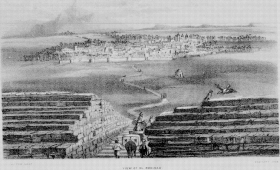
Ibn Maslama embraced Islam at the hands of Mus'ab ibn Umayr before his fellow Aus clansmen Sa'd ibn Mu'adh and Usaid Bin Hudair, and before Muhammad and Meccan Muslims immigrate to Medina, around the year of 621-622 AD.[6] After the Meccan arrived in Medina, the Medinan immediately instructed by the Prophet to bond brotherhood with the Meccan, with Ibn Maslama were paired with Abu Ubaidah ibn al-Jarrah.[6] According to Nagendra Kumar Singh, the reason of his pairing with Abu Ubaidah were due to Muhammad's observance that Ibn Maslama character and temperaments, along with personal tastes and similarity in attitude that matched Abu Ubaydah character.[7]: 242
Thus, Hereafter the arrival of Muslims of Mecca, Ibn Maslama served in various military campaign, where the first pitched battle were fought at the Battle of Badr in March 624.[8]: 330 [6]: 347 Later, When the Muslims defeated the Qaynuqa tribe in April, Ibn Maslamah supervised their expulsion from Medina and the seizure of their possessions. Muhammad awarded him a coat of mail.[9]: 89 In the same year, approximately in the month of September, Ibn Maslama were sent by prophet Muhammad along with some of his kinsmen and allied tribe of Aws in a mission to assassinate Ka'b ibn al-Ashraf. Ibn Maslamah pretended to Ibn al-Ashraf that he needed a loan and offered to leave his weapons with him as security. Ibn al-Ashraf therefore came out to meet him and four others by night when they were fully armed, as Ka'b allowed the gate guard Ibn Maslama and his colleagues to bring out the weapons.[10] They caught him off-guard and killed him,[5]: 367 [9]: 93 [6]: 347–348 [11]: 95–97 [12] While Ibn Maslama and his colleagues managed to escape undetected within the night, as the tribes of Ka'b only learned the death of Ka'b on tomorrow, as they found the corpse of Ka'b lying on the ground.[10]
In April 625, the Muslims were engaged in the Battle of Uhud against Quraish under Abu Sufyan ibn Harb. Ibn Maslamah was put in charge of fifty men that has been tasked with patrolling the camp at night before the battle.[13][14] In this battle, the Muslims suffered heavy losses from the unexpected flanking from behind by Khalid ibn al-Walid. As the Muslims retreated, Ibn Maslamah was one of few soldiers who stood by Muhammad.[1]: 347 Later, In August 625 Ibn Maslamah who brought the message to the Jewish tribe of Banu Nadir that Muhammad wanted to expel them. This act by Ibn Maslama shocked Nadir tribesmen, as they did not though an Aws clansmen would dare to threat them like that.[9]: 179–180 [11]: 158 Later, when the Nadir tribe surrendered to Muhammad and were expelled from Medina, it was Ibn Maslamah who supervised their exit and collected all their confiscated property and weapons.[9]: 183, 185
In the next year of 626, in between of August and September, Ibn Maslama was involved with the cattle-raid on Invasion of Dumatul Jandal, where he was the only Muslim who captured a human prisoner; the other raiders only stole cattle and camels.[9]: 198 However, the captive of this expedition who has been brought by Ibn Maslama turns out are important in Arab named Thumamah ibn Uthal, chieftain of Banu Hanifa clan that inhabiting Al-Yamama Najd, Central Arabia.[15] Thumamah later freed by prophet Muhammad without any ransom, which caused the impressed Thumamah to embrace Islam and urged his followers of Hanifa to embrace Islam. the conversion of Thumamah had significant political impact of Muslim Medina for two reasons:
- Thumamah clan, Banu Hanifa were agricultural community in Central Arabia and important suppliers of wheat to many tribes across the Arabian desert. After embracing Islam, Thumamah boycotted Quraysh Mecca, rival of Medina, which caused the Quraysh to cease the aggression towards Medinan Muslims to some extent.[15]
- Later during Apostate rebellions in the era of Abu Bakr Rashidun Caliphate, Thumamah branch of Banu Hanifa retract themselves from Musaylimah faction, who also hailed from Banu Hanifa and instead assisting the caliphate by providing significant numbers of manpower of warriors to fight under Khalid ibn al-Walid, who also has converted to Islam and fight under caliphate, against their own clansmen under Musaylamah in the Battle of Yamama.[15]
The next major battle Ibn Maslama participated were the Battle of the Trench which occurred in the spring of 627, when the coalitions of Quraysh, Ghatafan, and other smaller tribes which numbered to 10,000 besieged Medina. Ibn Maslama served as bodyguard of Muhammad's tent by night.[9]: 228–229 [1]: 347 Then in the following day after the besiegers of Medina has been retreated, Ibn Maslama participated in the punitive siege operation against another Jewish tribe in Medina, the Qurayza tribe who betrayed Medina and sided with the coalition army in the Battle of the Trench.[9]: 246 As the Qurayza tribesmen surrendered, Ibn Maslama was the one who tied the prisoners' wrists.[9]: 250 Ibn Maslama were tasked to guard the Jewish tribe captives which are waiting for execution. A Jew named 'Amr ibn Suda passed the guard during the night, slipped out of Medina and was never seen again. Ibn Maslamah told Muhammad that he had deliberately allowed 'Amr to escape because he had not participated in the treachery of the Qurayza. Muhammad accepted this story and said that God had delivered 'Amr because of his faithfulness.[5]: 463 [9]: 247–248 [16]: 32 When the Qurayza prisoners were being sold, Ibn Maslama bought a woman and her two sons for 45 coins of dinar. This coins were acquired by Ibn Maslama before as he was awarded three portions of the spoils of war, since the Fiqh ruling in Islam allowed the horsemens for bigger spoils from Infantry, and Ibn Maslama fought in this siege by riding horse.[9]: 257
Ibn Maslamah led 30 horsemen on the raid to al-Qurata in June 627. They marched by night and hid by day. At al-Sharaba they attacked the Bakr clan of the Kilab tribe and killed ten of them. Then they drove the cattle, 150 camels and 3000 sheep back to Medina.[5]: 660 [9]: 262–263 [1]: 348 The following month Muhammad sent him with ten men to Ghatafan territory in Dhu’l-Qassa. Ibn Maslama and his men were ambushed in the night while they are sleeping. When the enemy started shooting arrows, Ibn Maslamah was the first to awaken and warns his mens return the fire with their own arrows The Bedouins threw spears and killed three of them; the Muslims killed one; then the ambushers killed seven more. Ibn Maslamah fell with a wounded ankle although he managed to survive and escape, as the enemies stripped the corpses and departed. Later, a Muslim happened to pass the site, and on finding Ibn Maslamah alive, he gave him food and water and transported him back to Medina.[9]: 270 [1]: 348 [16]: 93 Later, Ibn Maslama also present at al-Muraysi in January 628.[9]: 203
During the Pledge of the Tree,Ibn Maslama was among the twenty horsemen sent as an advance guard to Hudaybiyyah[9]: 286 and he was on the night-watch roster. One night the Quraysh sent fifty men to the Muslim camp. Ibn Maslamah managed to capture them and bring them to Muhammad.[9]: 296 According to one tradition, he was later a witness to the Treaty of Hudaybiyyah;[9]: 301 but an alternative tradition asserts that the witness was his brother Mahmud.[5]: 505
Siege of Khaybar
.jpg.webp)
At the Battle of Khaybar in May/July 628, it was Ibn Maslamah who located the best site for the Muslim camp.[9]: 317 On the first day of the fighting, his brother Mahmud was killed while he was sitting in the shade of Fort Na'im. Inside the fortress, the Jewish warrior Marhab threw down a millstone, which landed on Mahmud's head.[5]: 511 [9]: 317 Mahmud took three days to die, in which time Ibn Maslamah promised to take care of his brother's daughters.[9]: 324
On the same day, Ibn Maslama avenged his brother's death by killing the murderer of his brother, a Jewish warrior named Marhab, in vicious duel, which so intense to the point that palm trees within the garden outside the fortress wall, where the duel occurred were chopped-off completely.[17] The battle ended with Ibn Maslama managed to chopped off one of Marhab leg.[17] However, before Ibn Maslama deliver the killing blow he was intercepted by Ali who passed by and cut off Marhab's head. This entitled Ali to take the booty which prompted Ibn Maslamah to argue the claims of Ali to Muhammad, and after they referred their dispute to Muhammad, he granted Marhab's sword, shield, cap and helmet to Ibn Maslamah.[17][5]: 513 [9]: 323 [16]: 118 Later, Ibn Maslama also killed another Jewish champion named Yusayr,[9]: 323 and also participated as one of squad who shielded Muhammad when they besieged the fortress of al-Saab ibn Muadh.[9]: 324 After the battle, Kinana ibn al-Rabi was tortured by Zubayr ibn al-Awwam in the hope that he would reveal where he had hidden the treasure of the Abu'l-Huqayq clan. When Kinana was no longer able to speak, Muhammad ordered al-Zubayr to hand him over to Ibn Maslama. Ibn Maslama was allowed to cut off Kinana's head.[5]: 515 [9]: 331 [16]: 123 [18]: 135
Career until death of Muhammad
Later, After all of eight fortresses in Khaybar were subdued, Ibn Maslama and the Muslim forces marched again and passed the Jewish tribe of Wadi al-Qura, which they confront either until they are surrender. The Muslims stayed for while dividing the spoils of war, Ibn Maslamah was awarded one share in Wadi al-Qura.[5]: 526 [9]: 354–355
On The first pilgrimage of 629 Muhammad sent ahead of him a hundred horsemen, led by Ibn Maslamah, which frightened the Quraysh, although the prophet reassure them that he had no military intentions.[1]: 348 [16]: 138 Ibn Maslamah also participated in the Conquest of Mecca in January 630. When Muhammad circumambulated the Kaaba on his camel al-Qaswa, just before destroying its idols, Ibn Maslamah was holding the camel's reins.[9]: 409 It is recorded that Ibn Maslama has involved in all military campaign by Muhammad, with the exception of Expedition of Tabuk, for on that occasion Muhammad appointed him governor over Medina.[1]: 347 [9]: 488
Life during Rashidun Caliphate
During the Caliphate Ibn Maslamah worked as a tax-collector, bringing in the zakat that was due from the Ashja tribe.[19]
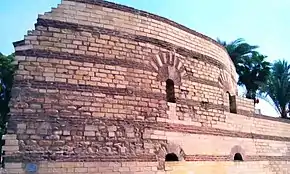
During the Muslim conquest of Egypt, the Rashidun commander, Amr ibn al-Aas requested reinforcements during his expedition to Egypt, Ibn Maslamah was one of those sent by Umar at the head of a detachment of a thousand men.,[20] It was recorded by al-Dhahabi that during Siege of Babylon Fortress, Ibn Maslamah was one of the soldier who selected by Zubayr ibn al-Awwam to form a small team who accompany Zubayr in his daring act of personally climbing the wall of Babylon Fortress and forcing their way towards the gate and open it for Muslim army.[4]
In 638 Umar sent Ibn Maslamah to the newly founded settlement of Kufa. Sa'd ibn Abi Waqqas, hero of Battle of al-Qadisiyyah and Siege of Ctesiphon (637), had built a public citadel next door to his own house. The noise from the nearby market was so deafening that Saad had built a locked gate into the citadel, which prompted the Caliph to sent Ibn Maslama to destroy the gate, which he did by setting fire to it.[21] He refused all of Sa'd's offers of hospitality, but handed him a missive from Umar reminding him that the citadel should be available to the public and suggesting that he move his house. Saad denied to Ibn Maslamah that he had made the alleged remarks. Ibn Maslamah did not take enough supplies for his homeward journey. Later, in 642 Ibn Maslamah continues his job as Caliph's personal overseer investigating any complaints across the caliphate realm.[22]: 190 [7]: 242 until he found more complaints against Sa'd in Kufa, and Ibn Maslamah was sent to back Kufa to investigate. He visited all the local mosques and heard all the complaints in public. Nearly everyone expressed satisfaction with Saad's conduct as governor; but eventually there was an accusation that he did not lead the prayers correctly and spent too much time hunting. Ibn Maslamah took Sa'd and his accusers back to Umar, which later Sa'd proven innocent while the accuser were only spreading rumors, although Umar keep on replacing Sa'd as governor.[10]
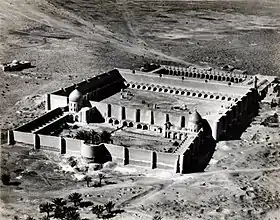
Later, after the ascension of Uthman as caliph, Ibn Maslama continued to act as inspector under Uthman. In 655 Uthman sent him to Kufa to investigate certain complaints; but Ibn Maslamah reported back that he had found nothing amiss.[23]: 147
During the turmoil in Medina from Kharijites and Shia against caliph Uthman, Ibn Maslama remained a supporter of Uthman. When Uthman warned from the pulpit that the Egyptian rebels had been cursed by Muhammad, Ibn Maslamah stood up and testified he also heard from Muhammad himself regarding the Hadith which told by Uthman, that those dissidents were prophesied before will cause trouble, which the chroniclers though particularly during this time .[23]: 165 Uthman later sent Ibn Maslamah along with Ali to lead a delegation to order the Egyptian dissidents out of Medina.[23]: 174–175 When unrest continued, Ibn Maslamah set out with fifty cavalry to negotiate with the Egyptians. He entered their leaders' tent and stressed Uthman's rights and how they had bound themselves to his leadership in their oath of allegiance. He warned them of the dangers of civil war and of what might happen if Uthman were killed. Then he offered himself as a guarantor that Uthman would meet the Egptians' demands. One of them asked the possibility of Uthman change of opinion, which replied by Ibn Maslama if so, the it is up to them.[23]: 191, 194 Ibn Maslama then returned to the private chamber of the Caliph and warned him to escape with his life, as he though the dissidents will kill Uthman, which replied by Uthman that he will not change or escape from the face of those dissidents.[23]: 191 As the Egyptians returned to Medina. Uthman asked Ibn Maslamah's advice, which replied by him as the Egyptian dissidents have malice intention. Uthman told him to send the Egyptians away again, However Ibn Maslamah replied, that he would not do such things as he promised them that the Caliph will stop doing certain things, which prompted Uthman to pray. Soon afterwards the Egyptians besieged his house.[23]: 191–192, 197 The Egyptians approached Ibn Maslamah directly to advise him of the discovery of a letter in which Uthman had ordered various officials to be flogged.[23]: 192 Ibn Maslamah accompanied Ali to an audience with Uthman, where Ali voiced this allegation. Uthman denied all knowledge of the letter; Ibn Maslamah and Ali believed him and decided that it must have been forged by Marwan. Ali told Uthman that he must repeat his denial in the hearing of the Egyptians.[23]: 192–193 The Egyptians entered and repeated all their complaints, and Uthman repeated his denial of the letter. The Egyptians countered that if he was so incompetent that it was possible for someone to forge letters by appropriating his personal scribe, seal, slave and camel, then he ought to abdicate anyway. Uthman refused to abdicate the office to which God had appointed him, and the interview became loud. Ibn Maslama and Ali managed to usher them out of Uthman's presence before there was any physical violence, but the siege of Uthman's house continued until the caliph were murdered.[23]: 193–196
After Uthman was assassinated, Ibn Maslamah was one of the few who did not give allegiance to Ali.[24]: 6, 9 Later, when a messenger from Basra and inciting some troubles with Usama ibn Zayd regarding the pledge of allegiance to Ali as Caliph, which prompted some of Ali's supporters leapt to attack Usama, and Ibn Maslamah was among those who jumped up to protect him. Suhayb ar-Rumi managed to calm down the immediate situation, but the reports of half-hearted support for Ali returned both to him and to his opponents.[24]: 65–66 During the period of strife, Subayaa ibn Husayn al-Thaalabi saw a tent set up by a well in the desert. He was told that it belonged to Muhammad ibn Maslamah, who was by then an old man. Subayaa asked Ibn Maslamah why he was living there. Ibn Maslamah replied that he had left Medina because he want to avoid the civil war within caliphate.[1]: 348–349
Death
Muhammad ibn Maslamah died in Medina in May/June 663[3]: 32 or April/May 666 aged about 75.[1]: 349 It was reported by Ibn Sa'd, Ibn Maslama were murdered by a citizen of Jordan, Levant, who resented Ibn Maslama neutrality and pacifism during the civil war.[6]
Marwan ibn Hakam, cousin of Umar and Mu'awiyah were leading his funeral prayer.[1]: 349 [3]: 32 According another record, It was Mu'awiyah who led the funeral prayer.[6]
Hadith & personal characteristic
Ibn Maslama were described as a physically tall and stout, with dark skin and bald head.[1]: 348
As Ibn Maslama mostly fought as cavalry troopers, It is recorded by Waqidi that the horse of Ibn Maslama were named Dhu al-Limma.[9]: 266
It is said that Ibn Maslamah were deemed by prophet Muhammad has similar character and attitude with Abu Ubaydah ibn al-Jarrah, a senior Muhajirun Sahaba.[7]: 236 Ibn Maslama also deemed as personally few of words and never complained when given difficult task, such as the assassination of Jewish chieftain Ka'b ibn Ashraf. This quality, according to Nagendra, was the reason why Umar trusted Ibn Maslama as his personal agent to overseeing his governors during the former's reign as Caliph[7]: 242
He encouraged his children to ask him about Muhammad's military expeditions. He said he knew about all of them first-hand, except for Tabuk, which he had heard about directly from its participants.[1]: 348 He carved a sword out of wood and put it on a bowl hung up in his house "in order to alarm the anxious".[1]: 349
Muhammad had given Ibn Maslamah a sword, saying, "Fight the idolators with it when they fight. When you see the Muslims facing one another, take it to Uhud and strike it until it breaks. Then sit in your house until it ends."[1]: 348, 349 When the civil war broke out, Ibn Maslamah took the sword that Muhammad had given him and broke it.[1]: 349
When Abu Bakr raised the legal question of the inheritance due to a grandmother, Ibn Maslamah testified that Muhammad had allocated her one-sixth of the estate.[25]
After the ascension of Umar as Caliph, the Umar once asked about the blood-money required for the killing of an unborn child by assaulting its mother. Ibn Maslamah testified that Muhammad had set the price at "a high-quality slave" of either sex.[26][27][28]
During the reign of Umar as Caliph, Ibn Maslamah was involved in a dispute with a neighbour, al-Dahhak ibn Khalifa, who wanted to divert a stream through Ibn Maslama's property. Ibn Maslama refused permission even when Dahhak reminded him that it could not harm him and he would have unlimited rights to take the water. Dahhak referred the case to Umar, and Ibn Maslama repeated to the Caliph that he would not allow it. In the end, Umar giving verdict in favor of Dahhak, and the stream was diverted as Dahhak had wished.[29]
Family
Ibn Maslamah had ten sons and six daughters by seven different women.[1]: 347
- Umm Amr bint Salama of the Abdul-Ashhal clan of the Aws. Her brother was present at the Second pledge at al-Aqabah, and she was one of the women who gave allegiance to Muhammad.[30]: 222
- Abdulrahman
- Umm Isa
- Umm al-Harith
- Amra bint Masud of the Zafar clan of the Aws. She and her daughter, together with her mother, sister and niece, were among the first women in Medina who gave allegiance to Muhammad.[30]: 231, 232
- Abdullah
- Umm Ahmad
- Qutayla bint al-Husayn of the Murra branch of the Qays ibn Aylan tribe.
- Saad
- Jaafar
- Umm Zayd
- Zahra bint Ammar of the Murra branch of the Qays ibn Aylan tribe.
- Umar
- A woman from the Atba clan of the Kalb tribe.
- Anas
- Amra
- A concubine.
- Qays
- Zayd
- Muhammad
- Another concubine.
- Mahmud
- Hafsa
References
- Muhammad ibn Saad. Kitab al-Tabaqat al-Kabir vol. 3. Translated by Bewley, A. (2013). The Companions of Badr. London: Ta-Ha Publishers.
- ibn Sa‘d, Muḥammad. "sahaba.rasoolona; Quoting Tabaqat al-Kabeer". Retrieved 27 November 2021.
- Muhammad ibn Jarir al-Tabari. Tarikh al-Rusul wa'l-Muluk. Translated by Morony, M. G. (1987). Volume 18: Between Civil Wars: The Caliphate of Mu’awiyah. Albany: State University of New York Press.
- ad-Dhahabi, Shams ad-Din. "Siyar A'lam Nubala". Retrieved 27 November 2021.
- Muhammad ibn Ishaq. Sirat Rasul Allah. Translated by Guillaume, A. (1955). The Life of Muhammad. Oxford: Oxford University Press.
- Ibn Sa'd, Muhammad. Major Classes [Tabaqat al-Kubra vol 3]. p. 338. Retrieved 27 November 2021.
- Singh, Nagendra K. (2003). Prophet Muhammad and His Companions (Hardcover). Global Vision Publishing House. ISBN 9788187746461. Retrieved 27 November 2021.
- Ibn Ishaq, Muhammad (1967). Sirah Nabawi translation. Translated by A. Guillaume. ISBN 978-0196360331.
- Waqidi, Muhammad ibn Umar (2011). The Life of Muḥammad: Al-Wāqidī's Kitāb Al-maghāzī. Translated by Rizwi Faizer; Amal Ismail; Abdulkader Tayob. Routledge. ISBN 9780415574341. Retrieved 27 November 2021.
- Safiur Rahman Mubarakpuri (1995). Sealed Nectar. the University of Michigan. p. 250. Retrieved 28 November 2021.Fadlan Fahamsyah (2020). Sahabat Nabi MUHAMMAD BIN MASLAMAH Radhiyallahu 'anhu (in Indonesian and Arabic). Surabaya, Java Island. Event occurs at 13m31s-46m30s.
- Muhammad ibn Jarir al-Tabari. Tarikh al-Rusul wa'l-Muluk. Translated by McDonald, M. V. (1987). Volume 7: The Foundation of the Community. Albany: State University of New York Press.
- Montgomery Watt, W. "Ka'b ibn al-Ashraf". In P.J. Bearman; Th. Bianquis; C.E. Bosworth; E. van Donzel; W.P. Heinrichs (eds.). Encyclopaedia of Islam Online. Brill Academic Publishers. ISSN 1573-3912.
- Safiur Rahman Mubarakpuri (1995). Sealed Nectar. the University of Michigan. p. 250. Retrieved 28 November 2021.
- Muir, W. (1912).The Life of Mohammad from Original Sources, 4th Ed., pp. 256-267. Edinburgh: John Grant.
- Al-Mishri, Mahmud; Karimi, Izzudin; Syuaeb al-Faiz, Mohammad (2010). "Tsumamah bin utsal". Sahabat-sahabat Rasulullah (in Malay). Pustaka Ibnu Katsir. ISBN 9789791294393. Retrieved 28 November 2021.Khalid Zeed Abdullah Basalamah (2019). Kisah Sahabat Nabi ﷺ Ke-44: Tsumamah bin Utsal "Pemimpin Suku Hanifah"; Commentary review of Sahabat-sahabat Rasulullah book (in Indonesian and Arabic). Jakarta, Java Island.
- Muhammad ibn Jarir al-Tabari. Tarikh al-Rusul wa'l-Muluk. Translated by Fishbein, M. (1997). Volume 8: The Victory of Islam. Albany: State University of New York Press.
- Safiur Rahman Mubarakpuri (1995). Sealed Nectar. the University of Michigan. p. 250. Retrieved 28 November 2021.Khalid Zeed Abdullah Basalamah (2017). Sirah Nabawiyyah ke 17 - Perang Khaibar; of Sirah Nabawiyah by Khalid Basalamah commentary (in Indonesian and Arabic). Jakarta, Java Island. Event occurs at 1h12m11s-1h19m51s.
- Muhammad ibn Jarir al-Tabari. Tarikh al-Rusul wa'l-Muluk. Translated by Poonawala, I. K. (1990). Volume 9: The Last Years of the Prophet. Albany: State University of New York Press.
- Malik ibn Anas, Al-Muwatta 17:29.
- Butler, A. J. (1978). The Arab Conquest of Egypt and the Last Thirty Years of the Roman Dominion, 2nd. Ed., pp. 226, 229. Oxford: Oxford University Press.
- Devecka, Martin (2020). Broken Cities A Historical Sociology of Ruins. Johns Hopkins University Press. p. 71. ISBN 9781421438429. Retrieved 28 November 2021.
Baladhuri; Futuh
- Muhammad ibn Jarir al-Tabari. Tarikh al-Rusul wa'l-Muluk. Translated by Juynboll, G. H. A. (1989). Volume 13: The Conquest of Iraq, Southwestern Persia, and Egypt. Albany: State University of New York Press.
- Muhammad ibn Jarir al-Tabari. Tarikh al-Rusul wa'l-Muluk. Translated by Humphreys, R. S. (1990). Volume 15: The Crisis of the Early Caliphate. Albany: State University of New York Press.
- Muhammad ibn Jarir al-Tabari. Tarikh al-Rusul wa'l-Muluk. Translated by Brockett, A. (1997). Volume 16: The Community Divided. Albany: State University of New York Press.
- Malik ibn Anas, Al-Muwatta 27:4.
- Bukhari 9:83:42.
- Muslim 16:4174.
- Bukhari 9:92:420.
- Malik ibn Anas, Al-Muwatta 36:1437.
- Muhammad ibn Saad. Kitab al-Tabaqat al-Kabir vol. 8. Translated by Bewley, A. (1995). The Women of Madina. London: Ta-Ha Publishers.