Murder of Carlos Palomino
Carlos Javier Palomino Muñoz, age 16, was murdered in Madrid, Spain on 11 November 2007. He was traveling with 100 others to attend a counter-protest to a neo-Nazi rally. The death occurred at Legazpi Station, where he was stabbed to death.[1]
Josué Estébanez de la Hija, the man who stabbed him, originated from the Basque Country and was a soldier in the Spanish army. He received a 26-year prison sentence.[2]
Trial and sentencing
During the trial, which was attended as a private prosecution by the mother of Carlos Palomino and the young people who accompanied him, and Esteban Ibarra – leader of the Movement against Intolerance – as part of the popular prosecution,[3] the facts of murder were considered proven after viewing the video surveillance cameras. Also, Josué Estébanez was a right-wing extremist due to the fact that he was wearing a sweatshirt of a brand considered to be neo-Nazi symbolism, as well as gestures that could be observed in the said recording, such as the shout and greeting "Sieg Heil".[4][5] At all times, the accused tried to dissociate himself from the ultra movement,[6] despite the fact that various fascist and neo-Nazi associations openly showed their support for him.[7][8] The psychotic break and mental imbalance were also ruled out.[7] During the trial, Estébanez showed no remorse for the acts;[7] he only intervened on the last day of the trial to ask for forgiveness for what had happened.[9]
_y_el_colectivos_Madres_contra_la_represi%C3%B3n_-_26990187395_(cropped).jpg.webp)
The defence requested a prison sentence of six months for reckless homicide and three months for a crime of injury for the stabbing of a second person.[7] After two years of trial, the Provincial Court of Madrid sentenced Josué Estébanez to a total of 26 years in prison – 19 years for the crime of murder with the aggravating circumstance of ideological hatred and 7 years for attempted homicide,[10] plus compensation of 150,000 euros.[8] The family prosecution asked for 37 years in prison and compensation, while the Alto del Arenal residents' association and the Movement against Intolerance asked for 30 years for hate crime.[11] The sentence was confirmed in its entirety in cassation by the Second Chamber of the Supreme Court in its judgement 360/2010 of 22 April, making the conviction final.[12]
Consequences and tributes
The murder of Carlos Palomino was the most publicised neo-Nazi hate crime of the first decade of the 21st century in Spain. It was also the first time that the Spanish judiciary applied the aggravating factor of ideological motives in a conviction.[4][7][8]
After Palomino's death, his mother, Mavi Muñoz, became an anti-fascist activist. She founded the Association of Victims of Fascist, Racist and Homophobic Violence, to fight against fascist violence and demand the outlawing of these groups,[4] [13] and is a member of the association Mothers Against Repression[8] of which she is honorary president.[14]
Anti-fascist collectives placed plaques on up to four occasions at the Metro stations where Carlos Palomino had died, but they were always vandalised.[15] In 2016, Madrid City Council placed a plaque at number 145 Paseo de las Delicias,[16] where Palomino was murdered.[17]
The plaque reads
"Aquí fue asesinado el 11 de noviembre de 2007 Carlos Javier Palomino Muñoz a la edad de 16 años, luchador contra el fascismo y el racismo"[17]
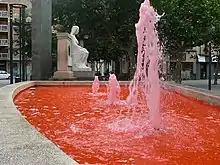
Every 11 November, various anti-fascist groups organise demonstrations to pay tribute to Carlos Palomino, 2021222324 who has become a symbol of their struggle.[18][19] In 2017, the tenth anniversary of the crime, a demonstration was organised in Madrid, attended by around a thousand people.[20] On that date, protest actions were also held in other Spanish cities. As a memorial, the water in various fountains is often dyed red during demonstrations.[21]
A brigade of Spaniards, in imitation of the International Brigades, went to the conflict in Ukraine in 2014, forming the Carlos Palomino Brigade.[22]
References
- "Teenager killed at Madrid rally". BBC. 12 November 2007. Archived from the original on 7 September 2019. Retrieved 16 March 2019.
- Quesada, Juan Diego (15 March 2019). "New Zealand attacker had name of Spanish killer on weapon". El Pais. Archived from the original on 15 September 2019. Retrieved 16 March 2019.
- "Josué Estébanez: "No quería quitar la vida a nadie"". www.publico.es. Archived from the original on 9 July 2018. Retrieved 22 February 2021.
- "Diez años del asesinato fascista de Carlos Palomino". La Vanguardia (in Spanish). 11 November 2017. Archived from the original on 26 January 2021. Retrieved 22 February 2021.
- ""Eligió matar por motivos ideológicos"". www.elsaltodiario.com (in Spanish). Retrieved 22 February 2021.
- "El saludo nazi de Josué el 'apolítico'". www.publico.es. Archived from the original on 1 October 2020. Retrieved 22 February 2021.
- "La fiscal considera que Estébanez actuó por odio ideológico". www.elsaltodiario.com (in Spanish). Archived from the original on 11 November 2020. Retrieved 22 February 2021.
- "Qué fue del asesino neonazi de Carlos Palomino: Josué estudia Derecho y hace alfarería". El Español (in Spanish). 16 November 2018. Archived from the original on 13 November 2020. Retrieved 22 February 2021.
- "Josué Estébanez: "No quería quitar la vida a nadie"". www.publico.es. Archived from the original on 9 July 2018. Retrieved 22 February 2021.
- "Condenado a 26 años de cárcel el asesino de Carlos Palomino". El País (in Spanish). 19 October 2009. ISSN 1134-6582. Archived from the original on 5 November 2020. Retrieved 22 February 2021.
- "Así murió Carlos Palomino". El País (in Spanish). 9 May 2009. ISSN 1134-6582. Archived from the original on 22 February 2021. Retrieved 22 February 2021.
- Álvarez, Pilar (28 December 2017). "Muerte de un antifascista". El País (in Spanish). ISSN 1134-6582. Archived from the original on 22 February 2021. Retrieved 22 February 2021.
- Madridiario. "Familiares y amigos homenajean a Carlos Palomino en el X aniversario de su muerte". Madridiario (in Spanish). Retrieved 23 February 2021.
- ""Rubalcaba me reconoció que tenían un altísimo grado de neonazis metidos en el ejército"". Cuartopoder (in Spanish). 11 November 2014. Retrieved 23 February 2021.
- 20minutos (16 December 2010). "Detenida una persona mientras rompía la placa homenaje a Carlos Palomino en Legazpi". www.20minutos.es - Últimas Noticias (in Spanish). Retrieved 23 February 2021.
- Press, Europa (13 May 2016). "Palomino es recordado con una placa en Delicias y se unirá a las de otras víctimas del odio". www.europapress.es. Retrieved 23 February 2021.
- "Una placa para recordar a Carlos Palomino | Periódico Diagonal". www.diagonalperiodico.net. Retrieved 23 February 2021.
- "Unidad a un año de la muerte de Carlos | Periódico Diagonal". www.diagonalperiodico.net. Retrieved 23 February 2021.
- 20minutos (12 November 2010). "Más de 500 antifascistas recuerdan a Carlos Palomino tres años después de su muerte". www.20minutos.es - Últimas Noticias (in Spanish). Retrieved 23 February 2021.
- Press, Europa (11 November 2017). "Convocan una manifestación por el X aniversario del asesinato de Carlos Palomino, símbolo del movimiento antifascista". www.europapress.es. Retrieved 23 February 2021.
- "Tiñen el agua de cinco fuentes de Valladolid". El Norte de Castilla (in Spanish). 12 November 2018. Retrieved 23 February 2021.
- Press, Europa (7 September 2014). "Un grupo de españoles resucitan las Brigadas Internacionales y acuden a Ucrania para combatir: "la guerra es un hecho"". www.europapress.es. Retrieved 23 February 2021.