Muschampia floccifera
Muschampia flocciferus, the tufted skipper or tufted marbled skipper, is a butterfly of the family Hesperiidae.
| Muschampia floccifera | |
|---|---|
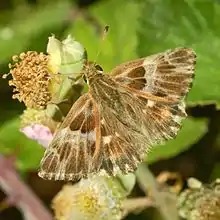 | |
| Adult of Carcharodus flocciferus | |
Scientific classification  | |
| Kingdom: | Animalia |
| Phylum: | Arthropoda |
| Class: | Insecta |
| Order: | Lepidoptera |
| Family: | Hesperiidae |
| Genus: | Muschampia |
| Species: | M. flocciferus |
| Binomial name | |
| Muschampia flocciferus (Zeller, 1847) | |
| Synonyms | |
| |
Distribution
This principally mountain species can be found in Spain, France, Italy, the Alps and the Balkans, from southern and central Europe, north to central Germany and east to North Macedonia and Bulgaria. It is also found in peninsular Italy, in Portugal, Corsica, Sardinia and in northern and western France (uncommonly).Outside of Europe it occurs in Morocco , in Turkey , in the Middle East and East across the Palearctic to Siberia. It is not present in the United Kingdom.[1][2] The species usually inhabits the sunny edges and glades of forests, and damper areas with grasses and meadows.[2]
Description
Muschampia flocciferus has a wingspan of 32–35 millimetres (1.3–1.4 in). The basic color of the forewings is marbled gray-brown, with dark brown and clearer markings. The underside of the front wings is light gray-brown. A rusty "tuft" is present on the underside of the forewings (hence the common name of the species). On the upper side of the hind wings there are bright spots. The underside of the hindwings is rather uniform. Antennae show a black spot on the top. Both sexes bear the same wing drawings, but the female has no hair.
The dark brown eggs are flattened, with strong ribs to the upper end. The relatively compact and strongly hairy caterpillars are initially gray with a black head. Later they become somewhat brighter. The pupa is bluish with a black longitudinal stripe on the back of the thorax.[3]
This species is quite similar in appearance to Carcharodus alceae, Muschampia lavatherae and Muschampia orientalis. In this species forewings are larger than in Carcharodus alceae.
Biology
Adults are on wing from May to June or July to September in two generations.[2] At higher altitudes there is only one generation from June to August. The eggs are laid singly on the upper side of the leaves of the host plants. The larvae feed on Stachys (Stachys officinalis, Stachys recta, Stachys alpina), Marrubium (Marrubium vulgare, Marrubium peregrinum), Thymus roegneri and Ballota nigra. The larvae overwinter at the base of the plant.[4][5]
This species was formerly a member of the genus Carcharodus. As a result of genomic research published in 2020, it was transferred to the genus Muschampia along with five other species.[6]
References
- "Carcharodus floccifera (Zeller 1847)". Fauna Europaea. 29 August 2013. Retrieved 30 January 2017.
- Rowlings, Matt. "Carcharodus flocciferus Tufted Marbled Skipper". Eurobutterflies. Retrieved 30 January 2017.
- "Carcharodus floccifera (ZELLER, 1847) - Heilziest-Dickkopffalter". Bestimmungshilfe für die in Europa nachgewiesenen Schmetterlingsarten (in German). Lepiforum.de. Retrieved 30 January 2017.
- Mazzei, Paolo; Morel, Daniel; Panfili, Raniero. "Carcharodus flocciferus (Zeller, 1847)". Moths and Butterflies of Europe and North Africa. Retrieved 30 January 2017.
- "Carcharodus Hübner, [1819]". Lepidoptera and some other life forms. Retrieved 30 January 2017.
- Zhang, Jing; Brockmann, Ernst; Cong, Qian; Shen, Jinhui; et al. (2020). "A genomic perspective on the taxonomy of the subtribe Carcharodina (Lepidoptera: Hesperiidae: Carcharodini)". Zootaxa. 4748 (1): zootaxa.4748.1.10. doi:10.11646/zootaxa.4748.1.10. PMC 8018707. PMID 32230093.
External links