Glockenspiel
The glockenspiel (German pronunciation: [ˈɡlɔkənˌʃpiːl] or [ˈɡlɔkŋ̍ˌʃpiːl], Glocken: bells and Spiel: Play)[1] is a percussion instrument composed of a set of tuned keys arranged in the fashion of the keyboard of a piano. In this way, it is similar to the xylophone, although the xylophone's bars are made of wood, while the glockenspiel's are metal plates or tubes, thus making it a metallophone. The glockenspiel, additionally, is usually smaller and, because of both its material and smaller size, higher in pitch.[2]
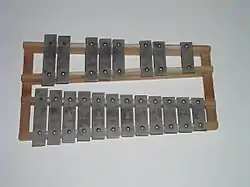 | |
| Percussion instrument | |
|---|---|
| Other names | Concert bells, orchestral bells, carillon |
| Classification | Keyboard percussion |
| Hornbostel–Sachs classification | 111.212 (Concussive idiophone or set of percussion sticks whose sound is generated by way of being struck by a mallet) |
| Playing range | |
| written like F3–C6, sounds like F5–C8 | |
| Related instruments | |
| xylophone, marimba, vibraphone, tubular bell | |
In German, a carillon is also called a glockenspiel, while in French, the glockenspiel is often called a carillon. In music scores the glockenspiel is sometimes designated by the Italian term campanelli.
Range
The glockenspiel is limited to the upper register, and usually covers about two and a half to three octaves, but can also reach up to three and a half octaves. The C8 fundamental frequency of 4186 Hz makes this one of the highest pitches in common use. The glockenspiel is a transposing instrument; its parts are written two octaves below the sounding notes. When struck, the bars give a very pure, bell-like sound.
History
The history of the glockenspiel is very old. In Europe, the bell is closely related to the type, and the name Glockenspiel also means 'playing the bell'. Early glockenspiel was made to have a carillon effect, and was played by striking a small bell made of bronze and tuned with a drumstick. It was from the 17th century onwards that sound plates were used as they are today.
The earliest used glockenspiele in the art music of the modern Europe is a keyboard type, In French, it is known as glockenspiele, which refers to a keyboard type iron metal. In the 19th century, the glockenspiel became obsolete in orchestra. When it reappeared in the late 19th century, the use of drumchae came to be used instead of the keyboard type. In the keyboard type, the sound board is struck with a hammer from the bottom by the action of a simple action. The toy piano used by children today is a type of keyboard-type iron metal with a steel rod as the pronunciation body instead of a sound board. This is also the instrument called the xylophone in school. Gamelan, a traditional ensemble in Indonesia, also uses iron metal called gampan.
Construction
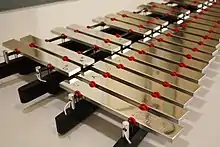
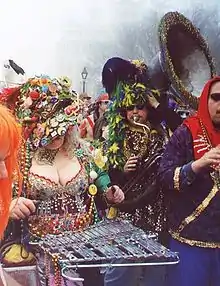
When used in a marching or military band, the bars are sometimes mounted in a portable case and held vertically, sometimes in a lyre-shaped frame. However, sometimes the bars are held horizontally using a harness similar to that found on a marching snare. In orchestral use, the bars are mounted horizontally.
Larger sets of glockenspiel (i.e. sets three octaves or larger) are often equipped with a sustain pedal, not unlike that of a vibraphone.[3]
Mallets
A pair of hard, unwrapped mallets, generally with heads made of plastic or metal, are used to strike the bars, although mallet heads can also be made of rubber (though using too-soft rubber can result in a dull sound). If laid out horizontally, a keyboard glockenspiel may be contrived by adding a keyboard to the instrument to facilitate playing chords. Another method of playing chords is to use four mallets, two per hand.
Use in popular music
Glockenspiels are quite popular and appear in almost all genres of music. Percussionist Neil Peart of the rock band Rush used the glockenspiel in several of the band's arrangements, most notably in "The Spirit of Radio" and "Closer to the Heart", and also in album tracks "Xanadu" and "Circumstances". A keyboard-operated glockenspiel, as played by Danny Federici on such hit songs as "Born to Run" and "Hungry Heart", is considered part of Bruce Springsteen and the E Street Band's signature style.[4] Glockenspiel appears presented in its own section at the end of the first side of Tubular Bells by Mike Oldfield.
The glockenspiel was also featured in Sloop John B as recorded by The Beach Boys, Jimi Hendrix's classic ballad "Little Wing",[5] Avenged Sevenfold's song "Nightmare" during the intro, as well as in indie folk music by artists such as Paul Duncan of Warm Ghost.[6] George Martin, The Beatles' producer, plays glockenspiel on the band's song "Being for the Benefit of Mr. Kite!" to help create the atmosphere of the Pablo Fanque circus performance that inspired the song.[7] John Lennon also plays it on "Only a Northern Song". Panic! at the Disco have used glockenspiel in several of their songs, including their hits "I Write Sins Not Tragedies" and "Build God, Then We'll Talk". Radiohead have used glockenspiel on their single "No Surprises" as well as on "The Tourist", "Lull", "Morning Bell/Amnesiac", "Sit Down/Stand Up", and "All I Need".[8] "Redbone" by Childish Gambino also incorporates a glockenspiel, played by producer Ludwig Göransson.[9] The Jurassic Park main theme composed by John Williams, which plays when the T-rex crashes into the visitor centre at the movie's climax, also has a glockenspiel solo accompanied by trumpets. Weezer's "The Good Life," (Pinkerton) "Heart Songs" (Red Album), and "California Kids" (White Album) all feature glockenspiel.
Famous orchestral excerpts
- Saul, oratorio by George Frideric Handel
- Symphony No. 4 by Gustav Mahler
- Finale from act I of the opera The Magic Flute by Wolfgang Amadeus Mozart
- Alexander Nevsky, cantata by Serge Prokofiev
- Piano Concerto No. 1, by Prokofiev
- Romeo and Juliet, by Prokofiev
- Scythian Suite by Prokofiev
- The Carnival of the Animals, by Camille Saint-Saens (commonly substituted for the specified glass harmonica)
- Waltz, No. 6 from the ballet The Sleeping Beauty by Pyotr Ilyich Tchaikovsky
- Capriccio Italien by Tchaikovsky
- The Nutcracker by Tchaikovsky
- "Wotan's Farewell" and "Magic Fire Music" from the opera Die Walküre by Wagner
- "Siegfried's Rhine Journey" from Götterdämmerung by Wagner
- The Sorcerer's Apprentice by Paul Dukas
Related instruments
Other instruments that work on the same struck-bar principle as the glockenspiel include the marimba and the vibraphone.
The Dulcitone has a similar sound to the glockenspiel since its sound is made by hammers striking tuning forks. The dulcitone uses soft hammers which damp the forks, compared to the hard hammers of the glockenspiel, creating a more gentle sound.[10]
There are also many glockenspiel-like instruments in Indonesian gamelan ensembles.
Bell lyre
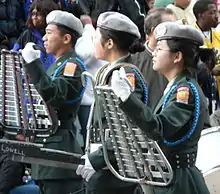
In the United Kingdom, the United States, and Canada, there is a form of glockenspiel called a bell lyre, bell lyra, or lyra-glockenspiel.[11] The bell lyre is a form of glockenspiel commonly used in marching bands. It is played upright and has an extendable spike which is held on a strap. The player marches with the strap over his shoulder and plays the instrument upright with a beater. Another variation of the bell lyre exists which is held by a strap round the shoulders and back. This variation is played horizontally with two beaters as it does not need to be held upright. Since the middle of the 19th century this form of the instrument has also been used in military and civil bands in Germany, where it is called a Stahlspiel or Militär-Glockenspiel. The all-percussion Drum and lyre corps in the Philippines uses this as a main instrument. This form of glockenspiel is also popular in Colombian marching band music.[12]
One of the few US college marching bands with a glockenspiel section is UC Berkeley's University of California Marching Band, where glockenspiels are affectionately referred to as "Glocks."[13]
Gallery
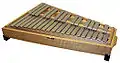 Most orchestral glockenspiels are mounted in a case
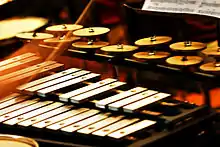 Glockenspiel and crotales
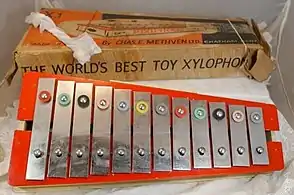 Like many similar toys, the Pixiphone was sold as a xylophone but is in fact a glockenspiel
- Handcrafted Glockenspiel
References
- https://www.collinsdictionary.com/dictionary/english/glockenspiel(1815–25; G, equiv. to Glocken bells + Spiel play]
- George Grove (ed.), A Dictionary of Music and Musicians, 4 vols. (London: Macmillan and Co., 1878–1889).
- "Brief Description - Vienna Symphonic Library". www.vsl.co.at. Retrieved 2021-05-25.
- Cromelin, Richard, (19 April 2008). "E Street Band's keyboard player," Los Angeles Times. Retrieved 2 February 2014.
- weird instrument glockenspiel, Wouter Adriaensen, 2010
- Funk, Peter (19 January 2006). "Paul Duncan: Be Careful What You Call Home". PopMatters. Retrieved 2011-05-08.
- Lewisohn, Mark (1988). The Beatles Recording Sessions. New York: Harmony Books. ISBN 0-517-57066-1.
- Jonny Greenwood's Rig, The King of Gear, 2014
- Nostro, Lauren (2017), The Making Of Childish Gambino's "Redbone" With Ludwig Göransson, Genius
- Campbell, Murray; Greated, Clive (1994). The Musician's Guide to Acoustics. Oxford: Oxford University Press. p. 436. ISBN 019159167X. Retrieved 12 October 2016.
- Blades, James (2001). "Bell-lyra". In Sadie, Stanley; Tyrrell, John (eds.). The New Grove Dictionary of Music and Musicians (2nd ed.). London: Macmillan.
- "Banda de Guerra". Fuerza Aérea Colombiana (in Spanish). Retrieved 2020-07-16.
- Chen, Jeremy (27 January 2013). "Glocks, Oboes and Violins? Oh, My!". Halftime Magazine.
External links
 |
Look up Glockenspiel in Wiktionary, the free dictionary. |
- . Encyclopædia Britannica. 11 (11th ed.). 1911.
- Glockenspiel at the Vienna Symphonic Library
- Royalschoolsources Percussion Pages—Online sources for the prescribed music of the Royal Schools of Music practical exams
Authority control  | |
|---|---|
| General | |
| Other | |