Superteams in the National Basketball Association
A superteam in the National Basketball Association (NBA) is a franchise whose roster typically has three or more Hall of Fame-caliber players in the prime of their career assembled primarily through free agency.[1] They may alternatively be All-Star or All-NBA players, recently or currently.[2] The first superteam was ushered in when LeBron James joined fellow draft-class players Dwyane Wade and Chris Bosh, on the Miami Heat in the 2010 offseason.[3][4][5]
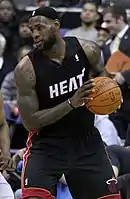
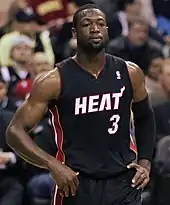
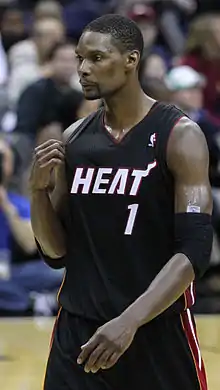
They were named the "Big Three" and would establish their dominance by making the NBA Finals in all of their four years together, winning titles in 2012 and 2013. James had joined the Heat as a reigning back-to-back MVP and equal six-time All-Star with Dwyane Wade, whilst Chris Bosh had five All-Star selections.[6][7][8]
Due to this, many other superteams have been formed/drafted since in order to secure a championship.[9] The second superteam was again led by LeBron James when he returned to the Cleveland Cavaliers to play with Kyrie Irving and Kevin Love from 2014–2017. The most prominent superteam since the Heat's formation was the Golden State Warriors from 2016–2019. This team included four perennial All-Stars in Stephen Curry (also 2-time MVP, and first unanimous MVP winner), Klay Thompson, Draymond Green and Kevin Durant.[4] In 2018, the Warriors also signed All-Star DeMarcus Cousins from the New Orleans Pelicans in free agency and was the first NBA franchise in 42 years (since the 1976 Boston Celtics) to start five players that had been All-Stars the previous season.[10][11]
Although superteams are mostly thought of as a new concept, some have retroactively applied the term to 20th century teams that featured multiple star players. However, some refute this by claiming that those players were past their prime and teamed up as a last ditched effort to win a championship, such as the 2007–2012 Celtics. Teams with multiple stars that were drafted by that team do not meet the superteam criteria in many's eyes.
Superteams of the NBA
1956–1969: Bill Russell's Celtics
After winning 11 championships in 13 years, the Boston Celtics of the 1950s and '60s were regarded as an NBA superteam, serving as a guidepost for future dynasties.[12][13][14][15][16] Led by 5-time MVP Bill Russell, they won an NBA record 8 consecutive championships.
Prior to the 1976 settlement of Robertson v. National Basketball Association, free agency did not exist in the NBA. As a result, Russell and his teammates were acquired through NBA drafts and trades. The Celtics drafted Tom Heinsohn in 1956, Sam Jones in 1957, and John Havlicek in 1962. Bob Cousy was taken in the 1950 Chicago Stags dispersal draft, after being drafted into the league the same year. Others like Bill Sharman and Bailey Howell were traded to the Celtics. Russell himself was acquired in a draft day trade.
2008: Kevin Garnett, Ray Allen, and Paul Pierce, create first modern superteam
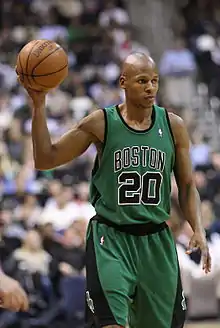
Following a lackluster 2006-2007 season, finishing 24-58, the Celtics sought a new move to propel them to the top of the league.[17] Following the end of the season, during the summer of 2007, Danny Ainge made a blockbuster move. "On draft night, he traded No. 5 pick Jeff Green, Wally Szczerbiak and Delonte West to Seattle for perennial all-star Ray Allen and Seattle's second-round pick (which the team used to select LSU's Glen "Big Baby" Davis). The Celtics then traded Ryan Gomes, Gerald Green, Al Jefferson, Theo Ratliff, Sebastian Telfair, and a first-round draft pick to the Timberwolves in exchange for superstar power forward Kevin Garnett. These moves created a new "Big Three" of Pierce, Allen, and Garnett."[18] This new "Big Three" created the most drastic record changes in NBA history seeing them finish 66-16 for the season en route to the 2008 NBA Championship.[19][20]
2010: LeBron James and Chris Bosh join Miami Heat to create the second modern superteam
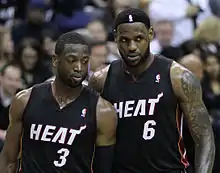
In the 2010 offseason, LeBron James entered free agency with free choice of his next team. He had just come off one of the best statistical seasons of his career, been voted All-Star six times, and won back-to-back MVP awards with the Cleveland Cavaliers.[21][22] Although there was much speculation and hype surrounding James and his choice, it was kept hidden for many weeks until he announced his plans on a live ESPN broadcast, The Decision.[23] He chose to join the Miami Heat and fellow draft class member and good friend, Dwyane Wade.
Wade had already had proven himself a superstar with the Miami Heat where he won the 2006 NBA championship and Finals MVP. His other achievements included 6-time All-Star, 5-time All-NBA teamer, and 2010 scoring champion. Chris Bosh, another member of their draft class, would also join James and Wade, then a 4-time All-Star and franchise all-time leader in points, rebounds, blocks and minutes played at the time he left the Toronto Raptors. The three banded together to make 4 straight NBA Finals out of 4 seasons played together. They first lost the 2011 NBA Finals to the Dallas Mavericks before winning two straight over the Oklahoma City Thunder and the San Antonio Spursrespectively, and becoming the first Eastern Conference team to win back-to-back titles since the 1998 Chicago Bulls. During this time, they had dominated much of the NBA and the Eastern Conference only to rematch the Spurs in the 2014 Finals, which they lost.[24]
Following the loss, LeBron James reentered free agency, left the Miami Heat, and returned to his hometown team, the Cleveland Cavaliers, thus ending the run of the Miami Big Three. During their time, James won back-to-back MVP and Finals MVP (2012 and 2013) as well as the 3 members were voted All-Stars for all 4 years. They also made NBA history with such feats as 27 straight victories from February 3 to March 25, 2013, the second-longest win streak in NBA history,[25] as well as only the second time that three teammates had each scored 30 points and grabbed 10 rebounds in a regulation match, which had last happened over 50 years prior.[26]
Many other players and franchises would follow in the footsteps of the Big Three by joining other superstar players to form their own superteam in a quest to win an NBA championship. However, it would be LeBron James himself who formed the next "big three" of the league.[27][28]
2014–2018: Cavaliers vs. Warriors
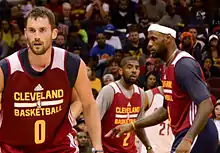
After the 2014 Finals loss, LeBron James went back into free agency, deciding to end his Miami Heat stint and head back to his hometown to the Cleveland Cavaliers to bring a title to the "Promised Land".[29] Cleveland already had Kyrie Irving on their roster, whom they drafted in 2011 (1st overall). Irving had won Rookie of the Year in 2012, was a two-time All-Star (and All-Star MVP in 2014), as well as was the youngest player in NBA history to score 40 points at Madison Square Garden.[30][31] Joining them via trade would be Kevin Love from the Minnesota Timberwolves to complete the trio. Love had finished the previous season with his best production yet, with career-high averages in points and assists as well as an All-Star selection in 2012. In his 6-year stint with the Wolves, he had also recorded the longest streak of double-doubles (double figures in two of either points, rebounds, assists, blocks or steals) at 52, as well as became the first player since Moses Malone in 1982 to record 30 points and 30 rebounds in a regulation game.[32][33] With the Boston Celtics and San Antonio Spurs' respective big threes nearing retirement, Lebron James sought out easier-to-win championships with the Cleveland Cavaliers just as he attempted with the Miami Heat. Kevin Love, considered one of the best power forwards in the league, Kyrie Irving, a perennial All-Star and budding superstar, and LeBron James instantly making the Cleveland Cavaliers a title favorite.[34]
Also during the 2015 season, the Golden State Warriors had their own emerging team, becoming a dynasty that would dominate the league and establish them as another superteam with the 2016 addition of Kevin Durant.[35] Although James' team was built through trades and free agency, the Warriors would build their team through the draft and development to obtain the core that would come to challenge the Cavaliers for championships. The Warriors had drafted Stephen Curry as the No. 7 pick in 2009, Klay Thompson at No. 11 in 2011, and Draymond Green at No. 35 in 2012, to form the nucleus of this team, while adding Andrew Bogut (another team's No. 1 draft pick in 2005) and Andre Iguodala (2-time Defensive Player of the Year) as core players to run for the title in the 2015.[36] The Warriors completed the 2015 regular season with the No. 1 Western seed with a 67-15 record, won a Western Conference championship, and faced the Eastern Conference champion Cavaliers in the NBA Finals.

The young Warrior team won the Finals over the Cavaliers in six games, following the injuries to Kevin Love and Kyrie Irving, their first championship in 40 years.[37] This firmly established the Warriors as a great team after their core players won a multitude of awards in their breakthrough season/competed for others: Stephen Curry (MVP, All-Star selection, All-NBA First team), Klay Thompson (All-Star Selection, All-NBA team, tenth in MVP voting), Draymond Green (All-Defensive team selection, the runner up for the Defensive Player of the Year award) and Andre Iguodala (2015 Finals MVP).[38] Cleveland's Big Three had won accolades as well to further bolster their superteam status despite the Finals loss: Kyrie Irving (All-Star Selection, All-NBA Third team) and LeBron James (All-Star Selection, All-NBA First team).[39] Following the 2015 Finals, these two teams would dominate their respective conferences the next year and rematch the Finals.
.jpg.webp)
The Warriors had started the 2015–16 season by breaking the opening wins record (24, before losing on December 12 to the Milwaukee Bucks) as well as some other NBA records by the end of the season. These include the most road wins in a season (34), most consecutive home wins (54), and best regular season record at 73–9, edging the Michael Jordan-led 1996 Bulls' 72–10.[40] The Cleveland Cavaliers topped the Eastern Conference and again made the NBA Finals after defeating the Detroit Pistons. Atlanta Hawks, and Toronto Raptors. The Warriors also made the Finals, but en-route had faced some problems in the Western Conference Finals where they fell down 3–1 against the Oklahoma City Thunder (after beating the Houston Rockets and the Portland Trail Blazers in the prior rounds).[41] The Warriors came back and won the series and once again faced the Cavs for the NBA title. This Finals saw the Cleveland Cavaliers make their own 3–1 comeback, the first team to ever come back 3-1 in the NBA Finals.[42] Both teams' key players were selected in the All-Star match. Stephen Curry became the first-ever unanimous MVP, LeBron James won Finals MVP in the series and Draymond Green joined both LeBron and Curry in the All-NBA teams.[43][44]
The following off-season, the Warriors made a move to re-assert their spot as the most dominant franchise in the league by acquiring Kevin Durant in free agency.[45] Durant had been a member of the Oklahoma City Thunder and was part of the team that had led the Warriors 3–1 in the Western Conference Finals but then blew the lead and missed out on their first conference championship since 2012.[46] Durant joined the Warriors highly decorated and as one of the best players in the league with a resume of 2014 MVP, five-time NBA Scoring Champion, seven-time All-Star, and six-time All-NBA teamer.[47][48]
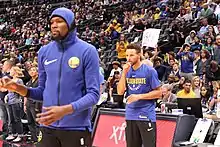
Before the playoffs, the Warriors had matched or broken several NBA records. They reclaimed the top seed with 67 wins along, won the most ever games by a 40-point-plus margin, and extended their run of most games without back-to-back losses in the regular season to 146 (spanning from April 9, 2015 to March 2, 2017).[49][50] The starters, Curry, Durant, Draymond Green, Andre Iguodala, and Klay Thompson, were known by some as the "Hampton 5", or the "Death Lineup".[51]
In the postseason, the Warriors broke the records for best start (15–0), longest win streak (15), and best overall record (16–1), whilst the Cavaliers made a strong run of their own. Cleveland entered the Finals with only one loss in the conference playoffs before relinquishing the title to the Warriors 4–1.[52][53] The season's accolades between the two teams included: the Warriors had four players in the All-Star match (Stephen Curry, Kevin Durant, Draymond Green, and Klay Thompson) a shared NBA record, as well as the Cavs had their Big Three in (LeBron James, Kyrie Irving, and Kevin Love).[54] All-NBA selections were also given to Curry, Green, James, and Durant, whom won Finals MVP.[43][55]
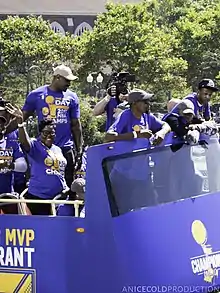
Although both the Warriors and Cavaliers remained favorites in their respective conferences, there was another shift in the when the Cavaliers traded point guard Irving to the Boston Celtics in August for their own starting point guard, Isaiah Thomas, who was injured at the time.[56] Although Thomas had won an All-NBA selection the previous season, he was not seen as the same caliber of player as Irving. Thomas would struggle to come back from his injury in Cleveland, subsequently getting traded. The Cavaliers nonetheless made the Finals, with a more troubled path featuring near loses in series to the Indiana Pacers (a 4–3 win) in the First Round, and the Boston Celtics (also 4–3) in the Eastern Conference Finals, as only the fourth seed in the Eastern Conference standings. The Warriors also did not finish atop of the Western Conference (2nd seed) as well as slimly won the Western Conference Finals over the Houston Rockets in seven games.[57] They swept the 2018 Finals over Cleveland to win a second straight title, and three out of four Finals.[35][58]
Kevin Durant won another Finals MVP and made the All-NBA team, alongside LeBron James and Stephen Curry. After the two teams had battled in four straight Finals (an NBA first), their rivalry ended as James joined the LA Lakers on a four-year deal in Free Agency, ending Cleveland's title hopes as well.[59][43]
2018–19 season: Warriors form an All-Star team
As in 2016 when the Warriors signed Kevin Durant, they reaffirmed their place as a superteam cast when they signed Demarcus Cousins as a free agent from the New Orleans Pelicans in the 2018 off-season. Although he was injured then, he was still considered a dominant "big man" with great skill and defensive tenacity, which had won him two All-NBA selections and four All-Star games before the signing. The Golden State Warriors became the first franchise in 42 years to be able to start five All-Stars (as they had all been the previous year), one in each floor position.[60] It was almost a year after his injury occurred when Cousins took the floor as the Warriors faced the Los Angeles Clippers on January 19, 2019, that the team finally started the five perennial All-Stars in a game.[61]
Other franchises look to create their own Big Three
.jpg.webp)
During the 2017 off-season, a year after Kevin Durant left for the Warriors, the Oklahoma City Thunder acquired Paul George from the Indiana Pacers, and Carmelo Anthony from the New York Knicks, to join Russell Westbrook in a bid to form their own Big Three against the established superteams, the Golden State Warriors and the Cleveland Cavaliers.[62] Anthony joined the Thunder as an aging star but had boasted 10 All-Star appearances and 6 All-NBA selections whereas George was arriving at the prime of his career with 4 All-Star appearances and 3 All-NBA selections.[63][64] However, that would all come to an end the following season after a less-than-impressive showing by Anthony that saw him get traded to the Houston Rockets in their attempt to form a Big Three along with James Harden and Chris Paul at the beginning of the 2018–19 season. Harden had been a part of the Houston organisation since he was traded from the Thunder in 2012. He garnered five All-Star appearances and four All-NBA selections by the time Anthony joined his team. Paul joined the Rockets from the LA Clippers at the start of the 2017–18 season with 5 All-Star appearances and 4 All-NBA selections.[65][66] This also failed as a few weeks into the season, the Rockets traded Carmelo Anthony to the Chicago Bulls who eventually waived him, thus ending the Houston Big Three.[67]
.jpg.webp)
.jpg.webp)
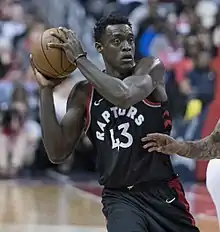
During the 2018 off-season, the Toronto Raptors traded DeMar DeRozan to the San Antonio Spurs for four-time All-Star and two-time Defensive Player of the Year Kawhi Leonard. They began the 2018–19 NBA season 12–1, and finished the season with a 58–24 record. With Pascal Siakam winning the NBA Most Improved Player Award with averages of 16.9 points, 6.9 rebounds and 3.5 assists, the Raptors formed a Big Three of Leonard, Siakam, and 6-time All-Star Kyle Lowry. In the playoffs, the Raptors beat the Orlando Magic in five games and the Philadelphia 76ers in seven, capped by Leonard's historic Game 7 buzzer-beating, game-winning jumper. They went on the beat the 60–22 Milwaukee Bucks and MVP Giannis Antetokounmpo in six games. Finally, they defeated the injury-plagued Warriors in six games in the NBA Finals to win their first NBA championship. Unfortunately, Kawhi decided to not return to the Raptors next season, and ending up with the Los Angeles Clippers.
On November 13, 2018, the Philadelphia 76ers made a mid-season trade for Jimmy Butler from the Minnesota Timberwolves to team him up with emerging superstars Joel Embiid and Ben Simmons. Butler joined the team as a veteran with 4 All-Star, 2 All-NBA, and 4 All-Defensive team selections to add to Embiid's growing talent (himself with an All-Star, All-NBA and All-Defensive team selection) and Simmon's budding-superstar potential that would see him make the All-Star game that season.[68][69][70][71] The 76ers would also move for Tobias Harris (whom would have one of his best seasons, averaging 20.9 points, 7.9 rebounds, and 2.7 assists), from the Clippers, on deadline day to add another star to the Philadelphia starting lineup to create their own version of a Big Four.[72]
Near the start of the 2020–21 season, on January 13, 2021, the Brooklyn Nets traded for James Harden in a blockbuster four-team trade, which reunited Harden with his Oklahoma City Thunder teammate Kevin Durant, and also gave him All-Star Kyrie Irving to form a new superteam in the East.[73] Later they managed to sign former All-Stars LaMarcus Aldridge and Blake Griffin on waivers.
During the 2021 offseason on July 29, the Los Angeles Lakers traded for Russell Westbrook in a trade that also sent two future 2nd round draft picks (2024 and 2028) to the Lakers and Montrezl Harrell, Kyle Kuzma, Kentavious Caldwell-Pope, and the 22nd pick of the 2021 NBA draft to the Washington Wizards. This trade formed a new superteam of LeBron James, Russell Westbrook, and Anthony Davis in the West.[74]
Pre-modern NBA: Great teams
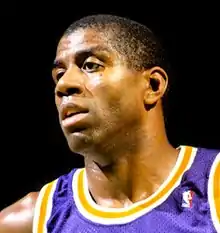
In the 1980s, the Los Angeles Lakers had a formidable team in the Showtime Lakers that boasted stars Kareem Abdul-Jabbar (five-time MVP, nine-time All-Star and All-NBA),[75] Magic Johnson, and James Worthy, whom combined won 23 All-Star and 14 All-NBA selections, three MVPs, and five Finals MVPs in the decade. The team won five NBA championships, eight conference championships, and developed a culture of Hollywood glamour and entertaining basketball.[76]
They also had a dynasty rivalry with the Boston Celtics whom won three NBA championship rings in the '80s.[77] Boston featured all-time greats Larry Bird (nine All-Stars, three MVPs, 10 All-NBA and two Finals MVP),[78] Robert Parish (seven All-Stars, two All-NBA),[79] Kevin McHale (five All-Star, two All-NBA),[80] and Dennis Johnson (five All-Star, two All-NBA and one Finals MVP).[81][82] They faced Los Angeles in three memorable NBA Finals, '84, '5, and '7, winning just the first. They also broke the record for regular home wins in 1986 (40-1; later tied) on the way to their last championship, often named the best Celtic team ever. The Lakers and Celtics dominated the '80s with 8 championships.
Notes:
- All All-NBA and All-Star stats were at the time of the team being formed. Does not show total appearances in their career.
- Included the teams that have won an NBA championship
Controversies
There have been some controversies about the new superteam era in the NBA. Claims persist that superstar players are no longer looking to make the game competitive but rather finding an easier way to attain an NBA championship ring and nullifying smaller contenders by joining other elites.[83] From James' decision for the Miami Heat and Durant joining the all-time winningest team in the Golden State Warriors, there has been derision from the media and fans in their efforts to unbalance the NBA.[84] However, there have been cases for both sides as others argue that the NBA has achieved its highest grossing TV revenue, that it was all done under the rules of the salary cap, and that it's rather some enjoyable sports entertainment.[85]
References
- Nast, Condé (May 23, 2017). "What Should the NBA Do When Nobody Can Touch the Superteams?". GQ. Retrieved May 17, 2019.
- "NBA superteam rankings: Who has the most star power?". ESPN.com. August 17, 2018. Retrieved May 17, 2019.
- Lynch, Andrew; ET, 2017 at 8:35a (June 16, 2017). "The history of NBA superteams, from Wilt Chamberlain to the 2017 Warriors". FOX Sports. Retrieved October 7, 2020.
- Gallo, D. J. (June 5, 2017). "LeBron James created the modern NBA superteam. Now it will destroy him". The Guardian. ISSN 0261-3077. Retrieved May 17, 2019.
- Gamble, J. R. (May 5, 2017). "Breaking Down The Definition Of An NBA Big Three Versus Super Teams". The Shadow League. Retrieved May 17, 2019.
- "NBA Players: Chris Bosh Profile and Basic Stats". www.landofbasketball.com. Retrieved May 17, 2019.
- "NBA Players: LeBron James Profile and Basic Stats". www.landofbasketball.com. Retrieved May 17, 2019.
- "NBA Players: Dwyane Wade Profile and Basic Stats". www.landofbasketball.com. Retrieved May 17, 2019.
- "Next NBA superteam? Nine teams to watch". ESPN.com. July 31, 2017. Retrieved May 17, 2019.
- Jeva Lange (July 3, 2018). "The Golden State Warriors will be the first team in over 40 years to be able to start 5 All-Stars". The Week. Retrieved March 1, 2021.
- Connor Letourneau (February 12, 2019). "Warriors' five-All-Star lineup looks to work out early kinks". San Francisco Chronicle. Retrieved March 1, 2021.
- United Press International (January 3, 1968). "Are Celtics on the way down?". Madera Tribune. Retrieved April 9, 2021.
- Mueller, Lee (October 23, 1969). "Knicks Could Have Best Team in NBA". Desert Sun. Retrieved April 9, 2021.
- Gannett News Service (February 12, 1978). "Dynasty or lucky 'baloney'". San Bernardino Sun. Retrieved April 9, 2021.
- Robinson, Brandon (July 31, 2018). "Magic Johnson's Lakers & Bill Russell's Celtics were a super team, Clyde Drexler says". basketballsocietyonline.com. Retrieved April 9, 2021.
- Mathew, Aaron (July 18, 2020). ""A Lot of Money at Stake": Anonymous NBA Coach Predicts Big Player Movements and Superteams After the Orlando Bubble". essentiallysports.com. Retrieved April 9, 2021.
- "2006-07 Boston Celtics Roster and Stats". Basketball-Reference.com. Retrieved December 1, 2021.
- "Boston Celtics", Wikipedia, November 30, 2021, retrieved December 1, 2021
- "2008 NBA Finals - Lakers vs. Celtics". Basketball-Reference.com. Retrieved December 1, 2021.
- "2007-08 Boston Celtics Roster and Stats". Basketball-Reference.com. Retrieved December 1, 2021.
- "LeBron James Stats". Basketball-Reference.com. Retrieved May 17, 2019.
- "NBA MVP Award Winners". NBA.com. Retrieved May 17, 2019.
- "Trifecta: LeBron will join Wade, Bosh with Heat". ESPN.com. July 8, 2010. Retrieved May 17, 2019.
- Smith, Sekou. "Decade of Dominance: LeBron James, Miami Heat climb to top of NBA heap". NBA.com. Retrieved May 17, 2019.
- "NBA Longest Winning Streaks - Regular Season". Land of Basketball. Retrieved November 1, 2020.
- Russell, Adrian. "Miami's 'Big 3' put together historic stat night". The42. Retrieved May 19, 2019.
- "The Big 3 starts and ends with LeBron James". ESPN.com. October 26, 2010. Retrieved May 19, 2019.
- Gallo, D. J. (June 5, 2017). "LeBron James created the modern NBA superteam. Now it will destroy him". The Guardian. ISSN 0261-3077. Retrieved May 19, 2019.
- Withers, Tom (July 2, 2018). "Cavs owner praises LeBron, promises to retire his jersey".
- "NBA Players: Kyrie Irving Profile and Basic Stats". www.landofbasketball.com. Retrieved May 17, 2019.
- "Irving's career-high 41 can't lift Cavs by Knicks". ESPN.com. December 16, 2012. Retrieved May 19, 2019.
- "Love passes Malone with 52nd double-double". ESPN.com. March 10, 2011. Retrieved May 19, 2019.
- "Love has 30-30 game in Wolves' win over Knicks - USATODAY.com". usatoday30.usatoday.com. Retrieved May 19, 2019.
- "Love officially traded to Cavs in 3-team deal". ESPN.com. August 23, 2014. Retrieved May 19, 2019.
- "Warriors prove super teams can be built through the NBA Draft - Sportsnet.ca". www.sportsnet.ca. Retrieved May 20, 2019.
- "Timeline Of How The Warriors Built A Powerful Superteam". Fadeaway World. April 7, 2019. Retrieved May 20, 2019.
- Gallo, D. J. (June 17, 2015). "Golden State Warriors win first NBA title in 40 years – as it happened". The Guardian. ISSN 0261-3077. Retrieved May 20, 2019.
- "Golden State Warriors Awards By Type - RealGM". basketball.realgm.com. Retrieved May 20, 2019.
- "Cleveland Cavaliers Awards By Type - RealGM". basketball.realgm.com. Retrieved May 20, 2019.
- "Records held by Golden State Warriors | NBA.com". The official site of the NBA. Retrieved May 20, 2019.
- "2016 NBA Playoffs Summary". Basketball-Reference.com. Retrieved May 20, 2019.
- McLaughlin, Eliott C. "'Finally, we did it!': Cavs' title ends 52 years of Cleveland sports agony". CNN. Retrieved May 20, 2019.
- "Year-by-year All-NBA Teams". NBA.com. Retrieved May 20, 2019.
- "2015–16 NBA Annual Award Voting Results". nba.com. May 25, 2016. Retrieved May 20, 2019.
- "Durant joins Curry, will sign deal with Warriors". ESPN.com. July 4, 2016. Retrieved May 20, 2019.
- "Oklahoma City Thunder Playoff History - RealGM". basketball.realgm.com. Retrieved May 20, 2019.
- Spears, Marc J. (July 4, 2016). "'Strength in Numbers' convinced Kevin Durant to join Warriors". The Undefeated. Retrieved May 20, 2019.
- "NBA Players: Kevin Durant Profile and Basic Stats". www.landofbasketball.com. Retrieved May 20, 2019.
- "NBA Teams: Golden State Warriors Records Year by Year". www.landofbasketball.com. Retrieved May 20, 2019.
- ""Warriors"" (PDF). nba.com.
- Ziller, Tom (May 7, 2018). "Yes Warriors, you have a lineup called The Hamptons Five. Own it". SBNation.com. Retrieved May 20, 2019.
- Hoffman, Benjamin; Ma, Jessia; Pearce, Adam; Ward, Joe (June 17, 2017). "The Golden State Warriors' Record-Setting Postseason". The New York Times. ISSN 0362-4331. Retrieved May 20, 2019.
- "2017 NBA Playoffs Summary". Basketball-Reference.com. Retrieved May 20, 2019.
- "NBA Teams". NBA.com. Retrieved May 20, 2019.
- Davis, Scott (June 6, 2017). "The Warriors built the most terrifying team in the NBA with perfect timing, a little bit of luck, and a fateful decision from the players' union". Business Insider Australia. Retrieved May 20, 2019.
- "Sources: Kyrie seeks trade to evade LeBron". ESPN.com. July 21, 2017. Retrieved May 20, 2019.
- "2018 NBA Playoffs Summary". Basketball-Reference.com. Retrieved May 20, 2019.
- "Warriors vs. Cavaliers - Game Recap - June 9, 2018 - ESPN". ESPN.com. Retrieved May 20, 2019.
- "LA-Bron: James, Lakers agree to four-year deal". ESPN.com. July 2, 2018. Retrieved May 20, 2019.
- Fromal, Adam. "Warriors Redefine the Superteam Again with DeMarcus Cousins Signing". Bleacher Report. Retrieved May 20, 2019.
- "If DeMarcus Cousins' Warriors debut is any indication, the rest of the NBA is in big trouble". CBSSports.com. Retrieved May 20, 2019.
- Tjarks, Jonathan (September 24, 2017). "The Key to Making OKC's Big Three Work". The Ringer. Retrieved May 20, 2019.
- "Carmelo Anthony". NBA Stats. Retrieved May 20, 2019.
- "Paul George". NBA Stats. Retrieved May 20, 2019.
- "NBA Players: James Harden Profile and Basic Stats". www.landofbasketball.com. Retrieved May 20, 2019.
- "NBA Players: Chris Paul Profile and Basic Stats". www.landofbasketball.com. Retrieved May 20, 2019.
- "Report: Carmelo Traded to Bulls, Will Be Released and Become Free Agent". SLAM. January 20, 2019. Retrieved May 20, 2019.
- "It's done: Butler trade to Philly completed". ESPN.com. November 12, 2018. Retrieved May 20, 2019.
- "NBA Players: Ben Simmons Profile and Basic Stats". www.landofbasketball.com. Retrieved May 20, 2019.
- "NBA Players: Joel Embiid Profile and Basic Stats". www.landofbasketball.com. Retrieved May 20, 2019.
- "NBA Players: Jimmy Butler Profile and Basic Stats". www.landofbasketball.com. Retrieved May 20, 2019.
- "Los Angeles Clippers Agree to Trade Tobias Harris to Philadelphia 76ers in Six-Player Deal, Per 'ESPN'". www.inquisitr.com. February 6, 2019. Retrieved May 20, 2019.
- "Brooklyn-bound: Nets land Harden in blockbuster". ESPN.com. January 13, 2021. Retrieved January 14, 2021.
- "Reports: Lakers agree to Russell Westbrook trade". NBA.com. July 29, 2021. Retrieved July 30, 2021.
- "NBA Players: Kareem Abdul-Jabbar Profile and Basic Stats". www.landofbasketball.com. Retrieved May 21, 2019.
- Robinson, Brandon 'Scoop B' (December 26, 2018). "Lakers News: Magic Johnson Showtime Era Was A Super Team Says Ex Teammate". Heavy.com. Retrieved May 21, 2019.
- "ESPN BOSTON Hall of Fame - Larry Bird". www.espn.com. Retrieved May 21, 2019.
- "NBA Players: Larry Bird Profile and Basic Stats". www.landofbasketball.com. Retrieved May 21, 2019.
- "NBA Players: Robert Parish Profile and Basic Stats". www.landofbasketball.com. Retrieved May 21, 2019.
- "NBA Players: Kevin McHale Profile and Basic Stats". www.landofbasketball.com. Retrieved May 21, 2019.
- "NBA Players: Dennis Johnson Profile and Basic Stats". www.landofbasketball.com. Retrieved May 21, 2019.
- Hartwell, Darren (June 26, 2017). "Clyde Drexler Believes This Celtics Squad Actually Was NBA's First 'Superteam'". NESN.com. Retrieved May 21, 2019.
- Ryan, Shane. "Until the NBA breaks up its "super teams," it is basically just European soccer". Golf Digest. Retrieved May 21, 2019.
- Berger, Ken. "Who's to Blame for the Warriors Bringing NBA Teams to Their Knees?". Bleacher Report. Retrieved May 21, 2019.
- "Why Kevin Durant and the Warriors aren't to blame for the NBA's Superteam problem". USA TODAY. Retrieved May 21, 2019.