United States Border Patrol
The United States Border Patrol (USBP) was created on May 28, 1924. As of 2021, it was a federal office within Customs and Border Protection (CBP), which was, in turn, an agency of the Department of Homeland Security (DHS). It is the largest federal law enforcement agency.[1]
| United States Border Patrol | |
|---|---|
.png.webp) Right sleeve patch | |
 Seal and left sleeve patch of the United States Border Patrol | |
 USBP badge | |
 USBP flag | |
| Abbreviation | USBP |
| Motto | Honor First |
| Agency overview | |
| Formed | May 28, 1924 |
| Jurisdictional structure | |
| Federal agency (Operations jurisdiction) | United States |
| Operations jurisdiction | United States |
| Size | 20,500 lineal miles |
| Legal jurisdiction | INA 235 & INA 287. Title 8 USC, 18 USC, 19 USC & 21 USC |
| Governing body | Department of Homeland Security |
| General nature | |
| Specialist jurisdiction |
|
| Operational structure | |
| Headquarters | Washington, D.C., U.S. |
| Border Patrol Agents | Congress Mandated 21,370 |
| Agency executives |
|
| Parent agency | U.S. Customs and Border Protection |
| Website | |
| http://www.cbp.gov | |
The USBP consists of armed and uniformed federal police that secure the nation’s borders by intercepting people, weapons, and illegal substances entering the United States. According to the U.S. Customs and Border Protection website, “The Border Patrol is specifically responsible for patrolling nearly 6,000 miles of Mexican and Canadian international land borders and over 2,000 miles of coastal waters surrounding the Florida Peninsula and the island of Puerto Rico.” [2]
There have been repeated complaints, over many years, of Border Patrol agents mistreating migrants and exceeding their legal authority. The Border Patrol refuses to have its agents wear body cameras.[1] Plagued by sexism and misogyny, the Border Patrol has the lowest proportion of female agents or officers of any federal agency.[3][4][5]
Most Border Patrol agents were enthusiastic about the 2016 election of President Donald Trump, with his anti-immigrant policy. The 2020 victory of Joe Biden, who had promised immigration reform, left them feeling abandoned and bitter.[5]
History
In May 1924, the U.S. Congress passed H.R. 8350, which approved funding for the Border Patrol to manage borders and border crossings. At the time, 450 patrol inspectors were paid $1,680 per year, provided with food for their horses, and given uniforms. In 1925, Border Patrol duties expanded from securing ports of entry on land to also patrolling seacoast areas.
The expansion of duties for Border Patrol Inspectors, who are commonly known as Border Patrol Agents, also came with extensive recruitment from institutions such as, Texas Rangers, local sheriff deputies, appointees from Civil Service Register of Railroad Mail Clerks, and Mounted Inspectors from the Chinese Division of the Department of Labor’s Immigration Services. In addition, many of the early Border Patrol officers were working-class white men who were against Mexican immigration into the United States or Mexican American men who were forced to assimilate as “Spanish-Americans” in order to be fully participating citizens.[6] It became clear that with the growth of Border Patrol authority, also came an increase of enforcement of white and nonwhite.[6]
In the 1930s, Ruel Davenport and George J. Harris were two Chiefs that led the Border Patrol. Given that the United States was under the Prohibition Era, one of their main concerns was liquor smuggling.
As the Border Patrol agency continued to grow, so did the training practices. In 1934, El Paso established the El Paso District Training School for officers in their area. The school taught officers the Spanish language, immigration law, officer conduct, search and seizure laws, evidence and court procedures, firearms, Morse code, patrolling techniques, and sign cutting. In December 1937, the Immigration Service renamed the school the Border Patrol Training School (BPTS) and required all recruits, nationwide, to attend.[7]
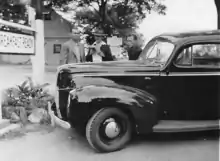
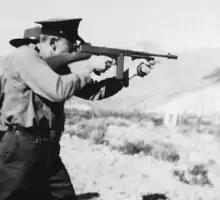
Following the outbreak of World War II in Europe, Border Patrol staffing doubled to 1,500 in 1940, and the INS was moved from the Department of Labor to the U.S. Department of Justice.[7] Additional stations were temporarily added along the Gulf Coast, Florida and the Eastern Seaboard during the 1960s after Fidel Castro triumphed in the Cuban Revolution, and that was followed by the Cuban Missile Crisis. The INS was decommissioned in March 2003 when its operations were divided between U.S. Customs and Border Protection (CBP), United States Citizenship and Immigration Services, and U.S. Immigration and Customs Enforcement.
In the next decade, the U.S. Border Patrol was moved from the Department of Labor and into the Department of Justice, and their Border Patrol officers went from 773 in 1939 to 1,531 in 1941.[7] In the 1940s, incoming recruits went from being mostly Texas Rangers and sheriff deputies to war veterans. In fact, in 1943 almost half of the new applicants were vets from World War II.
.png.webp)
.svg.png.webp)
In the wake of the attacks of September 11, 2001, the Border Patrol was placed under the umbrella of the Department of Homeland Security, and preventing terrorists and terrorist weapons from entering the United States was added to its mission. The Border Patrol's traditional mission continued: deterring, detecting and apprehending illegal aliens and individuals involved in the illegal drug trade who generally entered the United States at places other than through designated ports of entry. The Border Patrol also erected 33 permanent interior checkpoints near the southern border of the United States.
For fiscal year 2019, the nationwide total of Border Patrol agents was 19,648, with 16,731 patrolling the southern border.[8] Agents primarily patrol the Mexico–United States border, where they control drug trafficking and illegal immigration.[9]
The majority of Border Patrol agents are minorities. According to 2016 data, Latinos constitute slightly more than 50% of the Border Patrol.[10]
In terms of Border Patrol accountability, “An internal disciplinary board at CBP found that 60 agents committed misconduct, and recommended firing two dozen of them. But only two were ultimately fired, according to a recent report by the House Oversight and Reform Committee. Most of the other agents are now back at work.”[11]
Strategies
1986: Employer sanctions and interior enforcement
The Border Patrol's priorities have changed over the years. In 1986, the Immigration Reform and Control Act placed renewed emphasis on controlling illegal immigration by going after the employers that hire illegal aliens. The belief was that jobs were the magnet that attracted most illegal aliens to come to the United States. The Border Patrol increased interior enforcement and Form I-9 audits of businesses through an inspection program known as "employer sanctions". Several agents were assigned to interior stations, such as within the Livermore Sector in Northern California.
Employer sanctions never became the effective tool it was expected to be by Congress. Illegal immigration continued to swell after the 1986 amnesty despite employer sanctions. By 1993, Californians passed Proposition 187, denying benefits to illegal aliens and criminalizing illegal aliens in possession of forged green cards, identification cards, and Social Security numbers. It also authorized police officers to question non-nationals as to their immigration status and required police and sheriff departments to cooperate and report illegal aliens to the INS. Proposition 187 drew nationwide attention to illegal immigration.
Checkpoint stations
United States Border Patrol Interior Checkpoints are inspection stations operated by the USBP within 100 miles (160 km) of an international border (with Mexico or Canada) or any U.S. coastline.[12]
“Operation Wetback”
In June 1954, immigration law enforcement launched “Operation Wetback,” where hundereds of USBP officers (aside from the ones already stationed) were flown out or bussed to California, Arizona, Texas, Illinois, and the Mississippi Delta to deport unsanctioned immigrants. USBP used military-style strategies and transportation machines provided by the government such as trains, planes, and boats.
During Operation Wetback, the Border Patrol arrested approximately 1.3 million people, mostly Mexican nationals, making it the largest mass deportation of undocumented workers in U.S. history.[13]
USBP received a lot of pushback from the community not only because of their militrized tacits, but also because of their use of the term “wetback.” “Wetback” is a racially discriminatory and derogatory slur used against immigrants who allegedly entered the United States by swimming across the Rio Grande River. In addition to the racially discriminatory connotations attributed to the title of the operation, those who were deported, along with the community, criticized how a larger percentage of the people who were forced back to Mexico did not have relational ties or economic stability in that country. Therefore, deportees were left stranded without jobs, housing, or food.
El Paso Sector's Operation Hold the Line
El Paso Sector Chief Patrol Agent Silvestre Reyes started a program called "Operation Hold the Line". In this program, Border Patrol agents would no longer react to illegal entries resulting in apprehensions, but would instead be forward deployed to the border, immediately detecting any attempted entries or deterring crossing at a more remote location. The idea was that it would be easier to capture illegal entrants in the wide open deserts than through the urban alleyways. Chief Reyes deployed his agents along the Rio Grande, within eyesight of other agents. The program significantly reduced illegal entries in the urban part of El Paso, however, the operation merely shifted the illegal entries to other areas.
San Diego sector's Operation Gatekeeper

Congressman Duncan Hunter became a major proponent of additional border fencing in the San Diego sector; surplus military landing mats were obtained to use as an initial border fence.[14] Stadium lighting, ground sensors and infra-red cameras were also placed in the area. Eventually the primitive landing mat fence was replaced with a modern triple fence line[15][16] that begins over one hundred yards into the Pacific Ocean at Imperial Beach, California, and ends more than 13 miles (19 km) inland on Otay Mesa where the mountains begin.
Northern border
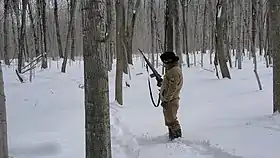

Through agency whistleblowers, Agent Mark Hall and Agent Robert Lindemann, it was revealed that in 2001, the Border Patrol had approximately 324 agents assigned along the Canada–United States border.[17] Northern border staffing had been increased by 1,128 agents to 1,470 agents by the end of fiscal year 2008, and is projected to expand to 1,845 by the end of fiscal year 2009, a sixfold increase. Resources that support Border Patrol agents include the use of new technology and a more focused application of air and marine assets.
The northern border sectors are (west to east): Blaine (Washington), Spokane (Washington), Havre (Montana), Grand Forks (North Dakota), Detroit (Selfridge ANGB, Michigan), Buffalo (New York), Swanton (Vermont), and Houlton (Maine).[18]
New strategy
In November 2005, the U.S. Border Patrol published an updated national strategy.[19] The goal of this updated strategy was operational control of the United States border. The strategy has five main objectives:
- Apprehend terrorists and terrorist weapons illegally entering the United States
- Deter illegal entries through improved enforcement
- Detect, apprehend, and deter smugglers of humans, drugs, and other contraband
- Use "smart border" technology
- Reduce crime in border communities, improving quality of life.
Capabilities
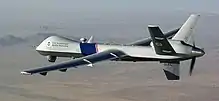
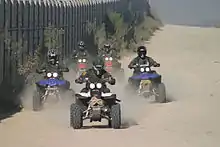
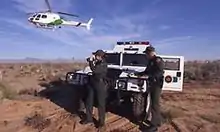
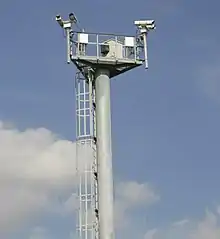
The United States border is a barely discernible line in the uninhabited deserts, canyons, or mountains and rivers. The Border Patrol utilizes a variety of equipment and methods, such as electronic sensors placed at strategic locations along the border, to detect people or vehicles entering the country illegally. Video monitors and night vision scopes are also used to detect illegal entries. Agents patrol the border in vehicles, boats, aircraft, and afoot. In some areas, the Border Patrol employs horses, all-terrain motorcycles, bicycles, and snowmobiles. Air surveillance capabilities are provided by unmanned aerial vehicles.[20]
Many techniques were tested with no official training or supervision, in the preliminar formation of the U.S. Immigraion Law Enforcement.[6] One technique was “line watches,” which is the activity of patrolling at or near the border, surveilling unauthorized immigrants, responding to electronic sensors, television systems and aircraft sightings, and interpreting and following tracks, marks, and other physical evidence. Major activities include traffic check, traffic observation, city patrol, transportation check, administrative, intelligence, and anti-smuggling activities.[6]
In 1926, Chief Patrol Inspector Chester C. Courtney of the Border Patrol’s subdistrict office, discovered that line watches were not an effective method since USBP officers were focused on policing Mexicans or those they deemed as Mexican. Despite Courtney's discovery, line watches continued to be used by Border Patrol agents.
Traffic checks are conducted on major highways leading away from the border to detect and apprehend immigrants attempting to travel further into the interior of the United States after evading detection at the border, and to detect illegal narcotics.[20]
Transportation checks are inspections of interior-bound conveyances, which include buses, commercial aircraft, passenger and freight trains, and marine craft.[20]
Marine patrols are conducted along the coastal waterways of the United States, primarily along the Pacific coast, the Caribbean, the tip of Florida, and Puerto Rico and interior waterways common to the United States and Canada. The Border Patrol conducts border control activities from 130 marine craft of various sizes. The Border Patrol maintains watercraft ranging from blue-water craft to inflatable-hull craft, in 16 sectors, in addition to headquarters and special operations components.[20]
Horse and bike patrols are used to augment regular vehicle and foot patrols. Horse units patrol remote areas along the international boundary that are inaccessible to standard all-terrain vehicles. Bike patrol aids city patrol and is used over rough terrain to support line watch.[20] Snowmobiles are used to patrol remote areas along the northern border in the winter.
Expansion
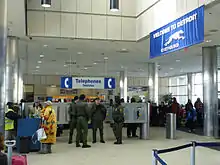
In 1992, the United States Border Patrol had approximately 4,139 patrol agents on the job. Attrition in the Border Patrol was normally at 5%. From 1995 to 2001 annual attrition rose to above 10%, which was a period when the Border Patrol was undergoing massive hiring. In 2002 the attrition rate climbed to 18%. The 18% attrition was largely attributed to agents transferring to the Federal Air Marshals after 9/11. Since that time the attrition rate has decreased. Congress increased journeyman Border Patrol agent pay from a GS-9 rate to a GS-11 rate in 2002. The Border Patrol Marine Position was created in 2009 (BPA-M).
The Intelligence Reform and Terrorism Prevention Act of 2004 (signed by President Bush on December 17, 2004) authorized hiring an additional 10,000 agents, "subject to appropriation". This authorization nearly doubled the Border Patrol size, from 11,000 to 20,000 agents by 2010.[22] As of 2016, roughly half of the agents are Latino Americans.[23]
The Secure Fence Act, signed by President Bush on October 26, 2006, has met with much opposition. In October 2007, environmental groups and concerned citizens filed a restraining order hoping to halt the construction of the fence, set to be built between the United States and Mexico. The act mandated that the fence be built by December 2008. Ultimately, the United States seeks to put fencing around the 1,945-mile (3,130 km) border, but the act requires only 700 miles (1,100 km) of fencing. DHS secretary Michael Chertoff has bypassed environmental and other oppositions with a waiver that was granted to him by Congress in Section 102 of the act, which allows DHS to avoid any conflicts that would prevent a speedy assembly of the fence.[24][25]
This action has led many environment groups and landowners to speak out against the impending construction of the fence.[26] Environment and wildlife groups fear that the plans to clear brush, construct fences, install bright lights, motion sensors, and cameras will scare wildlife and endanger the indigenous species of the area.[27] Environmentalists claim that the ecosystem could be affected because a border fence would restrict movement of all animal species, which in turn would keep them from water and food sources on one side or another. Desert plants would also feel the impact, as they would be uprooted in many areas where the fence is set to occupy.[28]
In 2008, property owners in these areas feared a loss of land. Landowners would have had to give some of their land over to the government for the fence. Brownsville mayor Pat Ahumada favored alternative options to a border fence. He suggested that the Rio Grande be widened and deepened to provide for a natural barrier to hinder illegal aliens and drug smugglers.[29]
Special operations groups
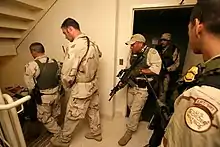
- Border Patrol Tactical Unit (BORTAC)
- Border Patrol, Search, Trauma and Rescue (BORSTAR)
- Mobile Response Team (MRT)
Other specialized programs
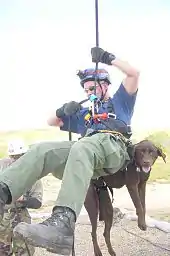
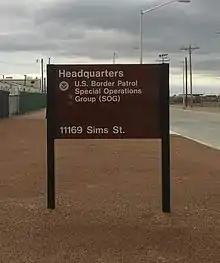
In 2007, the U.S. Border Patrol created the special operations group (SOG) headquartered in El Paso, Texas, to coordinate the special operations units of the agency.[30]
The U.S. Border Patrol has a number of other specialized programs and details. Marine patrol – In the riverine environments of the northern and southwestern borders of the continental United States, the Border Patrol conducts border control activities from the decks of marine craft of various sizes. Since 2006, the U.S. Border Patrol has relinquished its littoral law enforcement missions in the Great Lakes and territorial seas to the Office of Air and Marine. The U.S. Border Patrol maintains over 130 vessels, ranging from blue-water craft to inflatable-hull craft, in 16 sectors, in addition to headquarters special operations components.
[31] K9 units, mounted patrols, bike patrols, sign-cutting (tracking), snowmobile units, infrared-scope units, intelligence, anti-smuggling investigations unit (ASU/DISRUPT, Border Criminal Alien Program, multi-agency anti-gang task forces (regional and local units), honor guards, pipes and drums, chaplains, peer support, and mobile surveillance units.
Illegal border crossing deterrence
"Operation Gatekeeper" was launched in 1994 to stop aliens from crossing illegally into the United States. The strategy included increased enforcement and extensive fencing near border cities, with the twofold purpose of deflecting aliens to remote areas where they could more easily be detected and apprehended, as well as using the formidable mountains, deserts, and Rio Grande as a deterrent to easy passage.[32] The newly erected Mexico–United States barrier—which at some remote locations is no more than a fence—has also forced aliens and human traffickers to seek out remote desert locations in California, Arizona, New Mexico and Texas where they may attempt crossing.[33][34] The "funnel effect" created by both these strategies has contributed to the deaths of thousands of aliens, whose remains are often found in the hot desert or freezing mountains.[35]
As early as 1998, the former Immigration and Naturalization Service implemented the Border Safety Initiative in response to concerns about the number of aliens injured or killed while attempting to cross the border. It was noted that Border Patrol agents routinely supplied water, food, and medical care to aliens.[36] That same year, Border Patrol, Search, Trauma and Rescue (BORSTAR), a specialized unit trained in emergency search and rescue, was established with the purpose of assisting injured or stranded aliens at remote locations.[37]
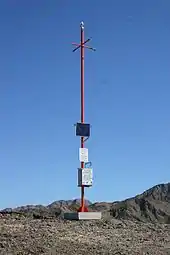
In 2002, the first "rescue beacons" were installed in desert areas considered especially dangerous.[38] The beacons are solar powered and highly visible, and have a button which alerts Border Patrol agents by radio signal, after which a helicopter or ground unit is dispatched.[39] U.S. Senator Bill Frist commented in 2006: "these beacons, I believe, are an absolutely vital link in our border security system... We know that beacons work: CBP has already saved dozens of people based entirely on beacon alerts."[38] The Border Patrol frequently publishes reports about stranded and injured individuals rescued at beacon locations.
During a 12-month period in 2011–12, Border Patrol agents made 1,312 rescues along the Mexico–United States border, nearly half occurring in the Tucson sector.[40]
Border Patrol sectors
.jpg.webp)
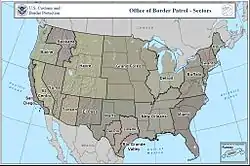
There are 20 Border Patrol sectors, each headed by a sector chief patrol agent.
Training
All Border Patrol agents spend a minimum of 26 weeks at the Border Patrol Academy in Artesia, New Mexico, which is a component of the Federal Law Enforcement Training Center (FLETC). Border Patrol Agent Trainees are instructed in courses including; Spanish, criminal law, nationality law, and administrative immigration law, police sciences, self-defense and arrest techniques, firearms training with pistol, shotgun and rifle, police vehicle driving, and other Border Patrol / federal law enforcement subjects.
Once they arrive back at their duty station, Trainees then must graduate from the Field Training Officer (FTO) program, an on-the-job training program, which varies in length from a minimum of 12 weeks to a maximum of over 16 weeks long, depending on the practical demands of the duty station and local management. They must also successfully complete the Post Academy Training Program, an extension of the Border Patrol Academy where Trainees complete additional classroom-based training over the course of their first nine months back at their duty station.
Appearance
Uniforms
The Border Patrol, c. 2007, wore the following types of uniforms:
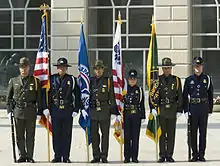
- Summer dress uniform – The summer dress uniform consists of a short-sleeve, olive-green dress shirt (which may or may not have blue shoulder straps), brass nameplate, badge, olive-green slacks with a blue stripe running the length of the seam, and black dress shoes or dress boots. A green, straw campaign hat is worn with this uniform.
- Winter dress uniform – The winter dress uniform consists of a long-sleeve, olive green dress shirt, navy-blue clip-on tie with a brass tie tack, olive-green ike jacket with blue accents (shoulder straps and cuffs), brass nameplate, badge, olive-green slacks with a blue stripe running the length of the seam, and black dress shoes or dress boots. a green, felt campaign hat with a black, leather hat band is worn with this uniform.
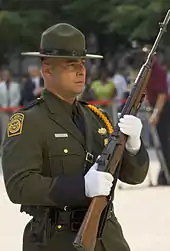
- Ceremonial dress uniform – Worn primarily by Border Patrol honor guard agents, the ceremonial dress uniform is roughly identical to the winter dress uniform, with the exception that a tunic is worn with this uniform, rather than an ike jacket. White, cloth gloves are also worn with this uniform.
- Rough duty uniform – The rough duty uniform consists of a green, long-sleeve or short-sleeve work shirt, green cargo pants, and black work boots; a green baseball cap or cowboy hat is typically worn with this uniform.
- There are also specialized rough duty uniforms for marine patrol (riverine), northern border cold weather, horse patrol and bike patrol agents.
- Highland uniform – Worn by members of the United States Border Patrol Pipes and Drums in the performance of their official duties, this uniform includes a kilt made of the official Border Patrol tartan, custom made olive-green ceremonial coat, glengarry, sporran and white spats.
- Organization patches – The Border Patrol wears two:
- The CBP patch is worn on the right sleeves of the uniform. It contains the DHS seal against a black background with a "keystone" shape. A keystone is the central, wedge-shaped stone in an arch, which holds all the other stones in place.
- Border Patrol agents retain the circular legacy Border Patrol patch, which is worn on the left sleeve.
The Border Patrol uniform is getting its first makeover since the 1950s to appear more like military fatigues and less like a police officer's duty garb.[41] Leather belts with brass buckles are being replaced by nylon belts with quick-release plastic buckles, slacks are being replaced by lightweight cargo pants, and shiny badges and nameplates are being replaced by cloth patches.
Border Patrol (USBP) ranks and insignia
| Location | Title | Collar insignia | Shoulder ornament | Pay grade |
|---|---|---|---|---|
| Border Patrol Headquarters | Chief of the Border Patrol |  |
Gold-plated | Senior Executive Service (SES) |
| Deputy Chief of the Border Patrol |  |
Gold-plated | SES | |
| Division Chief |  |
Gold-plated | SES | |
| Deputy Division Chief |  |
Gold-plated | GS-15, General Schedule | |
| Associate Chief | |
Gold-plated | GS-15 | |
| Assistant Chief |  |
Gold-plated | GS-14 | |
| Operations Officer (OPO) |  |
Gold-plated | GS-13 | |
| Border Patrol sectors | Chief Patrol Agent (CPA) | |
Silver-plated | SES or GS-15 |
| Deputy Chief Patrol Agent (DCPA) | |
Silver-plated | SES or GS-15 | |
| Division Chief/ACTT Director | |
Silver-plated | GS-15 | |
| Executive Officer/Assistant Chief Patrol Agent (ACPA) | |
Silver-plated | GS-14 | |
| Special Operations Supervisor (SOS) | |
Silver-plated | GS-13 | |
| Operations Officer (OPO) | |
Silver-plated | GS-13 | |
| Supervisory Border Patrol Agent (SBPA) |  |
Silver-plated | GS-13 | |
| Border Patrol Agent (Sector Programs) |  |
No insignia | GS-13 | |
| Border Patrol Agent – Intelligence (BPA-I) |  |
No insignia | GS-12 | |
| Border Patrol stations | Patrol Agent In Charge (PAIC) | |
Oxidized | GS-13, 14, 15 |
| Deputy Patrol Agent In Charge (DPAIC) |  |
Oxidized | GS-14 or GS-13 | |
| Watch Commander (WC) | |
Oxidized | GS-14 or GS-13 | |
| Special Operations Supervisor (SOS) | |
Oxidized | GS-13 | |
| Supervisory Border Patrol Agent (SBPA) | |
Oxidized | GS-13 | |
| Border Patrol Agent – Intelligence (BPA-I) | |
No insignia | GS-12 | |
| Border Patrol Agent (BPA) | |
No insignia | GL-5, 7, 9, GS-11, 12 | |
| Border Patrol Academy | Chief Patrol Agent (CPA) | |
Silver-plated | GS-15 |
| Deputy Chief Patrol Agent (DCPA) | |
Silver-plated | GS-15 | |
| Assistant Chief Patrol Agent (ACPA) | |
Silver-plated | GS-14 | |
| Training Operations Supervisor (TOS) | |
Oxidized | GS-14 | |
| Supervisory Border Patrol Agent (senior instructor) | |
Oxidized | GS-13 | |
| Supervisory Border Patrol Agent (instructor) | |
Oxidized | GS-13 | |
| Border Patrol Agent (detailed instructor) | |
Oxidized | GS-11, 12 |
Border Patrol shoulder ornaments

Awards
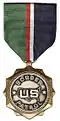
| Newton-Azrak Award for Heroism | Chiefs Commendation Medal | Purple Cross Wound Medal | 75th Anniversary Commemorative Medal | |
|---|---|---|---|---|
 |
 |
 |
 | |
 Current heroism award |  Awarded from 2002–2004 |  Current wound award |  No longer worn |
Newton-Azrak Award for Heroism
The Border Patrol's highest honor is the Newton-Azrak Award for Heroism. This award is bestowed to Border Patrol agents for extraordinary actions, service; accomplishments reflecting unusual courage or bravery in the line of duty; or an extraordinarily heroic or humane act committed during times of extreme stress or in an emergency.
This award is named for Border Patrol inspectors Theodore Newton[42] and George Azrak,[43] who were murdered by two drug smugglers in San Diego County in 1967.
Border Patrol uniform devices
| Tactical unit (BORTAC) | Search and rescue unit
(BORSTAR) |
Honor guard | Pipes and drums cap badge | K-9 handler | Chaplain | Field training officer | Peer support | |
|---|---|---|---|---|---|---|---|---|
 |
 |
 |
 |
 |
 |
 |
 | |
Equipment
Weapons
Border Patrol agents have a choice of being issued either the Glock 47 or the Glock 19M pistol in 9mm caliber. The Glock 47 can contain as many as 18 rounds of ammunition (17 in the magazine and 1 in the chamber), while the Glock 19 can contain as many as 16 rounds. Up until 1995 the Border Patrol issued its patrol agents .357 Magnum revolvers as their duty sidearms, Smith & Wesson or Ruger model large frame, six-shot revolvers. The Border Patrol preferred this weapon because it did not jam in harsh conditions, like those of the southwestern border, and also because of the strong "stopping power" of the .357 Magnum cartridge. Although up until 1995 patrol agents could purchase weapons from the agency list of approved authorized personal weapons for duty carry. This list included the Glock Models 17 and 19 pistols in 9 mm, the SIG Sauer P220 pistol in .45 ACP caliber, the Colt Python .357 Magnum revolver, and the Smith & Wesson Model 19/66 .357 Magnum revolver. The Border Patrol adopted the Beretta Model 96D, a .40 S&W caliber semi-automatic pistol (modified for double-action only) (with 11-round capacity magazines) as its duty issue sidearm in 1995. The .40 S&W caliber jacketed hollow-point cartridge was adopted because of its excellent "stopping power" and its superior ballistic characteristics over the 9 mm cartridge. In late 2006 the H&K P2000 pistol was adopted as the Border Patrol's primary duty sidearm. The H&K Model USP compact pistol, H&K Model P2000SK (sub-compact) and Beretta M96D .40 S&W caliber pistols are authorized as secondary sidearms.
On April 9, 2019, CBP announced that the U.S. Border Patrol would transition from the .40 caliber H&K P2000 to an unnamed 9-millimeter Glock pistol, by the end of fiscal year 2021.[44] It has since been revealed that the three Glock handguns that are to be issued to CBP officers and agents are the model G26, model G19, and the specifically manufactured for CBP model G47.[45]
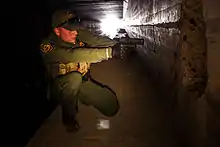
Like many other law enforcement agencies, the 12 gauge Remington Model 870 is the standard pump-action shotgun. The Border Patrol issue Model 870 has been modified by Scattergun Technologies to Border Patrol specifications including: a 14-inch barrel, a five-shot capacity magazine, a composite stock with pistol grip, and night sights with a tactical "ghost-ring" rear sight. The old Border Patrol "anti-bandit" units used to use 12-gauge, semi-automatic shotguns with sawed-off barrels. This weapon had the designated name of a "Sidewinder". The USBP anti-bandit units were decommissioned in the late 1980s.
Border Patrol agents also commonly carry the .223 caliber Colt M4 Carbine (specifically, the updated M4A1) and the H&K UMP .40 caliber submachine gun. The .308 caliber M14 rifle is used for ceremonial purposes and by agents who are qualified with the rifle and BORTAC.
As a less than lethal option, the Border Patrol uses the FN 303 launcher. The FN 303 fires plastic pellet balls containing OC (oleoresin capsicum) pepper dust. The plastic pellet balls burst on impact spraying the suspect with OC pepper dust and also acts as impact projectiles. The Border Patrol also issues its agents OC pepper spray canisters, tasers and a collapsible/telescopic (or telescoping) steel police baton.
Transportation


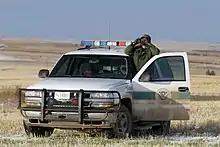
Unlike in many other law enforcement agencies in the United States, the Border Patrol operates over 10,000 SUVs and pickup trucks, which are known for their capabilities to move around in any sort of terrain. These vehicles may have individual revolving lights (strobes or LEDs) and/or light bars and sirens and/or have their bumpers removed or have off-road suspension and tires. An extensive modernization drive has ensured that these vehicles are equipped with wireless sets in communication with a central control room. Border Patrol vehicles may also have equipment such as emergency first aid kits. Some sectors make use of sedans like the Ford Crown Victoria Police Interceptor or the Dodge Charger as patrol cars or high speed "interceptors" on highways. The U.S. Border Patrol has approximately 2,000 sedans. The Border Patrol also operates all-terrain vehicles, motorcycles, snowmobiles, and small boats in riverine environments.
In 2005, all Border Patrol and ICE aircraft operations were combined under CBP's Office of Air and Marine. All CBP vessel operations within the Customs Waters and on the high seas are conducted by Marine Interdiction Agents of the Office of Air and Marine.
Color schemes of Border Patrol vehicles are either a long green stripe running the length of the vehicle (older vehicles) or a broad green diagonal stripe (newer vehicles) on the door. Most Border Patrol vehicles are painted predominantly white. During the 1960s to mid-1980s Border Patrol vehicles were painted a light green.
The Border Patrol also extensively uses horses for remote area patrols. As of 2005, the U.S. Border Patrol has 205 horses. Most are employed along the Mexico–United States border. In Arizona, these animals are fed special processed feed pellets so that their wastes do not spread non-native plants in the national parks and wildlife areas they patrol.[46]
Killed in the line of duty
Since 1904, the Border Patrol has had 123 officers killed in the line of duty, more than any other federal law enforcement agency during that time period.[47]
| Cause of death | Number of officers |
|---|---|
| Aircraft accident | 14 |
| Assault | 2 |
| Automobile accident | 33 |
| Drowned | 4 |
| Duty-related illness | 3 |
| Fall | 4 |
| Gunfire | 31 |
| Gunfire (accidental) | 4 |
| Heart attack | 6 |
| Heat exhaustion | 2 |
| Motorcycle accident | 3 |
| Stabbed | 2 |
| Struck by train | 5 |
| Struck by vehicle | 4 |
| Vehicle pursuit | 2 |
| Vehicular assault | 4 |
Armed incursions
On March 14, 2000, 16 Mexican soldiers in two humvees chased a Border Patrol agent near Santa Teresa, New Mexico, while another agent came under gunfire. Backup arrived and nine of the soldiers were detained. The Mexican government said the soldiers were unfamiliar with the border in that area as those soldiers were normally deployed to Mexico's interior. The U.S. State Department ordered them sent back to Mexico along with their weapons.[48]
On August 7, 2008, Mexican troops crossed the border into Arizona and held a U.S. Border Patrol Agent at gunpoint. Agents stationed at Ajo, Arizona, said that the Mexican soldiers crossed the border into an isolated area southwest of Tucson and pointed rifles at the agent, who has not been identified. The Mexicans withdrew after other U.S. agents arrived on the scene.
Death threats
Testifying in front of the United States Senate, Border Patrol Chief Mark Morgan said that the Border Patrol is the one of the most assaulted law enforcement agencies;[49] since 2006, over seven thousand agents of the Border Patrol were attacked.[50] On numerous occasions USBP agents have been fired upon from the Mexican side of the international border. Intelligence gathering has discovered bounties being placed on Patrol Agents to be paid by criminal smuggling organizations upon the confirmed murder or kidnapping of a U.S. Border Patrol Agent. In 2008, intelligence learned of a two-million-dollar contract for the murder of a Border Patrol Agent. In 2009 Border Patrol Agent Rosas was murdered in an ambush while on patrol; a bounty may have been paid to the assassins.[51]
Criticisms
Payouts to settle claims of mistreatment
Official data released under the Freedom of Information Act shows that between 2005 and 2017, the federal government paid out more than $60,000,000 in legal settlements of cases in which border agents were involved in deaths, driving injuries, alleged assaults, and wrongful detention.[1]
Allegations of abuses
Various civil activist and human rights organizations, such as Amnesty International, have reported on abuses of illegal aliens by Border Patrol agents, and about a pattern of inaction on reports of abuses:
- According to the ACLU of Texas, between 2010 and December 13, 2021, there were 46 migrant deaths while in the custody of the Border Patrol, and 68 deaths as a result of Border Patrol-involved car chases.[52]
- In October 2021 Human Rights Watch released reports by U.S. asylum officers of over 160 reports of mistreatment by Border Patrol agents. In some cases the asylum officers apologized to the migrants for the treatment they had received from the Border Patrol. According to Clara Long, associate director of Human Rights Watch, "The documents make clear that reports of grievous C.B.P. [Customs and Border Protection] abuses—physical and sexual assaults, abusive detention conditions and violations of due process—are an open secret within D.H.S. [Department of Homeland Security]. They paint a picture of D.H.S. as an agency that appears to have normalized shocking abuses at the U.S. border."[53][54]
- In September 2021, while mounted Border Patrol agents in Del Rio, Texas, responded to an influx of Haitian refugees crossing the Mexico–United States border, a photograph was captured of an agent using his bridle reins to control his horse, after a migrant had grabbed the horse's halter. Some media outlets mistakenly alleged the photograph showed the agent whipping the migrant. US President Joe Biden said, "To see people treated like they did, horses barely running over, people being strapped. It's outrageous. I promise you those people will pay. There will be an investigation underway now, and there will be consequences. There will be consequences."[55][56] The photographer, when interviewed, said he did not see any whipping.[57]
- In the year Sept. 2018–Sept. 2019, ten aliens died in the custody of the U.S. Border Patrol or its parent agency.[5]
- In a practice scaled back under President Obama but expanded under President Trump,[58][59] at some Greyhound bus stations and along certain routes, agents from United States Department of Homeland Security (DHS), U.S. Immigration and Customs Enforcement (ICE), and United States Border Patrol have been known to stop and interrogate passengers. While DHS, ICE, and US Border Patrol Agents are legally allowed to interrogate passengers within 100 air miles of the borders of the United States, according to the ACLU and some legal experts, without a warrant, United States Border Patrol agents need the explicit consent of Greyhound to be on Greyhound property, including their buses.[60] On June 7, 2018, a bus travelling from Bakersfield, California, to Las Vegas, Nevada, was stopped and boarded by United States Border Patrol agents at an agricultural checkpoint near the Nevada state line. A passenger recognized that the agents of the United States Border Patrol lacked authorization to conduct their interrogations because they were not within 100 air miles of a U.S. border. After a short argument with the passenger who alerted everybody, the United States Border Patrol agents left the bus.[61] Later, the passenger who had argued with the Border Patrol agents posted an online petition on change.org titled "Greyhound: Stop endangering migrants" as a warning for passengers against these unauthorised searches. The online petition has gathered over 60,934 signatures worldwide. An online petition on the ACLU web site, titled "Greyhound: Stop Throwing Passengers Under the BUS", gathered 111,895 signatures as of 2019.[62] On February 21, 2020, Greyhound, which faced a lawsuit in California alleging that it violated consumer protection laws by facilitating raids,[59] adopted a policy of refusing unwarranted inspections, and said it would provide training on the issue to its employes. A memo addressed to all chief patrol agents and signed by then-Border Patrol Chief Carla Provost said agents can't board private buses without consent from bus companies.[58]
- In 2018, activists from No More Deaths released videos showing Border Patrol agents destroying water and food supplies left for migrants.[63] Within days, eight members of No More Deaths were arrested and charged with various crimes.[64] None of the charges has led to a conviction.[65][66] In the most serious case, the felony charges against Scott Daniels, a jury was unable to reach a verdict;[67] upon retrial he was acquitted.[68]
- In 2014, the American Immigration Council published No Action Taken: Lack of CBP Accountability in Responding to Complaints of Abuse. A Freedom of Information request produced 809 complaints of alleged abuse by Border Patrol agents between 2009 and 2012. The largest number of complaints were for “physical abuse” (40 percent of all cases), followed by “excessive use of force” (38 percent). 40% of the cases were unresolved as of the time the data was received. Of those that had been decided, in 97% of the cases no action was taken. "There is a clear need for a stronger system of incentives (both positive and negative) for Border Patrol agents (and all CBP officers) to obey the law, respect legal rights, and refrain from abusive conduct."[69]
- Between 2010 and 2011 alleged excessive use of force by Border Patrol and Field Operations agents led to the death of six Mexican citizens. A PBS report, Crossing the Line, released in July 2012, profiled the case of Hernández-Rojas who died after being beaten and while in custody of the USBP, ICE, and CBP in May 2010.[70][71] In 2012, in a letter to President Obama posted on the website of the Washington Office on Latin America, 118 civil society organizations criticized the Border Patrol for failing to thoroughly investigate the incident and stated that the Border Patrol "is operating with very little transparency and virtual impunity, especially in the southern border region where Border Patrol and other CBP agents regularly violate the human and civil rights of those who call the border region home."[72]
- From 2008 to 2011, the Arizona organization No More Deaths interviewed nearly 13,000 illegal aliens who had been in Border Patrol custody, in the Arizona border towns of Naco, Nogales, and Agua Prieta. Their report, A Culture of Cruelty, documents alleged abuses including denial of or insufficient water and food; failure to provide medical treatment; verbal, physical and psychological abuse; separation of family members; and dangerous repatriation practices. In February 2012, Border Patrol Chief Michael Fisher stated in congressional testimony that the Border Patrol takes allegations of abuse seriously.[73] However, No More Deaths testified before the Inter-American Commission of Human Rights in March 2012 and stated that in spite of raising their concerns for several years, "the agency has taken the position that such abuses simply do not occur."[70]
- In 2006, Jesus A. Trevino reported on Border Patrol abuses in an article published in the Houston Journal of International Law, with a request to create an independent review commission to oversee the actions of the Border Patrol. Creating such review board, he said, would make the American public aware of the "serious problem of abuse that exists at the border by making this review process public" and that "illegal immigrants deserve the same constitutionally-mandated humane treatment of citizens and legal residents".[74]
- In 1998, Amnesty International investigated allegations of ill-treatment and brutality by officers of the Immigration and Naturalization Service, and particularly the Border Patrol. Their report said they found indications of human rights violations during 1996, 1997, and early 1998.[75]
- An article in Social Justice by Michael Huspek, Leticia Jimenez, Roberto Martinez (1998) cites that in December 1997, John Case, head of the INS Office of Internal Audit, announced at a press conference that public complaints to the INS had risen 29% from 1996, with the "vast majority" of complaints emanating from the southwest border region, but that of the 2,300 cases, the 243 cases of serious allegations of abuse were down in 1997. These serious cases are considered to be distinct from less serious complaints, such as "verbal abuse, discrimination, extended detention without cause."[76]
Ramos and Compean
In February 2005, Border Patrol Agents Ignacio Ramos and Jose Compean were involved in an incident while pursuing a van in Fabens, Texas. The driver, later identified as Aldrete Davila, was shot by Agent Ramos during a scuffle. Davila escaped back into Mexico, and the agents discovered that the van contained a million dollars worth of marijuana (about 750 pounds). None of the agents at the scene orally reported the shooting, including two supervisors: Robert Arnold, first-line Supervisor and Jonathan Richards, a higher ranking Field Operations Supervisor.[77][78] Ramos and Compean were charged with multiple crimes. Ramos was convicted of causing serious bodily injury, assault with a deadly weapon, discharge of a firearm in relation to a crime of violence, and a civil rights violation.[79] Compeán was found guilty on 11 counts, including discharging a firearm during the commission of a violent crime, which by itself carries a federally mandated 10-year minimum sentence. Without that charge, both agents involved would have received far shorter sentences. Ramos was sentenced to 11 years and a day in prison and Compean to 12 years.[80] Jonathan Richards was promoted to the Patrol Agent in Charge of the Santa Teresa, New Mexico Border Patrol Station soon after the incident.[81] On January 19, 2009, President Bush commuted the sentences of both Ramos and Compean, effectively ending their prison term on March 20, 2009,[82] and they were released on February 17, 2009.[83] The case generated widely differing opinion among various commentators and advocacy groups: civil libertarians asserted the agents used illegal and excessive force, while advocates of tighter border control defended the agents actions.[84]
Death of Anastasio Hernández-Rojas
On May 30, 2010, Anastasio Hernandez-Rojas died of a heart attack while in the custody of United States Border Patrol (USBP), Immigration and Customs Enforcement (ICE), and U.S. Customs and Border Protection (CBP) and agents and officers at the San Diego–Tijuana border.[85][71] He was beaten and then shocked by tasers at the San Ysidro Port of Entry,[85][71] within view of many bystanders with cameras on the busy pedestrian bridge.[85] Although the United States Department of Justice (DOJ) investigation concluded on November 6, 2015, that Hernández-Rojas died of a heart attack, an offer of a million-dollar settlement was made to his family.[71] None of the agents or officers involved were fired or disciplined for excessive use of force.[71] In February 2017, his common-law wife and five children accepted the settlement.[86] Hernández-Rojas's death was profiled in a 2012 PBS report called Crossing the Line,[70] in Nonny de la Peña's 2013 five-minute-long virtual reality called Use of Force,[87] and in a 2014 American Civil Liberties Union report.[88]
Death of Sergio Hernandez
Sergio Adrian Hernandez was a teenager who was shot once and killed on June 7, 2010 by Border Patrol agents under a bridge crossing between El Paso, Texas, and Ciudad Juárez, Mexico.[89]
Border Patrol agents claimed that there was a mob that was throwing stones at them.[89] They also claimed that Hernandez was trying to cross the U.S. border illegally and that he had already tried to do so in the past. For his involvement in the incident, Border Patrol agent Jesus Mesa, Jr., invoked qualified official immunity in his defense.[90]
On June 10, Mexican President Felipe Calderón called on the United States to launch a "thorough, impartial" probe into the deaths of two Mexican nationals, including the 14-year-old Hernandez, at the hands of U.S. border police: "I demand the United States government conduct a thorough, impartial...investigation, concluding with an establishment of the facts and punishment of the culprits."[91]
On June 12, 2010 the television network Univision aired cellphone video footage of the incident, after which Mexican legislators called unsuccessfully for the extradition of the officer accused of the shooting.[92][93]
Death of José Antonio Elena Rodriguez
As the Washington Office on Latin America's Border Fact Check site points out, a similar incident occurred in October 2012 when 16-year-old José Antonio Elena Rodríguez was killed in downtown Nogales, Mexico, when a Border Patrol Agent, Lonnie Swartz, opened fire at a group of people allegedly throwing rocks at him; Rodriguez was shot seven times in the back. WOLA and other human rights organizations assert that "law enforcement experience offers a series of non-lethal responses to rock throwing incidents along the U.S.-Mexico border," such as pepper ball launchers.[94] In September 2015, Swartz was indicted on the charge of second-degree murder.[95] He was acquitted of that charge, and was subsequently acquitted at a second trial on manslaughter charges. The victim's family has filed a civil suit against Swartz.[96]
Antonín López Aguilar, deliberately struck by agent's vehicle
Matthew Bowen, a Border Patrol agent stationed in Nogales, Arizona, was indicted in June, 2018, for deliberately hitting and knocking down a migrant, Antolín López Aguilar, with his vehicle, and then lying about it;[97] some reports say he ran over the migrant.[96] At that time he was suspended without pay. Just before his trial, he accepted a plea deal in which he admitted having deliberately run over the migrant, agreed to resign from the Border Patrol, and pled guilty to the misdemeanor of violating the rights of this migrant. The charge of lying on a report was dropped.[96] He was sentenced to three years of supervised probation, together with 150 hours of community service and restitution to the victim for his medical expenses and lost income. The judge sentencing him said that he believed this was a harsher sentence than six months in jail; he would not be able to put the incident immediately behind him.[98]
Incidents involving use of tear gas and pepper spray
On November 25, 2013, the San Diego Tribune reported that 100 aliens who tried to cross the border illegally near the San Ysidro port were pepper-sprayed and tear-gassed after throwing bottles and rocks at border patrol agents.[99] A similar incident was reported in November 2018.[100]
Corruption
According to James Tomchek, formerly a senior Border Patrol official, the corruption in Customs and Border Patrol exceeds that of any other federal law enforcement agency. Between 2005 and 2017, more than 140 Customs and Border Patrol agents were arrested or convicted on corruption charges.[101]
Incidences of corruption in the U.S. Border Patrol include:
- U.S. Customs and Border Protection gave Accenture Federal Services a $297 million contract in 2017 to hire 7,500 people over five years. An audit by the Department of Homeland Security found that, as of Oct. 1, 2018, Accenture had already been paid $13.6 million but had only hired two people.[102]
- Pablo Sergio Barry, an agent charged with one count of harboring an illegal alien (8 U.S.C. § 1324),[103] three counts of false statements, and two counts of making a false document.[104] He pleaded guilty.[105]
- Christopher E. Bernis, an agent indicted on a charge of harboring an illegal alien for nine months while employed as a U.S. Border Patrol Agent.[106]
- Jose De Jesus Ruiz, an agent whose girlfriend was an illegal alien. He was put on administrative leave pending an investigation.[106]
- Oscar Antonio Ortiz, an illegal alien[107] who used a fake birth certificate to get into the Border Patrol. He admitted to smuggling more than 100 illegal aliens into the U.S., some of them in his government truck.[108] He was charged with conspiring with another agent to smuggle aliens.
- An unidentified patrol agent who was recorded on a wiretap stating that he helped to smuggle 30 to 50 aliens at a time.[107]
Facebook group
In 2019, ProPublica revealed the existence of a 3-year-old group on Facebook with 9,500 members, in which Border Patrol agents "joke about migrant deaths and post sexist memes". Latina lawmakers about to visit them were called "scum buckets" and "hoes".[97][3][109] A posting said that agents should "throw a burrito at these bitches [members of Congress]."[3] Another showed Alexandria Ocasio-Cortez engaged in oral sex with a migrant, titled "Lucky Illegal Immigrant Glory Hole Special Starring AOC."[3][110] (Ocasio-Cortez, a Democrat who represents El Paso, had previously compared Border Patrol camps for detainees with Nazi concentration camps.)[111]
After a year of investigation, no one has been publicly identified as having made the offensive posts, nor has anyone been disciplined, according to available information. Members of Congress complained that the CBP leadership was uncooperative and "obstructing a Congressional investigation".[112]
The "group where agents posted sexist and callous references to migrants and the politicians who support them reinforced the perception that agents often view the vulnerable people in their care with frustration and contempt." Carla Provost, at the time head of the agency, was among them; she retired in 2020.[5]
Call for Congressional oversight
The Project on Government Oversight, a non-profit, in October of 2021 issued a lengthy report, calling Customs and Border Patrol "America's Largest, Least Accountable Law Enforcement Agency". They called for action by Congress.[113]
Morale
According to a posting in Law Enforcement Today in August 2021, morale among Border Patrol agents was "in the toilet". Its collapse followed the election of Joe Biden (see #Endorsement of Donald Trump). In Del Rio, Texas, where illegal aliens were so numerous they were detained in a squalid camp underneath the international bridge,[114] agents were so overwhelmed with processing those that self-surrendered that there were no agents patrolling large stretches of the border.[115]
Agents were surprised to find that "people actively hate us".[5]
Between 2007 to 2018, more than 100 CBP employees committed suicide. Stress from the job was a factor.[5]
National Border Patrol Council
National Border Patrol Council (NBPC) is the labor union which represents over 17,000 Border Patrol agents and support staff. The NBPC was founded on November 1, 1965, and its parent organization is the American Federation of Government Employees, AFL-CIO. The NBPC's executive committee is staffed by current and retired Border Patrol agents and, along with its constituent locals, employs a staff of a dozen attorneys and field representatives. The NBPC is associated with the Peace Officer Research Association of California Legal Defense Fund/California's Legal Defense Fund.[116]
Endorsement of Donald Trump
The National Border Patrol Council endorsed Donald Trump for president in 2016. It was the group's first presidential endorsement.[117] They were happy with his election, seeing him as a president who "gets it".[118] In the Facebook group referred to above, a drawing was posted of President Trump pushing Representative Ocasio-Cortez's head to his crotch.[111]
Border Patrol Foundation
The Border Patrol Foundation was founded in 2009 to assist the survivors of agents killed in the line of duty. The foundation provides financial support to immediate family members, peer family support, and a scholarship to eligible children. The foundation recognizes community leaders who have supported the families of fallen agents, and supports programs to improve awareness of the risks faced by agents.[119]
Chiefs of the Border Patrol
.jpg.webp)
| Name[120] | Term | Notes |
|---|---|---|
| Willard F. Kelly | 1924–1944 | |
| John Nelson | 1944–1946 | |
| Donald Tollaer | 1946–1950 | |
| Harlon B. Carter | 1950–1957 | |
| James F. Greene | 1957–1959 | |
| Donald R. Coppock | 1960–1973 | |
| Robert L. Stewart | 1973–1977 | |
| Robin J. Clack | 1977–1979 | |
| Donald Day | 1979–1980 | Acting |
| Roger P. "Buck" Brandemuehl | 1980–1986 | |
| Hugh Brien | 1986–1989 | |
| Michael S. Williams | 1990–1995 | |
| Douglas M. Kruhm | 1995–1998 | |
| Gustavo de la Viña | 1998–2004 | |
| David V. Aguilar | 2004–2010 | |
| Michael J. Fisher | 2010–2015 | |
| Ronald Vitiello | 2015–2016 | Acting[121] |
| Mark Morgan | 2016–2017 | Resigned January 26, 2017[122] |
| Ronald Vitiello | 2017 | Became Acting Deputy Commissioner of the CBP on April 26, 2017[123] |
| Carla Provost | 2017–2018 | Acting[123] |
| 2018–2020[124] | Promoted to permanent post, first female chief[125] | |
| Rodney Scott | 2020–2021[126] | |
| Raul Ortiz | 2021–present |
In popular culture
Books
- Lines and Shadows, by Joseph Wambaugh.
- Border Patrol, by Alvin Edward Moore.
- Bleeding Borders, by Steve Arthur Timper
- The Border Patrol, by Deborah Wells Salter.
- EWI: Entry Without Inspection, by Fortuna Testarona Valiente.
- Tracks in the Sand: A Tale of the Border Patrol, by Kent E Lundgren.
- On The Line: Inside the U.S. Border Patrol, by Alex Pacheco and Erich Krauss.
- Patrolling Chaos: The U.S. Border Patrol in Deep South Texas, by Robert Lee Maril.
- The U.S. Border Patrol: Guarding the Nation, by Connie Collwell Miller.
- My Border Patrol Diary: Laredo, Texas, by Dale Squint.
- Holding the Line: War Stories of the U.S. Border Patrol, by Gerald Schumacher.
- The Border Patrol Ate My Dust, by Alicia Alarcon, Ethriam Cash Brammer, and Ethriam Cash Brammer de Gonzales.
- The Border: Exploring the U.S.-Mexican Divide, by David J. Danelo.
- Beat The Border: An Insider's Guide to How the U.S. Border Works and How to Beat It, by Ned Beaumont.
- West of the Moon: A Border Patrol Agent's Tale, by D.B. Prehoda.
- The Journey: U.S. Border Patrol & the Solution to the Illegal Alien Problem, by Donald R. Coppock.
- Border Patrol: With the U.S. Immigration Service on the Mexican boundary, 1910–54, by Clifford Alan Perkins.
- Border Patrol: How U.S. Agents Protect Our Borders from Illegal Entry, by Carroll B. Colby.
- In Mortal Danger: The Battle for America's Border and Security, by Tom Tancredo.
- Border Songs, by Jim Lynch.
- Crossing the Wire, by Will Hobbs.
Film
- Border Patrolman, a 1936 film in which Border Patrolman Bob Wallace, played by George O'Brien, resigns in protest after being humiliated by the spoiled granddaughter of a millionaire.
- Border Patrol, a 1943 film starring William C. Boyd, Andy Clyde, George Reeves, and Robert Mitchum.
- Borderline, a 1950 film noir starring Fred MacMurray about drug smuggling across the Mexico-U.S. border.
- Border Patrol, a 1959 television series starring Richard Webb as the fictitious deputy chief of the U.S. Border Patrol.
- Borderline, a 1980 movie starring Charles Bronson about a Border Patrol Agent in charge of a station located in the hills southeast of San Diego, near the Mexico-U.S. border. Bronson's character and the agents under his command pursue and apprehend a violent human trafficker/smuggler played by Ed Harris who murdered a veteran patrol agent, portrayed by Wilford Brimley, who had intercepted the smuggler one evening bringing in a shipment of illegal aliens across the border. Their investigation leads to the breaking up of the vicious smuggling operation run by Harris's character.
- Border Cop, a 1980 film starring Telly Savalas.
- The Border, a 1982 film starring Jack Nicholson as a patrol agent working on the Mexico-U.S. border.
- El Norte, a 1983 film about the plight of Central American Indian peasants traveling to the Mexico-U.S. border.
- The 1983 movie Lone Wolf McQuade deals with smuggling and criminals in various parts of Texas including the Mexico-U.S. border.
- Flashpoint, a 1984 film starring Kris Kristofferson, Treat Williams, Rip Torn, and Kurtwood Smith.
- Last Man Standing, a 1996 film starring Bruce Willis as a professional gunman and Ken Jenkins as Texas Ranger Captain Tom Pickett who is investigating the murder of an unnamed patrol inspector (played by Larry Holt) in the town where Willis's character is working.
- Traffic (2003 film), a movie featuring the US Mexico border.
- Men in Black, a 1997 science fiction comedy action film starring Tommy Lee Jones, Will Smith and Vincent D'Onofrio. The Border Patrol is portrayed as Immigration Inspectors in an unflattering portrayal.
- The Gatekeeper, a 2002 film by John Carlos Frey about the struggles of aliens at the Mexico-U.S. border.
- The Three Burials of Melquiades Estrada, a 2005 film by Tommy Lee Jones about the accidental killing of an illegal Mexican alien by a Border Patrol Agent.
- The Shepherd: Border Patrol, a 2007 film starring Jean-Claude Van Damme.
- Linewatch, a 2008 film starring Cuba Gooding, Jr., as a Border Patrol agent defending his family from a group of Los Angeles gang members involved in narcotics importation.
- Hunt to Kill, A 2010 film starring Stone Cold Steve Austin and Eric Roberts as U.S. Border Patrol Agents.
Documentaries
- Border Patrol: American's Gatekeepers, by A&E Network with former U.S. Attorney General Janet Reno.
- Investigative Reports: Border Patrol: America's Gatekeepers, by A+E Networks Investigates.
- History the Enforcers: Border Patrol, by the History Channel.
- Border Wars, a "reality" television program produced by the National Geographic Channel.
- Run For Your Life, a Canadian Broadcasting Corporation documentary about the dangers faced by young Hondurans aboard a freight train headed to the Mexico-U.S. border, where they will seek illegal entry.
- Under Siege: America's Northern Border by Discovery Channel. A 2013 documentary about the efforts and difficulties of agents to prevent illegal cross-border activities in the Detroit, Michigan, area.
- The Second Cooler, directed by Ellin Jimmerson, narrated by Martin Sheen, produced by the Huntsville Immigration Initiative, LLC. A migrant justice documentary which explores major themes of unauthorized migration to the US including NAFTA and major implications including border militarization and thousands of migrant deaths.
- Immigration Nation, a Netflix series (2019). According to Netflix, the series "highlights cruelty in the immigration system."[3][127]
- Missing in Brooks County is a 2021 feature-length documentary focused on the Border Patrol's interior checkpoint in Brooks County, Texas.
See also
- Border control
- Border Network for Human Rights
- Brooks County, Texas
- CBP Office of Air and Marine
- CBP Office of Field Operations
- Diplomatic Security Service (DSS), U.S. State Department
- Federal law enforcement in the United States § List of agencies and units of agencies
- Human migration
- Illegal immigration to Canada
- Illegal immigration to Mexico
- Illegal immigration to Russia
- Illegal immigration to the United States
- Immigration detention in the United States
- Immigration law
- Minuteman Project
- Missing in Brooks County
- National Border Patrol Museum
- No More Deaths
- Operation Gatekeeper
References
- Macaraeg, Sarah (May 1, 2018). "Border patrol violence: US paid $60m to cover claims against the agency. Exclusive: analysis of more than a decade of official data reveals government paid settlements after deaths, alleged assaults and wrongful detention". The Guardian.
- "Border Patrol Overview". U.S. Customs and Border Protection. Archived from the original on February 15, 2021. Retrieved November 5, 2021.
- Thompson, A.C. (July 1, 2019). "Inside the Secret Border Patrol Facebook Group Where Agents Joke About Migrant Deaths and Post Sexist Memes". ProPublica. Archived from the original on November 22, 2021. Retrieved November 23, 2021.
- Ripley, Amanda (November 14, 2017). "Federal law enforcement has a woman problem. Police agencies are the most male-dominated part of the federal government — and that undermines their mission". Politico. Archived from the original on October 26, 2021. Retrieved November 23, 2021.
- Fernandez, Manny; Jordan, Miriam; Kanno-Youngs, Zolan; Dickerson, Caitlin (September 15, 2019). "'People Actively Hate Us': Inside the Border Patrol's Morale Crisis. Overwhelmed by desperate migrants and criticized for mistreating the people in their care, many agents have grown defensive, insular and bitter". The New York Times. Archived from the original on October 25, 2021. Retrieved October 25, 2021.
- Hernandez, Kelly Lytle. Migra!: A History of the U.S. Border Patrol. University of California Press, 2010.
- "History of the Border Patrol". Border Patrol Museum. Retrieved November 23, 2021.
- "U.S.B.P. Staffing FY1992-2019" (PDF). Archived (PDF) from the original on March 18, 2021. Retrieved October 7, 2020.
- "Who we are and what we do". CPB.gov. U.S. Customs and Border Protection. September 3, 2008. Archived from the original on May 10, 2009. Retrieved June 1, 2009.
- Mejia, Brittny (April 23, 2018). "Many Latinos answer call of the Border Patrol in the age of Trump". Los Angeles Times. Archived from the original on June 24, 2018. Retrieved June 24, 2018.
- "The inquiry into border agents on horseback continues. Critics see a 'broken' system". NPR.org. Retrieved November 19, 2021.
- Starr, Tina (April 28, 2010). "Local man's film highlights plight of migrant farm workers". Barton, Vermont. Archived from the original on August 10, 2018. Retrieved August 9, 2018.
- Blakemore, Erin. "The Largest Mass Deportation in American History". HISTORY. Archived from the original on October 28, 2021. Retrieved November 19, 2021.
- Broder, John M. (July 4, 2005). "With Congress's Blessing, a Border Fence May Finally Push Through to the Sea". The New York Times. ISSN 0362-4331. Archived from the original on October 28, 2015. Retrieved December 8, 2015.
- Engber, Daniel (September 25, 2006). "What's a Double-Layer Fence". Slate. ISSN 1091-2339. Archived from the original on December 10, 2015. Retrieved December 8, 2015.
- "Border Control: Revised Strategy Is Showing Some Positive Results". www.gao.gov (GGD-95-30). January 31, 1995. Archived from the original on December 11, 2015. Retrieved December 8, 2015.
- Border Patrol Agrees To Reinstate Whistleblowers Archived July 22, 2013, at the Wayback Machine. CNS News. Retrieved on July 23, 2013.
- "Border Patrol Sectors | U.S. Customs and Border Protection". www.cbp.gov. Archived from the original on August 30, 2016. Retrieved September 21, 2016.
- "National Border Patrol Strategy" (PDF). Archived from the original (PDF) on November 12, 2005. Retrieved November 28, 2005.
- "Border Patrol overview". CPB.gov. U.S. Customs and Border Protection. August 22, 2008. Archived from the original on October 17, 2009. Retrieved June 1, 2009.
- Woodard, Colin (January 9, 2011). "Far From Border, U.S. Detains Foreign Students". The Chronicle of Higher Education. Archived from the original on July 21, 2013.
- Kelly, Erin (June 3, 2010). "Governor:Ariz. besieged". Florida Today. Melbourne, Florida. pp. 5A. Retrieved August 9, 2018.
- Carroll, Rory (December 12, 2016). "Life as a Mexican American on the Border Patrol: 'The system is not broken'". Guardian. United Kingdom. Archived from the original on December 30, 2016. Retrieved December 31, 2016.
- Coyle, Marcia (March 3, 2008). "Waivers for border fence challenged: Environmental groups take their complaints to Supreme Court". The Recorder.
- Archibold, Randal C. (April 2, 2008). "Government issues waiver for fencing along border". The New York Times. Archived from the original on September 27, 2011. Retrieved April 2, 2008.
- "Conservation groups call for an immediate halt to construction of border fence in San Pedro National Conservation Area". US Newswire. October 5, 2007.
- Gordon, David George (May 2000). "A 'grande' dispute". National Geographic World. p. 4.
- Cohn, Jeffrey P. (2007). "The environmental impacts of a border fence". BioScience. 57 (1): 96. doi:10.1641/B570116. S2CID 84341799.
- "Expansive border fence stirs fights over land". Tell Me More. March 3, 2008. NPR. Archived from the original on May 16, 2008.
- 2007 State of the U.S. Border Patrol video Archived November 20, 2005, at the Wayback Machine
- Border Patrol Overview Archived October 17, 2009, at the Wayback Machine. CBP.gov. Retrieved on July 23, 2013.
- Fan, Mary D. "Prevention-Through-Deterrence and Death Mitigation: Fantasy and Fetishes in Border Law's Symbolic Order". All Academic. Archived from the original on March 4, 2016. Retrieved September 21, 2016.
- "U.S. Border Patrol Southwest Border Fence Maps" (PDF). U.S. Customs and Border Protection. February 13, 2013. Archived (PDF) from the original on September 23, 2013.
- Kolb, Joseph J. (July 1, 2013). "Fort Hancock, Texas: Where a fence and hope for illegals ends". Fox News Channel. Archived from the original on September 22, 2013.
- "A Continued Humanitarian Crisis at the Border: Undocumented Border Crosser Deaths Recorded by the Pima County Office of the Medical Examiner, 1990–2012" (PDF). University of Arizona. 2013. Archived from the original (PDF) on September 20, 2013.
- "Border-Crossing Deaths Have Doubled Since 1995; Border Patrol's Efforts to Prevent Deaths Have Not Been Fully Evaluated" (PDF). U.S. Government Accountability Office. August 2006. Archived (PDF) from the original on September 30, 2014.
- "Border Patrol Search, Trauma, and Rescue (BORSTAR)" (PDF). U.S. Customs and Border Protection. May 2009. Archived from the original (PDF) on September 26, 2013.
- Polliard, Brittany (February 7, 2013). "Rescue Beacons ("Panic Poles")". National Border, National Park: A History of Organ Pipe Cactus National Monument. Archived from the original on September 1, 2013. Retrieved June 24, 2018.
- Stine, Mark. "Border Patrol Rescue Beacons". KOLD News Tucson. Archived from the original on September 23, 2013. Retrieved June 24, 2018.
- "United States Border Patrol Sector Profile – Fiscal Year 2012" (PDF). U.S. Customs and Border Protection. February 4, 2013. Archived from the original (PDF) on March 3, 2013.
- Spagat, Elliot (August 16, 2007). "Border Patrol uniform gets first makeover since the 1950s". North County Times. Archived from the original on June 26, 2009. Retrieved June 1, 2009.
- "Border Patrol Inspector Theodore L. Newton Jr". The Officer Down Memorial Page. Archived from the original on September 27, 2007. Retrieved June 1, 2009.
- "Border Patrol Inspector George F. Azrak". The Officer Down Memorial Page. Archived from the original on September 30, 2007. Retrieved June 1, 2009.
- "CBP Awards Contract for Duty Handguns | U.S. Customs and Border Protection". Archived from the original on March 20, 2021. Retrieved April 10, 2019.
- "SHHH...Glock just released a new Glock without really saying anything (G47)". April 12, 2019. Archived from the original on June 1, 2019. Retrieved October 23, 2019.
- Rostien, Arthur H. (June 9, 2005). "Border Patrol horses get special feed that helps protect desert ecosystem". Environmental News Network. Archived from the original on September 3, 2009. Retrieved June 1, 2009.
- "United States Department of Homeland Security – Customs and Border Protection – Border Patrol". Officer Down Memorial Page. Archived from the original on May 4, 2011. Retrieved June 24, 2018. Note: The United States Marshals Service has suffered more total line of duty deaths, though over a longer time period (see "United States Department of Justice - United States Marshals Service, US". Archived from the original on September 21, 2013. Retrieved September 20, 2013.).}
- "Mexican soldiers briefly held in U.S." Archived from the original on April 29, 2021. Retrieved April 29, 2021.
- Gehrke, Joel (September 13, 2016). "Border Patrol chief: Agents 'most assaulted' law officers in the U.S." Washington Examiner. Archived from the original on May 10, 2017. Retrieved December 31, 2016.
- "Rock Throwing Attacks on Border Patrol Agents on the Rise". KRGV. Rio Grande Valley, Texas. December 1, 2016. Archived from the original on January 1, 2017. Retrieved December 31, 2016.
- Robert W. Rosas, Jr. Archived March 7, 2010, at the Wayback Machine. CBP.gov. Retrieved on July 23, 2013.
- ACLU of Texas. "CBP Fatal Encounters Tracker". Retrieved December 13, 2021.
- Sullivan, Eileen (October 21, 2021). "'It Should Not Have Happened': Asylum Officers Detail Migrants' Accounts of Abuse. More than 160 reports, obtained by Human Rights Watch, reveal details of mistreatment that asylum seekers described experiencing from border officials and while in U.S. custody". The New York Times. Archived from the original on November 5, 2021. Retrieved November 22, 2021.
- Long, Clara (October 21, 2021), 'They Treat You Like You Are Worthless'. Internal DHS Reports of Abuses by US Border Officials, Human Rights Watch
- Concha, Joe (September 26, 2021). "Biden, Harris push big lie about Border Patrol". The Hill.
- Aguayo, Christina (September 25, 2021). "George P. Bush: Biden has stripped another tool from our men & women protecting this country". KTSM.
- Shear, Michael D.; Rogers, Katie (September 24, 2021). "Biden Condemns Border Patrol Treatment of Haitian Migrants as Expulsions Continue". The New York Times.
- Miller, Andrew Mark (February 22, 2020). "Greyhound to stop allowing Border Patrol immigration checks on buses". Washington Examiner. Archived from the original on June 21, 2020. Retrieved September 8, 2020.
- Johnson, Gene (February 21, 2020). "Greyhound to Stop Allowing Immigration Checks on Buses. Greyhound said it would provide its drivers and bus station employees updated training". WCAU (NBC 10).
- Amy Martyn (December 10, 2019). "Spokane vs. The Border Patrol: How Immigration Agents Stake Out a City Bus Station". theintercept.com. Archived from the original on December 12, 2019. Retrieved December 12, 2019.
- Cerullo, Megan (June 14, 2018). "California woman who knows her rights forces Border Patrol off Greyhound bus at agricultural checkpoint". New York Daily News. Archived from the original on December 13, 2019. Retrieved December 20, 2019.
- "Greyhound: Stop Throwing Passengers Under the Bus". aclu.org. July 24, 2019. Archived from the original on December 24, 2019. Retrieved December 20, 2019.
- Carroll, Rory (January 17, 2018). "US border patrol routinely sabotages water left for migrants, report says". The Guardian. Archived from the original on May 31, 2021. Retrieved June 25, 2021.
- Carroll, Rory (January 24, 2018). "Eight activists helping migrants cross brutal desert charged by US government. Charges fuel fears of Trump crackdown after Arizona-based group accused border patrol agents of sabotaging water containers". The Guardian.
- Associated Press (January 22, 2018). "Timing of arrest and charges for Scott Daniel Warren, a volunteer with No More Deaths, raises suspicion". The Guardian.
- Carroll, Rory (January 24, 2018). "Eight activists helping migrants cross brutal desert charged by US government. Charges fuel fears of Trump crackdown after Arizona-based group accused border patrol agents of sabotaging water containers". The Guardian.
- Associated Press (June 12, 2019). "Jurors refuse to convict activist facing 20 years for helping migrants. Jury could not reach a verdict against Scott Daniel Warren who was arrested in 2018 for giving migrants water, food and lodging". The Guardian.
- Associated Press (November 20, 2019). "Arizona activist who gave migrants humanitarian aid acquitted in second trial. Scott Warren was arrested in January 2018 by US agents who were staking out a humanitarian aid station in Arizona". The Guardian.
- Martínez, Daniel E.; Cantor, Guillermo; Ewing, Walter (May 4, 2014). No Action Taken: Lack of CBP Accountability in Responding to Complaints of Abuse. American Immigration Council. Archived from the original on November 20, 2021. Retrieved November 20, 2021.
- Meyer, Maureen. "Are migrants routinely abused by Customs and Border Protection agents?". Border Fact Check. Washington Office on Latin America. Archived from the original on January 20, 2013. Retrieved August 23, 2012.
- Federal Officials Close the Investigation into the Death of Anastasio Hernandez-Rojas, United States Department of Justice, November 6, 2015, archived from the original on March 18, 2017, retrieved March 29, 2017
- "U.S. Organizations Urge President Obama to Address Border Patrol Abuses". Washington Office on Latin America. May 30, 2012. Archived from the original on November 8, 2012. Retrieved August 23, 2012.
- Fisher, Michael. "Testimony of Chief Michael Fisher" (PDF). Transcript of House Appropriations Subcommittee on Homeland Security Hearing on the Proposed Fiscal 2013 Appropriations for the U.S. Customs and Border Protection. House Appropriations Subcommittee on Homeland Security. Archived from the original (PDF) on April 12, 2013. Retrieved August 23, 2012.
- Jesus A. Trevino (1998). "Border violence against illegal immigrants and the need to change the border patrol's current complaint review process" (PDF). Houston Journal of International Law. 21 (1): 85–114. ISSN 0194-1879. Archived from the original (PDF) on July 26, 2011. Retrieved June 1, 2009.
- "United States of America: Human rights concerns in the border region with Mexico". Amnesty International. May 19, 1998. Archived from the original on October 21, 2007. Retrieved June 1, 2009. Cite journal requires
|journal=(help) - Huspek, Michael; Roberto Martinez; Leticia Jimenez (1998). "Violations of human and civil rights on the U.S.-Mexico border, 1995 to 1997: a report" (Reprint). Social Justice. 25 (2). ISSN 1043-1578. Archived from the original on January 19, 2012. Retrieved June 1, 2009.
The data compiled in this report suggest that law enforcement in the southwest region of the United States may be verging on lawlessness. This statement receives fuller support from announcements emanating from the INS. In December 1997, John Chase, head of the INS Office of Internal Audit, announced at a press conference that public complaints to the INS had risen 29% from 1996, with the "vast majority" of complaints emanating from the southwest border region. Over 2,300 complaints were filed in 1997 as opposed to the 1,813 complaints filed in 1996. Another 400 reports of "minor misconduct" were placed in a new category. Chase was quick to emphasize, however, that the 243 "serious" allegations of abuse and use of excessive force that could warrant criminal prosecution were down in 1997, as compared with the 328 in 1996. These "serious" cases are considered to be distinct from less serious complaints, such as "verbal abuse, discrimination, extended detention without cause.
- "Uproar over U.S. Border Patrol shooting". UPI. August 28, 2006. Archived from the original on February 10, 2014. Retrieved March 8, 2012.
- "Ramos and Campean – court appeal". Archived from the original on July 24, 2012. Retrieved June 1, 2009.
- Seper, Jerry (August 23, 2006). "Lawmakers seek review of border agent case". The Washington Times. Archived from the original on November 20, 2021. Retrieved December 14, 2006.
- Gilot, Louis (October 20, 2006). "Sentence handed to border agents; free until Jan. 17". El Paso Times. Archived from the original on November 2, 2006. Retrieved December 14, 2006.
- "DA: Teen Who Allegedly Smuggled Aliens Should Be Tried as Adult". ABC News. April 17, 2012. Archived from the original on April 12, 2016. Retrieved September 21, 2016.
- Riechmann, Deb. "Bush commutes prison sentences of 2 former U.S. border agents". Star Tribune. Archived January 23, 2009, at the Wayback Machine, Associated Press, January 19, 2009.
- Breaking News: Former El Paso Border Patrol Agents Released From Prison Archived February 21, 2009, at the Wayback Machine
- "Ex-Border Patrol Agents Released Early from Prison". CNN. February 17, 2009. Archived from the original on October 16, 2013.
- Kristina Davis (March 2, 2017), "San Diego judge poised to approve $1 million settlement in border death case", The San Diego Union-Tribune, archived from the original on March 25, 2017, retrieved March 28, 2017
- Cleve R. Wootson Jr. (March 28, 2017), "Border agents beat an undocumented immigrant to death. The U.S. is paying his family $1 million", The Washington Post, archived from the original on March 29, 2017, retrieved March 29, 2017
- Neal Ungerleider (September 25, 2013), "Put On A Helmet, And You're In The Story: Why Virtual Reality Journalism Is The Future", Fast Company, archived from the original on August 18, 2016, retrieved March 29, 2017
- Chris Rickerd (May 28, 2014). "Justice for Anastasio". American Civil Liberties Union (ACLU). ACLU Washington Legislative Office. Archived from the original on November 25, 2015. Retrieved March 29, 2017.
- "U.S. border agent kills Mexican teen". Toronto Sun. June 9, 2010. Archived from the original on June 12, 2010. Retrieved July 1, 2010.
- Doyle, Charles (May 22, 2018). Is There Liability for Cross-Border Shooting? (PDF). Washington, D.C.: Congressional Research Service. Archived (PDF) from the original on June 5, 2018. Retrieved June 5, 2018.
- "Mexico urges U.S. probe of border deaths". Sydney Morning Herald. June 11, 2010. Archived from the original on December 7, 2010. Retrieved July 1, 2010.
- "Video Fuels Anger Over Mexico Border Shooting". Sky News. June 12, 2010. Archived from the original on June 15, 2010. Retrieved July 1, 2010.
- "U.S. Border Patrol shooting (new video) threatens Mexico drug war cooperation". Christian Science Monitor. Archived from the original on June 14, 2010. Retrieved July 1, 2010.
- Meyer, Maureen. "Is firing bullets at rock throwers a justified use of force by the Border Patrol?". Border Fact Check. Washington Office on Latin America. Archived from the original on December 3, 2012. Retrieved October 23, 2012.
- "U.S. Border Patrol agent indicted for murder over 2012 shooting". Reuters. September 25, 2015. Archived from the original on March 5, 2016.
- Carranza, Rafael (August 13, 2019). "Border agent pleads guilty to running over migrant near Nogales [pt. 2]". Arizona Republic (Phoenix, Arizona). p. A7 – via newspapers.com.
- Hinkle, Jeannette (July 3, 2019). "Sen. McSally condemns postings on Facebook by Border Patrol officers". Arizona Republic (Phoenix, Arizona). p. A14 – via newspapers.com.
- Casanova, Stephanie (November 21, 2019). "Border officer gets probation for using truck to hit migrant". Arizona Daily Star (Tucson, Arizona). p. B1 – via newspapers.com.
- Aguilera, Susan Shroder, Elizabeth (November 26, 2013). "Border Patrol: crowd confronts agents". The San Diego Union-Tribune. Archived from the original on March 14, 2019. Retrieved March 20, 2019.
- "Trump defends use of tear gas against migrants, including children, as Beto O'Rourke and others condemn tactic". The Dallas Morning News. November 26, 2018. Archived from the original on November 26, 2018. Retrieved November 26, 2018.
- Raff, Jeremy (May 5, 2017). "The Border Patrol's Corruption Problem. More than 140 Customs and Border Protection agents were arrested or convicted of corruption in recent years—and President Trump's promise to hire 5,500 new agents could make the problem worse". The Atlantic.
- Papenfuss, Mary (December 11, 2018). "Trump Administration Paid Firm Nearly $14 Million To Recruit Just 2 Border Agents". Huffington Post. Archived from the original on December 11, 2018. Retrieved December 11, 2018.
- 8 USC § 1324 – Bringing in and harboring certain aliens | Title 8 – Aliens and Nationality | U.S. Code | LII / Legal Information InstituteArchived April 5, 2017, at the Wayback Machine. Law.cornell.edu. Retrieved on July 23, 2013.
- "Border agent accused of hiding an illegal entrant". Arizona Daily Star. June 23, 2005. Archived from the original on December 21, 2007. Retrieved June 1, 2009.
- "Border agent pleads guilty to harboring illegal entrant". Arizona Daily Star. September 22, 2005. Archived from the original on December 21, 2007. Retrieved June 1, 2009.
- "U.S. border agent indicted". Arizona Daily Star. March 11, 2005. Archived from the original on December 21, 2007. Retrieved June 1, 2009.
- "Border agent said to also be smuggler". SignOnSanDiego.com. Union-Tribune Publishing. August 5, 2005. Retrieved June 1, 2009.
- Spagat, Elliot (July 28, 2006). "Border agent gets 5 years for smuggling". The Washington Post. Archived from the original on March 31, 2012. Retrieved June 1, 2009.
- "US Border Patrol investigates 'disturbing' secret Facebook group". BBC News. July 2, 2019. Archived from the original on September 1, 2021. Retrieved August 30, 2021.
- Aguilera, Jasmine (July 1, 2019). "CBP Investigating Offensive Border Patrol Facebook Group Activity". Time. Archived from the original on April 14, 2021. Retrieved November 23, 2021.
- Thompson, A.C. (July 3, 2019). "La burla cruel y sexista es de uso común. [The cruel, sexist mocking is widespread.] [pt. 2]". El Nuevo Herald (Miami, Florida). p. A2.
- Thompson, A.C. (August 5, 2020). "After a Year of Investigation, the Border Patrol Has Little to Say About Agents' Misogynistic and Racist Facebook Group. The Border Patrol vowed a full accounting after ProPublica revealed hateful posts in the private Facebook group. Now congressional investigators say the agency is blocking them and revealing little about its internal investigation". ProPublica. Archived from the original on October 12, 2021. Retrieved November 23, 2021.
- Turberville, Sarah; Rickerd, Chris (October 12, 2021), An Oversight Agenda for Customs and Border Protection: America's Largest, Least Accountable Law Enforcement Agency, Project on Government Oversight
- Dobbins, James; Kitroeff, Natalie; Kurmanaev, Anatoly; Sandoval, Edgar; Jordan, Miriam (September 17, 2021). "How Hope, Fear and Misinformation Led Thousands of Haitians to the U.S. Border". The New York Times. Archived from the original on October 25, 2021. Retrieved October 25, 2021.
- Hoyt, Gregory (August 23, 2021). "Report: Border Patrol agents demoralized over not being able to do job – 'Morale is in the toilet'". Law Enforcement Today. Archived from the original on October 25, 2021. Retrieved October 25, 2021.
- "About NBPC". National Border Patrol Council. August 14, 2008. Archived from the original on March 15, 2009. Retrieved June 1, 2009.
- New York Times Editorial Board (April 5, 2016). "The Border Patrol's Bizarre Choice". The New York Times. Archived from the original on July 19, 2021. Retrieved November 23, 2021.
- Del Cueto, Art (September 24, 2019), "A Conversation with a Border Patrol Agent", The New York Times
- "Border Patrol Foundation". Border Patrol Foundation. 2013. Archived from the original on May 31, 2013.
- Chiefs of the U.S. Border Patrol Archived January 27, 2017, at the Wayback Machine
- "Union-Backed Ronald Vitiello Named to Lead Border Patrol". NBCUniversal. January 31, 2017. Archived from the original on February 1, 2017.
- Litton, Andra (January 27, 2017). "Border Patrol Chief Mark Morgan Resigns". Elpasoproud.com. Archived from the original on January 27, 2017.
- "Border Patrol Names Carla Provost Acting Chief". U.S. News & World Report. April 26, 2017. Archived from the original on August 9, 2017. Retrieved June 28, 2017.
- "USBPChief". Twitter.com. US Customs and Border Protection. January 31, 2020. Archived from the original on February 2, 2020. Retrieved February 1, 2020.
Today, I retire from government service.
- "Carla Provost officially named first female chief of Border Patrol". Archived from the original on August 9, 2018. Retrieved August 9, 2018.
- Sands, Geneva (January 24, 2020). "Rodney Scott Named Border Patrol Chief as Provost Leaves her Post". CNN. Archived from the original on January 31, 2020. Retrieved March 5, 2020.
- "New Documentary Series Highlights Cruelty in Immigration System". Families Belong Together. August 2, 2020. Archived from the original on May 6, 2021. Retrieved November 23, 2021.
Further reading (most recent first)
- Leutert, Stephanie; Lee, Sam; Rossi, Victoria (May 2020). Migrant Deaths in South Texas (PDF). Austin, Texas: Strauss Center for International Security and Law, University of Texas at Austin.
- Cantú, Francisco (2018). The Line Becomes a River. Dispatches from the Border. The author was a member of the Border Patrol from 2008 to 2012. New York: Riverhead Books (an imprint of Penguin Random House). ISBN 9780525536253.
- Martínez, Daniel E.; Cantor, Guillermo; Ewing, Walter (2014). No Action Taken: Lack of CBP Accountability in Responding to Complaints of Abuse. American Immigration Council.
809 complaints of alleged abuse lodged against Border Patrol agents between January 2009 and January 2012...run the gamut of physical, sexual, and verbal abuse. Although it is not possible to determine which cases had merit and which did not, it is astonishing that, among those cases in which a formal decision was issued, 97 percent resulted in 'No Action Taken.' On average, CBP took 122 days to arrive at a decision when one was made. Moreover, among all complaints, 40 percent were still 'pending investigation' when the complaint data were provided to the Immigration Council.
- Martinez, Daniel E. (2013). The Crossing Experience: Unauthorized Migration along the Arizona-Sonora Border. Ph.D. Dissertation, University of Arizona. OCLC 852230845.
- Hernandez, Kelly Lytle (2010). Migra! A History of the U.S. Border Patrol. Draws on previously lost and untapped records in a history of the force since its beginnings in 1924. University of California Press. ISBN 0520257693.
External links
 Media related to United States Border Patrol at Wikimedia Commons
- Official website

- Border Patrol official recruiting page
- Border Patrol Museum
Authority control | |
|---|---|
| General | |
| National libraries | |