Nano Nagle
Honora Nagle known as Nano Nagle (1718 – 26 April 1784) was a pioneer of Catholic education in Ireland despite legal prohibitions. She founded the Sisters of the Presentation of the Blessed Virgin Mary (PBVM), commonly known as the Presentation Sisters, now a worldwide Catholic order of women religious. She was declared venerable in the Roman Catholic Church on 31 October 2013 by Pope Francis.
Nano Nagle | |
|---|---|
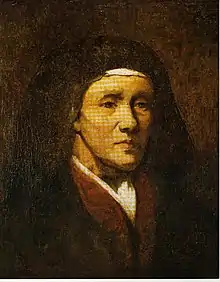 Portrait of Nano Nagle | |
| Virgin, Religious, Foundress, Educator | |
| Born | Honora Nagle c. 1718 Ballygriffin, County Cork, Kingdom of Ireland |
| Died | 26 April 1784 (age 65) Cork City, Kingdom of Ireland |
| Venerated in | Catholic Church |
| Major shrine | South Presentation Convent Cemetery, Douglas Street, Cork City, Ireland |
| Feast | 26 April |
| Attributes | Monastic habit Rosary |
Background
Nano Nagle lived during the period when the Catholic majority in Ireland were subject to the anti-Catholic Penal Laws. The Catholic Irish were denied political, economic, social and educational rights that would have lifted them from mass poverty. The parliamentarian and philosopher, Edmund Burke, a younger cousin of Nagle who spent part of his childhood in her birthplace, described those laws: "Their declared object was to reduce the Catholics in Ireland to a miserable populace, without property, without estimation, without education."[1]
Family
Nano Nagle was born in Ballygriffin, just north of Killavullen, County Cork, in 1718, the daughter of Garrett and Ann Mathew Nagle. The name "Honora" given at baptism was soon replaced in the family circle by the affectionate name "Nano". She was the eldest of six or seven children, the others being Mary (omitted in many sources), Ann, Catherine, Elizabeth, David, and Joseph.[2]
Nano was born in the Blackwater Valley in County Cork which possesses views of the distant Nagle Mountains. Much of this region was once the property of the Nagle family.[1] They were connected to some of the most-prominent local families, and their ancestors had lived in the area for hundreds of years. However, after the Williamite War in Ireland, the Nagle family's loyalty to the exiled Catholic King James II led to many of their ancestral lands being confiscated by the government.However, when Nano's parents married, the family still owned considerable property at Ballygriffin, Killavullen. Garrett's brother Joseph kept it in nominally Protestant hands so that the family could retain it under the Penal Laws.[2]
Education
Nano Nagle is believed to have attended a local hedge school, like her cousin Edmund Burke, before she travelled to France to complete her education.[3] The Education Act 1695 banned Catholic schoolteachers in Ireland, while also prohibiting overseas travel for Catholic education. Nagle relatives with strong connections in France arranged for Nano and her sister Ann to travel to Paris, perhaps smuggled in a cargo ship. They finished their schooling and Nano enjoyed a busy social life in Paris[1] – "balls, parties and theatre outings, all the glamour of the life of a wealthy young lady." After one of these parties, "she noticed a group of wretched-looking people huddled in a church doorway" and was struck by the contrast with her privileged life.[3]
Work with the poor
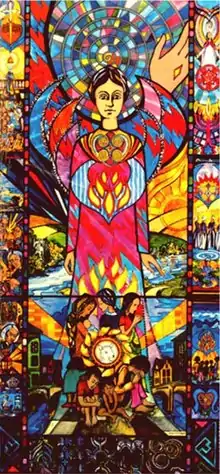
After their father's death in 1746, Nano and her sister joined their mother in Dublin, witnessing further poverty. Their mother died soon after, and Nano returned to Paris intending to enter an Ursuline convent, but a religious director advised her to help the poor of her own country instead. She returned to Cork and her brother Joseph, and established her first school for the poor in 1754, "in a rented mud cabin in Cove Lane, in defiance of the law, and in complete secrecy at first, even from her brother." He discovered her secret when a poor man came begging for Nano to accept his child into her school. "Her brother was very angry with her at first, because of the risks involved, but later became reconciled and gave her his full support."[1]
Nagle's first school opened with about 30 students, and this is now the site of South Presentation convent.[4] At first alone, and later with the support of her family, particularly her uncle Joseph Nagle who had used Protestantism to preserve the family's wealth, she established a network of Catholic schools in Cork. Not everyone in Cork welcomed the initiative: "She was insulted in the street on occasion, and her pupils were dismissed as 'beggars' brats'."[3] Within nine months, she was educating 200 girls. Within a few years, she had opened seven schools, five for girls and two for boys. These provided pupils with a basic education and religious instruction.[5]
The French Petites Écoles provided the model on which to base her schools, but she was to develop her own system of education. She described in a letter her ideas for education, and how she wanted the spiritual and temporal welfare of her pupils to be interwoven and to flow naturally together.[5]
Nagle "began to visit the sick and the elderly after school, bringing them food, medicine and comfort."[6] She went from hovel to hovel each day to gather the neediest people to teach. Nighttime ministries to poverty-ridden elderly and sick in her hometown gave Nagle the nickname The Lady with the Lantern. The lantern later became the symbol of the Presentation Sisters worldwide.
Institute of Charitable Instruction of the Sacred Heart of Jesus
As her workload increased, Nagle realised that she would need help with her work. In 1767, she stayed with the Ursuline Sisters in Paris while visiting her cousin Margaret Butler, who had been professed the previous year. In 1771, Nagle sponsored the first Ursuline convent in Ireland, a community of four women in Cork city who were professed in Paris, together with a reverend mother.[7] However, they were unable to educate the poor widely, because at that time Ursulines were required to remain enclosed in their convents.
Nagle and her assistants continued their work without becoming an established religious congregation, so they were free to work for the poor without being enclosed. On Christmas Eve 1775 she founded the Society of Charitable Instruction of the Sacred Heart of Jesus, in Cork, the first convent of what would later be the Presentation Sisters. She resisted the local bishop when he expressed fears that the establishment of the convent might provoke a Protestant backlash.[4] She received the habit on 29 June 1776, taking the name of "Mother Mary of St John of God". The sisters made their first annual vows on 24 June 1777.
The Presentation Sisters
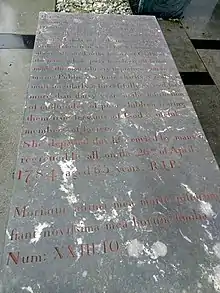
Nagle died from tuberculosis on 26 April 1784 in Cork city, at age 65.[6][8][9][10] By then she had established links with Teresa Mulally, who had founded a Catholic girls school for Dublin's inner-city poor. In 1794, a group of women who had helped with Mulally's projects in Dublin joined with Nagle's Cork group who had been renamed the Sisters of the Presentation of the Blessed Virgin Mary in 1791. Today, congregations of the Presentation Sisters exist all over the world. For example, in 1854, sisters travelled from Ireland to San Francisco, California, and within two weeks opened the first of many schools in the United States. In 1866, another group sailed from Ireland to Tasmania, establishing the first of many Presentation convents and schools in Australia.[11]
Legacy
In 2000, "Nagle was voted Irish Woman of the Millennium, in recognition of her importance as a pioneer of female education in Ireland."[4] In a 2005 radio poll, she was voted Ireland's greatest woman ever.[12] She inspired Edmund Ignatius Rice, the founder of the Christian Brothers, to bring education to the poor people. The Presentation Sisters became one of Ireland's prominent Catholic teaching orders along with The Ursulines, Christian Brothers and Presentation Brothers. The Presentation order has spread to two dozen countries worldwide.[3] Some of the schools founded by the Presentation Sisters are named after Nagle, and her teachings are still followed today. Ireland also honoured her with a pair of postage stamps for her order's 1975 bi-centenary[13][14] and with a 1985 footbridge across Cork's River Lee.[15] Nano Nagle Place, surrounding her original 1771 convent in Cork city, includes her tomb, museum, and archive.[16]
The Roman Catholic Church officially opened Nagle's cause for canonization in 1984, the bi-centenary of her death.[6] She was declared a Servant of God in 1994, and Venerable on 31 October 2013.[10][17]
References
- "Nano Nagle: Foundress of the Presentation Order". Cathedral of St. Mary and St. Anne, Cork. Archived from the original on 3 November 2013.
- Raftery, Deirdre; Nowlan-Roebuck, Catherine; Delaney, Catriona (2019). Nano Nagle: The Life and the Education Legacy. Irish Academic Press. p. 25. ISBN 978-1788550598.
- "Nano Nagle – remains an influential educator". Irish Independent. 29 April 2009. Retrieved 27 February 2021.
- Clear, Caitriona (Summer 2009). "Nano Nagle (1718–1784): Educator". Studies: An Irish Quarterly Review. 98 (390): 135–143. JSTOR 25660652.
- de Bhál, Dolores (Autumn 2000). "A Biographical Note: Nano Nagle, 1718–1784". Studies: An Irish Quarterly Review. 89 (355): 274–279. JSTOR 30095377.
- "Nano Nagle". Sisters of the Presentation, Dubuque. Retrieved 4 March 2021.
- Clarke, Sr M. Ursula. The Ursulines in Cork since 1771 (Cork: Ursuline Convent, 2007) ISBN 978-0-9528160-0-3
- English, Eoin (29 June 2017). "Watch: 'Urban oasis' convent set to open in Cork after €10m renovation". Irish Examiner. Retrieved 25 April 2021.
With money provided by her uncle, she acquired the South Presentation site and founded the Sisters of Presentation on Christmas Eve, 1775, before she took her final vows in June 1776, aged 58. She died, aged 66, on April 26, 1784, and is buried on the site.
- Raftery et al, p. 40.
- McQuinn, Cormac (31 October 2013). "Vatican announces Irishwoman Nano Nagle on path to sainthood". Irish Independent. Retrieved 29 November 2020.
- Herbermann, Charles, ed. (1913). . Catholic Encyclopedia. New York: Robert Appleton Company.
- Fitzgerald, James (25 June 2005). "Nano Nagle wins title of Ireland's greatest woman". The Irish Times. Retrieved 23 May 2017.
- "Nano Nagle (5 p)". Stamp catalog. Colnect. Retrieved 1 March 2021.
- "Nano Nagle (7 p)". Stamp catalog. Colnect. Retrieved 1 March 2021.
- "Nano Nagle Bridge". Structurae. Retrieved 1 March 2021.
- "Nano Nagle Place (Cork)". Retrieved 6 March 2021.
- "The Nano Nagle Cause". Presentation Sisters Union. Retrieved 5 March 2021.
Further reading
- Consedine, Mary Raphael. One Pace Beyond: The Life of Nano Nagle (Victoria, 1977)
- Coppinger, William. The Life of Miss Nano Nagle (Cork, 1794), via Eighteenth Century Collections Online
- Harnett, Mary Kieran. Nano Nagle, Woman of Vision (Dublin, 1975)
- Hutch, William. Nano Nagle (Dublin, 1875)
- Murphy, Dominick. Memoirs of Miss Nano Nagle (Cork, 1845)
- O'Farrell, Mary Pius. Nano Nagle: Woman of the Gospel (Monasterevan, 1996)
- Walsh, T.J. Nano Nagle and the Presentation Sisters (Dublin, 1959)


Authority control  | |
|---|---|
| General | |
| National libraries | |
| Biographical dictionaries | |
| Other | |