Sarah Lawrence (educator)
Sarah Lawrence (1780–1859)[1][2] was an English educator, writer and literary editor. She ran a girls' school in Gateacre near Liverpool, and was a family friend of the Aikins of Warrington, and an associate of members of the Roscoe circle.[3]
Early life
The Lawrence family were self-consciously descendants, in the fifth generation, of Philip Henry (1631–1696), an ejected minister. Sarah was one of nine daughters and two sons (two daughters and one son dying young) of Nathaniel Lawrence of Birmingham, who married in 1777 Mary Johnson.[4] The family belonged to the congregation of the Old Meeting House on Worcester Street. Nathaniel was a chapel warden in 1785. Both the Old Meeting House, and the New Meeting House on Moor Street, were destroyed in the first phase of the 1791 Priestley Riots, on the orders of an under-sheriff and two magistrates.[5][6]
In 1793 Nathaniel Lawrence lost his business in a financial slump.[7] A Nathaniel Lawrence of Birmingham declared bankrupt that year was a wine merchant.[8] Mary Lawrence and her daughters set up a girls' school in Birmingham.[7]
Eliza, the eldest daughter, at this time spent a period as a governess, as did other sisters, Sarah among them.[9][10] Mary's plan was that her daughters should spend time in other families, coming together later in a family-run school.[11] In Sarah's case, she was a governess in the household of Dr. Peter Crompton of Eton House, a radical physician and anti-corruption campaigner in Liverpool.[12][13]
The school at Gateacre
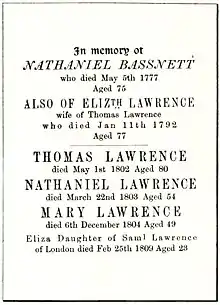
After the death of her parents Nathaniel and Mary, Sarah Lawrence, described as "a writer, poet and good Horatian scholar", with other members of her family founded a school for girls in Gatacre near Liverpool in 1807; she became the principal. It built up a good reputation.[10][7][14] There was an existing successful school in Gateacre, run by the Unitarian minister William Shepherd.[15] Together, in early decades of the 19th century, the two schools at Gateacre were "where the sons and daughters of the merchant aristocracy of Liverpool were educated".[16]
Schools of this time run in accordance with Unitarian views might do so tacitly, and attract pupils from Anglican families.[17] The Lawrences' school has been considered Unitarian, in a group with Lant Carpenter's school in Bristol, and locally the Everton school founded by the Swiss educator Carl Voelker.[18][19] Sarah Lawrence subscribed to the 1823 book of sermons of Henry Turner (died 1822), minister of the Unitarian High Pavement Chapel in Nottingham, as did Miss Benton of Gateacre, who in 1815 was advertising a preparatory school for boys 5 to 15 there, giving Shepherd, the Miss Lawrences and the Rev.Christopher Wyvill as references.[20][21] Advertising a school in Allerton, Liverpool in 1828, Voelker and Staehle used as references Sarah Lawrence, Thomas Stewart Traill and the Rev. Augustus Campbell of Childwall.[22][23] Another successful founder of a Unitarian school, near Wakefield, was Richmal Mangnall.[7]
After a generation Sarah Lawrence's school suffered from financial limitations and parsimony, and it was taken over in 1839, transferred to the Misses Holland.[7][14][11] By this time, there was a fashionable boy's preparatory school at Gateacre, run by Miss Hunt, and attended by Edmund Knowles Muspratt and Henry Enfield Roscoe.[24][25]
Location and aftermath
The Hollands' school was called at this point Gatacre School. They left it around 1863.[26] On the site, Cornelius Sherlock built for Andrew Barclay Walker Gatacre Grange, in 1866.[27]
Pupils and their backgrounds
Helen Bourn (1797–1871), a pupil at the school,[28] came from a "distinguished middle-class family", but also one with a long tradition of nonconformist ministry, from her great grandfather Samuel Bourn the younger.[29][30] She was an only child, her father Joseph Bourn being in business, probably textiles, and living in Bolton le Moors; her mother was Ellen Gaskell. Her father made difficulties about her first marriage, requiring that her fiancé should give up his medical career and move to north-west England as a fustian manufacturer.[31][32] She married Thomas Martineau, brother of Harriet Martineau, was widowed, and married Edward Tagart.[30]
The background of Dorothy Nicholson (1803–1893) who attended the Lawrences' school was nonconformist, mercantile and politically radical: her father Thomas Nicholson (1753–1825) of Gorton Hall was a cousin of Frances Nicholson (died 1829), Shepherd's wife, daughter of the Liverpool merchant Robert Nicholson (1727–1779) who was abolitionist and a governor of Warrington Academy; and she had early memories of the chant "Roscoe for ever!" of 1807. Dorothy was given tuition in the classics by Shepherd.[33][34]
Jane Ashton (1806–1884) from the Manchester area, maternal grandmother of Beatrix Potter, attended the school.[35] She was the daughter of John Ashton (1777–1845), a Unitarian and cotton manufacturer in Hyde, and his wife Harriot or Harriet Booth; and the sister of Thomas Ashton.[36][37] She married John Leech, a cotton merchant in Stalybridge.[38]
Family associations
In the diary of Hannah Mary Rathbone (née Reynolds) (1757–1839), wife of William Rathbone IV, Mary Crompton (the wife of Peter Crompton), her daughter, and Sarah Lawrence appear as a group of visitors in August 1805, and in October 1809. The first occasion is noted as "Miss Lawrence".[39][40] Sara Coleridge, wife of Samuel Taylor Coleridge, visited the Cromptons and then the Lawrences in Birmingham at the end of 1806.[41]
Eliza Lawrence took care of Catherine Emmet, orphaned daughter of Christopher Temple Emmet.[42] William Drennan, who had met Catherine at the Cromptons, wrote to his sister that "Miss L is a singularly interesting girl", and that "Holmes is expected in England to take away Miss Emmet" from the school.[43] Eliza married in 1810 Robert Holmes, Catherine's great-uncle, as his second wife, and died in 1811.[42][4] Catherine, after a short period in the United States, then went to live with William Hazlitt at Addlestone.[42]
"Two of the Miss Lawrences" were in Paris in 1820, and met Maria Edgeworth there, with a letter of introduction from a Miss Carr.[44] Maria offered one of them, who "with her sisters, had a large school at Liverpool", a governess post, with the Duchess of Orleans, but the position was turned down.[45] Miss Carr, in Edgeworth's correspondence, may be Sarah Grace Carr who in 1821 married Stephen Lushington.[46]
Robert Perceval Graves's biography of William Rowan Hamilton states that it was the elder of the two sisters in Paris who was offered the position as governess.[47] In 1825 there were five surviving sisters, Eliza and Frances having died as adults: in order of age, Sarah, Mary, Arabella, Jane, and Harriet, none of whom married.[4] Hamilton met one of the these sisters, in 1825, and Graves presumes the occasion was when this Miss Lawrence was a guest of Maria Edgeworth.[47] Hamilton then (according to Graves) corresponded with "the elder" sister.[47] In modern scholarship, the correspondent from 1825 of Hamilton is identified as Arabella.[48]
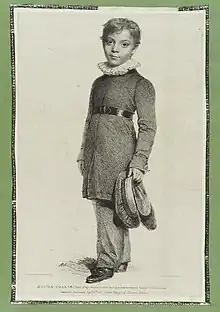
In 1827 Hamilton wrote to his sister Grace about "some of" the Lawrence sisters having met his sister Eliza Mary Hamilton (1807–1851), a poet, in Dublin.[49][50] Also in 1827, the calculator Master Noakes was brought to the school, where Hamilton had a chance to assess him.[51]
Hamilton was given an introduction to Coleridge, by Sarah.[47] This was at the end of Coleridge's life: he replied to Sarah's letter recalling memories of her and Crompton's wife Mary.[12]
Sarah Lawrence was a close friend of Arthur Aikin, and Charles Rochemont Aikin and family. She corresponded with Arthur, and Helen Martineau, sister-in-law of Harriet Martineau. Manuscripts from the correspondence with Martineau contain poems that have been attributed to Anna Letitia Barbauld, though they are in Lawrence's hand.[1] It was in a letter to Sarah that Arthur described the last days of Anna Letitia, his aunt.[3]
Arabella Lawrence and Lady Byron
Arabella Lawrence, around 1820, gave a reference to a Miss Lamont from Ireland, who was then employed by Lady Byron to care for her daughter Ada Byron at Kirkby Mallory. Lady Byron took up the reference with Arabella, who defended Miss Lamont and had Lady Byron's respect.[52] From the late 1820s to 1832, Arabella was one of those supervising the education of the teenage Ada Byron (born 1815). The others in the group of family friends given the task by Lady Byron were William King and Sophia Frend.[53] Arabella continued to correspond with Lady Byron, who in 1839 wrote to her in connection with her efforts on agricultural schools.[54]
Works
- Stories Selected from the History of Greece, for Children (1820)[55]
- The Descendants of Philip Henry, M.A., Incumbent of Worthenbury, in the County of Flint (1844)[56] Sarah worked on this project, which began with a family tree made by Helen Martineau, from about 1840, with Samuel Sharpe.[28]
- The Laurel: Fugitive Poetry of the Nineteenth Century (1841),[57] editor of the anthology.
- Poems (1847)[58]
Later lives and deaths
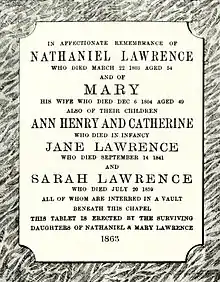
Leaving Gateacre in 1839, the sisters moved to Leamington Spa.[11] They lived at 2 Warwick Place. Jane Lawrence died in 1842.[4] Sarah Lawrence died, at home in Warwick Place, on 20 July 1859.[2] Harriet (given as "Harriette") died there on 10 March 1863.[59] Mary Lawrence who died at Warwick Place, Leamington Spa, a few weeks later, formerly of "The Grange, Gatacre", presumably, was her sister.[60]
Arabella Lawrence died at home, in Warwick Place, Leamington Spa, on 13 August 1873. She was the last survivor of the Lawrence sisters.[61]
Next generations
Sarah's brother Nathaniel Lawrence the younger married Francis Sarah Ogden, daughter of Abraham Ogden, in 1815. He had been in the United States since at least 1810. He died in 1824.[4][62][63] There were three sons and two daughters of the marriage, the eldest son Robert Holmes Lawrence dying young.[64] One of the sons was Philip Henry Lawrence (1822–1895). He was brought up by the Lawrence sisters, his aunts, as was his brother Nathaniel Tertius Lawrence.[65] Mary Lawrence, one of the daughters, might be confused with her aunt of the same name. Sarah Frances, the other daughter, married in 1837 William Talbot, a solicitor in Kidderminster; they had four sons and two daughters.[66]
Penelope Lawrence, founder with her half-sisters of Roedean School, was the daughter of Philip Henry Lawrence and his first wife Charlotte Bailey;[67] Susan Lawrence the politician was the daughter of Nathaniel Tertius Lawrence and his wife Laura Bacon, daughter of James Bacon.[68][69] Laura Frances, eldest daughter of Nathaniel Tertius Lawrence, married in 1884 Henry Turton Norton, and was mother of Jane Elizabeth Norton and Henry Turton James Norton.[70][71]
Notes
- Barbauld, Anna Letitia (1 January 1994). The Poems of Anna Letitia Barbauld. University of Georgia Press. ISBN 978-0-8203-1528-7.
- "Died". Liverpool Albion. 25 July 1859. p. 3.
- Chandler, George (1953). William Roscoe of Liverpool. London: Batsford. p. xxix.
- Lawrence, Sarah (1844). The Descendants of Philip Henry, M.A., Incumbent of Worthenbury, in the County of Flint. London: Simpkin, Marshall & Co. p. 25.
- Beale, Catherine Hutton (1882). Memorials of the Old Meeting House and Burial Ground, Birmingham.
- Thomas, Amanda J. (30 May 2020). The Nonconformist Revolution: Religious dissent, innovation and rebellion. Pen and Sword History. p. 192. ISBN 978-1-4738-7570-8.
- Watts, Ruth (6 June 2014). Gender, Power and the Unitarians in England, 1760-1860. Routledge. p. 54. ISBN 978-1-317-88862-8.
- The Universal Magazine of Knowledge and Pleasure. Published ... according to Act of Parliament, for John Hinton. 1793. p. 397.
- Watts, Ruth (6 June 2014). Gender, Power and the Unitarians in England, 1760-1860. Routledge. p. 86. ISBN 978-1-317-88862-8.
- Bellaigue, Christina de (16 August 2007). Educating Women: Schooling and Identity in England and France, 1800-1867. OUP Oxford. p. 48. ISBN 978-0-19-928998-1.
- Bellaigue, Christina de (16 August 2007). Educating Women: Schooling and Identity in England and France, 1800-1867. OUP Oxford. pp. 79–80. ISBN 978-0-19-928998-1.
- Coleridge, Samuel Taylor; Coleridge, Ernest Hartley; Coburn, Kathleen (1895). Letters of Samuel Taylor Coleridge : in two volumes. London : William Heinemann. p. 758.
- "Liverpool 1820-1832, History of Parliament Online". www.historyofparliamentonline.org.
- Kamm, Josephine (16 April 2010). Hope Deferred (Routledge Revivals): Girls' Education in English History. Routledge. p. 101. ISBN 978-1-135-15580-3.
- Webb, R. K. "Shepherd, William (1768–1847)". Oxford Dictionary of National Biography (online ed.). Oxford University Press. doi:10.1093/ref:odnb/25340. (Subscription or UK public library membership required.)
- Phillips, Paul T. (1978). The View from the Pulpit: Victorian Ministers and Society. Macmillan of Canada. p. 216. ISBN 978-0-7705-1590-4.
- Watts, Ruth (6 June 2014). Gender, Power and the Unitarians in England, 1760-1860. Routledge. p. 53. ISBN 978-1-317-88862-8.
- Paz, Denis G. (1995). Nineteenth-century English Religious Traditions: Retrospect and Prospect. Greenwood Publishing Group. p. 111 note. ISBN 978-0-313-29476-1.
- Koss, Stephen E. (2 October 1970). Sir John Brunner: Radical Plutocrat 1842-1919. CUP Archive. p. 3.
- Turner, Henry (1823). Sermons. pp. xxv.
- "Preparatory School for Young Gentlemen". Liverpool Mercury. 15 November 1816. p. 1.
- "Education in the Classics and Modern Languages". The Albion. 24 November 1828. p. 1.
- "Campbell, Augustus (CMBL803A)". A Cambridge Alumni Database. University of Cambridge.
- Reed, Peter (9 March 2016). Entrepreneurial Ventures in Chemistry: The Muspratts of Liverpool, 1793-1934. Routledge. p. 48. ISBN 978-1-317-14263-8.
- Roscoe, Henry Enfield (1906). The Life & Experiences of Sir Henry Enfield Roscoe. Macmillan and Company, limited. p. 14.
- "Memories of Miss Holland at Gateacre". Liverpool Daily Post. 25 March 1903. p. 3.
- Costambeys, Marios; Hamer, Andrew J.; Heale, Martin (2007). The Making of the Middle Ages: Liverpool Essays. Liverpool University Press. p. 223. ISBN 978-1-84631-068-3.
- Clayden, Peter William (1883). Samuel Sharpe: Egyptologist and Translator of the Bible. K. Paul, Trench & Company. p. 87.
- Kenyon, Olga (21 October 2011). 800 Years of Women's Letters. History Press. p. 96. ISBN 978-0-7524-7200-3.
- Gordon, Alexander (1898). . In Lee, Sidney (ed.). Dictionary of National Biography. 55. London: Smith, Elder & Co.
- Turner, William (1843). The Lives of Eminent Unitarians: With a Notice of Dissenting Academies. Unitarian Soc. p. 334.
- Peart, Ann Sonja (2006). Forgotten Prophets : the lives of unitarian women, 1760-1904. theses.ncl.ac.uk (Thesis). Newcastle University. pp. 1–23, 103, 120.
- "Liverpool Worthies". Liverpool Mercury. 3 April 1893. p. 4.
- Sekers, David (editor). "The Diary of Hannah Lightbody 1786/1770" (PDF). qmul.ac.uk. pp. 21, 173.CS1 maint: extra text: authors list (link)
- Potter, Beatrix (17 July 2017). Selected Journal Entries by Beatrix Potter - Delphi Classics (Illustrated). Delphi Classics. p. 15. ISBN 978-1-78877-455-0.
- Lear, Linda (6 March 2008). Beatrix Potter: A Life in Nature. Penguin Books Limited. p. 20. ISBN 978-0-14-191962-1.
- Middleton, Thomas (1899). Annals of Hyde and district : containing historical reminiscences of Denton, Haughton, Dukinfield, Mottram, Longdendale, Bredbury, Marple, and the neighbouring townships. Manchester: Cartwright & Rattray. p. 153.
- Taylor, Judy. "Potter [married name Heelis], (Helen) Beatrix". Oxford Dictionary of National Biography (online ed.). Oxford University Press. doi:10.1093/ref:odnb/35584. (Subscription or UK public library membership required.)
- Greg, Emily Rathbone (1905). Reynolds-Rathbone diaries and letters, 1753-1839. Edinburgh: Printed for private circulation. p. 104.
- Greg, Emily Rathbone (1905). Reynolds-Rathbone diaries and letters, 1753-1839. Edinburgh: Printed for private circulation. p. 147.
- Coleridge, Sara Coleridge; Coleridge, Edith (1875). Memoir and letters of Sara Coleridge. London : H.S. King. p. 7.
- Madden, Richard Robert (1860). The United Irishmen, Their Lives and Times. James Duffy. p. 20.
- Drennan, William; McTier, Martha Drennan (1998). The Drennan-McTier Letters: 1802-1819. Women's History Project. p. 635. ISBN 978-1-874280-43-9.
- Edgeworth, Maria (1894). The Life and Letters of Maria Edgeworth (Complete). Library of Alexandria. p. 326. ISBN 978-1-4655-2108-8.
- Edgeworth, Frances Anne Beaufort (15 September 2021). A Memoir of Maria Edgeworth: With a Selection from her Letters: Vol. II. II. BoD – Books on Demand. p. 72. ISBN 978-3-7525-2997-5.
- Taylor, David (2020). The Remarkable Lushington Family: Reformers, Pre-Raphaelites, and the Bloomsbury Group. Rowman & Littlefield. p. 21. ISBN 978-1-7936-1716-3.
- Graves, Robert Perceval (1882). Life of Sir William Rowan Hamilton: Knt., LL. D., D. C. L., M. R. I. A., Andrews Professor of Astronomy in the University of Dublin, and Royal Astronomer of Ireland, Etc. Etc.: Including Selections from His Poems, Correspondence, and Miscellaneous Writings. Hodges, Figgis, & Company. p. 191.
- Brown, Daniel (2012). "William Rowan Hamilton and William Wordsworth: the Poetry of Science". Studies in Romanticism. 51 (4): 490. ISSN 0039-3762. JSTOR 24247229.
- Graves, Robert Perceval (1882). Life of Sir William Rowan Hamilton. Hodges. p. 259.
- Blain, Virginia H. "Hamilton, Eliza Mary (1807–1851)". Oxford Dictionary of National Biography (online ed.). Oxford University Press. doi:10.1093/ref:odnb/61561. (Subscription or UK public library membership required.)
- The Kaleidoscope: or, Literary and scientific mirror. 1828. p. 95.
- Seymour, Miranda (22 March 2018). In Byron's Wake. Simon & Schuster UK. pp. 103–104. ISBN 978-1-4711-3859-1.
- Baillie, Joanna (1999). The Collected Letters of Joanna Baillie. Fairleigh Dickinson Univ Press. p. 728. ISBN 978-0-8386-3816-3.
- Pierson, Joan (1992). The Real Lady Byron. London: Robert Hale. p. 195. ISBN 978-0-7090-4957-9.
- Lawrence, Sarah (1820). Stories Selected from the History of Greece, for Children. author.
- Lawrence, Sarah (1844). The Descendants of Philip Henry, M.A., Incumbent of Worthenbury, in the County of Flint. London: Simpkin, Marshall & Co.
- Lawrence, Sarah (1841). The Laurel: Fugitive Poetry of the Nineteenth Century. Tilt & Bogue.
- Lawrence, Sarah (1847). Poems. London: Kinder.
- "Deaths". Liverpool Mercury. 24 March 1863. p. 10.
- "Deaths". Liverpool Mercury. 21 April 1863. p. 3.
- The Illustrated London News. Elm House. 1873. p. 138.
- Wheeler, William Ogden; Van Alstyne, Lawrence; Ogden, Charles Burr (1907). The Ogden family in America, Elizabethtown branch, and their English ancestry; John Ogden, the Pilgrim, and his descendants, 1640-1906. Philadelphia, Printed for private circulation by J.B. Lippincott company. p. 104.
- Zouche, Dorothy E. De (1955). Roedean School, 1885-1955. The School. p. 14 note 2.
- Lawrence, Sarah (1844). The Descendants of Philip Henry, M.A.: Incumbent of Worthenbury, in the County of Flint; who was Ejected Therefrom by the Act of Uniformity in 1662. Simpkin, Marshall, and Company John Merridew, Leamington. p. 25.
- Ogilvie, Marilyn Bailey; Harvey, Joy Dorothy (2000). The Biographical Dictionary of Women in Science: L-Z. Taylor & Francis. p. 754. ISBN 978-0-415-92040-7.
- The Law Times. Office of The Law times. 1888. p. 87.
- "Lawrence, Penelope (LWRN876Pw)". A Cambridge Alumni Database. University of Cambridge.
- Hartley, Cathy (2003). A Historical Dictionary of British Women. Psychology Press. p. 269. ISBN 978-1-85743-228-2.
- The Solicitors' Journal and Reporter. Law Newspaper Company. 1860. p. 571.
- The Eagle. XXVI. W. Metcalfe. 1906. p. 213.
- "Norton, Henry Turton (NRTN865HT)". A Cambridge Alumni Database. University of Cambridge.