National Pro Patria Party
The National Party of the Fatherland[9] (Spanish: Spanish: Partido Nacional Pro-Patria), usually named National Pro Patria Party, was a Salvadoran nationalist and authoritarian political party founded in 1931 by General Maximiliano Hernández Martínez to support his policies and rule, and establish a one party system, effectively banning all political parties except for Pro Patria, eliminating all competition in election and membership recruiting.
National Party of the Fatherland Partido Nacional Pro-Patria | |
|---|---|
| Leader | Maximiliano Hernández Martínez |
| Founded | 1931 |
| Dissolved | 1944 |
| Preceded by | National Republican Party |
| Headquarters | San Salvador, El Salvador |
| Ideology | Fascism[1][2] Anti-communism[3][4][5] Conservatism[6] Agrarian oligarchy[7][8] |
| Political position | Far-right |
| Slogan | "Paz, Orden, Justicia, y Probidad" (English: "Peace, Order, Justice, and Probity") |
Electoral history
Presidential elections
| Election | Party candidate | Votes | % | Result |
|---|---|---|---|---|
| 1935 | Maximiliano Hernández Martínez | 329,555[10] | 100% | Elected  |
| 1939 | 210,810[10] | 100% | Elected | |
| 1944 | 100% | Elected |
Legislative Assembly elections
| Election | Party leader | Votes | % | Position | Seats | +/– | Outcome |
|---|---|---|---|---|---|---|---|
| 1932 | Maximiliano Hernández Martínez | Election canceled | |||||
| 1936 |  1st 1st |
42 / 42 |
42 |
Sole legal party | |||
| 1939 | 210,810 | 100% |  1st 1st |
42 / 42 |
|
Sole legal party | |
| 1944 | 1st |
42 / 42 |
|
Sole legal party | |||
PNPP Presidents of El Salvador
| No. | Portrait | Name
(Birth–Death) |
Elected | Term of office | ||
|---|---|---|---|---|---|---|
| Took office | Left office | Time in office | ||||
| 1 (–) |
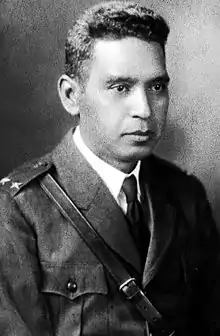 |
Maximiliano Hernández Martínez (1882–1966) |
— | 4 December 1931 | 28 August 1934 | 2 years, 267 days |
| 2 (–) |
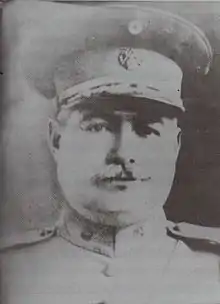 |
Andrés Ignacio Menéndez (1879–1962) |
— | 28 August 1934 | 1 March 1935 | 185 days |
| 3 (30) |
|
Maximiliano Hernández Martínez (1882–1966) |
1935 1939 1944 |
1 March 1935 | 9 May 1944 | 9 years, 69 days |
| 4 (–) |
|
Andrés Ignacio Menéndez (1879–1962) |
— | 9 May 1944 | 20 October 1944 | 164 days |
References
- Carmelo Francisco esmeralda Astilla (1976). "The Martinez Era: Salvadoran-American Relations, 1931-1944". Louisiana State University and Agricultural & Mechanical College.
- Dunkerley, James (1998). British documents on foreign affairs : reports and papers from the Foreign Office confidential print. University Publications of America. ISBN 978-1-55655-673-9. Retrieved 5 July 2020.
- Luna, David (2000). University of El Salvador (ed.). Analisis de una dictadura fascista latinoamericana. Maximiliano Hernandez Martinez, 1931-1944.
- Wood, Andrew G. (2014). Oxford University Press (ed.). Agustin Lara: A Cultural Biography. p. 99. ISBN 9780199892464.
- Leonard, Thomas M.; Bratzel, John F. (2007). Rowman & Littlefield (ed.). Latin America During World War II. p. 9. ISBN 9780742537415.
- Middlebrook, Kevin J. (2000). Johns Hopkins University Press (ed.). Conservative Parties, the Right, and Democracy in Latin America. p. 175. ISBN 9780801863851.
- Peñate, Oscar Martínez (2003). El Salvador Sociologia General. p. 88. ISBN 9789992380031.
- Dimas, Roldán (2013). Xlibris Corporation (ed.). El Ultimo Latido de una Madre. p. 44. ISBN 9781483699448.
- Lauria-Santiago, Aldo; Binford, Leigh (2004). University of Pittsburgh Press (ed.). Landscapes of Struggle: Politics, Society, and Community in El Salvador. p. 60. ISBN 9780822972549.
- "Elections and Events 1935–1969". Retrieved 20 July 2020.
| Represented in the Legislative Assembly | |
|---|---|
| Unrepresented | |
Portal:Politics - List of political parties - Politics of El Salvador | |
This article is issued from Wikipedia. The text is licensed under Creative Commons - Attribution - Sharealike. Additional terms may apply for the media files.