Nekrasov Central Library
The Central Universal Science Nekrasov Library (Russian: Центральная универсальная научная библиотека имени Н. А. Некрасова; English: Nekrasov Library) is a public library located in Moscow and founded in 1919.[1] The library receives its name after Russian poet and writer Nikolay Nekrasov. With over 2 million items in more than 100 languages, Nekrasov Library is a public library service for Moscow citizens. The center is also founded to support and coordinate other public libraries of Moscow, in addition being a public space for cultural events, lectures and expositions.
| Центральная универсальная научная библиотека имени Н. А. Некрасова | |
 | |
 | |
| Established | 1919 |
|---|---|
| Location | Moscow, Russia |
| Branches | 3 |
| Collection | |
| Size | 1 117 399 (2019) |
| Access and use | |
| Population served | 13515 (2018) |
| Other information | |
| Director | Maria Privalova |
| Staff | 150 |
| Website | nekrasovka |
History
By 1941 the library's book fund consisted of 193 599 copies and there were 43 899 readers. During the Second World War the library served veterans and became a centre for the formation of mobile libraries for the front. Hundreds of packets with library books were sent to the army post offices.
Nekrasov Central City Public Nekrasov Library
Following the decision of the Government and due to the 125 anniversary of the great poet and democrat N. A. Nekrasov, in 1946 the library was given his name.
In 1955 the library moved from Arbat to the estate of A. S. Saltykova, which was the architectural monument of the XVIII century situated on Bolshaya Bronnaya street. In 1963 it was the first time when the library got an opportunity to disclose its collections.
Due to the public domain, readers could choose any book and work with the reference and bibliographic system. The system of cards and catalogues was created for people to use thematic bibliography. The book fund increased to 600 thousand books. It included literature on 36 languages. Scientific and pop-science literature made up 73.4% of the fund.
Nekrasov Central Universal Scientific Library
In 1968 the library was entrusted with theoretical and methodical development of local history issues with regard to the conditions of a large city. At the local history development section the club "Moscow" was organized, resulted in the formation of the city local history community. Furthermore, in 1968 the library took part in the activities of the commissions of the USSR and RSFSR Ministries of culture ("Centralization of network of libraries"). So, it became a base for research work of the Moscow State Art and Cultural University and the Russian State Library.
By the beginning of 1970s, the library contained a substantial fund of literature focusing on art. Owing to this fund and Moscow collectors’ gifts, the library opened a specialized art literature and art department. In 1972, at the 50 anniversary of USSR, the department of literature in languages of the Soviet Union was opened.
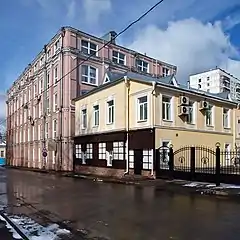
In 2002 the library moved to Baumanskaya street, 58/25, building 14.That year it got the website: www.nekrasovka.ru.
In 2004 the first experimental step to introduce the service system “Single Reading Card” was carried out in Nekrasov CUSL and other Moscow public libraries through the OPAC-Global automated information system. To improve the information and bibliographic service for users a remote service through the library's website – “Online Help” – was implemented.
In 2006, by the order of the Moscow Department of Culture the Nekrasov Central City Public Library was renamed for the Nekrasov Central Universal Scientific Library. It was decided to staff the library with research workers. A department of non-stationary differentiated service for people with disabilities, veterans, elderly people and large families began to function in the library. At the same time the Center of restoration and preservation of publications was created, where people with limited abilities were provided with trainings and teleworking.
In 2010 the library took part in an action “Boulevard of Art” coinciding with the Moscow City Day for the first time.
In 2012 the Nekrasov CUSL became a part of the “Biblionight” as a co-organizer and as a coordinator of a press-center for online connections of all Moscow libraries participating in this project.
The library is a member of the International Association of Metropolitan City Libraries (INTAMEL), participates in a number of international organisations and professional associations, including UNESCO, International Assembly of Capitals and Cities and some others. Also, it regularly takes part in the contest "Golden Formulary". The substantial work of the library is mostly determined by the main topics and dates of a year.
Today the Moscow cultural budgetary institution "Nekrasov Central Universal Scientific Library" is a public cultural, educational and research establishment with a diversified book collection. It provides a platform for organizing people's leisure and communications in the metropolis being a center of socially important information.
In 2019, the CUSL collection included 1 117 399 copies, as follows: 768 361 of them are books or print editions, 188 501 magazines, 138 199 microfilms and microfiches, 19 168 CD/ DVD, 3 170 newspapers.
There are 97 913 copies in foreign languages and in national languages of the peoples of the Russian Federation in the fund: 66 510 of them are in national languages of the peoples of Russia 31 403 – in foreign languages.
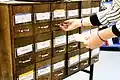
In 2019 the library got 117 magazines and 11 newspapers by subscription. By the end of 2018 13 515 people were registered. There were 201 827 visits. The library keeps an electronic and traditional card catalogues.
According to the mayor office, Nekrasov Library was on the third place in terms of attendance in Moscow in 2018. Nevertheless, the institution continues to look for new formats to increase brand recognition. Since 2019 Nekrasovka gives away not only books, but also some table games.
“The most important achievement of a library is to be able to tell about yourself so that people will come to the institution,” – tells the winner of “The best librarian of Moscow-2019” Nikita Golovanov, the head of department of the library's collections and reading promotion.
Users of the library get an access to online, new bibliographic and information services, a “Callback” option, video- and audio requests and answers in Skype. Moreover, they are provided with the service of electronic delivery of documents within the framework of the Civil Code of the Russian Federation and the interlibrary subscription. In addition, users have an access to free Wi-Fi connection.
The Nekrasov CUSL continues working on the program “Creation of Moscow territorial insurance documentation fund”, which is held jointly with the Scientific and Technical Center “Region”. During last year more than 750 colored insurance copies of rare fund's collection documents were digitized.
An access to remote electronic documents, such as legal bases, databases of periodicals as well as to open full-text Internet libraries in the reading hall of the Media Library, is organized.
Since 2013 readers have an access to the electronic library “BookFund” where they can download texts from online-catalogue “LitRes”. The conferences held in the library were broadcast online on the BiblioGorod portal until 2017.
Currently Nekrasov library develops social partnerships with higher and secondary educational institutions, provides patronage over orphanages and boarding schools and is a member of the International Academy of the integration of science and business.
Fund
The fund of literature on art and fine products includes books on all kinds of arts, antique editions, the fund of reproductions, collections of industrial graphics, ex-libris and phillumeny.[2] Apart from the current periodicals, there are also foreign art magazines of the 19th century and the Russian pre-revolutionary editions in the magazine collection. Historical and artistic value is represented by the fund of book signs, which numbers 40 thousand ex-libris made by famous artists, the fund of graphics – packages, labels of confectionary, perfume, canning and tobacco industry of pre-revolutionary and soviet Russia and the collection of phillumeny (50 albums), which consists of 120 thousand items and includes the world famous L. Zheverzheev's collection of matches labels.
The fund of rare books has 4,5 thousand items, including such publications as: “The Acts of Peter the Great” (1788–1796), N. M. Karamzin's lifetime edition "The history of the Russian State " in 12 volumes (1815–1829), collections of works of great Russian writers, published in the XIX century, an illustrated edition of N. V. Gogol's poem "The Travels of Chichikov, or Dead Souls" (1900), the Encyclopedic Dictionary of Brockhaus and Efron in 86 volumes, F. Schlosser's "World History" in 6 volumes (1868–1872), "The history of the XIX century" by Lavisse and Rambo (1905–1907), a complete collection of fables by Lafonten with drawings by Angien Lambert (1901) and others. The library forms the fund of microfiches for the most requested literature and periodicals, which allows to ensure the preservation of the book collection.
The library has a book fund on 150 languages of the peoples of the Russian Federation, countries of near and far abroad. It contains more than 100 thousand documents of the end of XIX-the beginning of XXI centuries. The collection includes dictionaries and textbooks in popular European languages as well as in rare ones – Khmer, Sanskrit, Crimean Tatar, etc. Here you can find a collection of works by Joyce, "The World Police Encyclopedia", Eskimo fairy tales, poems of Persian romantic Nizami and much more – in the original language.
Electronic resources of the N. A. Nekrasov CUSL are formed as a part of unified distributed information resources of Moscow public libraries. The digital library's fund consists of editions on CD-ROM and other multimedia resources. Among them – electronic works of Russian literature classics, collections of world paintings of various epochs and styles, editions devoted to Moscow history, interactive multimedia courses on information technologies and the unique encyclopedic resource "Media Library of Kirill and Methodius".
.jpg.webp)
_14.jpg.webp)
_40.jpg.webp)
_45.jpg.webp)
_58.jpg.webp)
Structure
The library has more than ten departments, including the department of cultural and educational projects and programs, the department of reading and collections promotion, the department of restoration and conservation of editions.
Affiliates
- Point of book delivery in the shopping center "Oceania". 121170, Moscow, 57 Kutuzovsky prospect, 4th floor (Slavyansky bulvar metro station). It is the first library point in a shopping and entertainment center in Russia. Its visitors can sign up for the Nekrasov Library, take books home, order or return books from the main fund of the library and get acquainted with book novelties;
- Point of book delivery in the shopping mall "Vodny". Moscow, 5 Golovinskoye Chaussee, 2nd floor (Vodny Stadion metro station);
- Typography, 127521, Moscow, 58 Oktyabrskaya st. (Maryina roshcha metro station).
There are two special reading halls in the summer: A summer reading room in Bauman Garden; “Place of the Book” – in Muzeon Park of Arts.
Projects
The library actively supports the bookcrossing movement and regularly holds book exchange actions.
The project "Electronekrasovka"
In 2017 the project "Electronekrasovka" was launched – a new site for the library's digitized collections. Over 20 000 digitized books, newspapers and magazines from 1564 to 2001 are available there.
More than a hundred publications on the site are particularly rare and valuable, including "The Tale of Igor’s Campaign" (1800), "Psalter with commentary by Martin Luther" (1610), "The Acts of Peter the Great" (1790), "Canon of the Five Orders of Architecture" (1564).
Now there are about 18 000 periodicals editions on the site. It is the largest digitized collection of periodicals in the Russian Internet, which received the award "Free knowledge 2019".
The collection includes magazines "The world of art" and "Novy Lef", architectural magazines "Zodchy" and "Stroitelstvo Moskvy", photo magazines "USSR on construction", "Proletarian photo", "Amateur photographer" by Sergei Prokudin-Gorsky as well as foreign, satirical and theatre magazines of different years and much more. The archive of the newspaper "Evening Moscow" from 1934 to 1961 is in the process of digitization.
The web-site regularly publishes materials prepared on the basis of the Nekrasov library's archive – chronics, articles, games, tests. For instance, you can read there about the construction of the Shukhov Tower, find a guidebook to revolutionary Moscow of 1917 and the manifesto of the agitprop theatre "Blue Blouse".
The project "Questionnaire about Nekrasov"
In 1920s Korney Chukovsky, who studied Nekrasov's works, made and distributed a "Questionnaire about Nekrasov" among writers.
Famous poets and writers – Alexander Blok, Maximilian Voloshin, Anna Akhmatova, Zinaida Gippius, Nikolay Gumilyov, Evgeny Zamyatin, Vladimir Mayakovsky and others – answered ten questions: which Nekrasov's poems they considered the best, whether Nekrasov influenced their own work, whether they considered him an immoral person and so on.
- Do you like Nekrasov’s poetry?
- Which of Nekrasov's poems do you consider the best?
- How do you feel about Nekrasov's poetry technique?
- Wasn't there a period in your life when his poetry was more precious for you than Pushkin's poems?
- How did you feel about Nekrasov in your childhood?
- How did you feel about Nekrasov in youth?
- Didn't Nekrasov have an influence on your work?
- How do you feel about a famous Turgenev's statement that “poetry did not spend the night” [there is no poetry] in Nekrasov's poems?
- What is your opinion about people's love of Nekrasov?
- How do you feel about the widespread opinion that Nekrasov was a vicious and immoral man?
“For each writer whose works live through several epochs, every new epoch imposes new grid which closes in a writer’s image one features every time – and opens other…" – once wrote Chukovsky in his diary. It is easy to verify the faithfulness of this judgement if you put together everything what was written about Nekrasov in different years, in different eras.
For the first time such a questionnaire was conducted on the 25th anniversary of the death of N. A. Nekrasov. The newspaper "Daily news" distributed an article "Has Nekrasov lived out?" among writers and poets. It was said in the article: “The history comes for Nekrasov in his poetry. We found it interesting to make at least a faint attempt to look into the verdict of this history, to guess what place it had prepared for him, whether immortality or oblivion is waiting. Was Nekrasov a “knight for an hour”, in his own words, or a true poet? At least, how does modernity answer that in faces of its prominent representatives?”
On 27 December 1902, the newspaper posted its questions and answers. A. P. Chekhov, P. D. Boborykin, N. N. Zlatovratsky, L. N. Andreev, N. M. Minsky, I. A. Bunin, V. Y. Bryusov, S. A. Naydyonov, I. E. Repin, A. A. Volynsky responded to the questions of the newspaper.
In 1920s Korney Chukovsky compiled and distributed among writers a new "Questionnaire about Nekrasov".
It was answered by N. Aseev, A. Akhmatova, A. Blok, M. Voloshin, M. Gerasimov, Z. Gippius, M. Gorky, S. Gorodetsky, N. Gumilyov, E. Zamyatin, V. Ivanov, V. Kirillov, A. Kraysky, M. Kuzmin, V. Mayakovsky, D. Merezhkovsky, B. Pilnyak, I. Repin, I. Sadofyev, F. Sologub and N. Tikhonov.
Finally, the Nekrasov CUSL distributed a new questionnaire about Nekrasov, which was compiled by V. N. Leonovich, in 1986. The following people sent their answers: L. Anninsky, V. Berestov, S. Biryukov, E. Blaginina, K. Vansheknin, L. Vysheslavsky, A. Geleskul, Y. Karabhcievsky, V. Kornilov, M. Kudimova, A. Kushner, B. Lakshin, S. Lipkin, Y. Morits, L. Ozerov, B. Okudzhava, L. Panteleev, I. Petrova, I. Rodnyanskaya, N. Ryabinina, D. Samoylov, B. Sarnov, B. Chichibabin, A. Chudakov and A. Yudakhin.
Following the tradition established by Korney Chukovsky in 1920s together with the poet Sergey Neshcheritov and the journalist Konstantin Vorovich 28 answers on a questionnaire about Nekrasov out of modern poets, writers and philologists from Vladimir Aristov to Marietta Chudakova were collected.
Library publications
The library periodically published bibliographic indexes to national memorial dates and albums-catalogues based on the collections of the library's rare fund. For example, two albums based on the materials of ex-libris collection, – “Booksigns of the libraries of the Imperial House of Romanov” and “Booksigns of the libraries of the participants of the Patriotic War in 1812” – were awarded honorary certificates by the International Federation of Societies of Ex-libris collectors (FISAE), the bibliography index “Ivan Semyonovich Efimov (1878–1959)” won the RBA competition “The best professional book of the year – 2013”, the bibliography index-directory to the 65th anniversary of the Victory “Cannot be forgotten: The Great Patriotic War on movie screen and in fiction literature” received first place in the professional contest “Golden Formulary – 2010”. In recent years 8 thematic and 12 personal bibliography indexes have been published. «Vestnik bibliotek Moskvy»
Events
Every year the library holds more than 500 mass socially significant events.[3] Among them are: Biblionight, “Night of Arts”, festivals, various presentations (exhibitions, books), lectures, meetings of the city literary club “Nekrasov’s Fridays”, demonstrations, literary and musical evenings. It is a venue for actions “Ethnographic Dictant”, “Geographical Dictant”, “Total Dictant”.
_-_2017_-_25.jpg.webp)
References
- "Некрасов Николай Алексеевич". www.rulex.ru. Retrieved 24 July 2021.
- "The Bank of Russia provides Moscow libraries with financial literacy textbooks | Bank of Russia". www.cbr.ru. Retrieved 24 July 2021.
- Times, The Moscow (4 January 2016). "Moscow Science Library Lets You Celebrate the Joy of Chocolate". The Moscow Times. Retrieved 24 July 2021.
External links
 |
Wikimedia Commons has media related to Nekrasov Library. |
