Nemo's Garden (Noli)
Nemo's Garden is an underwater cultivation designed by Sergio Gamberini along with a team from Ocean Reef Group in 2012, and currently coordinated by Gianni Fontanesi.[1] The project was born to face main global issues, such as: climate change, pollution, malnourishment and hunger. It actively operates, and is open to visitors, from late June until late September.
| Nemo's Garden | |
|---|---|
 Bay of Noli | |
| |
| Type | Botanical |
| Location | Noli, Italy |
| Coordinates | 44.1202°N 8.2500°E |
| Opened | 2012 |
| Owned by | Ocean Reef |
| Operated by | Scuba Divers and Engineers |
| Visitors | 100,000 |
| Plants | 150/200 |
| Species | 40 |
| Collections | Basil, Zucchini, Aromatic plants, Peas, Beans |
| Budget | $2.3 million |
| Website | www |
The garden is located in Noli, Italy, and it consists in an underwater installation of several vinyl-plastic biospheres containing various kinds of herbs, vegetables and flowers that are being tested and observed for this alternative and sustainable way of gardening.[2]
This concept of underwater agriculture exploits the sea, and the possibilities it offers, as its primary resource. It aims to be adaptable to the most hostile places on earth, where the lack of agricultural means causes poverty and hunger, and repopulate the reef in areas where pollution has destroyed it.[3]
Nemo's Garden has the main goal of not harming the planet, consequently it was designed to be: self-sustainable, using mainly renewable energy from natural resources such as the sun and having the ability of reutilizing the freshwater it produces, eco-friendly, not harming the surrounding environment and its natural marine ecosystem that is heterogeneous, has an oligotrophic nature, a high diversity in marine species, and a high rate of endemism,[4] and ecological, not producing any pollution.[2]
The project is divided into two phases: the one going from 2012 until 2016, called "the 2016 phase", and the one being observed now. During the 2016 phase the objectives were: collecting data from the plants and analyzing their characteristics, designing and making the hydroponic system work, and taking into consideration the possibility of using the garden in cosmetic, pharmaceutical, and nutraceutical applications.[5]
Location

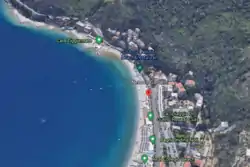
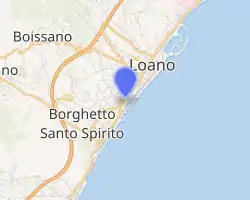
Nemo's Garden is located in a small inlet in the bay of Noli (in the Riviera di Ponente, Savona, Liguria). The beach is located between a cliff named Capo Noli and Punta Vescovato. The overall length of the bay is almost 1 kilometre long.[6] The underwater farm is placed about 40 meters away from Letizia Beach and between 32 and 40 feet under the sea level.
In Liguria the general depth of the sea varies from 6500 and 10,000 feet, but in the area of Noli the depth reaches a maximum of 3200 feet.[7]
The small village of Noli (Neapolis in Greek, means "new city"), is an Italian municipality placed on the west coast of Liguria. Historically speaking, from 1192 up until 1797, the time of the Napoleonic invasion, it was one of the Maritime Republics, called "Republic of Noli".[8] The territory of this municipality is part of the Pollupice Mountain Community.
History
In 2012, Sergio Gamberini, decided to combine his passions: gardening and scuba diving, and created an underwater cultivation. The first plant he and the team decided to cultivate was green basil, one of Liguria's regional symbols.[9] In 2013 they analyzed the basil plants and discovered they had the same taste as the ones grown on land, but they contained 20% more of essential oils. The following year they decided to build another biosphere where they started cultivating salad.[10]
In 2015 the project's team participated in the event Expo 2015, which helped publicize the garden, led to an increase in the number of different kinds of plants they could cultivate due to newly acquired funds, and higher involvement of the people working on the project.[11]
In 2016 the Tree of Life, an exhibit from Expo Milano, was built in the garden. The original structure was designed by Creative Director Marco Balich and reaches an overall height of 37 metres. This piece of architecture has the objective of representing the connection between past and future, united in one object, and becomes a metaphor for prosperity and hope. The creator claims his art piece is inspired by Michelangelo's flooring in Piazza del Campidoglio, Rome.[12]
In 2018 some of the plants in the Garden were destroyed by Cyclone Zorbas, a storm that struck in the Mediterranean Sea. The biospheres were not damaged themselves, but the level of water in them increased so much, it ended up killing the plants. Following this event, the team worked on restoring the habitat and rebuilding the biospheres to be more resistant.[13]
Italy was one of the first countries to be affected by the COVID-19 pandemic, which made it difficult for divers to collect new research data, and subsequently the team from Ocean Reef Group at Nemo's Garden was forced to take a break.[14]
In the final months of 2020, Nemo's Garden made it through thunderstorms and the Winter season, which was registered as the most successful period in terms of plant growth.[15]
Design and working principles
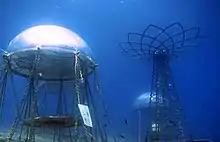
Nemo's Garden is made up of six biospheres' composed by a vinyl-plastic dome, that allows the sunlight to reach the plants inside, and an internal metallic scaffold that anchors the structure to the seabed through 24 chains and special screws. Each sphere is filled with 2,000 litres (440 imp gal; 530 US gal) of air volume that is periodically refreshed, for a diameter of two metres (6 ft 7 in), and has a step grid at the bottom where divers can stand to operate.[16]
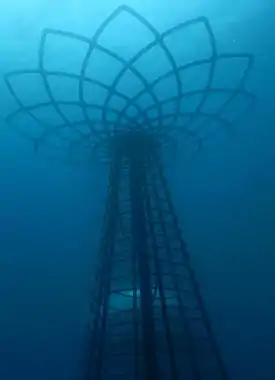
The Garden was originally structured in the shape of a pentagon with five biospheres, but in 2021 a new one was added. The Tree of Life is positioned in the middle, and it is 3.5 metres (11 ft) high and 3 m (9.8 ft) large. The metallic structure hides the cables going into the biospheres and provides illumination for the habitat, as well as webcams monitoring the Garden from the top.[17] Cameras are also positioned in every biosphere and they work thanks to a wireless underwater communication network with a range of operation of 100 metres from the Tree of Life.
A Control Tower that monitors and supervises all the activities in Nemo's Garden is built on the shoreline and it is used by the "agrinauts" (divers working in the biospheres) to communicate with their colleagues working on land.
This underwater farm uses a cultivation system called "Hydroponics", a method of growing plants using mineral solutions in water without soil. The solutions contain nutrients based on K+ ions and NO3- (Nitrate). This system requires a special structure to operate: inside the plastic domes is installed a spiral tube 10 m (33 ft) long that has holes positioned every 15 cm (5.9 in) that function as seedbeds, for a total of 60 holes in each biosphere and a total of 150 to 200 plants.[18]
Every sphere has monitoring sensors that detect and record physical and chemical data. Specifically:
- Air temperature
- Humidity rate; controlled by fans powered by solar energy.
- Luminosity
- Levels of oxygen and carbon dioxide
The Garden is provided with an irrigation system situated in a tank in the lowest part of the spiral tube. The irrigation water is obtained thanks to the phenomenon of condensation caused by the difference between the air temperature inside of the biospheres and the surrounding water temperature. The water obtained is stored in the tanks and mixed with fertilizers and it is redistributed to the plants thanks to a pump, powered by solar energy, pushing the water from the bottom to the top of the spiral tube that then descends by gravity reaching the plants.
The two main renewable energy sources used for the project are solar energy and energy obtained through the desalination of water. In absence of solar energy, LED lights are employed to provide enough light.
Different kinds of herbs, vegetables and flowers were selected for the project, specifically:[16]
- Stevia Rebaudiana
- Salvia Elegans
- Eschscholzia californica
- Vinca
- Calendula
- Pansy
- Small Tomatoes
- Lemon balm
- Basil
- Thyme
- Orchids
- Sophora
- Goji
- Oregano
- Mentha
- Beans
The aim is to observe how these plants can survive, and grow in this kind of environment.
Agriculture
One of the most significant systems for modern farming is industrial agriculture based on large-scale monoculture. This method takes into account the increasing importance of sustainability, but the many improvements in this branch, like plant breeding and the use of agrochemicals, have caused significant ecological damage and are known to have negative health effects on humans as well.[19]
Water represents one of the main resources for agriculture and its management is particularly important, especially in countries where rainfalls are insufficient or variable. In the last years, the availability of freshwater has started to decrease making it harder for the agricultural systems to produce more food.[20]
This new underwater system of agriculture hopes to help overcome problems related to the use of harmful pesticides, that are known to demage both the fauna and the flora of the reef, but also human's health as these pesticides end up being in the food we eat.[21] The closed ecosystem of the biospheres would disable the parasites to attack the plants to begin with. It will also be possible to produce natural fertilizers from algae growing in the areas surrounding the farms, to make the project completely sustainable.[22]
The biospheres are made from non-toxic polymeric materials and have minimum interactions with the surroundings, so they could and are becoming the right habitat for small-sized marine animals. This is a phenomenon known as repopulation of the reef and it will eventually increase.[23] As a result, the population of Noli's coastline has already increased by 150%.
In contrast to ordinary greenhouses, Nemo's Garden can maintain mild stable temperatures within its biospheres without extra unnecessary thermoregulation, which in normal conditions leads to carbon dioxide emissions and greenhouse effect, two of the main issues regarding modern agriculture.[24]
Future projects
Nemo's Garden main ongoing challenge consists in how the systems can remain diverse and productive infinitely. Since this type of project has never been done before, many questions still need to be answered:
- The time needed for the plants to grow underwater rather than on land.
- The depth at which the project could be installed for the plants to survive.
- The various pros and cons of the different locations, materials, etc...
One of the future applications for this modern system of agriculture will be its commercialization in the marketplace. This would result in allowing public and private entities to use the farms for the production of food, on a much larger scale, to be sold to the public.[25]
The team at Nemo's Garden is expanding their research to be able to find a way to adjust their general structure of the Garden in function of the environment it would be placed in. This means finding or exploiting even more, certain resources and energy sources based on the climate and specific environment of a designated area. (For example, more usage of solar panels in desert areas) [26]
Another future application of the project would be that of ECO tourism. This implies opening the installations up for the public, or even placing them in resorts, to help with the growth of tourism in certain areas and to spread awareness on climate change, pollution related to the current methods of agriculture, and other main issues tied to the time we are living in.[27]
A phenomenon that is being observed in the Garden is the behaviour of sea animals around the biospheres, as many of them have started to inhabit the areas surrounding the domes. This led to the idea of using these cultivations also for fish farming, or for the growth of seaweed and corals to repopulate the reef that is lately been particularly affected by damaging activities such as chemical fishing or use of harmful pesticides and disastrous events, such as leaks of petroleum in the sea.[28]
The team at Nemo's Garden is partnering up with scientists like Professor Giovanni Tanda and Professor Marco Fossa from the Engineering Group of the University of Genoa, for researches on thermal and hydrometrical issues caused by water evaporation in the biospheres, and Prof. Luisa Pistelli and Dr. Laura Pistelli from the University of Pisa for botanical studies, specifically the phytochemical composition of the plants, their aroma profile, their morphological structure, the histochemical features and their physiological behaviour compared to those grown on land.
Scuba diving
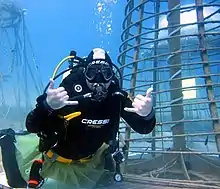
Scuba diving is an adventurous sport and before the COVID-19 pandemic struck, it was practiced in Italy by more than 100.000 people per year. After the pandemic only 20% of diving centres have registered no loss in profit, 60% has estimated a loss between 25 and 50% and the rest have had a loss of 50% or more. This emergency situation is expected to help the Italian scuba diving centres in the long run, especially for summer 2021–2022, as many Italian divers (50%) have decided to stay local, and explore the Italian coasts to save money and still be able to practice this sport.[29]
Liguria is one of the main locations for scuba diving in Italy and between the main spots we can find: the area of the Cinque Terre, Portofino, the island of Bergeggi and Pelagos Sanctuary.[30]
The team from Ocean's Reef Group at Nemo's Garden, along with Gamberini and Fontanesi, aim to make Liguria and its treasures more known to divers and tourists in general. They want to transform their farm in one of the top attractions and spots for scuba diving and tourism. The Garden is open to the public and it can be visited along with a guide.[31]
Gallery
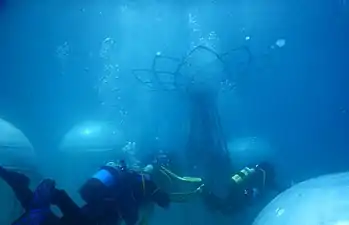 Divers entering a biosphere
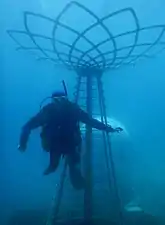 Diver in the forefront of the Tree of Life
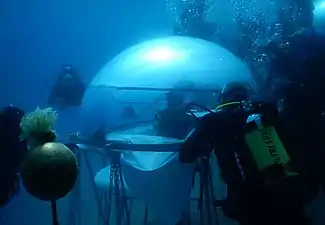 Close-up with a biosphere
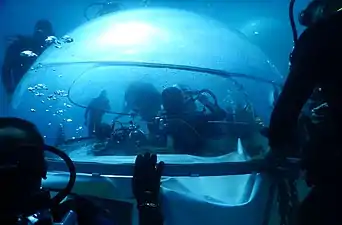 Biosphere analysis
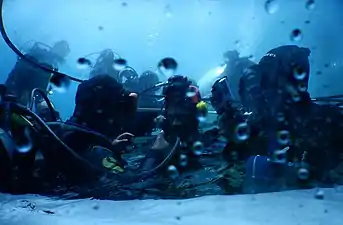 Inside a biosphere
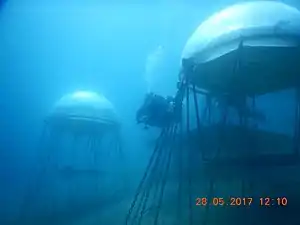 Down angle: Biospheres
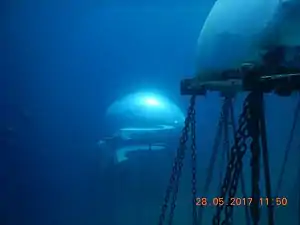 Frontal perspective: Biospheres
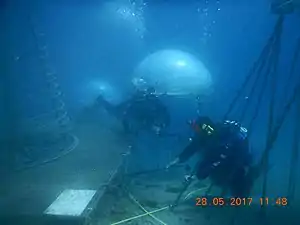 Structure maintenance
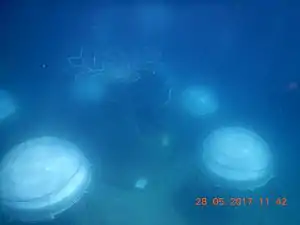 Up angle: Nemo's Garden
External links
References
- "Nemo's Garden". Tech Princess. Retrieved 17 November 2021.
- Pistelli, Laura; Pistelli, Luisa; Flamini, G.; Ascrizzi, R.; Giuliani, C.; Cervelli, C.; Ruffoni, B.; Princi, Elisabetta; Gamberini, Sergio; Gamberini, Luca; Fontanesi, Giovanni (2016). "Preliminary results on basil grown in the Nemo's Garden". Planta Medica. New York: Thieme E-Journals. doi:10.1055/s-0036-1596796.
- Kriti, Malik (13 July 2017). "An Underwater Farm that Grows Basil, Strawberries & More". food.ndtv.com. NDTV. Retrieved 2 December 2021.
- Piroddi, Chiara; Colloca, Francesco; Athanassios, Tsikliras C. (22 May 2020). "The living marine resources in the Mediterranean Sea Large Marine Ecosystem". ScienceDirect. ScienceDirect (published 29 August 2020). Retrieved 18 November 2021.
- Princi, Elisabetta; Dini, Giorgio; Gamberini, Sergio; Gamberini, Luca (19–23 September 2016). Nemo’s Garden: Growing plants underwater. San Marcos, CA, USA: IEEE. p. 4. ISBN 978-1-5090-1537-5.CS1 maint: date format (link)
- "LIGURE, MARE in "Enciclopedia Italiana"". www.treccani.it (in Italian). Retrieved 2021-11-23.
- Platania, Giovanni. "Ligure, Mare". Treccani. Treccani. Retrieved 17 November 2021.
- Fossati, Alessandro (23 September 2011). "Noli". Liguria nautica (in Italian). Carmolab SAS. Retrieved 10 November 2021.
- Redazione 4Surf (2018-05-10). "Nemo's Garden, la serra subacquea in baia a Noli". 4ActionSport (in Italian). Retrieved 2021-11-02.
- Pistelli, Laura; Ascrizzi, Roberta; Giuliani, Claudia; Cervelli, Claudio; Ruffoni, Barbara; Princi, Elisabetta; Fontanesi, Gianni; Flamini, Guido; Pistelli, Luisa (4 July 2019). "Growing basil in the underwater biospheres of Nemo's Garden: Phytochemical, physiological and micromorphological analyses". Science Direct (published 19 September 2019). Retrieved 5 December 2021.
- Borghino, Dario (3 July 2015). ""Nemo's Garden" grows terrestrial crops underwater". Newatlas. Retrieved 5 December 2021.
- Vitali, Chiara (12 October 2015). "Cosa significa l'Albero della Vita di Expo 2015". LeNius.it (in Italian). Le Nius. Retrieved 2 December 2021.
- Floyd, Charlie (13 March 2018). "A father and son are growing fruit and vegetables 8 metres below the surface of the Mediterranean Sea — here's why". Insider. Retrieved 5 December 2021.
- Katanich, Dolores; Orlandi, Giorgia (6 July 2021). "World's first underwater farm reopens growing lettuce and strawberries". Euronews. Retrieved 5 December 2021.
- "Nemo's Garden". Nemo's Garden. Retrieved 10 November 2021.
- Dini, Giorgio; Princi, Elisabetta; Gamberini, Sergio; Gamberini, Luca (19–23 September 2016). Nemo’s Garden: growing plants underwater. an Marcos, CA, USA: IEEE (published 1 December 2016). p. 3. doi:10.1109/OCEANS.2016.7761335. ISBN 978-1-5090-1537-5.CS1 maint: date format (link)
- Bonazza, Valentina (2021-08-05). "Nemo's Garden: quando il basilico cresce sott'acqua (in mongolfiere marine)". Fruitbook Magazine (in Italian). Retrieved 2021-11-05.
- Razzetti, Michele (2020-11-15). "Nel "Giardino di Nemo", dove l'agricoltore diventa subacqueo". Vanity Fair Italia (in Italian). Retrieved 2021-11-05.
- Gliessman, Stephen R. (1998). Agroecology: Ecological Processes in Sustainable Agriculture. Chelsea: Ann Arbor Press.
- Smedley, Tim (12 April 2017). "Is the world running out of fresh water?". BBC.com. Retrieved 5 December 2021.
- "Pesticide residues in food". Wold Health Organization. 19 February 2018. Retrieved 5 December 2021.
- Baweja, Pooja; Kumar, Savindra; Kumar, Gaurav (10 August 2019). "Organic Fertilizer from Algae: A Novel Approach Towards Sustainable Agriculture". SpringerLink. doi:10.1007/978-3-030-18933-4_16. Retrieved 5 December 2021.
- Formisani, Lisa (4 February 2020). "How to save the coral reefs". Eni.com. Retrieved 5 December 2021.
- Rosati, Antonio (17 December 2018). "An underwater garden". alimentarium.org. The Guardian [online]. Retrieved 2 December 2021.
- Hansman, Heather (23 July 2015). "Off the Coast of Italy, Two Divers Are Building Underwater Greenhouses". Smithsonianmag. Retrieved 5 December 2021.
- Smart, Joanna (2019). "Nemo's Garden". Ocean Geographic. Retrieved 5 December 2021.
- Dini, Giorgio; Princi, Elisabetta; Gamberini, Sergio; Gamberini, Luca (19–23 September 2016). Nemo's Garden: Growing plants underwater. San Marcos, California, US: IEEE. pp. 5–6. ISBN 978-1-5090-1537-5.CS1 maint: date format (link)
- Everts, James (2021). "Threats to Coral Reefs: the Effects of Chemical Pollution". Costalwiki. Retrieved 5 December 2021.
- Daturi, Marco (25 June 2021). "Andamento della subacquea: analisi risultati sondaggio". Zeropixel (in Italian). Zeropixel. Retrieved 17 November 2021.
- Expedia Team (12 July 2017). "Immersioni In Liguria: I Migliori Posti Per Fare Diving". expedia.it (in Italian). expedia. Retrieved 17 November 2021.
- Fitzpatrick, Colette (2 October 2019). "An underwater farm not far from Genoa". Italy-villas. Retrieved 17 November 2017.