Neomugicha incident
The Neomugicha incident (西鉄バスジャック事件, Nishi-Tetsu basujakku jiken)[1] is the name given to the hijacking between May 3 and May 4, 2000, of a Japanese bus by a user of internet forum 2channel after placing a warning on the website.
History
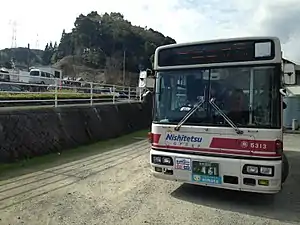
An hour after posting a cryptic threat in a thread with the name "Neomugicha" ("Neo-Barley Tea"; ネオむぎ茶), the 17-year-old hijacked a bus managed by (Nishi-Nippon Railroad Co., Ltd.) in Dazaifu, Fukuoka at 1:35 PM.[2] Armed with a Gyuto knife (牛刀 "gyūtō" or Chef's knife), stabbing one passenger to death and injuring 2.[3]
The hijacking was reported by 2:47 PM by a 40-year old female passenger after she was able to escape from the bus.[2]
The Special Assault Team's Osaka and Fukuoka teams stormed the hijacked bus and captured the teenager alive.[4][5][lower-alpha 1] The unnamed teenager was arrested under the Firearm and Sword Control Law and the Law for the Punishment of Extortion Involving Hostage-Taking.[6] Due to the self-defense requirements as stipulated in the Law Concerning Execution of Duties of Police Officials, it took more than 15 hours for the hostage crisis to end.[7]
The incident was resolved on May 4 at 5:03 AM.[2]
Aftermath
Later, a poster named "Neoūroncha" ("Neo-oolong tea") attempted to imitate Neomugicha by plotting to blow up the Odakyu Electric Railway in Japan and posting warnings about it on 2channel. After the Neomugicha incident, however, the Japanese police were keeping a close eye on 2channel, so he was identified and arrested before his plan could be carried out.
A poster called "Neobīru" ("Neo-Beer") also attempted to imitate the incident, planning a terrorist attack on a railway company, but he was also arrested.[3]
In 2006, the suspect was officially released from a medical reformatory facility.[8] This action led to calls to reform the Juvenile Act, which was law since 1948.[8]
The Hiroshima Prefectural Police established the Hostage Rescue Team in the Hiroshima Prefectural Police's Criminal Investigation Department as part of lessons learned from the incident.[9]



Notes
- In foreign news, the SAT was credited as anti-riot officers.
References
- "西鉄バスジャック事件 今も被害者に補償という「17歳少年」両親の十字架".
- https://web.archive.org/web/20211210113634/https://www.japantimes.co.jp/news/2000/05/05/national/chronology-of-bus-hijacking/
- Wired News. "2-Channel Gives Japan's Famously Quiet People a Mighty Voice". 19 April 2007.
- Itō 2004, pp. 193–203.
- "Riot police end hijack drama". BBC. 2000-05-03. Archived from the original on 2010-08-26. Retrieved 2009-01-26.
- "Police search the home of boy in bus hijacking". 7 May 2000. Archived from the original on 2015-02-05. Retrieved 2021-12-10.
- Ryuichiro Hosokawa (2000-05-16). "Failing youth and the victims of crime". The Japan Times. Archived from the original on 2013-11-04. Retrieved 2012-02-09.
- "Should School-Age Killers be Tried as Adults? | News & Views, Opinion". 12 July 2015.
- Kikuchi & Arimura 2021, pp. 98–109.
Bibliography
External links
- Neomugicha's thread (in Japanese)