New Philippines
The New Philippines (in Spanish: Nuevas Filipinas or Nuevas Philipinas) was a territory in New Spain also known as Nuevo Reino de Filipinas.[1] The territory was named in honor of its sovereign, king Philip V of Spain.[2] The ultimate demise of the New Philippines as a legal entity was coterminous with the extinction of New Spain in 1821.
.svg.png.webp)
Limits
This province of New Spain overlapped part of the current U.S. state of Texas, but its territory was substantially different. The land consisted of the region north of the Medina river, which is located in the current south central Texas; i.e., the New Philippines corresponded more or less with the Central-Northern part of the state. In fact, the river was the official border between New Extremadura and the New Philippines.[3] To the west, New Philippines bordered with Nueva Vizcaya and with Nuevo México (but near Taos, which is now half-way across New Mexico); to the north, the border was the Arkansas river, up to the area around present-day Pueblo (Colorado); to the south, with Nuevo Santander and with the aforementioned New Extremadura; to the east, consecutively with French, Spanish, and finally with U.S. Louisiana.
Disputed eastern border
France claimed its border extended west and south to the Rio Grande (thus entirely negating the existence of New Philippines); conversely, Spain claimed its east border extended to the Red River. The French founded Natchitoches in 1714 west of the Red River and the Spanish founded Los Adaes in 1721, east of the Sabine river. Informally, the border was set at the Arroyo Hondo, located between the French and the Spanish settlements, for the next 98 years.[4][5][6] Following the 1819 Treaty of Adams-Onís, the New Spain and Louisiana border moved 45 miles west to the Sabine River and remained there until the extinction of New Spain in 1821.
Origins of the name
The name was first used by Antonio Margil in July 1716, during his participation in Domingo Ramón's expedition to prevent French expansion from Louisiana.[lower-alpha 1]
The name first appeared in an official document in 1718, in a letter addressed to Martín de Alarcón[7] A March 11, 1718 instruction letter for Alarcon's 1718 reinforcements expedition refers to "Nuevas Filipinas",[lower-alpha 2] differentiating the New Philippines from the province of Coahuila and New Extremadura.[8] In a report of his services to the Spanish government, Alarcón would go on to refer to himself as "governor and lieutenant captain general of the Province of the Texas and New Philippines."[9] Alarcón signed the foundation document of the San Antonio de Valero mission, dating it May 1, 1718, in his capacity as "General of the Provinces of the Kingdom of the New Philippines."[10] Much later, the mission would be garrisoned and become the site of the 1836 Battle of the Alamo.
Use of the name in monographs and chronicles
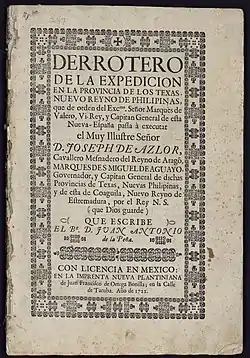
Juan Antonio de la Peña, a participant in the Marqués de Aguayo expedition, wrote Derrotero de la expedición en la provincia de los Texas, Nuevo Reyno de Philipinas, and had it printed in México in 1722.[11][12]
Pedro de Rivera y Villalón, a brigadier general, described the Reino de Nuevas Philipinas,[13]: 7 which he inventoried during his 1724-1728 mission to northern New Spain,[13]: 4 in his 1736 book Diario y derrotero de lo caminado.[14]
The Irish-Spaniard monk Juan Agustín Morfi wrote in 1779 the Relación geográfica e histórica de la provincia de Texas o Nuevas Filipinas. His book was translated to English and published in 1935 by Carlos Castañeda as "History of Texas: 1673-1779. By fray Juan Agustin Morfi. Missionary, Teacher, Historian".[15] Morfi is considered the most important chronicler and historian of the New Philippines.[lower-alpha 3]
Disestablishment
Following the death of king Philip in 1746, for centuries, there were no other Spanish kings named Philip. The name progressively fell into disuse, and by about a century later, by the early 1800s, few legal documents made reference to the New Philippines, and those are mostly land grants.[1]
With the end of New Spain and the creation of the Mexican Empire in 1821, the sole legal name for the territory of the New Philippines became Provincia de Texas, which years later became part of the Mexican state of Coahuila y Tejas.
Notes
References
- Jesús "Frank" de la Teja (1976). "New Philippines". Handbook of Texas. Texas State Historical Association. Archived from the original on 11 November 2020. Retrieved 31 August 2021.
- Guadalupe Curiel Defossé (2007). "The Relación geográfica e histórica de la provincia de Texas o Nuevas Filipinas: 1673-1779. A Manuscript from the Franciscan Archive of the National Library" [The Relación geográfica e histórica de la provincia de Texas o Nuevas Filipinas: 1673-1779. A Manuscript from the Franciscan Archive of the National Library]. Boletín del Instituto de Investigaciones Bibliográficas (in Spanish). Footnote 6: Universidad Nacional Autónoma de México. XII, New Epoch (1–2): 35. Retrieved 30 August 2021.
renombrada Nuevas Filipinas en el XVIII, en honor del monarca español Felipe V
CS1 maint: location (link) - Isaac Smith Homans; Isaac Smith Homans, Jr. (1858). A Cyclopedia of Commerce and Commercial Navigation. New York: Harper & Brothers, Publishers. p. 1834. Retrieved 31 August 2021.
But this province extended then only as far south as the river Medina. The southwester part of our present Texas belonged still for a long while to "the Province of Coahuila" [...] this establishment of Texas as a new and separate government by itself (in 1727) was also connected to the introduction of a new name —of Las Nuevas Filipinas
- "Tidbits of Shelby County History: The International Boundary Line between Texas, United States". Shelby County Museum. Shelby County Today. 30 July 2020. Retrieved 4 September 2021.
The Arroyo Hondo, a Red River tributary between the Sabine River and Natchitoches, as the boundary between Louisiana and New Spain
- Clare D’Artois Leeper (2012). "Arroyo Hondo". Louisiana Place Names (Illustrated ed.). Louisiana State University Press. p. 20. ISBN 978-0807147405. Retrieved 2 September 2021.
became famous after it was accepted as the temporary border between French Louisiana and the Spanish province of Texas
- https://web.archive.org/web/20131213214233/https://www.natchitoches.com/robeline
- https://www.esquiremag.ph/long-reads/features/new-philippines-a00304-20200614
- https://web.archive.org/web/20111102225518/http://www.coahuila.gob.mx//index.php/sitios/Denominacion_oficial
- https://www.tshaonline.org/handbook/entries/new-philippines
- Robert Garcia Jr.; Hector J. Cardenas; Amy Jo Baker (March 2018). "Tricentennial Chronology And The Founding Events In The History of San Antonio And Bexar County". County of Bexar, State of Texas. San Antonio, Texas: Paso de la Conquista. pp. 71–72. Archived from the original on 31 August 2021. Retrieved 31 August 2021.
Founding Document for Mission San Antonio de Valero on May 1, 1718
- Guadalupe Curiel Defossé (2016). "Tierra incógnita, tierra de misiones y presidios - El noreste novohispano según fray Juan Agustín Morfi, 1673-1779" (PDF). Históricas Digital. Historia Novohispana (in Spanish). Instituto de Investigaciones Históricas - Universidad Nacional Autónoma de México. 98: 110. Retrieved 2 September 2021.
Se trata de Juan Antonio de la Peña, Derrotero de la expedición en la provincia de los Texas, Nuevo Reino de Filipinas
- Peña, Juan Antonio de la (3 April 2021). "Derrotero de la expedicion en la provincia de los Texas, nuevo reyno de Philipinas". Collections - University of Texas Libraries. Benson Rare Book Collection: The University of Texas at Austin. Archived from the original on 2 September 2021. Retrieved 2 September 2021.
- MARÍA DEL CARMEN VELÁZQUEZ (1979). "NOTAS". Tres estudios sobre las provincias internas de Nueva España (in Spanish). 87. El Colegio de Mexico. pp. 157–170. ISBN 9789681200022. JSTOR j.ctv233nn0.8. Retrieved 30 August 2021.
- Pedro de Rivera y Villalón (1736). Diario y derrotero de lo caminado, Haviendo transitado por los Reinos del Nuevo Toledo, el de la Nueva Galicia, el de la Nueva Vizcaya, el de la Nueva Mexico, el de la Nueva Estremadura, el de las Nuevas Philipinas, el de Nuevo de Leon. Las Provincias, de Sonora, Ostimuri, Sinaloa, y Guasteca (in Spanish). Guatemala: Sebastián de Arebalo. Retrieved 30 August 2021.
- http://ru.atheneadigital.filos.unam.mx/jspui/handle/FFYL_UNAM/5022_TD180
- Pablo ÁLVAREZ (9 June 2013). "El ovetense Juan Agustín Morfi, el gran historiador de Texas". La Nueva España (in Spanish). Oviedo, Spain. Archived from the original on 1 September 2021. Retrieved 1 September 2021.