Monks Kirby
Monks Kirby is a village and civil parish in north-eastern Warwickshire, England. The population of the parish is 445.[1]
| Monks Kirby | |
|---|---|
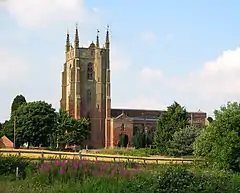 St Edith's Church | |
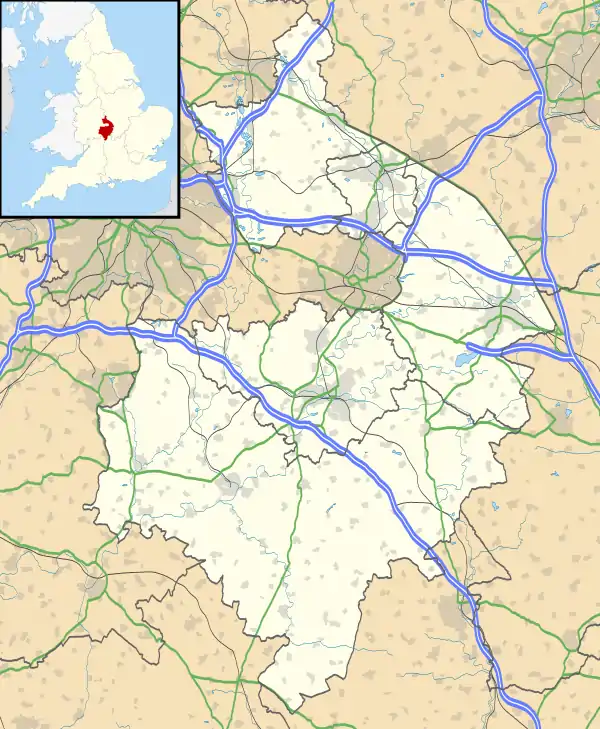  Monks Kirby Location within Warwickshire | |
| Population | 445 (2011) |
| OS grid reference | SP4683 |
| Civil parish |
|
| District | |
| Shire county | |
| Region | |
| Country | England |
| Sovereign state | United Kingdom |
| Post town | RUGBY |
| Postcode district | CV23 |
| Dialling code | 01788 |
| Police | Warwickshire |
| Fire | Warwickshire |
| Ambulance | West Midlands |
| UK Parliament | |
Monks Kirby is located around one mile east of the Fosse Way, around 8 miles north-west of Rugby, seven miles north-east of Coventry and six miles west of Lutterworth. Administratively it forms part of the borough of Rugby. One of the largest and most important villages in this part of Warwickshire from the Anglo-Saxon to the early modern period, by the nineteenth century Monks Kirby had become a small farming community. Monks Kirby is today an attractive, wealthy commuter village with many residents working in Coventry, Birmingham, Leicester and London.
Monks Kirby is dominated by the church of St Edith, a site of Christian worship since at least the 10th century AD and which functioned as a Priory from 1077 until the Reformation.
Reflecting its medieval aristocratic and ecclesiastical importance, Monks Kirby is the largest historic parish in Warwickshire and St Edith's one of the largest parish church in the county.[2]
History
Monks Kirby has been inhabited since at least Roman times, with evidence (Roman urns and bricks) found around the Church suggesting either a Roman cemetery or villa on the current Church site.[3]
The good soils, strategic location (near the meeting point of the Fosse Way and Watling Street) and size of the parish suggest it was the dominant village in this part of Warwickshire before the Norman Conquest.[4] The pre-Conquest church of Monks Kirby was the mother church for the surrounding area, connected to the important aristocratic estate of Newnham (the relation between the estate at Newnham and the Church shaped the history of the village from Saxon times until the Reformation) probably at least as far back as the eighth or ninth century.[5][note 1]
In the tenth century the village was on the frontier between the Viking controlled Danelaw and Anglo-Saxon Mercia. "Kirby" is a Norse place name[7] roughly meaning "church town" but the village is just on the west (Anglo-Saxon) side of Watling Street, which was the formal frontier.
At the time of the Norman Conquest, the neighbouring estate of Newnham Paddox was owned by Leofwin, nephew of Leofric, Earl of Mercia (husband of Lady Godiva).[8] After the Conquest, the land around Monks Kirby came into the ownership of Geoffrey de la Guerche, a Breton knight who married Aelgifu, Leofwin's daughter.[9][10] Geoffrey rebuilt the Anglo Saxon church, endowed it with lands (notably the village of Copston Magna), and gave it as a priory to the Benedictine Abbey of St Nicolas in Anjou in France. The Priory was named in honour of the Virgin Mary and St Denis. Unusually, the text of the founding Charter for the Priory survives:[note 2] the dedication took place on 1 July 1077 and the Charter tells us the names of the first monks – Geoffrey, Ranulf, Stephen, Maurice, Roger and Herman.[4]
After Geoffrey's death, his estates, including the lands around Monks Kirby reverted to the King, who subsequently granted them to Nigel d'Aubigny, the father of Roger de Mowbray. The Mowbray family (who in time were to become Dukes of Norfolk) continued to support the Monks Kirby priory.[12]
The Newnham family (who took their name from the estate) held the land of the Newnham Paddox Estate under the Mowbrays in the twelfth and thirteenth century. The property was held by a number of different families in the fourteenth and early fifteenth century until, on 11 November 1433, John Fildyng, or Feilding, bought the estate (see Earls of Denbigh below).[12]
In 1266 Henry III granted the monks a fair at Midsummer and a weekly market at Kirby; a result of Monks Kirby's growing importance. The name of one of the village streets, Bond End, reflects the boundary between the feudal tenants ("bondsmen") on the Newnham estate and the properties of the traders and craftsmen who operated around the Priory Church. Many miracles were apparently wrought at the Priory.
By the fourteenth century the war with France meant that relations between the French-led Benedictine monks at Monks Kirby and the surrounding population were at a low ebb. Having nearly fallen into ruin, the church was substantially rebuilt in around 1380: one of the bells that still ring out over the village today dates from this reconstruction. In 1415 Henry V agreed that the Duke of Norfolk could transfer the priory and its lands out of nominally French hands, to become a house of the Carthusian Abbey established on the Duke's estates at the Isle of Axholme, Lincolnshire. This was more than a change of management: the new Carthusian monks practised a strict monastic lifestyle very different from the Benedictine monks (in 1330 Monks Kirby's Benedictines had needed to be reminded of basic rules such as the non-admission of women to the monastery, and their duty to the poor).[13] The 100 years war with France also caused the dedication of the church to be changed to St Edith of Polesworth, a Warwickshire Saint (the connection with St Denis was revived in the 19th century for the chapel of St Denys, built in the neighbouring village of Pailton).[14] The church was again altered in the late fifteenth century, and an octagonal spire added.[note 3]
In the reformation, King Henry VIII confiscated the assets of the priory, granting the manor of Monks Kirby (ie the lands that had belonged to Monks Kirby priory) to the Bishop of Ipswich, and the rectory and the advowson of the vicarage to his (the King's) foundation of Trinity College, Cambridge in December 1546. The manor then changed hands several times over the following eighty years until the powerful Buckingham family passed to it to the Feildings who had been lords of neighbouring Newnham Paddox since the fifteenth century (see below).
The Feilding family, elevated to the aristocracy as Earls of Denbigh, thus came to own both the historic Newnham Paddox estate and the lands that in the medieval period had belonged to the Priory Church. The Earl of Denbigh owned most of the village and the land around it until the mid-twentieth century (see below). Trinity College retains the benefice and continues to be involved in the church's affairs today[18] but divested itself of substantial landholdings around Monks Kirby following the Second World War.
Parish boundaries and administration
Up to the industrial revolution and the coming of the railways, Monks Kirby was one of the most important villages in this part of Warwickshire. Early in the 17th century the hundred of Knightlow (one of the county's main administrative divisions, which included all of modern-day Coventry) was reorganised on a basis of four High Constables' divisions – Kenilworth, Monks Kirby, Rugby, and Southam. Monks Kirby retained its high constable until 1828.[19]
The historic parish boundaries of Monks Kirby, set in the Anglo-Saxon era and existing through to the nineteenth century included several neighbouring villages and hamlets: Copston Magna, Pailton, Stretton-under-Fosse, Newbold Revel, Brockhurst, Little Walton, Street Ashton and Easenhall. The Parish had an exclave in Leicestershire, the land known as Goresland in Ullesthorpe, separated from Monks Kirby by the neighbouring parish of Wibtoft and just over the county border. Monks Kirby was the largest parish in Warwickshire;[note 4] the historic size of Monks Kirby was around 10,000 acres, 15 square miles.[12] Around 1866, Pailton, Easenhall, Stretton-under-Fosse and Copston became separate parishes. Even within its much reduced modern boundaries, Monks Kirby civil parish still has an area of 4550 acres, around 7 square miles, placing it in top 11% of English parishes by area.[21] The ecclesiastical parish no longer includes Copston or Easenhall but still includes Pailton and Stretton-under-Fosse.[20] The (civil and ecclesiastical) boundaries of Monks Kirby still include the lands of the village of Cestersover, abandoned in the Middle Ages.
History of local government
People living in poverty in Monks Kirby in the 19th century were sent to the workhouse in Lutterworth: from 1834 the civil parish of Monks Kirby was part of Lutterworth Poor Law Union[22] The Lutterworth Rural Sanitary District was introduced in 1875 covering the same area as the Poor Law Union. Rural sanitary Districts were replaced with Rural Districts and aligned with county borders in 1894: Monks Kirby Rural District existed from 1894-1932 covering the Warwickshire parishes that had been in the Lutterworth RSD. In 1932 Monks Kirby Rural District was merged into Rugby Rural District, which in turn merged with Rugby Municipal Borough in 1974, to form today's Rugby Borough Council.
Roman Catholic Community
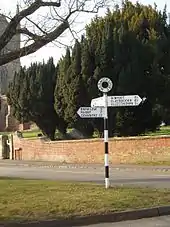
Monks Kirby has been a local centre for the Roman Catholic faith since the conversion of the 8th Earl of Denbigh to Catholicism in 1850. St Joseph's convent and girls school/orphanage were established in the village in the 1870s.[23] The first nuns were Sisters of Charity from a convent on the Earl's other estate at Pantasaph in Flintshire, North Wales.[23] The Sisters of Charity were succeeded by the Sisters of Mercy in 1923 who remained at the convent until 1977[24] In 1982 the convent was occupied by the first congregation of Mary, Mother of the Church (now called "Mater Ecclesiae") established by Sister Catherine Mulligan as a new convent for mature women looking to enter religious life.[23][25] In 1998 the Mater Ecclesiae congregation moved to Street Ashton House[25] in the neighbouring hamlet of Street Ashton, where it was based until 2020. The remaining, elderly sisters have now dispersed and Street Ashton House sold, bringing to an end a 150-year tradition of (renewed) monastic life in Monks Kirby.[26]
The nineteenth century convent buildings in the village of Monks Kirby have now been converted to housing but a new church, St Joseph's Church, was built in the 1990s to a design by the architect John Holmes.[23] This church was consecrated by the Archbishop of Birmingham, Bernard Longley, on 11 July 2012, the feast of St Benedict. St Joseph's continues to be a worshipping community today, with a large congregation gathering on Sundays from the parish which spreads beyond the small village of Monks Kirby. There is also a daily Mass in the parish. Planning permission has been granted for a small church hall, to be built on land to the rear of the Church.
Highlights during the year include the Annual May Procession when the parish process in honour of Our Lady ending with the crowning of the statue and Benediction of the Blessed Sacrament. There is also a Corpus Christi procession in June from the Village Green to St Joseph's.
In July 2018 St Joseph's fitted a new bell system which allows the Angelus to be rung at 12noon and 6pm as well as calling the faithful to Mass. At special times of the year and at the end of the school day Hymns are played on the automated carillon.
The present parish priest is a priest of the Ordinariate of Our Lady of Walsingham and the Parish is formally in the care of the Ordinariate.[27] The Ordinariate Use of the Mass (Divine Worship) is celebrated weekly and St Joseph's has become a focus for members of the Ordinariate from the Leicestershire and East Warwickshire area. Evensong and Benediction are celebrated.
On the outskirts of Monks Kirby is a Roman Catholic burial site, originally a private graveyard for the Feilding family but which today is used for burials from St Joseph's. The Chapel of the Sacred Heart at the burial ground was designed by the architect Thomas Henry Wyatt for the 8th Earl of Denbigh. Built in 1888, it is a Grade 2 listed building.[28]
The Revel School
Children from Monks Kirby and surrounding villages attend the Revel School, which is possibly unique in that it is a Church of England school with Catholic provision and Catechesis. Children from the school regularly visit the Church for worship and are prepared through the school for their First Holy Communion. Both the Rector and Catholic Parish Priest lead worship in the school. School Masses (within St Josephs) take place regularly.
The Earls of Denbigh and Monks Kirby
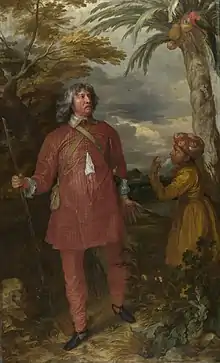
The Feilding Family have been Lords of Newnham Paddox since 1433. In 1622 James I made William Feilding first Earl of Denbigh: Feilding primarily owed his rise at court to his brother in law, the Duke of Buckingham who was the King's favourite. The Buckinghams also purchased, as a gift for the second Earl of Denbigh, the manor that had belonged to the pre-reformation priory of Monks Kirby.
Despite almost certainly being of Warwickshire origin, in the middle of the seventeenth century, following their elevation to the peerage, the Feilding family began to claim descent from the European royal house of Habsurg, a claim that has been ridiculed and debunked several times in the subsequent centuries.[29] The Habsburg double-headed eagle appears on Denbigh coats of arms and as a symbol around the village of Monks Kirby.
Newnham Paddox
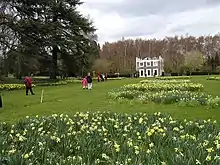
In 1754-68 Lancelot "Capability" Brown built a large mansion house for the fifth and sixth Earls (perhaps incorporating some elements of an earlier, 16th century house).[30] At the same time, Brown laid out landscaped garden. The house, which was further substantially developed in the nineteenth century (in a French style and including an ornate Roman Catholic chapel), was demolished in 1952 after receiving water damage resulting from the thawing of frozen pipes at a time when the family was hit by heavy death duties. The grand gates, stables and Brown's landscaped gardens remain and the current Earl still lives in a twentieth century, wooden house in the grounds.
The Denbigh family have - since the mid-twentieth century - steadily sold off most of their local land holdings (most recently selling 2,500 acres in 2014/15).[31]
Pubs
Monks Kirby has one pub, the Denbigh Arms, which is next to the church.
See also
Notes
- The Seventeenth century historian of Warwickshire, Dugdale, cites the Anglo Saxon Chronicle and claims that "this place" was built by Ethelfleda, daughter of Alfred the Great in 917, a claim repeated on the current Church sign. However (1) the reference to Ethelfleda building a fortification in Cyricbyrig is usually today taken as referring to a fort built in 915 in the similarly named Staffordshire village of Chirbury("Anglo Saxon Runcorn".) (2) modern academics believe Monks Kirby was the site of an anglo-saxon minster (mother church) which were typically established earlier than the tenth century (3) It's not at all clear what Dugdale means by "this place" (4) the name of the village suggests the Danes (who arrived in the 9th century) found a church already in the village.[6]
- The text of the charter survives but not the manuscript. Dugdale and others reproduce it from a manuscript in the Cotton Library which has since been lost or destroyed. [11]
- The Church has no spire today. Twenty feet of the spire was removed in 1630 and the remainder then blew down at some point in the early 18th century, probably Christmas night 1701 (the 1912 Kelly's Directory states the spire blew down in 1701, basing this on a then-visible inscription on the church roof reading "This roof was beat down.. ..the 25th December 1701", the pamphlet produced at the time of the Church's 900s anniversary in 1977 also says 1701). However, the second, updated edition of Dugdale's History of Warwickshire, published in 1730, says the remainder of the spire blew down on Christmas Night 1722 (and the 1951 Victoria County History follows). The spire was restored before 1730 according to Dugdale 2nd Ed., though not other sources. If it was restored it may have been finally removed at the time of the Victorian restoration of the Church in 1869, though in 1894 Jean E M Fielding (a visiting American member of the Feilding family) wrote of the church's "fallen pinnacle.".[15][16][12][17]
- Parish size can be compared on the Church of England's online map of ecclesiastical parishes; the CoE's map shows two Warwickshire parishes bigger than Monks Kirby but these are 21st century mergers and the historic parish of Monks Kirby included Copston Magna and Easenhall, which the CoE now classify as a separate parishes. The claim in Monks Kirby Parish Council's 2015 Neighbourhood Plan that the village was once one of the largest parishes in England seems unlikely.[20]
References
- Warwickshire Towns & Villages, by Geoff Allen (2000) (ISBN 1-85058-642-X)
- 1756 Acres: A History of the People of Pailton, Warwickshire, by Roy Bourne (1984).
- "Civil Parish population 2011". Neighbourhood Statistics. Office for National Statistics. Retrieved 30 December 2015.
- "St Edith's Church, Monks Kirby". Heritage Open Days.
- "Information for record number MWA4241: Site of Possible Roman Settlement by Church". Warwickshire County Council. Retrieved 27 November 2018.
- Greenway, Diana (1996). "Conquest and Colonization: The Foundation of an Alien Priory, 1077". In Blair & Golding (eds.). The Cloister and the World: Essays in Medieval History in Honour of Barbara Harvey.
- Graham Jones. The origins of Leicestershire: churches, territories, and landscape. p. 9.
- William Dugdale (1656). The antiquities of Warwickshire illustrated : from records, leiger-books, manuscripts, charters, evidences, tombes, and armes : beautified with maps, prospects, and portraictures. p. 50.
- "Archaeological Resource Assessment of the Aggregates Producing Areas of Warwickshire and Solihull" (PDF). Warwickshire County Council. 2008. p. 66. Retrieved 23 December 2020.
- K. S. B. Keats-Rohan. The Making of Henry of Oxford: Englishmen in a Norman World (PDF). p. 302.
- Geoffrey probably fought in the Battle of Hastings and was rewarded by William the Conqueror with "manors distributed over 6 counties, effectively grouped round four centres: - Monks Kirby in east Warwickshire; Melton Mowbray in Leicestershire; Epworth in the Isle of Axholme, and Gainsborough in Lincolnshire" E W Timmins. "Historical Notes the Manor of Crick - 2" (PDF). West Northamptonshire Local History.
- K. S. B. Keats-Rohan (1999). Domesday People: Domesday book. p. 53. ISBN 9780851157221.
- William Dugdale (1655). Monasticon Anglicanum: A History of the Abbies and Other ..., Volume 6, Part 2 (in Latin). p. 996.
- "Parishes: Monks Kirby". A History of the County of Warwick (Victoria County History): Volume 6, Knightlow Hundred. 1951. Retrieved 1 January 2021 – via British History Online.
- "Alien houses: Priory of Monks Kirby". A History of the County of Warwick. 2. Victoria County History. 1908. Retrieved 10 December 2021 – via British History Online.
- "House of Carthusian Monks 30. The Priory of Axholme (reproducing text from "A History of the County of Lincolnshire, Vol. 2", Page, pub 1906)". British History Online. Retrieved 20 December 2009.
- St Edith's Church Monks Kirby 1077 1977 (booklet produced by the church at the time of its 900th anniversary). Lutterworth: St Edith's Church Festival Committee (1977). 1977.
- Dugdale, William; Thomas, William (1730). The Antiquities of Warwickshire Illustrated... (2nd Edition). p. 77. Retrieved 21 November 2021.
- Kelly's Directory of Warwickshire, 1912. 1912. Retrieved 21 November 2021.
- "The College Livings". A Guide to Trinity College Chapel (PDF). Trinity College, Cambridge. 2013. p. 47.
- "Knightlow Hundred". A History of the County of Warwick. 6. Victoria County History. 1951. Retrieved 3 January 2011 – via British History Online.
- "Church of England Parish Map". Retrieved 21 November 2012.
- 1840.78 Hectares. "Standard Area Measurements (2017) for Parishes and Non-Civil Parished Areas". Office for National Statistics. 2017.
- "Lutterworth, Leicestershire". workhouses.org.uk.
- "Monks Kirby – St Joseph". Taking Stock: Catholic Churches of England and Wales. Catholic Bishops’ Conference of England and Wales. Retrieved 18 August 2020.
- "Monks Kirby Memories". Retrieved 9 December 2020.
- "The Church must stop turning its back on older people who have religious vocations". Catholic Herald. Retrieved 19 August 2020.
- "Mater Ecclesiae CIO Annual Report and Accounts to 31 March 2020". Charity Commission. 29 January 2021.
- "Monks Kirby – St Joseph". Retrieved 18 August 2020.
- Historic England. "Chapel of the Sacred Heart (1392656)". National Heritage List for England. Retrieved 18 August 2020.
- J H Round (1901). "Chapter 5 Our English Habsburgs: a Great Delusion". Studies in Peerage and Family History. p. 216.
- Historic England. "Nenwham Paddox (1001191)". National Heritage List for England. Retrieved 11 June 2016.
External links
 |
Wikimedia Commons has media related to Monks Kirby. |