2022 Hungarian parliamentary election
The next Hungarian parliamentary elections will be held in April or May 2022.
 | |||||||||||||||||||
All 199 seats in the National Assembly 100 seats needed for a majority | |||||||||||||||||||
|---|---|---|---|---|---|---|---|---|---|---|---|---|---|---|---|---|---|---|---|
| |||||||||||||||||||
 Map template for the election. | |||||||||||||||||||
| |||||||||||||||||||
.jpg.webp)

Background
Amendment of the electoral law
The electoral law, under which the previous two elections were held (2014, 2018) specified the number of constituency candidates a party needed to run nationwide at 27, in at least 9 counties.
On 15 December 2020, the National Assembly, in which the governing parties held the needed 2/3 majority, voted to increase the requirements to a total of 71 constituency candidates in at least 14 counties and the capital.[1][2]
Creation of joint opposition list
In 2019 local elections, Democratic Coalition, Jobbik, LMP, MSZP, Momentum Movement, Dialogue and numerous other parties or independent candidates ran in joint lists. It enabled opposition parties to win the majority in the General Assembly of Budapest and in ten of the 23 cities with county rights.[3]
On 14 August 2020, Democratic Coalition, Jobbik, LMP, MSZP, Momentum Movement, MLP,[4] UK[5] and Dialogue decided to field joint candidates in all of Hungary’s 106 constituencies and launch a joint program for the elections.[6]
On 15 November 2020, Democratic Coalition, Jobbik, LMP, MSZP, Momentum Movement and Dialogue agreed on running with a common candidate for Prime Minister, to be selected in a primary election. They expect the candidate to be selected by 23 October 2021.[7]
On 20 December 2020, Democratic Coalition, Jobbik, LMP, MSZP, Momentum Movement and Dialogue decided on running together on a common list (unnamed as of yet), solidifying their electoral alliance.[8][9] The leaders of the respective parties have also signed a declaration containing the terms of their cooperation, titled "Korszakváltás Garanciái" ("Principles for Hungary's governance after 2022"). The opposition coalition was very ideologically diverse, something described by observers as a potential hindrance to presenting a united front to defeat Orbán.[10]
Opposition primary
The Opposition primary was held in Hungary, between 18–28 September 2021 (first round) and 10–16 October 2021 (second round), to select the candidate for Prime Minister of Hungary supported by the opposition parties to form a coalition to compete in the 2022 Hungarian parliamentary election. It was the first countrywide primary election in the political history of Hungary.
On 17 October 2021, non-partisan candidate Péter Márki-Zay won in the runoff (second round) of the opposition primary, becoming the United Opposition candidate in the election for prime minister.[11] The parties had also selected common candidates for single-member districts via the primary in the first round.
Electoral system
The 199 members of the National Assembly were to be elected by two methods; 106 would be elected in single-member constituencies by first-past-the-post voting, with the remaining 93 elected from a single nationwide constituency mostly by proportional representation, via a partially compensatory system (a hybrid of parallel voting and the mixed single vote). The electoral threshold was set at 5%, although this was raised to 10% for coalitions of two parties and 15% for coalitions of three or more parties. Seats were to be allocated using the d'Hondt method.[12]
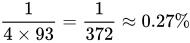
Since 2014, each of the Armenian, Bulgarian, Croatian, German, Greek, Polish, Romani, Romanian, Rusyn, Serbian, Slovakian, Slovenian, and Ukrainian ethnic minorities can win one of the 93 party lists seats if they register as a specific lists and reach a lowered quota of of the total of party list votes.[13]
Parties and coalitions
The following parties are represented in the National Assembly, or are commonly included in public opinion polling:
| Party/Coalition Full name |
Ideology | Leader(s) | 2018 result | Current seats | ||||
|---|---|---|---|---|---|---|---|---|
| Votes (%) | Seats | |||||||
| Fidesz–KDNP | Fidesz Fidesz – Hungarian Civic Alliance |
National conservatism | Viktor Orbán | 49.27 | 116 / 199 |
116 / 199 | ||
| KDNP Christian Democratic People's Party |
Christian right | Zsolt Semjén | 17 / 199 |
17 / 199 | ||||
| United Opposition[lower-alpha 3] | Jobbik Movement for a Better Hungary |
Conservatism | Péter Jakab | 19.06 | 26 / 199 |
17 / 199 | ||
| MSZP Hungarian Socialist Party |
Social democracy | Bertalan Tóth Ágnes Kunhalmi |
11.31 | 17 / 199 |
15 / 199 | |||
| Dialogue Dialogue for Hungary |
Green politics | Gergely Karácsony Tímea Szabó |
3 / 199 |
5 / 199 | ||||
| DK Democratic Coalition |
Social liberalism European federalism |
Ferenc Gyurcsány | 5.38 | 9 / 199 |
9 / 199 | |||
| LMP LMP – Hungary's Green Party |
Green liberalism | Máté Kanász-Nagy Erzsébet Schmuck |
7.06 | 8 / 199 |
6 / 199 | |||
| Momentum Momentum Movement |
Centrism Liberalism |
Anna Júlia Donáth | 3.06 | 0 / 199 |
0 / 199 | |||
| Mi Hazánk Our Homeland Movement |
Hungarian nationalism | László Toroczkai | Did not exist[lower-alpha 4] | 2 / 199 | ||||
| ISZOMM Yes Solidarity for Hungary Movement |
Kádárism | Tibor Szanyi | Did not exist[lower-alpha 5] | 1 / 199 | ||||
| PV Civic Response |
Liberal conservatism | János Bencsik | Did not exist | 2 / 199 | ||||
| ReforMerek ReforMers |
Christian democracy | Andrea Varga-Damm | Did not exist | 1 / 199 | ||||
| VP Volner Party |
Right-wing populism | János Volner | Did not exist | 1 / 199 | ||||
| MKKP Hungarian Two Tailed Dog Party |
Joke party | Gergely Kovács | 1.73 | 0 / 199 |
0 / 199 | |||
| Munkáspárt Hungarian Workers' Party |
Communism | Gyula Thürmer | 0.27 | 0 / 199 |
0 / 199 | |||
| NÉP Party of Normal Life |
Vaccine hesitancy | György Gödény | 0.07[lower-alpha 6] | 0 / 199 |
0 / 199 | |||
| MSZDP Social Democratic Party of Hungary |
Social democracy | László Hasilló | Did not run | 0 / 199 | ||||
| Independents | – | – | 1.01[lower-alpha 7] | 1 / 199 |
6 / 199 [lower-alpha 8] | |||
Opinion polls


Notes
- Aggregate results for Jobbik (26 seats, 19.1%), MSZP–Dialogue (20 seats, 11.9%), DK (9 seats, 5.4%), LMP (8 seats, 7.1%), and Momentum (0 seats, 3.1%).
- Composition:
- Jobbik, MSZP, DK, LMP, Dialogue and Momentum have agreed to run together in an electoral alliance. "United Opposition" is a placeholder, as the alliance's name has yet to be announced.
- Our Homeland Movement (Mi hazánk) was formed in 2018. In November 2018, three deputies defected from Jobbik and joined Mi hazánk. One later left, leaving the party with two deputies. Within the National Assembly, they are labeled as independents, as the party does not have its own parliamentary group.
- Yes Solidarity for Hungary Movement (ISZOMM) was formed in 2020. In June 2020, deputy Sándor Székely defected from the Democratic Coalition and joined ISZOMM. Within the National Assembly, he is labeled as an independent, as the party does not have its own parliamentary group.
- As "Common Ground Party"
- Constituency votes only; independents cannot run for the party list component.
- All deputies who are not members of a parliamentary group are designated as independent. There are officially 13 independent deputies in the National Assembly, of which seven are affiliated with a political party. Their composition is as follows:
- Mi hazánk (2)
- Civil Response (2)
- ReforMers (1)
- Volner Party (1)
- ISZOMM (1)
References
- "2011. évi CCIII. törvény az országgyűlési képviselők választásáról" [Act CCIII. of 2011. on the election of members of the National Assembly] (in Hungarian).
- "Megszavazták a választási törvény és az alaptörvény módosítását is" (in Hungarian).
- "Helyi önkormányzati választás 2019 - Nemzeti Választási Iroda". www.valasztas.hu. Retrieved 2019-10-15.
- "Liberálisok: Az ellenzéknek most nem szabad széthúznia" [Liberals: The opposition must not pull apart now] (in Hungarian). ATV. 14 August 2020.
- "KÖZLEMÉNY". Facebook (in Hungarian). 14 August 2020.
- "Opposition to Field Joint Candidates in All Constituencies in 2022". August 14, 2020.
- Közös miniszterelnök-jelöltet állítanak az ellenzéki pártok 2022-re, telex.hu (in Hungarian)
- "Megszületett a teljes ellenzéki összefogás". hvg.hu (in Hungarian). 2020-12-20. Retrieved 2020-12-23.
- Bayer, Lili (2020-12-20). "Hungarian opposition unites in bid to unseat Viktor Orbán". POLITICO. Retrieved 2020-12-23.
- Bayer, Lili (26 July 2021). "Inside the Hungarian campaign to beat Viktor Orbán". Politico. Retrieved 31 July 2021.
- Bayer, Lili (17 October 2021). "Conservative wins Hungarian opposition race to face Orbán in 2022". Politico.
- Electoral system IPU
- Nemzeti Választási Iroda National Election Office
External links
| Parliamentary elections | |
|---|---|
| European elections | |
| Local elections | |
| Referendums | |