Văn Cao
Văn Cao (born Nguyễn Văn Cao, Vietnamese pronunciation: [ŋʷjə̌ˀn van kaːw]; 15 November 1923 – 10 July 1995) was a Vietnamese composer whose works include Tiến Quân Ca, which became the national anthem of Vietnam.[1][2] He, along with Phạm Duy and Trịnh Công Sơn, is widely considered one of the three most salient figures of 20th-century (non-classical) Vietnamese music.[3] He was also a notable poet and a painter.
Văn Cao | |
|---|---|
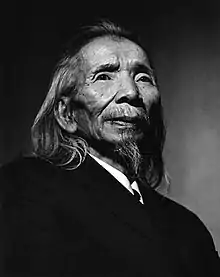 | |
| Born | Nguyễn Văn Cao 15 November 1923 Hai Phong, French Indochina |
| Died | 10 July 1995 (aged 71) Hanoi, Vietnam |
| Nationality | Vietnamese |
| Occupation | Composer |
| Known for | Composing music |
Notable work | Tiến Quân Ca |
Career
After the Nhân Văn–Giai Phẩm affair, a movement for political and cultural freedom in 1956, he had to stop composing. Most of his songs, except Tiến Quân Ca, Làng Tôi, Tiến Về Hà Nội, and Trường Ca Sông Lô were prohibited in North Vietnam.
All of his songs were once again authorized in Vietnam until after the Đổi Mới, 1987.
In 1991, the American composer Robert Ashley composed the solo piano piece Văn Cao's Meditation, which is based on the image of Văn Cao playing his piano.
Works
- Songs
- Bài ca Chiến sĩ Hải quân (1945) ("Song for marines")
- Bắc Sơn (1945) ("Bac-Son - a guerrilla center during the war with French colonialism")
- Bến xuân (music by Văn Cao, words written together with Phạm Duy) (1942) (Ben xuan idk)
- Đàn chim Việt (Vietnamese flock of birds)
- Buồn tàn thu (1939, the first song of Văn Cao)
- Chiến sĩ Việt Nam (1945) ("Vietnamese soldiers")
- Cung đàn xưa ("Melody of the past")
- Đêm sơn cước ("A night in the mountain")
- Gò Đống Đa (1942) ("Dong-Da Hillock")
- Hò kéo gỗ Bạch Đằng Giang (1941)
- Làng tôi (1947) ("My Village")
- Không quân Việt Nam hành khúc (1945) ("Vietnamese air force march")
- Hải quân Việt Nam hành khúc (1945) ("Vietnamese navy march")
- Ngày mai ("Tomorrow")
- Ngày mùa (1948) ("Harvest")
- Suối mơ ("Dream stream")
- Thăng Long hành khúc ca (Thang Long marching song)
- Thiên Thai (1941) ("paradise")
- Thu cô liêu
- Tiến về Hà Nội (March on Hanoi)
- Tiến Quân Ca (1944) (Army marching song)
- Tình ca Trung du (Trung du's love song)
- Trương Chi (1943) ("Not a word but a name")
- Trường ca sông Lô (1947) ("Lo river epic")
- Mùa xuân đầu tiên (1975) ("First Spring")
- Mùa xuân đầu tiên (1976) ("First Spring")
- Poems
- Anh có nghe không ("Do you hear?". Published in Giai phẩm Spring (Feb) 1956)
- Những ngày báo hiệu mùa xuân ("Days with signs of a spring to come")
- Lá (1988) ("Leaves")
References
- Dale Alan Olsen Popular Music of Vietnam: The Politics of Remembering 2008 "Văn Cao" p36-37, p129-130
- Shepherd Continuum encyclopedia of popular music of the world "Văn Cao"
- "Trinh Cong Son's love songs hit Hue palace". Tuổi Trẻ. 30 March 2011. Archived from the original on 2 April 2011.
External links
Authority control  | |
|---|---|
| General | |
| National libraries | |
| Other | |