Niš Declaration
The Niš Declaration (Serbian: Niška deklaracija/Нишка декларација) was the declaration of war aims of the Kingdom of Serbia in the First World War. It was issued on 7 December 1914, during the Battle of Kolubara, as a defensive declaration seeking to attract support from the South Slavs living in Austria-Hungary. In the Niš Declaration, the Serbian government promised to work for liberation of South Slavs from foreign rule and establishment of a common state after the war. The declaration was adopted in the temporary capital of Niš as the government fled Belgrade during that stage of the Serbian campaign for safety.
| Niš Declaration | |
|---|---|
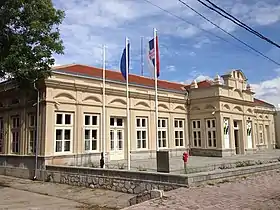 Former Officer's Club building in Niš, the site of adoption of the declaration | |
| Presented | 7 December 1914 |
| Location | Niš, Serbia |
The Triple Entente powers did not accept the objectives set out in the Niš Declaration because they were still supporting preservation of Austria-Hungary at the time. The allied support for a separate peace with Austria-Hungary and trialist reform proposals such as the 1917 May Declaration motivated the Serbian government to cooperation with the Yugoslav Committee. Talks between the two led to the Corfu Declaration on the principles of unification of South Slavs.
Background
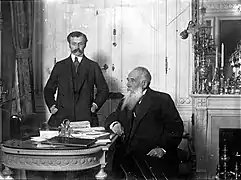
At the beginning of the First World War, the Royal Serbian Army successfully repulsed the Austro-Hungarian forces in the initial stages of the Serbian campaign. However, by early November 1914, the Serbian troops were forced to abandon the capital Belgrade and territory in the Northeast of the country. The government of the Kingdom of Serbia retreated South to the temporary capital city of Niš. Austro-Hungarian advance reached the Kolubara River in mid-November and was blocked there. In the ensuing month-long Battle of Kolubara, the initiative passed from the Austro-Hungarian forces to the Serbian Army which launched a counter-offensive on 3 December.[1]
Following the outbreak of the hostilities, Serbia considered the war an opportunity for territorial expansion beyond Serb-inhabited areas. A committee tasked with determining war aims produced a programme to establish a Yugoslav state by addition of Croatia-Slavonia, the Slovene Lands, Vojvodina, Bosnia and Herzegovina, and Dalmatia.[2] This echoed Serbian Foreign Minister Ilija Garašanin's 1844 Načertanije – a treatise anticipating the collapse of the Ottoman Empire, calling for establishment of Greater Serbia to pre-empt Russian or Austrian imperial expansion into the Balkans, and unifying all Serbs in a single state.[3]
Provisions
The Serbian government declared, and the National Assembly confirmed, its war aims in Niš on 7 December.[1] In the Niš Declaration, the National Assembly of Serbia announced the struggle to liberate and unify "unliberated brothers".[4] However, the declaration did not mention Greater Serbia. Instead, the declaration spoke of "three tribes of one people" when referring to the Serbs, the Croats, and the Slovenes.[5] Historian Andrej Mitrović described the declaration as the "Yugoslav" declaration of the Serbian government because the government claimed to work in the service of the Serbian state and the "Serbo-Croatian and Slovenian tribe" in the declaration.[6]
The concept of the "three tribes of one people" was introduced by a group of Belgrade-based scholars led by Jovan Cvijić in December 1914. Cvijić and his colleagues, as well as the government taking their cue from Cvijić, deemed the Macedonians and the Muslim Slavs (especially the Bosniaks) ethnically "unformed elements" which could be quickly assimilated by the Serbs.[5] The Montenegrins were not mentioned in the declaration, as Serbia assumed the central role in state-building of the future South Slavic polity with support from the major Entente powers.[7] Cvijić's views were incorporated into the Niš Declaration as hopes of a short war became unrealistic, and the declaration was meant as a way to attract support from South Slavs living in Austria-Hungary. The government was motivated to appeal to the fellow South Slavs as it feared little material support was coming from the Triple Entente allies.[5]
Aftermath
The Entente powers never accepted the Niš Declaration.[8] The international support would not begin to shift away from preservation of Austria-Hungary before the United States entered the war.[9] Nonetheless, in his Fourteen Points speech, President Woodrow Wilson only promised autonomy for the peoples of Austria-Hungary. Preservation of the dual monarchy was not abandoned before signing of the Treaty of Brest-Litovsk in March 1918 when the allies became convinced that Austria-Hungary could not resist Communist revolution.[10]
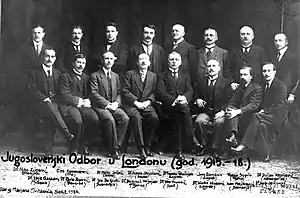
On 30 May 1917, South Slavic members of the Vienna Imperial Council presented the body with the May Declaration. It was a manifesto demanding unification of Habsburg lands inhabited by Croats, Slovenes, and Serbs into a democratic, free and independent state equal in status to Cisleithania or the Kingdom of Hungary, under the Habsburg dynasty.[11] The May Declaration was issued while the Entente was still looking for ways to achieve a separate peace with Austria-Hungary and thereby detach it from German Empire. This presented a problem for the Serbian government then exiled on the Greek island of Corfu following the Great Retreat in the winter of 1915/1916. It increased the risk of a trialist solution for the Habsburg South Slavs if the separate peace treaty materialised, preventing fulfilment of the Serbian war objectives.[12] Lacking previous strong Russian diplomatic backing since the February Revolution, Serbian Prime Minister Nikola Pašić felt compelled to come to an arrangement with the Yugoslav Committee,[13] an unofficial ad-hoc group of intellectuals and politicians from Austria-Hungary claiming to represent interests of South Slavs,[14] whose most prominent member, Frano Supilo, advocated a federation to counter the threat of Serbian hegemony in a common South Slavic state.[9]
Pašić invited the Yugoslav Committee to talks on the principles of post-war unification which produced the Corfu Declaration in July 1917. The new declaration retained the "one tri-named people" phrase first used in the Niš Declaration.[15]
References
- Lampe 2000, p. 102.
- Pavlowitch 2003, p. 29.
- Ramet 2006, p. 37.
- Ramet 2006, p. 40.
- Lampe 2000, pp. 102–103.
- Mitrović 2003, p. 44.
- Pavlović 2008, p. 70.
- Mitrović 2003, p. 53.
- Pavlowitch 2003, p. 31.
- Banac 1984, p. 126.
- Pavlowitch 2003, p. 32.
- Pavlowitch 2003, p. 33.
- Banac 1984, p. 123.
- Ramet 2006, pp. 41–43.
- Ramet 2006, pp. 41–42.
Sources
- Banac, Ivo (1984). The National Question in Yugoslavia: Origins, History, Politics. Ithaca: Cornell University Press. ISBN 0-8014-1675-2.
- Lampe, John R. (2000). Yugoslavia as History: Twice There Was a Country (2nd ed.). Cambridge: Cambridge University Press. ISBN 0-521-77357-1.
- Mitrović, Andrej (2003). "The Yugoslav Question, the First World War and the Peace Conference, 1914–1920". In Djokic, Dejan (ed.). Yugoslavism: Histories of a Failed Idea, 1918–1992. London: C. Hurst & Co. pp. 42–56. ISBN 1-85065-663-0.
- Pavlović, Srđa (2008). Balkan Anschluss: The Annexation of Montenegro and the Creation of the Common South Slavic State. West Lafayette: Purdue University Press. ISBN 9781557534651.
- Pavlowitch, Kosta St. (2003). "The First World War and Unification of Yugoslavia". In Djokic, Dejan (ed.). Yugoslavism: Histories of a Failed Idea, 1918–1992. London: C. Hurst & Co. pp. 27–41. ISBN 1-85065-663-0.
- Ramet, Sabrina P. (2006). The Three Yugoslavias: State-building and Legitimation, 1918–2005. Bloomington: Indiana University Press. ISBN 9780253346568.