Nicole d'Oliva
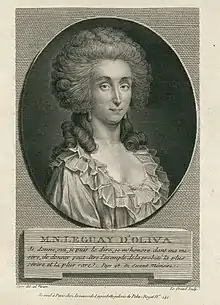
Marie Nicole Le Guay d'Oliva (Paris, September, 1761 – Fontenay-sous-Bois, 1789), was a French prostitute and memoirist. She is known in history as one of the participants of the famous fraud known as the Affair of the Diamond Necklace.[1]
Life
She was born in Paris as the daughter of Claude Le Guay and Marguerite David. She was orphaned early in life, and was forced to rely on prostitution to suport herself. She called herself 'Baroness d'Oliva', and prostituted herself in the gardens of the Palais Royal in Paris.
In the spring of 1784, she was contacted by Nicholas de la Motte, spouse of Jeanne de Valois-Saint-Rémy. She was hired by them to pose as queen Marie Antoinette in a late night meeting with a man in the garden of Versailles. During the meeting, she was to deliver a few words, a rose and a letter. The meeting was a crucial part of the fraud Affair of the Diamond Necklace: the man was Cardinal de Rohan, and the intent was to convince the him that the queen was indeed involved in the affair. She had been chosen to perform the part because of her likeness to the queen, and was to be dressed in a white dress similar to that of the queen.
In the summer of 1785, the fraud was exposed in Paris. On 16 October 1785, Nicole d'Oliva was arrested in Brussels in the company of a man named Toussaint de Beausire. She was transferred to the Bastille, were she gave birth to a child. All of the accomplices were put on trial.
Nicole d'Oliva stated in her trial, the she had not been aware of the fraud. She had participated in the famous meeting, but she had not been aware of the purpose of it. As far as she knew, she had simply been hired to play an acting role.
The court believed in Nicole d'Oliva's statement that she had been unaware of the fraud. She was the only person involved in the fraud who was freed in court with the exception of cardinal de Rohan.
After the trial, she had an affair with her defense lawyer. She died only four years after the trial, as a guest in the Fontenay-sous-Bois convent.
Memoirs
She published her own memoirs after the trial: Mémoire pour la demoiselle le Guay d’Oliva, fille mineure, émancipée d’âge, accusée, contre M. le Procurer-général.
References
- Jean-Claude Fauveau, Le prince Louis cardinal de Rohan-Guéméné ou les diamants du roi, L’Harmattan. 2007.