Nigihayahi
Nigihayahi no mikoto (尼ぎ速日の神) is a Kami in Japanese mythology.
Summary
In the Kojiki, Nigihaya-no-mikoto; in the Nihon Shoki, Rokuhaya-no-mikoto; and in the Kyūjimotoki, in addition to the name Rokuhaya-no-mikoto, he is also known as Amateru Kuniteruhiko Amateruhiyakushitama Rokuhaya-no-mikoto Amateru Kuniteruhiko Amagasaki Kushitama Nigihaya no Mikoto, Amateru Kuniteruhiko Amagasaki no Mikoto, and Amateru Kuniteruhiko Amagasaki no Mikoto. Other aliases include Amateru Mitama no Kami, Amaterasu Sumemitama no Okami, Kushitama no Mikoto, and Kushitama no Kami Nigihayahi no Mikoto. In the Kojiki (Records of Ancient Matters)
In the Kojiki (Records of Ancient Matters), he appears as a deity dedicated by Nagasudoribiko, a Gōzoku of the Yamato Province, during Emperor Emperor Jimmu's expedition to the Yamato region. In the Yamato region, Nagasudoribiko's younger sister, Tomiyabihime (known as Mitakuriyahime in the Chronicles of Japan), was his wife, with whom he had a son, Umashimasatomikoto. Umazimasuchinomikoto was the founder of the Mononobe ren, Hozumiomi, and Saimeomi. After Emperor Jimmu made an expedition to the east and Nagasudoribiko was defeated, he found out that Amaterasu was a descendant of Amaterasu and went down to join him.
According to the writings of Nihonshoki and other sources, prior to the eastern expedition of Jimmu, he received the Ten Divine Treasures from Amaterasu and descended to the land of Kawakami in Kawachi Province (Osaka Prefecture, Katano City) on a Tenban Boat. Yamato Province (Nara Prefecture). These stories are considered to be of a different lineage from the Ninigi-no-Mikoto story of descent. In addition, the existence of Reihayakuninomikoto involves many important issues, such as the fact that he is regarded as the ancestor deity of powerful clans, especially the Mononobe clan, which is in charge of rituals, and the fact that the myth clearly states that he resided in Yamato before Emperor Jinmu. There are also theories that suggest the existence of an Izumo kingship in the Yamato region before Emperor Jinmu, or that the Monobe clan had ties to some power in the Yamato region.
The Amateru Kuniteruhiko Amanohimei Kushitama Raohiyakunishi in the Old Chronicle of Japan states that he is the same god as Amenohoakari, the son of Amenohimimi and the elder brother of Qionionigi. He is also said to be the ancestor god of the Mononobe clan, the Hozumi clan, the Owari clan, the Kaifu clan, and the Kumano Kunizukuri.
In Shinsengumi, Nigihayahi is described as a heavenly deity (from Takamagahara, but not of the imperial lineage), and Amenohoakari as a descendant of Amaterasu.
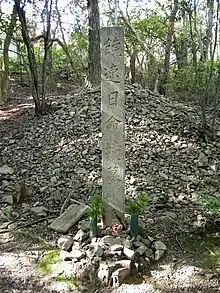
The tomb of Reihayoninushi-no-mikoto is located on Mount Shiraniwa in Shiraniwadai, Ikoma City, Nara Prefecture.
The deity who accompanied the descent
In The Old History of the Former Kingdom of Japan, Vol. 3, Tenjin Hongi,[1] it is said that Takamimusubi ordered the following thirty-two people to accompany him as his guardians when he descended from heaven.
- Ame-no-Kaguyama-no-Mikoto, ancestor of Owari-no-Muraji and others
- Ame-no-Uzume, ancestor of Sarume no Mikoto and others
- Ame-no-Futodama-no-Mikoto, ancestor of Imu-be-no-Obito and others
- Ame-no-Koyane, ancestor of the Nakatomi clan
- Futodama, ancestor of the Kamo clan and others.
- The ancestor of Ame-no-Michine no Mikoto, Kawase-no-Miyatsuko, and others. God of the same generation as Emperor Jinmu
- Ame-no-Kamutama-no-Mikoto, ancestor of Mishima-no-Agonushi and others. Son of Kamisusubi no Kami and father of Amagushi no Tamamikoto.
- Ancestor of Ame-no-Kunun-no-Mikoto, Nakato-no-Atai, and others. Brother of Ameyutsuhiko-no-mikoto.
- Ancestor of Ame-no-Nukadonomikoto, Kagamizukuri-no-Muraji and others.
- Tamamakotama-no-Mikoto, ancestor of Tamasakuren and others.
- Ame-no-Murakumo-no-Mikoto, ancestor of Watarai-no-Kannushi and others. Son of Amenokoyanomikoto, father of Ame-no-Koyane.
- Ame-no-Koyane, ancestor of Ame-no-Seo-no-Mikoto, Yamashiro-no-Kuga-no-Atai, and others. He is the son of Amasoko no Ritsunomikoto and the father of Amanojishin.
- Amemikage no Mikoto, grandson of Amaterasu, son (legitimate son) of Amatsuhikone, ancestor of Mikami no Hafuri, Mikami no Atai, and others.
- Ame-no-Tsukurihime-no-Mikoto, ancestor of Azumi-ren and others.
- Ame-no-Yomuke-no-mikoto, ancestor of Kuga-no-Atai and others
- Ame-no-Tomane no Mikoto or Ame-no-Tomami no Mikoto, the same deity as the above-mentioned Tenmyoin no Mikoto (another name for Tenmyoin no Mikoto, technically an incarnation of the humanoid Tenmyoin no Mikoto) He was the ancestor of Nukatabe-no-Yuza-ren and others, but when he took the name Amatomami-no-mikoto, his legitimate lineage was Bonkochi-no-kuni-no-miyatsuko, the Bonkochi clan.[2][3][4] He was also known as Ame-no-mahitokoto, who incarnated as a dragon god, and in this case the legitimate branch was Yamashiro-no-kuni-no-miyatsuko.[2][3][4] He has many other aliases, such as Amatsu-Mara-no-Mikoto,[3]
- Ame-no-Setome no Mikoto, ancestor of Owari-no-Nakajima-no-Amabe no Atai and others
- Ame-no-Tamakushihiko-no-Mikoto, ancestor of the Hashito no Muraji and others
- Ancestor of Ame-no-Yutsuhiko-no-Mikoto, Aki-no-Kuni-no-Miyatsuko, and others. Son of Kushi-Amitama-no-Mikoto
- Ame-no-kamutama-no-mikoto or Mimunehiko-no-mikoto, ancestor of Kadono-kamo-no-aganushi and others. Son of Kamisusubi no Kami, father of Amenokushitama no Mikoto
- Amemikudari-no-mikoto, ancestor of Toyota-no-Usa-no-kuni-no-miyatsuko and others. He was a descendant of Amakatsutamonomikoto, father of Usatsuhiko-no-mikoto.
- Ame-no-hinokami-no-mikoto, ancestor of Tsushima no Agatonushi and others. Son of Takamisusubi.
- The ancestor of Chiyahayahi-no-mikoto, Hirose-no-Kamuomino-muraji, and others. Nakatomi clan, ancestral deity of the Soe Agata clan.
- Yasakahiko-no-Mikoto, ancestor of Ise-no-Kamuomi-no-Muraji and others. Son of Nagashiraba, and according to one theory, father of Yasakatoumi.
- He is the ancestor of Isafutama-no-mikoto, Shidori-no-muraji, and others. Isafutama-no-mikoto, son of Kakugotomikoto, father of Amagasaki-no-mikoto.
- He is the son of Kakugotomikoto and the father of Tenzokidaritsunomikoto. He is the ancestor of Iki-shidaniho-no-mikoto, Yamashiro-no-kuni-no-miyatsuko, and others. Son of Shikanejin.
- Ikutama-no-mikoto, ancestor of Niitabe no atai. Son of Takamisusubi, father of Amanoshitachi no Mikoto.
- The founder of Shohikone no Mikoto, Tottori no Muraji, and others. He was the son of Amayuga Itagaki and father of Takehito no Mikoto.
- He was the son of Amatsuhiko-no-mikoto and the father of Tatehito-no-mikoto. He was the son of Akitsuhikone no Mikoto.
- He was the son of Omoikane (Shinto), the ancestor of Uwaharu-no-mikoto, Shinano-Achi-no-Iwai-be, and others. For more information on Shinano Achi no Iwaibe, see Achi Shrine (Achi Village).
- Ame-no-shita-haru-no-mikoto, ancestor of Musashi-Chichibu-no-kuni-no-miyatsuko and others.
- Tsukuyomi-no-Mikoto, ancestor of Tsuki no Kami no Mikoto, Iki no Agatonushi and others.
Tsuki no Agatonushi and others.
- Ama-Tsu-Mara (Amatsumara) The ancestor of the Mononobe clan (Mononobe no Miyatsuko)
- Amatsu Yuso, Ancestor of Kasanui-be and others
- Amatsu Akaura, ancestor of Inabe and others
- Amatsu Akaura, ancestor of Inabe and others
- Amatsu Akaboshi, ancestor of Tsukushi no Tsuruta no Monobe and others
In addition, for security purposes, they were accompanied by five "Zouzou" of the Amamonobe and twenty-five "Bouzou" with military staffs.
- Futada no Miyatsuko (Futada no Miyatsuko)
- Oba no Miyatsuko (Ohba no Miyatsuko)
- Toneri no Miyatsuko
- Yuso-no-miyatsuko
- Sakato no miyatsuko
- Futada no Mononobe
- Tagima no Mononobe
- Serita no Mononobe
- Torimi no Mononobe
- Yokota no Mononobe
- Shimato no Mononobe
- Ukita no Mononobe
- Soga no Mononobe
- Ashida no Mononobe
- Susaka no Mononobe
- Tajiri no Mononobe
- Akama no Mononobe
- Kume no Mononobe
- Satake no Mononobe
- Omame-no-Monobe
- Katano no mononobe
- Hatsukashi-no-Mononobe
- Hirokitsu no Mononobe
- Futsuru no Mononobe
- Sumitonobe (Sumito no Mononobe)
- Sanuki-no-Mononobe (Sanuki Mino Mononobe)
- Aizuki no Mononobe
- Tsukushi no Kiku no Mononobe
- Harima no Mononobe
- Tsukushi no Nieta no Mononobe (Tsukushi no Nieda no Mononobe)
These are said to have been transported by boat, and the names of those who operated the boats are given.
- Amatsu Habara, captain of the ship, ancestor of Atobe no Obito and others
- Amatsu-Mara: Ancestor of Kajitori, Atobe no Obitsuko, and others
- Amatsu-Maura: Ancestor of Funako, Yamato-no-Kanuchi, and others
- Amatsu-Maura: Ancestor of Funako, Kasahui, and others
Ancestor of Funako, Sono-Kasanui and others * Amatsu-Akamara
- Amatsu Akaboshi: Ancestor of Funako, Inabe and others
The relationship between Emperor Jinmu and Reihayakuninushi
-
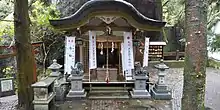 磐船神社 本殿
According to the Nihon Shoki (Chronicles of Japan) and Kojiki (Records of Ancient Matters), the story of the encounter between Emperor Jinmu (Iwarebiko) and Nigihayahi (Nigihayahi) is as follows.
Emperor Jinmu (Iwarebiko) heard from Old Man Shiodo that there was a beautiful land in the east and that someone had descended first on a Tenban ship. He took his clan and headed east from southern Kyushu through the Seto Inland Sea to Naniwa Facilitator (modern Osaka) to build a capital there. He then traveled from Kawachi Province to Mount Ikoma from Kusaka-eup in Kawachi Province. There, the native Nagasunehiko appears and they fight, but have a hard time. Jimmu decided to go northward, detouring to Kumano (the southern tip of Kii Peninsular), saying, "It is against the way of heaven to defeat an enemy facing the sun (east).
When he reached Uda, he climbed Mt. Takakura and looked around, and saw that the Eighty Owls had formed an army. That night, a heavenly deity appeared in Jimmu's dream and told him to respect and worship the gods of heaven and earth. He did as he was told and was able to eliminate the enemy forces, and then attacked Naganomewhiko.
Then Naganoharuhiko said, "We have served Nigihayahi, the son of Tenjin, who descended from the heavens in the Tenban ship. Do you claim to be a heavenly deity and wish to take our land?" Kamitake replied, "The sons of Tenjin are many. If you are the son of a heavenly deity, prove it to me. Naganumaehiko showed him the arrow and quiver of Rokuhayoninushi-no-mikoto. Jinmu then showed him the same items. Naganumaeiko did not stop fighting. Nigihayahi admonished Naganoharu, saying that heavenly gods and men were different, but Naganoharu's character was so twisted that he killed him and returned to Emperor Jimmu to swear his allegiance.
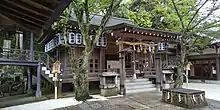
According to the history of the Ishikiri Tsurugidjar Shrine, he received the divine decree from Amaterasu to establish Yamato, and was given ten kinds of zuiho (sacred treasures).
According to the history of the Ishikiri Tsurugidani Shrine, Nohatsuhatsuhikami, who had received the divine decree from Amaterasu to establish Yamato, and who had been given ten kinds of sacred treasures, formed a fleet of boats, and carrying the Nuto-gokon Tsurugi and the Amatsuha-no-miya, the sign of the Son of the Sun, he boarded a Tenban ship, and led a large fleet of eighty Mononobe sailors to the Takamagahara Takamagahara. On their way, they stopped at Usa, Ōita in Buzen Province, where they split the fleet in two and gave the "Nuto Gotama Tsurugi" to their son, Ame-no-Kaguyama-no-Mikoto, who took charge of one of the ships. After crossing the Seto Inland Sea from Usa, Reihayoninushi went to Kawachi and Yamato, while Amakaguyama-no-Mikoto went to Kii. When the ship arrived at Takegamine (Mount Ikoma), overlooking the village of Torimi, Rokuhayoninushi looked around and exclaimed, 'The Land of Yamato in the Sky. This is Japan This was the beginning of the country name Japan. At that time, the area between Kawachi and Yamato was called Torimi-no-sato, a bountiful land blessed with peaceful nature and good food from the sea and mountains. The Torimi clan, a powerful family that ruled this region, had no skills in rice cultivation or iron making, but they were good hunters and fishermen, excelled in making living tools and houses, and were feared as "those of long marrow" because their tall and blessed physique excelled in battle. The chief of the Torimi clan at that time, Naganohiko, was struck by the virtues of Reihatsuhiko, and when he saw the cultural differences in the rice cultivation, textiles, iron-making tools and armor that Reihatsuhiko had brought to the clan, he realized the futility of fighting, and the whole clan followed him. At this time, Tomiyabihime (Mitsukuriya Ehime), the sister of Naganashikihiko, mediated between the two and later fathered Umashimajinomikoto with Takeru.
In this way, he came to rule the village of Torimi, and cultivated the rice paddies in this land, which was rich in water and suitable for rice cultivation, and began to reap a great harvest. This was the beginning of rice cultivation culture in the Kinki region. In the meantime, when the village of Torimi was in the midst of its prosperity, Banyohiko (the future Emperor Jimmu) continued his march eastward from Takachiho in Hyuga. Defeated in the battle, Banyohiko retreated toward Kii, bypassed the Kii Peninsula, and confronted Naganohide again. At this time, Reihayonichi had already passed away, and Umazimasunomikoto had taken his place as the chief of Torimi. Umazimasunomikoto presented Amamihazuya and Quiver to Banyohiko as proof that he was the Son of the Sun. The same items were then presented to him, and it became clear that he was a natural descendant. Umazimasunomikoto urged Naganedeshihiko to return to Banyohiko, and he himself led his clan in pledging allegiance to Banyohiko, offering him all of his vast rice fields and domains, as well as the "Ten Treasures" given to him by Amaterasu. In this way, the unification of Yamato was accomplished, and Banyohiko ascended to the throne as Emperor Jimmu.
Genealogy
In the Kujiki, he is identified with Amenohoakari, the son of Amaterasu's grandson Amanochihomimi-no-mikoto and the son of Takamatsusunrei-no-mikoto (Manhata Toyokitsushi-hime). In the "Genealogy of the Fukube Clan", he is said to be the son of Ōkuninushi In the "Honjo Family Records", his mother is said to be Manbatachihime, daughter of Ame-no-Kaguyama-no-Mikoto, while in the "Kamei Family Records", his mother is said to be Manbatachihime, daughter of Ame-no-Koyane, ancestor of the Nakatomi clan.
Her children are said to be Amakagoreyama-no-mikoto, born to Ame-no-Michihime, daughter of Okonomikoto, and Umashimasuchino-no-mikoto, born to Tomiyasu-no-mikoto, sister of Nagasudoribiko.
Her daughter, Yuhoyahime-no-mikoto, became the wife of Takakurashita.
Descendant clans
The Mononobe clan is a clan whose ancestor was Nigihayahi. The Hozumi clan and the Kumano no Kunizukuri Wada clan are said to have the same ancestor. The Yuge clan is closely related to the Mononobe clan.
A genealogical tree handed down to the Kaifu clan, the family of the Kagome Shrine, has been designated a national treasure .[lower-alpha 1] .[lower-alpha 2]
In addition, the Ifukube clan has a genealogy that incorporates Rokuhayoninomikoto into a genealogy that begins with Okikinomikoto, but this is said to be a genealogy that represents a son-in-law .
Shrines to worship
- Iwafune Shrine - The shrine's deity is a huge rock called "Ame-no-Iwafune" (Heavenly Rock).
- Amateru Tamamikoto Shrine (Kyoto Prefecture Fukuchiyama City, Imaan)
- Ishikiri Kenjya Shrine (Osaka Higashi Osaka City Higashi Ishikiri-cho)
- Fujihaku Shrine (Wakayama Prefecture Kainan City)
- Hirose Taisha (Nara PrefectureKitakatsuragi CountyKawai Town)
- Yada-za Kushiyamahiko Shrine (Yada-cho, Yamatokoriyama City, Nara Prefecture)
- Flying Shrine - Founded in the Taisho era as a god of airplanes. Reihayakuninushi-no-mikoto is regarded as the ancestor god of aviation based on the old saying, "Riding on a celestial ship, flying through the sky," and is also worshipped as the god of the sky.
- Izeki-san Shrine - Amateru Shrine was founded in Emperor Sujin 2 (BC 96), enshrining a huge rocky platform as the sacred body of Amateru Kuniteruhiko Himyo Kushitama Reihatsu-no-mikoto.
- Kunitsuhikonomikoto Shrine (Ehime Prefecture Matsuyama City, Hachitanchi)
- Monobe Shrine (Shimane Prefecture Ota City, Kawai-cho)
- Karamatsusan Tenjingu Shrine (Akita Prefecture Daisen City Kyowa)
- In September of the 7th year of the reign of Emperor Sujin, the deity Amaterasu Kuniteruhikohikamyo Kushitama Neihatsuhikonomikoto was given the posthumous title of Amaterasu Omikami. Later, Emperor Keiko gave him the posthumous title of Amaterasu.
Masumida Shrine
- Masumida Shrine - One shrine in Owari Province. (The deity Amahimyo-no-mikoto is also called Amateru Kuniteruhiko Amahimyo-no-mikoto in the shrine tradition.
- Kago Shrine - The first shrine in Moto-Ise. (The deity Hikohimyo-no-mikoto is also known as Amateru Kuniteru Hikohimyo-no-mikoto, or Hotohotemikoto, according to the shrine tradition.
Notes
- The authenticity of the contents is questionable
- The Kaifu clan, like the Owari clan, are descendants of Amanohiyakumei-no-mikoto and not of Nineiyakumei-no-mikoto
References
- Kokushi Taikei, Vol. 7, "The Old History of the Former Kingdom of Japan, Vol. 3, 'Tenjin Hongi'"}, p. 118-.
- 御上祝家系図(三上氏)(コマ番号84-97) / 諸系譜. 第28冊(国立国会図書館デジタルコレクション)
- 「御上神社沿革考 : 近江国野洲郡三上村鎮座」 大谷治作 編 / 出版: 太田治左衛門 / 出版年月日: 明32.2(国立国会図書館デジタルコレクション)
- 三枝部造 甲斐野呂氏後裔 輿石氏系図(コマ番号84-92) / 諸系譜. 第6冊(国立国会図書館デジタルコレクション)