Nirendranath Dasgupta
Nirendranath Dasgupta (1892 – 3 December 1915) was a revolutionary and a participant of the Indian independence movement.[1] He was a colleague of another revolutionary Purnachandra Das and a member of the Madaripur Samiti, a secret revolutionary organization led by Purnachandra . He took part in the skirmishes on the shores of Buri Balam led by the revolutionary Bagha Jatin.
Nirendranath Dasgupta | |
|---|---|
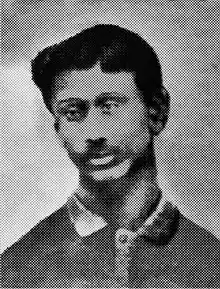 | |
| Born | 1892 Khairbhanga, Madaripur, present day Bangladesh British India |
| Died | 3 December 1915 (aged 22–23) |
| Cause of death | Execution |
| Nationality | Indian |
| Other names | Niren Dasgupta |
| Movement | Indian Independence Movement |
Early life
Nirendranath Dasgupta was born in December 1892 in the village of Khairbhanga under Madaripur Sadar upazila . His father, Lalit Mohan Dasgupta belonged to a family ayurvedic docters.[2] He became a revolutionary member of Madaripur Samiti in 1910, while as a student of Madaripur High School. He successfully passed his matriculation examination.[3]
Revolutionary activities
In 1913, he along with his cousin Manoranjan Sengupta were imprisoned on charges of Faridpur Conspiracy Case. After their release from prison, they shot and killed Nirad Haldar, a notorious intelligence officer, in 1915.[4] He was involved in the collection of arms and ammunition from the German ship "Maverick" off the coast of Baleshwar in Orissa in September 1915 under the leadership of the revolutionary Bagha Jatin.[5]
Death
Late at night on 6 September 1915, Bagha Jatin or Jatin Mukherjee returned to his temporary abode in Mahaldiha along with Chittapriya Ray Chaudhuri ,Jyotish Chandra Pal, Manoranjan and Niren. On 6 September, the whole day was spent in the deep forest. In the early morning of 9 September, they reached Balaramgarh in Baleshwar at Buribalam (in Orissa it is called "Budhabalang") On the banks of the river. They swam to the other side of the river and took refuge in a dry ditch, quite suitable for battle. In contrast, Charles Tegart, Commander Rutherford, and District Magistrate Kilby appeared with numerous armed police and military forces. Behind the bushes, there are five people led by Bagha Jatin, with mauser pistols in their hands. When the fighting started, Chittapriya Roy Chowdhury was killed on the spot by the police. Bagha Jatin was badly wounded and he died on 10 September 1915. Manoranjan, Jyotish Pal and Niren surrendered. Later Manoranjan and Niren were sentenced to death on 16 October 1915. Both of them were hanged on 3 December 1915. Jyotish Chandra Pal also did not live long. While serving his sentence in Andaman Cellular Jail, he went insane under the brutal torture of the police . He died on 4 December 1924 at Behrampur Ashram.[6]
References
- "Bagha Jatin: The unsung hero of Indian independence struggle". www.dailyo.in. Retrieved 22 August 2021.
- "Bagha Jatin (Life And Times of Jatindranath Mukherjee)". www.exoticindiaart.com. Retrieved 22 August 2021.
- GHOSH, KALI CHARAN (1960). THE ROLL OF HONOUR. VIDYA BHARATI,CALCUTTA.
- Roy, Aishi (1 April 2020). "'We Shall Die to Awaken The Nation': Bagha Jatin, Whose Bravery Shook the British Raj!". The Better India. Retrieved 22 August 2021.
- "Bangla turns to Jatin in secularism battle". www.telegraphindia.com. Retrieved 22 August 2021.
- ""Bâghâ Jatîn": J. N. Mukherjee, the Tiger, precursor of Gandhi". ContribCity. 15 May 2020. Retrieved 22 August 2021.