Ritonavir
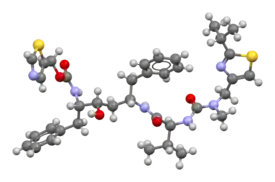
Ritonavir, sold under the brand name Norvir, is an antiretroviral medication used along with other medications to treat HIV/AIDS.[1][2][3] This combination treatment is known as highly active antiretroviral therapy (HAART).[3] Often a low dose is used with other protease inhibitors.[3] It may also be used in combination with other medications for hepatitis C.[4] It is taken by mouth.[3] The tablets of ritonavir are not bioequivalent to capsules as tablets may result in higher peak plasma concentrations.[3]
 | |
 | |
| Clinical data | |
|---|---|
| Trade names | Norvir |
| Other names | RTV |
| AHFS/Drugs.com | Monograph |
| MedlinePlus | a696029 |
| License data | |
| Pregnancy category |
|
| Routes of administration | By mouth |
| ATC code | |
| Legal status | |
| Legal status | |
| Pharmacokinetic data | |
| Protein binding | 98-99% |
| Metabolism | Liver |
| Elimination half-life | 3-5 hours |
| Excretion | mostly fecal |
| Identifiers | |
| |
| CAS Number | |
| PubChem CID | |
| DrugBank | |
| ChemSpider | |
| UNII | |
| KEGG | |
| ChEBI | |
| ChEMBL | |
| NIAID ChemDB | |
| PDB ligand | |
| CompTox Dashboard (EPA) | |
| ECHA InfoCard | 100.125.710  |
| Chemical and physical data | |
| Formula | C37H48N6O5S2 |
| Molar mass | 720.95 g·mol−1 |
| 3D model (JSmol) | |
| |
| |
  (what is this?) (verify) (what is this?) (verify) | |
Common side effects include nausea, vomiting, loss of appetite, diarrhea, and numbness of the hands and feet.[3] Serious side effects include liver problems, pancreatitis, allergic reactions, and arrythmias.[3] Serious interactions may occur with a number of other medications including amiodarone and simvastatin.[3] At low doses it is considered to be acceptable for use during pregnancy.[5] Ritonavir is of the protease inhibitor class.[3] Typically, however, it is used to inhibit the enzyme that metabolizes other protease inhibitors.[6] This inhibition allows lower doses of these latter medications to be used.[6]
Ritonavir was patented in 1989 and came into medical use in 1996.[7][8] It is on the World Health Organization's List of Essential Medicines.[9] Ritonavir capsules were approved as a generic medication in the United States in 2020.[10]
Medical uses
Ritonavir is indicated in combination with other antiretroviral agents for the treatment of HIV-1-infected patients.[1][2][3]
Side effects
When administered at the initially tested higher doses effective for anti-HIV therapy, the side effects of ritonavir are those shown below.[11]
- asthenia, malaise
- diarrhea
- nausea and vomiting
- abdominal pain
- dizziness
- insomnia
- sweating
- taste abnormality
- metabolic effects, including
- hypercholesterolemia
- hypertriglyceridemia
- elevated transaminases
- elevated creatine kinase
One of ritonavir's side effects is hyperglycemia, through inhibition of the GLUT4 insulin-regulated transporter, thus keeping glucose from entering fat and muscle cells. This can lead to insulin resistance and cause problems for people with type 2 diabetes.
Drug interactions
Ritonavir exhibits hepatic activity.[12] Ritonavir induces CYP1A2 and inhibits the major P450 isoforms 3A4 and 2D6. Concomitant therapy of ritonavir with a variety of medications may result in serious and sometimes fatal drug interactions.[13]
Mechanism of action
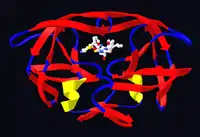
Ritonavir was originally developed as an inhibitor of HIV protease, one of a family of pseudo-C2-symmetric small molecule inhibitors.
Ritonavir is rarely used for its own antiviral activity but remains widely used as a booster of other protease inhibitors. More specifically, ritonavir is used to inhibit a particular enzyme, in intestines, liver, and elsewhere, that normally metabolizes protease inhibitors, cytochrome P450-3A4 (CYP3A4).[14] The drug binds to and inhibits CYP3A4, so a low dose can be used to enhance other protease inhibitors. This discovery drastically reduced the adverse effects and improved the efficacy of protease inhibitors and HAART. However, because of the general role of CYP3A4 in xenobiotic metabolism, dosing with ritonavir also affects the efficacy of numerous other medications, adding to the challenge of prescribing drugs concurrently.[15]
Pharmocodymanics and pharmacokinetics
The capsules of the medication do not have the same bioavailability as the tablets.[3]
History
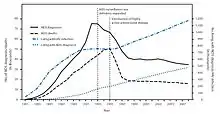
Ritonavir is manufactured as Norvir by AbbVie, Inc.. The US Food and Drug Administration (FDA) approved ritonavir on March 1, 1996,[17] making it the seventh U.S.-approved antiretroviral drug and the second U.S.-approved protease inhibitor (after saquinavir four months earlier). As a result of the introduction of "highly active antiretroviral thearap[ies]"—of which the protease inhibitors ritonavir and saquinavir were critical—the annual U.S. HIV-associated death rate fell from over 50,000 to about 18,000 over a period of two years.[16][18]
In 2014, the FDA approved a combination of ombitasvir/paritaprevir/ritonavir for the treatment of hepatitis C virus (HCV) genotype 4,[4] where the presence of ritonavir again capitalizes on its inhibitory interaction with the human drug metabolic enzyme CYP3A4.
Polymorphism and temporary market withdrawal
Ritonavir was originally dispensed as an ordinary capsule that did not require refrigeration. This contained a crystal form of ritonavir that is now called form I.[19] However, like many drugs, crystalline ritonavir can exhibit polymorphism, i.e., the same molecule can crystallize into more than one crystal type, or polymorph, each of which contains the same repeating molecule but in different crystal packings/arrangements. The solubility and hence the bioavailability can vary in the different arrangements, and this was observed for forms I and II of ritonavir.[20]
During development—ritonavir was introduced in 1996—only the crystal form now called form I was found; however, in 1998, a lower free energy,[21] more stable polymorph, form II, was discovered. This more stable crystal form was less soluble, which resulted in significantly lower bioavailability. The compromised oral bioavailability of the drug led to temporary removal of the oral capsule formulation from the market.[20] As a consequence of the fact that even a trace amount of form II can result in the conversion of the more bioavailable form I into form II, the presence of form II threatened the ruin of existing supplies of the oral capsule formulation of ritonavir; and indeed, form II was found in production lines, effectively halting ritonavir production.[19] Abbott (now AbbVie) withdrew the capsules from the market, and prescribing physicians were encouraged to switch to a Norvir suspension.
The company's research and development teams ultimately solved the problem by replacing the capsule formulation with a refrigerated gelcap. In 2000, Abbott (now AbbVie) received FDA-approval for a tablet formulation of lopinavir/ritonavir (Kaletra) which contained a preparation of ritonavir that did not require refrigeration.[22] Ritonavir produced in a solid dispersion by melt-extrusion was found to remain in form I, and was re-introduced commercially in 2010.[23]
Society and culture
Economics
In 2003, Abbott (AbbVie, Inc.) raised the price of a Norvir course from US$1.71 per day to US$8.57 per day, leading to claims of price gouging by patients' groups and some members of Congress. Consumer group Essential Inventions petitioned the NIH to override the Norvir patent, but the NIH announced on August 4, 2004, that it lacked the legal right to allow generic production of Norvir.[24]
Research
In 2020, the fixed-dose combination of lopinavir/ritonavir was found not to work in severe COVID-19.[25] In the trial the medication was started around thirteen days after the start of symptoms.[25] Virtual screening of the 1930 FDA-approved drugs followed by molecular dynamics analysis predicted ritonavir blocks the binding of the SARS-CoV-2 spike (S) protein to the human angiotensin-converting enzyme-2 (hACE2) receptor, which is critical for the virus entry into human cells.[26]
As of 2021, a formulation which combines ritonavir with the experimental protease inhibitor PF-07321332 is in phase III trials for the treatment of COVID-19.[27][28][29][30][31][32] In this combination, ritonavir serves to slow down metabolism of PF-07321332 by cytochrome enzymes to maintain higher circulating concentrations of the main drug.[33] In November 2021, Pfizer announced positive phase 2/3 results, including 89% reduction in hospitalizations when given within three days after symptom onset.[34]
Pfizer announced that a combination of ritonavir and the 3CLPro inhibitor PF-07321332 was found highly effective at preventing complications of COVID-19. The two taken together appear to reduce the mortality of COVID-19 to less than one fifth of the mortality without treatment.[35][36]
References
- "Norvir- ritonavir tablet, film coated NORVIR- ritonavir solution NORVIR- ritonavir powder". DailyMed. Retrieved November 17, 2021.
- "Norvir EPAR". European Medicines Agency (EMA). Retrieved August 20, 2020. Text was copied from this source which is © European Medicines Agency. Reproduction is authorized provided the source is acknowledged.
- "Ritonavir". The American Society of Health-System Pharmacists. Archived from the original on October 17, 2015. Retrieved October 23, 2015.
- "FDA approves Viekira Pak to treat hepatitis C". Food and Drug Administration. December 19, 2014. Archived from the original on October 31, 2015.
- "Ritonavir Pregnancy and Breastfeeding Warnings". drugs.com. Archived from the original on September 7, 2015. Retrieved October 23, 2015.
- British National Formulary 69 (69 ed.). Pharmaceutical Pr. March 31, 2015. p. 426. ISBN 9780857111562.
- Hacker M (2009). Pharmacology principles and practice. Amsterdam: Academic Press/Elsevier. p. 550. ISBN 9780080919225.
- Fischer J, Ganellin CR (2006). Analogue-based Drug Discovery. John Wiley & Sons. p. 509. ISBN 9783527607495.
- World Health Organization (2019). World Health Organization model list of essential medicines: 21st list 2019. Geneva: World Health Organization. hdl:10665/325771. WHO/MVP/EMP/IAU/2019.06. License: CC BY-NC-SA 3.0 IGO.
- "First Generic Drug Approvals". U.S. Food and Drug Administration (FDA). Retrieved February 13, 2021.
- "Norvir side effects (Ritonavir) and drug interactions - prescription drugs and medications at RxList". June 27, 2007. Archived from the original on June 27, 2007.
- Yeh RF, Gaver VE, Patterson KB, Rezk NL, Baxter-Meheux F, Blake MJ, et al. (May 2006). "Lopinavir/ritonavir induces the hepatic activity of cytochrome P450 enzymes CYP2C9, CYP2C19, and CYP1A2 but inhibits the hepatic and intestinal activity of CYP3A as measured by a phenotyping drug cocktail in healthy volunteers". Journal of Acquired Immune Deficiency Syndromes. 42 (1): 52–60. doi:10.1097/01.qai.0000219774.20174.64. PMID 16639344. S2CID 39632668.
- "Ritonavir: Drug Information Provided by Lexi-Comp: Merck Manual Professional". Merck Manuals Professional Edition. April 30, 2008. Archived from the original on April 30, 2008.
- Zeldin RK, Petruschke RA (January 2004). "Pharmacological and therapeutic properties of ritonavir-boosted protease inhibitor therapy in HIV-infected patients". The Journal of Antimicrobial Chemotherapy. 53 (1): 4–9. doi:10.1093/jac/dkh029. PMID 14657084.
- "Drug Development and Drug Interactions: Table of Substrates, Inhibitors and Inducers". U.S. Food and Drug Administration (FDA). December 3, 2019.
- Centers for Disease Control Prevention (CDC) (June 2011). "HIV surveillance--United States, 1981-2008" (PDF). MMWR. Morbidity and Mortality Weekly Report. 60 (21): 689–93. PMID 21637182. Archived from the original (PDF) on September 24, 2015.
- "Ritonavir FDA approval package" (PDF). March 1, 1996.
- The CDC, in its Morbidity and Mortality Weekly Report, ascribes this to "highly active antiretroviral therapy", without mention of either of these drugs, see the preceding citation. A further citation is needed to make this accurate connection between this drop and the introduction of the protease inhibitors.
- Bauer J, Spanton S, Henry R, Quick J, Dziki W, Porter W, Morris J (June 2001). "Ritonavir: an extraordinary example of conformational polymorphism". Pharmaceutical Research. 18 (6): 859–866. doi:10.1023/A:1011052932607. PMID 11474792. S2CID 20923508.
- Morissette SL, Soukasene S, Levinson D, Cima MJ, Almarsson O (March 2003). "Elucidation of crystal form diversity of the HIV protease inhibitor ritonavir by high-throughput crystallization". Proceedings of the National Academy of Sciences of the United States of America. 100 (5): 2180–2184. doi:10.1073/pnas.0437744100. PMC 151315. PMID 12604798.
- Lüttge A (February 1, 2006). "Crystal dissolution kinetics and Gibbs free energy". Journal of Electron Spectroscopy and Related Phenomena. 150 (2): 248–259. doi:10.1016/j.elspec.2005.06.007.
- "Kaletra FAQ". AbbVie's Kaletra product information. AbbVie. 2011. Archived from the original on July 7, 2014. Retrieved July 5, 2014.
- Zhang C, Matzger AJ (February 2017). "A Newly Discovered Racemic Compound of Pioglitazone Hydrochloride Is More Stable than the Commercial Conglomerate". Crystal Growth & Design. 17 (2): 414–417. doi:10.1021/acs.cgd.6b01638. PMC 6752731. PMID 31537981.
- Ceci Connolly (August 5, 2004). "NIH Declines to Enter AIDS Drug Price Battle". The Washington Post. Archived from the original on August 20, 2008. Retrieved January 16, 2006.
- Cao B, Wang Y, Wen D, Liu W, Wang J, Fan G, et al. (May 2020). "A Trial of Lopinavir-Ritonavir in Adults Hospitalized with Severe Covid-19". The New England Journal of Medicine. 382 (19): 1787–1799. doi:10.1056/NEJMoa2001282. PMC 7121492. PMID 32187464.
- Bagheri M, Niavarani A (October 2020). "Molecular dynamics analysis predicts ritonavir and naloxegol strongly block the SARS-CoV-2 spike protein-hACE2 binding". Journal of Biomolecular Structure & Dynamics: 1–10. doi:10.1080/07391102.2020.1830854. PMID 33030105. S2CID 222217607.
- Vandyck K, Deval J (August 2021). "Considerations for the discovery and development of 3-chymotrypsin-like cysteine protease inhibitors targeting SARS-CoV-2 infection". Current Opinion in Virology. 49: 36–40. doi:10.1016/j.coviro.2021.04.006. PMC 8075814. PMID 34029993.
- Schooley RT, Carlin AF, Beadle JR, Valiaeva N, Zhang XQ, Clark AE, et al. (September 2021). "Rethinking Remdesivir: Synthesis, Antiviral Activity, and Pharmacokinetics of Oral Lipid Prodrugs". Antimicrobial Agents and Chemotherapy. 65 (10): e0115521. doi:10.1128/AAC.01155-21. PMC 8448143. PMID 34310217. S2CID 236450769.
- Şimşek-Yavuz S, Komsuoğlu Çelikyurt FI (August 2021). "Antiviral treatment of COVID-19: An update". Turkish Journal of Medical Sciences. doi:10.3906/sag-2106-250. PMID 34391321. S2CID 237054672.
- Ahmad B, Batool M, Ain QU, Kim MS, Choi S (August 2021). "Exploring the Binding Mechanism of PF-07321332 SARS-CoV-2 Protease Inhibitor through Molecular Dynamics and Binding Free Energy Simulations". International Journal of Molecular Sciences. 22 (17): 9124. doi:10.3390/ijms22179124. PMC 8430524. PMID 34502033.
- "Pfizer begins dosing in Phase II/III trial of antiviral drug for Covid-19". Clinical Trials Arena. September 2, 2021.
- Nuki P (April 26, 2021). "Pfizer is testing a pill that, if successful, could become first-ever home cure for COVID-19". The Telegraph. Archived from the original on April 27, 2021 – via National Post.
- Woodley M (October 19, 2021). "What is Australia's potential new COVID treatment?". The Royal Australian College of General Practitioners (RACGP). Retrieved November 6, 2021.
- "Pfizer's Novel COVID-19 Oral Antiviral Treatment Candidate Reduced Risk Of Hospitalization Or Death By 89% In Interim Analysis Of Phase 2/3 EPIC-HR Study". November 5, 2021.
- Weintraub K (November 5, 2021). "Pfizer antiviral drug could nearly end deaths from COVID-19, company study suggests". USA Today.
- "Pfizer's Novel COVID-19 Oral Antiviral Treatment Candidate Reduced Risk of Hospitalization or Death by 89% in Interim Analysis of Phase 2/3 EPIC-HR Study" (Press release). Pfizer. November 5, 2021. Retrieved November 17, 2021 – via Business Wire.
Further reading
- Chemburkar SR, Bauer J, Deming K, Spiwek H, Patel K, Morris J, et al. (2000). "Dealing with the Impact of Ritonavir Polymorphs on the Late Stages of Bulk Drug Process Development". Organic Process Research & Development. 4 (5): 413–417. doi:10.1021/op000023y.