Nuclear Power Plants Authority (Egypt)
The Nuclear Power Plants Authority is an Egyptian public economic authority of a special nature affiliated to the Ministry of Electricity and Renewable Energy
Incorporation
The Nuclear Power Plants Authority[1]was established by Law No.13 of the year 1976 and amendments by Law No. 210 of the year 2017, to be a public economic authority of special nature that is affiliated to the Ministry of Electricity and Renewable Energy. The Nuclear Power Plants Authority is exclusively entrusted with establishing, operating and managing nuclear power plants in Egypt and is headquartered in Cairo.
The Authority has the national capabilities that are coupled with scientific competency and accumulated experiences necessary to successfully carry out its tasks in the management of nuclear power projects in the Arab Republic of Egypt.
Vision
Moving forward towards a bright and promising future for Egypt and its people through the peaceful nuclear energy project as one of the pillars of the National Strategy for Sustainable Development.
Mission
- Undertaking the implementation of the peaceful nuclear power plant projects in Egypt.
- Implementing consecutive technical training programs in order to allow the trainees to acquire the – knowledge and skills required.[2]
- Ensuring high professional performance of the selected candidates, working at the NPP.
- Adopting strict working policies that secure safe operation of the plant, taking into consideration the environment and human health.
- Addressing all the public concerns with transparency via publications and different media platforms.
Activities
NPPA is exclusively entrusted to carry out the following activities:
- Implementation, Operation and Management of NPP.
- Holding agreements with counter parties at home and abroad.
- Preparing and qualifying trainees at home and abroad.
- Establishment of nuclear power plants for electricity generation and water desalination.
- Conducting the research and studies required for the projects of establishing NPP.
- Setting out the basics and specifications for the establishment of NPP.
Organizational structure
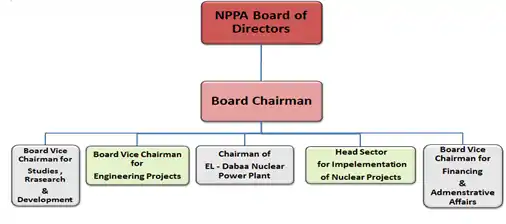
The importance of the Egyptian nuclear program
Egypt, since the early fifties of the last century, was one of the first developing countries that realized the importance of using nuclear energy to generate electricity and desalinate sea water to contribute to maximizing the utilization of Egypt's resources of primary energy and fresh water through:
- Diversifying sources of electric energy production.
- Developing and upgrading the national industry to the global level, with transferring and indigenizing this technology.
- Placing Egypt, as a leading country in the Middle East and Africa, on the map of developed countries, especially in areas related to the peaceful applications of nuclear energy.
- Preserving energy resources, such as petroleum and natural gas, which are depleted and non-renewable resources. Therefore, they must be consumed with caution and wisdom so as not to deprive future generations of important resources for sustainable and independent development.
- Maximizing the added value of using petroleum and natural gas as an indispensable raw material in the petrochemical industries, as well as fertilizers and transportation sector instead of burning them to generate electricity.
- Reducing the rates of importing petroleum products, of which Egypt has become a net importer in recent years, for all uses that are increasing year by year despite the expansion in the use of natural gas.
El-Dabaa NPP Project[4][5]
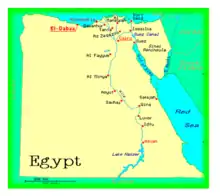
Efforts of Egypt and their governments throughout the years-long quest to enter the nuclear field have resulted in giving the start signal for the construction of the El-Dabaa nuclear power plant (DNPP), and it is planned to build four Russian- produced units of standard pressurized water with a capacity of 1200 megawatts (AES-2006) and this reactor belongs to the "Pressurized Water Reactor" type (Generation III reactors +), which are currently among the most modern reactors in the world.
The Egyptian nuclear project is currently being implemented at the El-Dabaa site[6] at a distance of 150 km west of Alexandria on the Mediterranean coast in the north of the Arab Republic of Egypt, and it has been agreed to establish and operate the nuclear power plant between the Nuclear Power Plants Authority (NPPA) and The Russian company “the Rosatom State Corporation” as the project main contractor under a number of contracts such as the Engineering, procurement, and construction "EPC" contract, the fuel supply contract, the operation and maintenance contract, as well as the spent fuel contract.
Implementation stages of the El-Dabaa NPP Project[7]
First stage
It is the preparatory stage that the project is going through now, which started since December 2017 and lasts about two years and a half. This stage aims to set up and prepare the site for the construction of the nuclear power plant.
It is worth mentioning that, the El-Dabaa NPP was chosen as one of the three best nuclear projects in terms of commissioning on the sidelines of the launch of the eleventh session of the largest nuclear conference and exhibition in the world, "Rosatom Expo", which was held in Sochi, Russia, and this is the first award of its kind that a nuclear project receives in the Middle East.
Second stage
This stage begins after obtaining permission to initiate construction and includes all building and construction works, employee training and preparation to start commissioning.
Third stage
It is the last stage after obtaining permission for pre-commissioning, which includes conducting commissioning and initiating on-site operation, and this stage continues until the initial handover of the first unit, as well as the issuance of the operating license.
The project progress is directly depending on the issuance of licenses, as their issuance aims to ensure that all the necessary legal documents are fulfilled for the safety and security of the power plant.
Accordingly, the NPPA is seeking to obtain all required licenses and permissions related to site, reactor design, construction, commissioning and commercial operation.
Milestones of the Egyptian Nuclear Program
Since then, Egypt has taken many procedures and activities to strengthen and qualify its nuclear infrastructure, to be able to implement and operate nuclear power plant projects with high efficiency, safety and reliability. The following table shows the milestones of the Egyptian nuclear program that have been taken to construct nuclear power plants to generate electricity.
| 1955 | Establishment of Atomic Energy commission. |
| 1957 | Establishment of Atomic energy institution. |
| 1961 | Operating the first research reactor at Inshas. |
| 1963 | Establishment of the Nuclear Engineering Dept. at Alexandria University. |
| 1964 | Invitation for an international tender to construct a nuclear power plant for electricity generation and sea water desalination at Sidi-krer. |
| 1966 | Issuance of a Letter of Intent to the first company in the tender. |
| 1967 | War of June 1967,the project came to a halt. |
| 1976 | Establishment the Nuclear Power Plants Authority (NPPA). |
| 1976 | Establishment of the Supreme Council of Energy. |
| 1977 | Establishment of the Nuclear Materials Authority. |
| 1979 | The project stopped as a result of TMI accident in the United States. |
| 1980 | Selection of El-Dabaa site for the construction of the Egyptian nuclear power plant. |
| 1981 | issuance of the presidential decree to allocate El-Dabaa site to establish the nuclear power project. |
| 1981 | Approval of the Supreme Council of Energy for the Egyptian nuclear program. |
| 1981 | Establishing a fund to support alternative energy projects. |
| 1983 | Invitation for an international tender for the construction of a nuclear power plant at El-Dabaa site. |
| 1986 | The project was interrupted as a result of Chernobyl accident in the former Soviet Union. |
| 1998 | Installation and operation of the second Egyptian experimental reactor at Inshas. |
| 2006 | Starting a national dialogue to study the use of nuclear power in electricity generation. |
| 2006 | Re-formation of the Supreme Council of Energy chaired by the Prime Minister. |
| 2007 | Declaration of Egypt`s strategic decision to build a number of reactors for electricity generation. |
| 2007 | Formation of the Supreme Council for the Peaceful use of nuclear energy headed by the President of the Republic. |
| 2009 | Choosing the company "Worley Parsons" as a project consultant. |
| 2010 | Preparing the documents required for obtaining the license for the El Dabaa site for the construction of the first nuclear power plant
and submitting them to the Nuclear and Radiation Regulatory Commission. |
| 2010 | Issuing Law No. (7) of 2010 on regulating nuclear and radiological activities. |
| 2011 | finalizing the preparation of technical specifications and tender offering documents. |
| 2015 | Egypt received three technical and financing offers from Russia, China and South Korea, accordingly it turned out that the Russian offer was the best one.
On November 19, 2015, an Inter-governmental agreement was signed between the Arab Republic of Egypt, represented by the Nuclear Power Plants Authority (NPPA) and the Russian Federation, represented by the Rosatom State Corporation, working in the field of establishing nuclear plants, according to which the El-Dabaa nuclear power plant will be constructed. |
| 2016/2017 | Negotiations with the Russian side to build, operate , fuel supplying
storage of spent fuel for a nuclear power plant consisting of 4 units with VVER type reactors , 1200 MW each. |
| 2019 | Site Approval Permit (SAP) for El Dabaa site was issued by the Egyptian Nuclear Regulation and Radiological Authority (ENRRA). |
Contracting with Russian company " the Rosatom State Corporation "[8]
Russia is currently considered one of the greatest exporters of nuclear reactors. It has existing nuclear power plant projects under construction in Bangladesh, Belarus, Finland, Hungary, China, India and Turkey. The Russian company “the Rosatom State Corporation” also has accumulated experience in the field of building and operating nuclear plants, as it has exported many nuclear plants in operation, numbering (96) reactors of different Russian models, which are efficiently operating in (14) countries.
Impact of the Project on the Egyptian national income
The implementation of the Egyptian nuclear project leads to many positive effects on the Egyptian national income in the following respects:
- The implementation of the program for the construction, operation and maintenance of nuclear plants will require thousands of trained manpower at all professional levels, which reduces the unemployment rate and positively reflects on the country's national income, where:
- A number of between 5000 - 6000 personnel participate in the construction of the power plant for a period of 6 consecutive years per unit, and in the case of implementing 4 units, the construction works will continue for about 10 years.
- About 1000 personnel also participate in the operation and maintenance of one unit, and in the case of 4 units the number reaches 4000 personnel over the operating life of the nuclear power plant, which is 60 years.
- Providing job opportunities in complementary industries and assisting various types of workshops such as (blacksmithing - electricity - plumbing - carpentry ...) workshops.
- The Egyptian nuclear program is going to lead to providing many new industries and raise the quality of the Egyptian current industry in line with the quality levels required for nuclear industries. This will necessarily lead to a great breakthrough in the capabilities of the local industry and its competitiveness in the local and global market, which will lead to improve the national income and improve the opportunities for self-sufficiency.[9]
- The expansion of the construction and use of the nuclear power plants to generate electricity is going to lead to a reduction in the rates of consumption of natural gas and petroleum, and their use in the petrochemical industries, which leads to an increase in their added value, which constitutes support for the national income.
- The production of electricity out of nuclear power plants is going to reduce the amount of support provided by the government to supply the consumer with electricity, which will have a positive impact on the national income of the country.
- Achieving a local participation rate of not less than 20% for the first unit, which gradually increases in line with the number of units to reach 35% for the fourth unit.
Achievements[10]
The El-Dabaa NPP was chosen as one of the three best nuclear projects in terms of commissioning on the sidelines of the launch of the eleventh session of the largest nuclear conference and exhibition in the world, "Rosatom Expo", which was held in Sochi, Russia, and this is the first award of its kind that a nuclear project receives in the Middle East. The award is the culmination of Egypt's efforts to reach the best specifications and terms that were contracted with the Russian partner implementing the El-Dabaa nuclear plant.[11]
See also
References
- "nuclear industry suppliers forum". www.zawya.com. Retrieved 2020-11-20.
- "training course for egyptian specialists at russian".
- "'Notice to proceed' contracts signed for El Dabaa - World Nuclear News". www.world-nuclear-news.org. Retrieved 2020-11-21.
- "El Dabaa Nuclear Power Plant, Egypt's first nuclear power plant". www.power-technology.com. Retrieved 2020-11-20.
- "رئيس هيئة المحطات النووية: الضبعة أكبر مشروع فى تاريخ مصر المعاصر..فيديو". صدى البلد. 2019-10-09. Retrieved 2021-01-02.
- "StackPath". dailynewsegypt.com. Retrieved 2020-12-16.
- "NPPA chief inspects work at Dabaa nuclear plant site".
- "Egypt and Russia to sign contract for Dabaa nuclear power station". Ahram Online. Retrieved 2020-11-20.
- "افتتاح منتدى «موردى الصناعة النووية» بالتعاون بين مؤسسة روساتوم وهيئة المحطات النووية لتوليد الكهرباء فى القاهرة - الجريدة العقارية". aleqaria.com.eg. Retrieved 2021-01-02.
- "الضبعة أفضل ثاني مشروع نووي بمعرض "إكسبو" في روسيا". مصراوي.كوم. Retrieved 2021-01-02.
- "'الضبعة' تفوز بجائزة 'روساتوم'.. ووزير الطاقة يشكر العاملين". جريدة الدستور. Retrieved 2021-01-02.