Nyatapola Temple
Nyatapola Temple (Nepal Bhasa: 𑐒𑐵𑐟𑐵𑐥𑑀𑐮𑑃/𑐒𑐵𑐟𑐵𑐥𑑀𑐮𑑂𑐴𑑃 ,Devanagari:ङातापोलँ where: Nyata "ङाता"= 5 Storeys " पाँच तल्ला & Pola "पोलँ" = Roof "छाना")is a five-stories Pagoda temple, located in Bhaktapur, Nepal. It is bejewelled with characteristic stone, metal and wood craftsmanship, has survived at least four major earthquakes. The temple was made during the reign of the Newari King Bhupatindra Malla(𑐖𑐸𑐖𑐸 𑐨𑐸𑐥𑐟𑐶𑐣𑑂𑐡𑑂𑐬 𑐩𑐮𑑂𑐮) during a 7-month period in 822NS (late1702AD to 1703AD). The temple is dedicated to Siddhi Lakshmi(not to be confused with Lakshmi),[1] the Tantric Goddess who bestows auspiciousness.[2]
| Nyatapola ("ङातापोलँ") | |
|---|---|
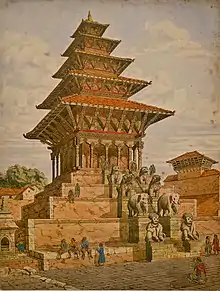 Watercolour of the Nyatapola Temple,1854 | |
| Religion | |
| Affiliation | Hinduism |
| District | Bhaktapur |
| Deity | Siddhi Lakshmi |
| Location | |
| Location | Taumadhi(Newari:ta:mārī tvā), Bhaktapur |
| Country | Nepal |
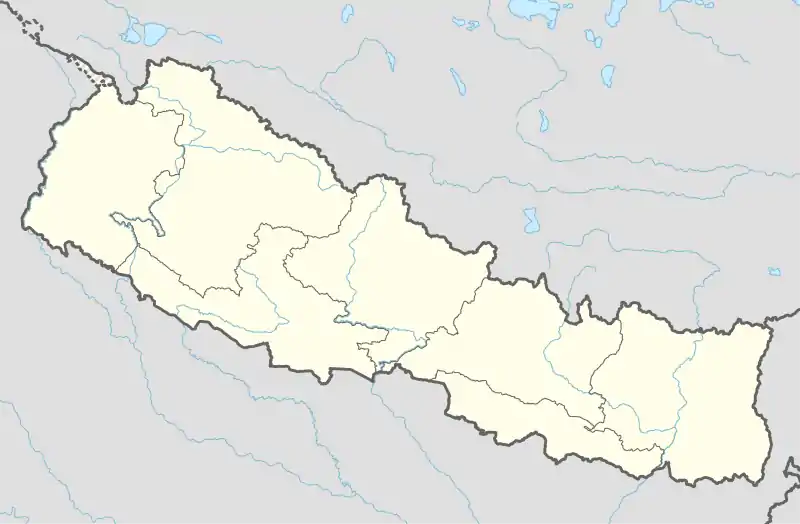  Location in Nepal | |
| Geographic coordinates | 27°40′17″N 85°25′43″E |
| Architecture | |
| Type | Pagoda |
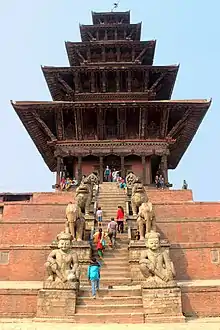
The Nyatapola temple dominates the skyline of Bhaktapur and is the tallest monument there. The locals of Bhaktapur believe that no other monument in the town shall be taller than the Nyatapola and any building taller than it will be continuously struck by lightning.[3] As such this temple is of a great cultural importance to the people of Bhaktapur as numerous other folklore of the city is based on the monument. The Nyatapola Square also divides the town of Bhaktapur into two parts:Thane(lit. 'Upper one') and Konhe(lit. 'Lower one').[4]
Construction
How it was built
According to the "Siddhagni Kotyahuti Deval Pratistha", a Newari manuscript kept at the National Archives, the temple was built in only 7 months with the help of the Kingdom of Yala(Patan) and other neighboring communities like Banepa, Panauti, Sanga, Dhulikhel Nala, Sankhu, Jhaukhel, Changu, Gokarna.[5][6] According to the above-mentioned manuscript 1,135,350 plus additional 123,304 bricks were used during the construction.[3] There are about 528 small bells(Newari:fye gan) that are hung on all the five roofs of the pagoda. It is believed that originally 529 of the bells were made and only 528 was used. The left out bell was subsequently lost. The lost bell later became an integral part of the local folklore with numerous stories linked to its disappearance with many saying that the child named Betal or Beta dyo, a mythological figure came in the construction site one night and shortened one of the roofs so that he could take that one extra bell.[7] Beta dyo is also said have been the one who installed the Gaju(golden pinnacle) at the top of the temple after everybody else was scared. Today, his painting can be found on a stone platform on the square.
The main reason for the quick construction of the temple advance preparation of all the required raw materials and the generous help by the people of Nepal Mandala.[8] After the construction work was over, the grateful King Bhupatindra Malla organized a grand feast(Newari:Ta bhoye) to all the helpers. According to historical records, more than 30,000 people participated in the grand feast ceremony.[3]
Guardians of Nytapola
.jpg.webp)
There are five plinths on the stairways to the entrance of the temple and each of the plinth has a pair of stone guardians. Each of the pair is said to ten times stronger than the one below them[1]. At the bottom are two Rajput wrestlers named Jai and Pratap who are said to be ten times stronger than normal men. Above them are the gaint statues of two elephants and above them are the statues of two Singhas, which is a mythical big cat and can be found throughout South and Southeast Asia.[9][10] Above the cats are the statues of two Sārdūlas , a griffin-like creature of local Newari mythology[10]. And in the topmost plinths are the Tantric deities, Simhanī and Vyāghranī, the lioness and tigress deity who are the strongest of all the guardians.
There are also a total of five Ganesha idols on four shrines, one on each corner of the structure(one of the shrines, the south western one has two idols on one shrine)[11]
Siddhi Lakshmi
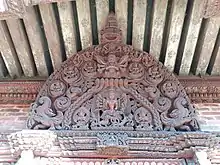
The temple of Nyatapola is dedicated to the Tantric deity of Siddhi Lakshmi who is considered the ancestral deity of the Malla royal family of Bhaktapur and is also regarded as the mother deity of the Newars of Bhaktapur. She hold the topmost position in Tantric divinity and as a result her primary visage is kept secret from public. Only the Karmacharya priests are allowed enter the temple.[11] Although, representation of her can be seen on carvings all over the temple, the primary image of the goddess is not shown to public.[11]
The image of Siddhi Lakshmi inside the temple is said to immensely beautiful and artistic and stands at least ten foot (3.048m) tall[3]. She is said to be standing with her feet on the shoulders of Bhairava, a fierce manifestation of Shiva and she herself has 9 heads and 18 arms[7]. Her image is also surrounded by smaller images numerous other deities.It is said that because her image was installed using Tantric methods, her image is hidden form the public.[11]
Significance of Nyatapola
Legend tells of the days when the Lord Bhairava, the Hindu God of destruction was causing havoc in society (1078 AD). Bhairava's temple stood in Taumadhi Square. To counteract his destructive behavior the king decided to call goddess parvati, then Parvati took the form of Siddhi Laxmi and then carried Bhairava in her hand and built a more powerful temple on the honor of Siddhi Laxmi (Parvati) in front of the Bhairab Temple. To make the brick and wood temple strong and powerful, King Bhupatindra Malla ordered guardians be placed in pairs on each level of the base leading up to the Nyatapola Temple. On the first level is a pair of likenesses of Bhaktapur's strongest man, Jaya mal Pata, a famous wrestler. Next, two elephants followed by two lions, two griffons and finally "Baghini" and "Singhini", the tiger and lion goddesses. After subduing Bhairaba, peace prevailed in the city. The Temple is the tallest temple in the Kathmandu Valley and stands 30 m high. It withstood the 1934 Nepal–Bihar earthquake.
The image of Siddhi Lakshmi is locked within the temple, and only the priests are allowed to enter to worship her. The five-storeyed temple, locally known as Nyatapola, stands in the northern side of Taumadhi Square in Bhaktapur. This is the only temple that is named after the dimension of architecture rather than from the name of the deity residing inside. The temple was erected in fewer than five months by King Bhupatindra Malla in 1701/1702 A.D.
2015 earthquake
The Bhairav kale survived the 2015 earthquake in spite of having the tallest shikhara in the valley. Many other temples were also damaged in the 2015 earthquake.[12][13] It had also survived the 1934 Nepal–Bihar earthquake that had damaged many other temples.[14]
Historical Sources and records
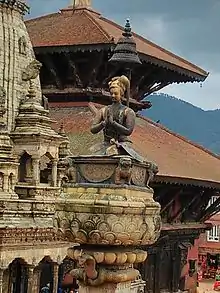
These details were found while going into the Siddhagni Kotyahuti Devala Pratistha manuscript.[15] From the start of digging the foundation to the completion of roofing, it took merely eighty-eight days. The excavation work for foundation lasted for seven days. Then was commenced construction of six plinths. That was accomplished in thirty-one days, and immediately after that started the erection of the superstructure. That was also completed within thirty-four days, after which roofing work was started from top to the lowest roof. In sixteen days all the five roofs were completed paving them with mini-tiles (Jhingati). Then they had to wait for an auspicious day for erecting the icons in the sanctum sanctorum and fix the pinnacle on the top of the temple. For this, they did wait for 38 days. In the meantime, the fire-sacrifice (Siddhagni Kotyahuti Yajna) was going on.
Presented here are six pages (three folios) of the facsimile copies of the manuscript which recorded major events from beginning to the end, as a summary of records in advance, incorporated in the manuscript containing 264 folios. There are fifty major records in the summary six-page facsimile.
The manuscript is preserved in the National Archives of Nepal. It is readily available for readers in microfilm as well, which can be read in the office or could be purchased in photocopy paying certain rupees per page.
The name of the manuscript is recorded as Siddhagni Kotyahuti Devala Pratistha. The name itself kept the enthusiasts on the subject of ancient architecture behind the curtain from knowing it. The accession number of the manuscript is ca. I. 1115 NGMPP micro number A 249/5. The manuscript is written in the Newar script in yellow Nepalese paper coated with Harital (orpiment). The size is 17.2 x 46.5 cm. Each page has nine lines. The manuscript has 264 folios, and the rest are missing Dr. Janak Lal Vaidya thinks. Some folios are ink-stained and some are damaged by rats. All the rest of the folios are in good condition.
Out of these six facsimile pages, Dr. Janak Lal Vaidya has published three folios (1, 2 and 4) without any transliteration and translation in Abhilekh No.8 published by the National Archives of Nepal. It is, however, necessary at least to give a full picture of the detailed records in those six important pages.
There is still interesting information contained in the following folios of the manuscript which were published by Dr. Janak Lal Vaidya in his articles published in Abhilekh, No. 8 and No. 14 and Kheluita No. 11 in English, Nepali and Newar respectively.
Gallery
 Festival
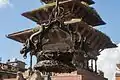
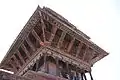 Wooden construction details
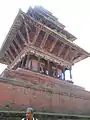 Wooden construction
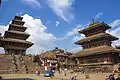 Nyatpola & Bhairav Temples
.jpg.webp) Bhairav Temple from Nyatpola
Bhairav Temple from Nyatpola.jpg.webp) Taumadhi Square
Taumadhi Square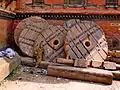 Wooden wheels of a disassembled festival cart for Bisket Jatra
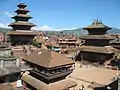 Bhojanalaya overlooking the temples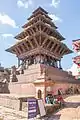
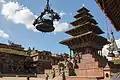
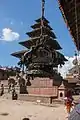
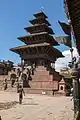
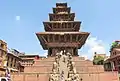 Wide view of Nyatapola Temple
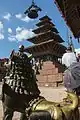
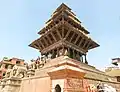 Another Side of Nyatapola Temple
References
- "Nyatapola, the tallest pagoda of Nepal". Bhaktapur.com. 2019.
- "Work index of Nyatapola temple". Goliath Business News. Retrieved 9 September 2009.
- ङातापोल्हँ जीर्णोद्धार २०७७ (in Nepali). Nepal: Bhaktapur Municipality. 2021. pp. 33–50. ISBN 978-9937-0-8663-9.
- Machamasi, Amit (2021). "Biska celebration begins in Bhaktpaur". Nepali TImes.
- "Nyatapola restoration, best utilization of lockdown". Bhaktapur.com. 2020.
- "Bhaktapur's Nyatapola receives post-earthquake facelift". The Kathmandu Post. 2020.
- Nyatapola Jirnodwar (in Newari and Nepali). Bhaktapur: Bhaktapur Municipality. 2021. pp. 55–170. ISBN 978-9937-0-8663-9.
- Suwal, Prem (2021). "ङातापोल्हँ गणितीय र वास्तुकलामा विश्वकै नमुना". Majdoor Dainak.
- "Singha-The Mythical Creature". Youtube. 2020.
- "Mythical Creatures of Nepal". OYE KTM. 2020.
- Arora, Vanicka (2021). "Five Stories of Nyatapola Temple" (PDF). Our World Heritage.
- Just returned from Bhaktapur, Nepal: Lesson learned the hardest way, ETN NEPAL, APR 29, 2015
- Man, baby rescued from rubble in Nepal, CNN, Apr 29, 2015, Chief Medical Correspondent Dr. Sanjay Gupta reports from Nepal, at 1:48
- Nepal earthquake: Centuries of architectural heritage gone in 80 seconds, PTI, Mid-Day, 01-May-2015
- Research Note Work Index Of Nyatapola Temple, Contributions to Nepalese Studies, Vol. 32, NO.2 (July 2005), 267–275.