Oerlikon KBA
The Oerlikon KBA is a 25 mm (25×137mm) autocannon, developed as a close range multipurpose weapon for the mechanized battlefield, originally made by Oerlikon-Bührle (renamed as Rheinmetall Air Defence AG following the merger with Rheinmetall in 2009).
| Oerlikon KBA 25 mm | |
|---|---|
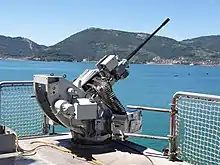 Oerlikon KBA 25 mm automatic cannon (Remote controlled weapon station) | |
| Type | Autocannon |
| Place of origin | Switzerland |
| Service history | |
| In service | Mid 1970s – present |
| Used by | See operators |
| Production history | |
| Designer | Oerlikon Contraves AG |
| Manufacturer | Rheinmetall AG |
| No. built | 4,000+ |
| Specifications | |
| Mass | 112 kg (247 lb) |
| Length | 2,888 mm (113.7 in) |
| Width | 263 mm (10.4 in) |
| Height | 283 mm (11.1 in) |
| Shell | NATO 25×137mm |
| Caliber | 25 mm |
| Rate of fire | Nominal: 600 rounds/min, Maximum: 700 rounds/min, Programmable: 175-300 rounds/min |
| Muzzle velocity | 1,400 m/s (4,600 ft/s) |
| Effective firing range | 3,020 m (9,910 ft) |
| Maximum firing range | 5,850 m (19,190 ft) |
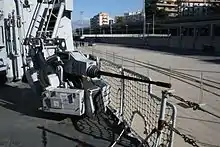
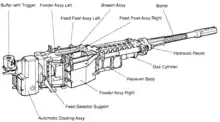
The Oerlikon KBA is a positively locked, gas-operated cannon with a rotating bolt head and a dual-belt selective feed system taking a 25 mm cartridge. The maximum rate of fire is 600 rounds per minute but it can be electronically reduced to 175 rounds per minute.
Due to its firepower, its range of ammunition and its "Instant Ammunition Selection Device" (IASD), which allows the gunner to easily switch between armor-piercing and high-explosive rounds, the KBA cannon can engage lightly armoured vehicles, infantry, anti-tank positions, helicopters, combat aircraft and ships.
Description
The Oerlikon KBA 25 mm is a fully automatic cannon based on the proven gas-operation principle with a rotating bolt head similar to the Mauser M 98 or M16 and double belt feed for the ammunition. These features guarantee high reliability and safety, even under the most extreme environmental conditions.
The KBA offers a wide range of firing modes: single shot, programmable rapid single shot with a rate of fire of up to 200 rds/min, and full automatic fire at 600 rds/min. The cannon functions, such as cocking and firing, are electrically actuated by a remote control unit or manually in auxiliary mode by means of a hand crank and a trigger pedal.
The Oerlikon KBA 25mm cannon has been designed for integration in various types of mounts, small size and low weight offering various integration possibilities such as:
- Human-operated or remote controlled turrets on IFVs and APCs
- Air defence gun mounts
- Naval mounts[1]
- Helicopter mounts
The various types of available ammunition combined with the unique Instant Ammunition Selection Device and selectable rates of fire support any type of operational use.
History
In 1964 the American company TRW Inc. (Thompson Ramo Wooldridge Inc.) was entrusted with the development of a 25 mm weapon while Oerlikon-Buehrle Machine Tool Works assumed responsibility for developing the ammunition and interior ballistics for it.[2]
The project for the new 25 mm autocannon was originally named "TRW 6425" and was developed by the famous American firearms designer Eugene M. Stoner. [3]
TRW's requirement for the project was that the gun had to be fully automatic and actively locked, be operated by pneumatic and revolving bolts, use a bidirectional feed system, and be able to switch quickly and easily between different type of ammunition.
At the beginning of 1967, technical tests and firing trials were carried out with the first two American TRW-6425[4] prototype cannons at Oerlikon-Buehrle Machine Tool Works followed by the first demonstrations for another NATO country.
Both were intended to meet the requirements for the armament of infantry fighting vehicles of the 80's and 90's:
- Ammunition performance: 25 mm armour steel, 60° (NATO) angle of impact, 1000m range, corresponding to the armour of a well-armoured infantry fighting vehicle.
- "Instant ammunition selection" for engagement of different targets
- Selectable firing mode: Accurate single shot, bursts with a rate of fire of more than 550 rds/min for engagement of aircraft
- Compact structure: with low weight for installation in gun turrets of APC's
- Simple to operate: and service in the hands of infantry
In the trials, however, the American prototypes displayed a number of basic functional deficiencies.[5] This persuaded Oerlikon-Bührle to undertake their own development work to effect system modifications, which then resulted in the required functional reliability and enabled the trials to be completed successfully in 1970. When the first prototype cannons became available, suitable gun turrets had also to be provided. In 1967 an agreement was signed between Oerlikon-Buehrle and a well-known and established sub-contractor to collaborate in the development and manufacture of 25 mm gun turrets. These gun turrets were in the first instance to be suitable for mounting on M113 armoured personnel carrier C&R of a NATO country's army. The complete system, cannon, hand-driven turret and ammunition underwent detailed firing trials between 1969 and 1971. Special new development efforts were devoted to improve functional reliability, durability and firing precision, and in 1971 sufficient progress had been made for the weapon system to fulfil the strict specifications laid down, and to be delivered to the Netherlands.
Within the framework of the product support service Oerlikon improves the product and adapts it regularly to the latest requirements. An important step forward was made in 1982/83 when the ammunition penetration performance range of the 25 mm APDS-T (sub-caliber) round was increased 150% from 1000 to 2500 m.
The wide range of strong points of the Oerlikon KBA 25 mm cannon, such as high rate of fire, ammunition performance, good safety record, dual belt feeder with first-round response, no external power requirement and simple maintenance lead to a considerably increasing interest in the Oerlikon KBA 25 mm cannon in years.
Ammunition
A wide range of ammunition has been developed for this weapon specifically developed to engage and defeat both ground and air targets.
The ammunition complies with all handling and operational safety requirements according to MIL-STD’s, and was subjected to intensive trials by NATO member countries prior to its introduction and standardization as NATO 25mmx137 ammunition.
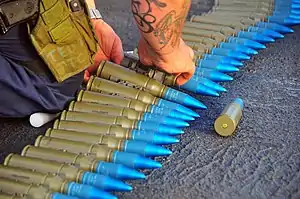
The current 25mm ammunition family consists of six combat and two training rounds:
- APFSDS-T: armour-piercing fin stabilized discarding sabot with tracer, for use against armoured ground targets
- APDS-T: armour-piercing discarding sabot with tracer, for use against armoured ground targets
- FAPDS-T: frangible armour-piercing discarding sabot with tracer, for use against air, ground and urban targets
- TPDS-T: target practice discarding sabot with tracer, a short range trainer for the above sub-calibre types
- SAPHEI-T: semi-armour-piercing high explosive incendiary with tracer, for use against well protected targets
- HEI-T: high explosive incendiary with tracer, for use against lightly protected targets
- MP-T: multipurpose with tracer
- TP-T: target practice with tracer, for training with the above full calibre types
Variants
Aselsan STOP
Turkish made Aselsan STOP stabilized weapon station can be fitted with a Oerlikon KBA.[6]
Operators
Current operators
 Bangladesh
 Italy
Italy
- FREMM multipurpose frigate (x2 KBA System)
- LHD Trieste Aircraft Carrier (x3 KBA System)
- CVH 550 Cavour Aircraft Carrier
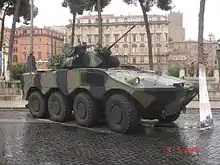
- IFV Freccia Infantry Fighting Vehicle
- IFV Dardo Infantry Fighting Vehicle
- SIDAM 25 self-propelled anti-aircraft gun
- Horizon-class frigate
 Netherlands
 Turkey
- ACV-300
- ASELSAN 25 mm STOP Stabilized Naval Gun System[8]
 Egypt
Egypt
- YPR-765
 Philippines
- AIFV-25
 Japan
Japan
 Malaysia
 Romania
- MLI-84 tracked infantry fighting vehicle
 Pakistan
- Navy Forces "Fleet Tanker"[10]
 Bahrain
- Netherlands
 Chile
Chile Mexico
 Turkmenistan
 Malta
Malta
References
- "Oto-Melara Breda Oerlikon KBA 25/80 mm machine gun system". www.seaforces.org. Retrieved 2021-03-19.
- Fitchett, Bev (2020-04-19). "Mm Trw Automatic Cannon - Machine Gun V5". Bev Fitchett's Guns Magazine. Retrieved 2020-05-11.
- Fabrique - Merken, design & interactie. "Automatisch kanon Oerlikon KBA, zoals ingebouwd in de YPR en ... - Zoeken in de collectie - Nationaal Militair Museum". NNM. Retrieved 2021-02-19.
- "Mm Trw Automatic Cannon - Machine Gun V5". www.bevfitchett.us. Retrieved 2017-03-30.
- Fiscal year 1977 authorization for military procurement, research and development, and active duty, selected reserve and civilian personnel strengthshearings before the Committee on Armed Services, United States Senate, Ninety-fourth Congress, second session, on S. 2965 ... Washington, D.C. 1976. hdl:2027/mdp.39015074749436.
- "25 mm STOP Remote Controlled Stabilized Naval Gun System". Aselsan. Retrieved 8 July 2021.
- "YPR-765 APC - IFV 1975". www.tanks-encyclopedia.com. Retrieved 2021-03-03.
- "Aselsan STOP 25mm Remote Weapon Stations for Pakistan Navy Fleet Tanker Project". Navy Recognition. Retrieved 2017-03-30.
- "YPR-765 APC - IFV 1975". www.tanks-encyclopedia.com. Retrieved 2021-03-03.
- "Aselsan STOP 25mm Remote Weapon Stations for Pakistan Navy Fleet Tanker Project". www.navyrecognition.com. Retrieved 2021-03-01.