Oho-to nochi and Oho-to mahe
Yifutonoujikami and Otonobenokami are a pair of gods in Japanese mythology.
Summary
In Kojiki, the elder brother is called Yifutonouchi, the younger sister is called Daitounoben, and the elder brother is called Otonomichi. In the Nihon Shoki, the elder brother is referred to as Otomanomichi-no-mikoto and the younger sister as Otomanobe-no-mikoto; in the Kujiki, the elder brother is referred to as Otomahiko-no-mikoto and the younger sister as Otomahime-no-mikoto.
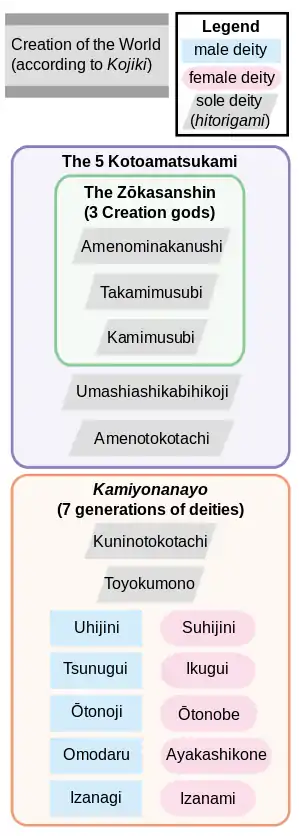
In the Kojiki (Records of Ancient Matters), the gods are the fifth generation of the seventh generation of the gods, with the elder brother, Yifutonouchi, being the male deity and the younger sister, Otomahime, being the female deity.
Some believe that the deity's name is a deification of the time when the earth was completely solidified, with "earth" meaning male and "ben" meaning female. There is also a theory that "To" is the "To" of "Mito no Magwai," symbolizing the genitals.
In the case of the god Yitomi Tounochi, "Yitomi" is "big" and a beautiful name, "Touno" is "gate/door" and a narrow passage in a village, "Noh" is a case particle, and "Chi" is "father" and a male parent name. In the case of Oto-no-Benjin, "Oto-no" is the same as in the case of Yifutono-Jijin, and "Ben" is a corruption of "Me" (woman), so the name is thought to be "the woman at the great gate.。[1]
Based on the above names of deities, it is believed that the narrow passages in the village are guarded by guardians of the walls, and that they have been worshipped.
Shrines to worship
- Takumiya Shrine (Tokushima PrefectureTokushima City, Kamiyamacho)
- Hasuha Shrine (172 Shimohashinami, Sada-machi, Izumo City, Shimane Prefecture)
- Monobe Shrine (Kawai-cho, Shimane Prefecture, Ota City)
- Imaibe Shrine (Higashi-Imaibe Town, Matsue City, Shimane Prefecture)
- Homi Suwa Jugo-shosho Shrine (Yamanashi Prefecture Hokuto City Nagasaka Town)
- Futarasan Shrine: Twelve shrines on the grounds of the shrine (Baba-dori, Tochigi PrefectureUtsunomiya, Utsunomiya)
- Kumano Hayatama Taisha (Wakayama PrefectureShingū City)
Related Items
References
- Shincho Japanese Classic Collection Kojiki