Old Jewish Cemetery, Česká Lípa
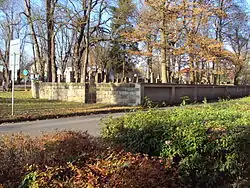
The Old Jewish Cemetery in Česká Lípa (Czech: Starý židovský hřbitov v České Lípě, Hebrew: בית קברות עתיק לאיפה, German: Alter jüdischer Friedhof im Böhmisch Leipa) is located in the northwestern part of the town of Česká Lípa near the town park, between Roháče z Dubé and U Střelnice streets, near the Střelnice railway station. It is one of the oldest preserved Jewish cemeteries in northern Bohemia.
Starý židovský hřbitov v České Lípě | |
 | |
| Details | |
|---|---|
| Established | c. 15th century[1] |
| Country | Czech Republic |
| Coordinates | 50°41′28″N 14°32′05″E |
Description
Approximately 140 tombstones have been preserved to this day, the oldest of which dates from 1682. Most of the tombstones date from the 17th and 18th centuries and are massive stelae. Burials took place in several layers in the cemetery, because further expansion at the existing site was not possible, similar to the Old Jewish cemetery in Prague.
A unique piece is a granite tombstone in the shape of a black prism, which commemorates the community's rabbi and other 31 victims of a pogrom from 1745. The oldest tombstone from 1682 was found during a survey carried out by the State Jewish Museum in Prague. Because Jewish faith does not allow manipulation of graves, the existence of older graves in the lower layer cannot be documented. The antiquity of the tombstones is redeemed by the fact that all epitaphs are relatively laconic, containing only basic data. The newer ones are stolen.
The cemetery is now protected as a cultural monument of the Czech Republic, entered in the national register under number 24003/5-2778.[2] It is bordered by a wall and locked.
History
The Old Jewish Cemetery in Česká Lípa was founded before 1575 behind the town walls (according to some unproven theories as early as 1479). It was expanded in 1758 and was used until 1905. That year, the New Jewish Cemetery was founded at the northeastern outskirts, next to the municipal cemetery, but this cemetery was desecrated and completely destroyed between the 1940s and 1980s. The old cemetery was devastated by the Nazis in 1938, and some of the tombstones were taken away and used to fill the river arm of Ploučnice.
Historical background
Jews have been documented in Česká Lípa since Berka z Dubé and the House of Wartenberg. Českolipské muzejníci (Ladislav Smejkal) mention the discovery of the seal of the Jew Rudiger from the 14th century. However, they have certainly been here reliably for several generations before the Battle of White Mountain. The Wartenberg residence Neuschloss (Gardens) was then one of the most exhibited Renaissance settlements of the Czech nobility in this region. Registries from the 19th century state that a number of the deceased stated that they were families of the lords of the garden - the "Neuschlosserherrschaft-Familiant". After the Battle of White Mountain, the local estates belonged to Albrecht of Wallenstein for a time, and after his murder in 1634 they passed along a family line through his widow Isabel of Harrach and later daughter Maria Elisabeth of Frýdlant into the Kounice family. They actually held Lípa until the abolition of serfdom in 1848.
The first written source confirming the presence of Jews in Česká Lípa comes according to data in Gold from 1570, physically preserved evidence of the existence of the Jewish quarter, synagogue and cemetery from 1699 - a report on Jewish element in the town. Acquired probably by a non-Jewish hand, talking, among other things, about "that the Jews gradually crept into the town (eingeschlichen), today they own various houses bought from Christians, their cemetery and also a wooden house used for their liturgy".
According to Gold, the land for the old cemetery was donated to the local Jews by Jan of Wartenberg at the end of the 16th century. The burghers of Lípa felt damaged and affected, and even a lawsuit broke out around it, as the town considered all the land near the so-called Ziegelteich as their property.
18th century
Gold's collaborator Rabbi Dr. Bernard Wolf, who compiled the motto "Leipe", also lists the families from 1724, where he mentions 358 souls and the fact that then two thirds of Leipzig's Jewry were old local families, about a third then Jews came – from Boleslav, Úštěk, Libochovice, and Radešín, as well as from greater distances – from Náchod, Postoloprty, Roudnice nad Labem and Kolín, even from the Germany, Austria, and Moravia. Two families even from Poland. In this list, we already meet the names of families whose members actually have their tombstones in the shooting cemetery. (Altschul, Gans, Schreiber, Schulhof, etc., but also the Koswein family from Boleslav or the infrequent Lewoja family.)
In December 1744, there was a pogrom against Jews by the Prussian pandurs of Major (Lieutenant) Schimpsen in Česká Lípa. The immediate pogrom lasted from about ten o'clock in the morning to four in the afternoon. 30 were killed, 40 were injured. The booty in cash and goods amounted to about 30,000 gold. The pogrom took place in December, with Jews leaving their homes in droves and hiding in the woods. Some of the wounded and dead were not found until several weeks after the incident, according to period sources. The reason why Schimpfen's hussars attacked can only be guessed. It was mainly prey. The looting of the Českolipská mob probably joined the looting of Jewish property. In the cemetery there is still a monument (No. 062) built by the local Chevra Kadisha on the anniversary of this event. The monument is now badly damaged. There are only three tombstones in the cemetery dating to 1744. (Nos. 021, 023 and 052), but these are tombstones of people who died before the date of the pogrom.
19th century
In 1850, a wave of cholera and dysentery hit Česká Lípa. According to the registries, this year shows probably the highest number of deaths. Given not only the higher percentage of Jewish settlement, but especially the cause of death.
The local Beit-Olam is so small that experts believe - given that the area of the cemetery is somehow higher than the rest of the terrain - that there was burial in layers - however, this is only a presumption if not likely. If burials were done in Česká Lípa, in the 1920s the cemetery would have to look roughly the same as the old Prague cemetery. A Jewish community with functioning Chevra Kadisha, Naase mitzvot, Bikur cholim, and Banot Zion (female offshoot of Chevra Kadisha) would find it difficult to allow older matzevas to remain covered in soil and not be planted on the surface. After all, flat (buried) older tombstones would also make further burials considerably more difficult. On the other hand, it is documented that the old cemetery was demolished by the Nazis during the war. A number of tombstones were forcibly removed and used to fill the Ploučnice arm.
20th century
The last burial in the cemetery was held in 1905,[1] and the Jews established a new burial ground. From about 1903 to 1905, there was still a kind of Jewish department at the communal cemetery. The new cemetery with a ceremonial building in the Moorish style survived the war, but was liquidated, sold and robbed in the years of normalization around 1983. Pavel Jakubec mentioned: I would be very interested in who bought the stone from the new cemetery, but according to their experience from Jablonec, it was probably a few subjects. Moreover, a sad but common normalization practice with a direct share of the guilt of the then representatives of Czech Jewry. Re-cut quality stones, without evidence and therefore without historical continuity about Leipzig's Jewish burial grounds.
There is no trace of Galician graves in the cemetery. However, this does not mean that the Leipzig community will not accept refugees as a result of the World War I. However, the refugees from Galicia were, of course, already buried in the new cemetery, and their stones were stolen and dragged away along with the tombstones of the locals.
In the 1990s, the cemetery underwent extensive reconstruction. The repair, modification and partial revitalization of the old cemetery was completed in 1999. After the modifications, half of the cemetery became a mere lapidary. Which doesn't stop anything halachically. Paradoxically, it has even happened that some tombstones that originally belonged to each other - the pedestal and the upper obelisk - are now considered to be different graves. It can be deduced from this that the revitalization took place without consultation with the Hebrews.
Rabbi Dr. Bernard Wolf also mentions in Gold that the registries of the dead began to be kept consistently from 1782. However, the online registries made available by the research room only include volumes iii. and iv. And thus the range of years 1839 to 1949 - respectively 1839–1865 and then 1875–1949; These data partly help to identify the family names of older tombstones, but given the above facts, a detailed link between the registers and the catalog - at least when the actor is employed and online from home from a computer - is almost impossible. of this catalog - volume iv. It is relatively legible and we probably won't find graves from 1903 to 1949 or tombstones from the liquidated cemetery !!)
References
- Cizek, Hrady cz s r o Jiri. "Starý židovský hřbitov, Česká Lípa". www.hrady.cz (in Czech). Retrieved 18 March 2021.
- "židovský hřbitov - Památkový Katalog". pamatkovykatalog.cz. Retrieved 18 March 2021.