Omniglot
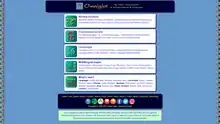
Omniglot (/ˈɒmnɪˌɡlɒt/) is an online encyclopedia focused on languages and writing systems.[2]
Type of site | Encyclopedia |
|---|---|
| Key people | Simon Ager[1] |
| URL | omniglot.com |
| Commercial | No |
| Launched | 1998 |
| Current status | Active |
Etymology
The name "Omniglot" comes from the Latin prefix omnis (meaning "all") and the Greek root γλωσσα (glossa, meaning "tongue").
History
The website was launched by British linguist Simon Ager in 1998, originally intended to be a web design and translation service. As Ager collected and added more information about languages and various writing systems, the project evolved into an encyclopedia.[3]
It provides reference materials for 341 written scripts used in different languages,[4][5] over 880 constructed, adapted and fictional scripts, and materials for learning languages.[6][7]
It also has reference materials in numerous languages.[8]
Its material was the source for a compendium of characters used for development of artificial intelligence, the Omniglot Challenge.[9] [10] The Omniglot compendium has been used widely since it was first released.[11][12][13]
As of December 2021, the number of languages detailed on the site is over 1,600.[14]
See also
References
- Melanie Moore (13 June 2016). "Interview with the Omniglot". Mango Languages. Retrieved 2017-07-17.
- "Omniglot : the guide to languages, alphabets and other writing systems". Library of Congress. Retrieved 2017-07-17.
- "Omniglot - a potted history". Retrieved 2017-07-17.
- Brookes, Tim (2013-06-29). "First Person: Save a Language, Save a Culture". National Geographic News. Retrieved 2021-01-22.
- Sheehan, Jennifer (2020-09-04). "Celtic Cultural Alliance art class offers chance to learn and create using ancient Irish alphabet, Ogham". Morning call (Allentown PA). Retrieved 2021-01-22.
- Steinkopf-Frank, Hannah (2020-12-21). "How to Learn French: A U.S. News Guide". US News and World Report. Retrieved 2021-01-22.
- "B. Board: One fowl could be a goose, and two are called geese; Yet the plural of moose should never be meese". Twin Cities Pioneer Press. 2016-09-25. Retrieved 2021-01-22.
- Sarkodie, Alex (2020-03-04). "The Origins Of The Akan-Speaking People Of Ghana".
- Lake (2015-12-11). "Human-level concept learning through probabilistic program induction" (PDF). Science.
- Markoff, John (2015-12-10). "A Learning Advance in Artificial Intelligence Rivals Human Abilities (Published 2015)". The New York Times. ISSN 0362-4331. Retrieved 2021-01-23.
- Press, Gil (2019-12-16). "Would You Trust A Self-Driving Car? 70% Of Americans Say 'No,' 72% Of Chinese Say 'Yes'". Forbes. Retrieved 2021-01-23.
- Lake (2019-06-03). "The Omniglot challenge: a 3-year progress report". Current Opinion in Behavioral Sciences.
- Lewis, Phillip J.; Heck, Stephen (2018-07-01). "Survey of Few-Shot Learning Techniques" – via Machine Learning and Deep Learning Conference 2018. Cite journal requires
|journal=(help) - "About Omniglot". Retrieved 2021-12-06.