Imiaslavie
Imiaslavie (Russian: Имяславие, literally "praising the name") or Imiabozhie (Имябожие), also spelled imyaslavie and imyabozhie, and also referred to as onomatodoxy, is a Christian dogmatic movement which asserts that the Name of God is God Himself. The movement emerged in the beginning of the 20th century but both proponents and opponents claim it to be connected with much religious thought throughout the history of Christianity (proponents claim its connections to the Church Fathers, while opponents claim the connections to the ancient heresiarchs).
Beginning
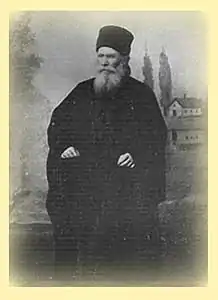
The 20th century history of imiaslavie started in 1907 with the publication of the book On the Caucasus Mountains by a revered starets, schema-monk Hilarion. In his book, Hilarion told of his spiritual experience with the Jesus Prayer as a proof that "The name of God is God Himself and can produce miracles". The book became extremely popular among the Russian monks on Mount Athos in Greece. Many of them argued that since, according to Plato & Stoics, names and forms pre-exist prior to becoming “sensual manifestations in the world",[1] so the name of God must pre-exist before the world was created, and that the Holy Name cannot be anything but God Himself. Among other things, this was thought to mean that knowledge of the secret name of God alone allows one to perform miracles (a similar concept exists in Kabbalah).[2]
Proponents and opponents
The main proponent of the imiaslavie doctrine was a Hieromonk of the Andreyevsky skete of Athos Mountain, Anthony Bulatovich, who published a few books on the subject. Those who promote this doctrine claim support from the writings of Saint John of Kronstadt, and the influential mystic and healer Grigori Rasputin, the popularly styled "mad monk" who was closely associated with the Russian Royal Family shortly before the October Revolution. St John of Kronstadt died before this controversy erupted, and his quotes, it can be argued, are taken out of context to support a whole set of ideas that are not found in his own writings. One of the most precise definitions of the Imiaslavie position comes from its advocate Aleksei Losev who writes that Imiaslavie is to be understood as “mystical formula”: “the exact mystical formula of Imiaslavie will sound like this: a) the name of God is energy of God, inseparable from the essence of God itself, and therefore is God himself. b) However, God is distinct from His energies and from His name, and that is why God is not His name or a name in general”[3] While the controversy never erupted within Catholicism, the Catechism of the Catholic Church in paragraphs 2666-2669 clearly teaches that "The name ‘Jesus’ contains all: God and man and the whole economy of creation and salvation. To pray 'Jesus' is to invoke him and to call him within us."[4] Social Psychology Prof. Martin Bauer frames this as a conflict over "representation" which "centres on the issue of whether a word is more than just a flatus voci (Latin for a vocal fart)."[5]
Aftermath
On 27 August 1914 the leader of the movement Fr. Antony Bulatovich asked to be sent as an Army chaplain to World War I, his request was granted by the Holy Synod. He sent two letters to the Tsar between 1914-16. In his 1914 letter he warned: The procrastination and actions of the Synod "push" Russia into disasters: "What further disasters this will lead Russia to, only God knows this”.[6] On 1 July 1915, the Holy Synod received a letter from the original author, schema-monk Illarion, asking whether he was expelled from the Church (Illarion lived as a hermit in the Caucasus Mountains and seems to have been unaware of all the commotion his book caused). Elder Illarion stated in July of 1915 that the persecution coming from “the highest members of the Russian hierarchy, is a sure omen of the proximity of times in which the last enemy of truth, the all-pernicious Antichrist, has to come.” Illarion died on 2 June 1916, without having received an answer.[7]
In September 1917 the Pomestny Sobor of the Russian Orthodox Church was assembled to solve the problem with Imiaslavie, with both strong proponents and opponents of Imiaslavie present. The work of the Sobor was aborted due to the October Revolution. Among the theologians who spoke out for Imiaslavie were Pavel Florensky and Sergey Bulgakov. Fr. Antony’s 2nd letter to the Tsar was written in 1916 and in it he “correlates the military failures of Russia in World War 1 at the front with the struggle of the Synod against Name-Glorification”.[7]
Bishop Hilarion (Alfeyev), in 1999, wrote: "Even though the movement of the 'Name-worshippers' was crushed at the beginning of the century on the orders of the Holy Synod, discussion of the matter regained impetus in the years preceding the Moscow Council (1917–18), which was supposed to come to a decision about this but did not succeed in doing so. Thus the Church's final assessment of Name-worshipping remains an open question to this day."[8]
Imiaslavie and mathematics
The Russian Mathematics School is considered by some to have been created by Dmitri Egorov and Nikolai Luzin, both of whom were imiaslavians and personal friends of Pavel Florensky as well as philosopher Aleksei Losev (both imiaslavians in theology).[9][10]
Notes
References
- Maurice Fluegel, Philosophy, Qabbala and Vedanta. Baltimore: Fleugel & Co., 1902; p. 247
- Gedalyah Nigal, Translated by Edward Levin, Magic, Mysticism, and Hasidism: The Supernatural in Jewish Thought. Jason Aronson, Inc., 1994.
- Dn. Lasha Tchantouridzé, “In the Name of God: 100 Years of the Imiaslavie Movement in the Church of Russia”; The Canadian Journal of Orthodox Christianity Volume VII, Number 3, Fall 2012; p. 225.
- "Catechism of the Catholic Church - IntraText".
- Gordon Sammut et al. editors; The Cambridge Handbook of Social Representations; Cambridge University Press: Cambridge, 2015; p. 43. https://doi.org/10.1017/CBO9781107323650.006
- http://www.omolenko.com/imyaslavie/ilarion.htm Pavel Florensky Brief biography of Starets Illarion and History of Imiaslavie in Russia
- Pavel Florensky Brief biography of Starets Illarion and History of Imiaslavie in Russia
- Bishop Hilarion Alfeyev. "Bishop Hilarion Alfeyev: Orthodox Theology on the Threshold of the Twenty-First Century - Paper at the international scholarly conference "The Russian Orthodox Church from 1943 to the present" at the Transfiguration Monastery in Bose (Italy), 15-17 September 1999". Department for External Church Relations of the Moscow Patriarchate.
- "Bulletin, spring 2005: Graham" (PDF). AmAcad. Archived from the original (PDF) on 2007-03-07. Retrieved 2006-05-27.
- "Unknown title". Examen database. Archived from the original on 2007-09-28. Retrieved 2006-05-27.
Further reading
- (in French) Bishop Hilarion Alfeyev, Le Nom grand et glorieux. La vénération du Nom de Dieu et la prière de Jésus dans la tradition orthodoxe. Paris: Cerf, 2007.
- (in French) Bishop Hilarion Alfeyev, Le mystère sacré de l'Eglise. L'introduction à l'histoire et à la problématique des débats athonites sur la vénération du Nom de Dieu. Fribourg: Academic Press, 2007.
- Daniel Colucciello Barber, Deleuze and the Naming of God (2015), Edinburgh University Press
- Robert Bird, Ph.D., "Imiaslavie and Baroque Spirituality." AAASS Convention, Pittsburgh, PA, 22 November 2002
- Sergius Bulgakov (author), Boris Jakim (translator), Icons and the Name of God (2012), Eerdmans
- (in Russian) Sergius Bulgakov, Философия имени [Philosophy of the Name], 1920)
- Dr. John Eugene Clay, Arizona State University, "Popular Uses of the Jesus Prayer in Imperial Russia from the Old Believers to the Name-Glorifiers", presentation at AAR, Philadelphia, Pennsylvania, November 2005
- Tom E. Dykstra, Hallowed Be Thy Name: The Name-Glorifying Dispute in the Russian Orthodox Church and on Mt. Athos, 1912-1914 , 2014. ISBN 978-1601910301
- Nicholas Fenne, Russian Monks on Mount Athos: The Thousand Year History of St Panteleimon's; Holy Trinity Seminary Press (September 28, 2021)
- Helena Gourko, Divine Onomatology: Naming God in Imyaslavie, Symbolism, and Deconstruction (2005), Ph.D. dissertation at Boston University
- Loren Graham, Jean-Michel Kantor, Naming Infinity: A True Story of Religious Mysticism and Mathematical Creativity, Harvard University Press, 2009
- Valentina Izmirlieva, All the Names of the Lord: Lists, Mysticism, and Magic (2008), University of Chicago Press
- Scott M. Kenworthy, Ph.D., "Church, State, and Society in Late-Imperial Russia: The Imiaslavie Controversy," presentation at American Association for the Advancement of Slavic Studies National Convention, Pittsburgh, Pennsylvania, November 2002
- Scott M. Kenworthy, Ph.D., "Church, State, and Society in Late-Imperial Russia: Nikon (Rozhdestvenskii) and Imiaslavie," presentation at Midwest Russian Historians Workshop, Miami University, Oxford, Ohio, March 2003
- Kenworthy, Scott M. (2020-05-26). "The revival of the Name-Glorifiers debate in post-Soviet Russia". Religion, State and Society. 48 (2–3): 180–195. doi:10.1080/09637494.2020.1766931. ISSN 0963-7494. S2CID 221538946.
- Michael T. Miller, The Name of God in Jewish Thought: A Philosophical Analysis of Mystical Traditions from Apocalyptic to Kabbalah (2015), Routledge
External links
- (in Russian) Met. Alfeyev, The Sacred Mystery of the Church
- (in Russian) Pavel Florensky, Brief biography of Starets Illarion and History of Imiaslavie in Russia
- (in Russian) Alexei Losev Imiaslavie
- (in Russian) Alexei Losev, Philosophy of a Name
- (in Russian) Metropolitan Veniamin (Fedchenko), Imiaslavie
- Martin W. Bauer, “On (social) representations and the iconoclastic impetus”, in The Cambridge Handbook of Social Representations; Edited by Gordon Sammut, Eleni Andreouli, Milton Keynes, George Gaskell, Jaan Valsiner; Cambridge University Press: Cambridge, MA (2015)
- Nel Grillaert, “What’s in God’s Name: literary forerunners and philosophical allies of the imjaslavie debate” (Ghent University: 2012)
- Clarification of Bishop Gregory of Petrograd and Gdov Concerning the Barlaamite Heresy of Bishop Photios of Marathon
- G.M. Hamburg, “The Origins of 'Heresy' on Mount Athos: Ilarion's Na Gorakh Kavkaza (1907)”
- Scott M. Kenworthy, "Archbishop Nikon (Rozhdestvenskii) and Pavel Florenskii on Spiritual Experience, Theology, and the Name-Glorifiers Dispute"
- Scott M. Kenworthy, "Debating the Theology of the Name in Post-Soviet Russia: Metropolitan Ilarion Alfeev and Sergei Khoruzhii"
- Anthony Khrapovitsky, “On The New False Teaching, The Deifying Name”
- (in Russian) Archbishop Nikon (Rozhdestvenskii), "The Crafty designs of the enemy will destroy...": Diaries: 1910-1917 - by active disputant in the controversy with the Imiabozhie
- Paul Ladouceur, “The Name of God Conflict in Orthodox Theology," St. Vladimir's Theological Quarterly, 56, 4 (2012), 415-436.
- K. Senina The status of divine revelation in the works of Hieromonk Anthony Bulatovich
- Nun Kassia (Senina) Theological Discussion About the Name of God: Historical and Contemporary
- Tatiana Senina '’The Divine Name Controversy
- (in French)Tatiana Sénina, Un palamite russe du début du XXème siècle : le hiéromoine Antoine Boulatovitch et sa doctrine sur l’énergie divine", in Scrinium, t. 6: Patrologia Pacifica Secunda (2010) 392-409.
- Teresa Obolevitch, “Christian Philosophy and the Name of God: Aesthetics as a Way of Life according to Alexei Losev”; The Journal of Eastern Christian Studies 71/1-2 (2019), p. 93-106
- (in Russian) Of imyaslavtsy or imyabozhniki: Dispute about nature of the name of God and Athos - Extensive discussion
- In the Name of God:100 Years of the Imiaslavie Movement in the Church of Russia
- Monk Hilarion On the Mountains of the Caucasus
- Matthew Raphael Johnson, “‘Name Worship,’ Epistemology and the Abuse of Christian Philosophy: A Revision”
- ONOMATOLATRIA: The Church decisions that condemned Name-Worshipping
- Loren Graham lectures on his book Naming God, Naming Infinity: Religious Mysticism and Mathematical Creativity