Oposa v. Factoran
| Oposa v. Factoran Minors Oposa | |||||
|---|---|---|---|---|---|
 | |||||
| Court | Supreme Court of the Philippines en banc | ||||
| |||||
| Decided | July 30, 1993 | ||||
| Citation | G.R. No. 101083 (224 S.C.R.A. 792) | ||||
| Case history | |||||
| Appealed from | Makati Regional Trial Court Branch 66: Minors Oposa v. Factoran (Civil Case No. 90-77) | ||||
| Ponente | Hilario Davide, Jr. | ||||
| Court membership | |||||
| Judges sitting | Andres Narvasa (Chief Justice), Hilario Davide Jr., Isagani Cruz, Teodoro Padilla, Abdulwahid Bidin, Carolina Griño-Aquino, Florenz Regalado, Flerida Ruth Pineda-Romero, Rodolfo A. Nocon, Josue Bellosillo, Jose Melo, Camilo Quiason, Florentino P. Feliciano, Reynato Puno, Jose C. Vitug | ||||
| Majority | Davide, Jr., joined by Cruz, Padilla, Bidin, Griño-Aquino, Regalado, Romero, Nocon, Bellosillo, Melo, Quiason | ||||
| Concurrence | Feliciano | ||||
| Narvasa, Puno, Vitug took no part in the consideration or decision of the case. | |||||
Oposa v. Factoran, G.R. No. 101083, 224 S.C.R.A. 792 (1993), alternatively titled Minors Oposa v. Factoran or Minors Oposa, is a landmark decision of the Supreme Court of the Philippines recognizing the doctrine of intergenerational responsibility on the environment in the Philippine legal system. The case is a contributor to the development of international environmental law.
Background
In 1987, a new Philippine constitution was drafted during a period of growing concern over the preservation of the natural environment and resources of the Philippines.[1] Section 16 of Article II of the 1987 Constitution provides the following state policy: "The State shall protect and advance the right of the people to a balanced and healthful ecology in accord with the rhythm and harmony of nature."[2] On June 10, the Aquino administration created the Department of Environment and Natural Resources (DENR) under Executive Order 192.[3]
Around that time, Antonio Oposa, fresh out of law school, formed the Philippine Ecological Network (PEN), one of the first environmental law organizations in the country.[4] In March 1990, PEN, led and counseled by Oposa, filed a suit against DENR Secretary Fulgencio S. Factoran, Jr. on behalf of several minor petitioners, including Oposa's children and relatives.[5] The suit sought to enjoin the DENR Secretary to cancel all existing timber license agreements in the country and to "cease and desist from receiving, accepting, processing, renewing or approving new timber license agreements." The complaint was instituted as a taxpayers' class suit with the petitioners attempting to represent "their generation as well as generations yet unborn."[6]
In their cause of action, the petitioners stated that the defendant Secretary had granted timber license agreements to various corporations thus cutting an aggregate area of 3.89 million hectares for commercial logging purposes. They argued that the act of the defendant Secretary constituted a "misappropriation of the natural property resources that he holds in trust for the benefit of the plaintiff minors and succeeding generations." In support of their claim, the petitioners invoked their right to a healthy environment under the Constitution, cited the enabling legislation of the DENR, and appealed to natural law.[7] On June 22, 1990, the respondent Secretary filed a motion to dismiss on the grounds that the petitioners had no sufficient cause of action, and that the issue raised was political, not justiciable.[6]
On July 18, 1991, without hearing oral arguments,[8] the Regional Trial Court of Makati granted the motion to dismiss. While acknowledging "that the plaintiffs have the noblest intentions," the court sustained both of the defendant's claims while adding that the relief prayed for would violate the non-impairment of contract clause of the Constitution.[9] The plaintiffs then filed an action for certiorari asking the Supreme Court to rescind and set aside the dismissal on the ground that the lower court judge gravely abused his discretion in dismissing the action.[6]
Decision
Justice Hilario Davide Jr. delivered the unanimous judgment, joined by ten other justices, while Justice Florentino Feliciano gave a separate concurring opinion. The Court granted the petition for certiorari and set aside the decision of the lower court dismissing the initial action.[6]
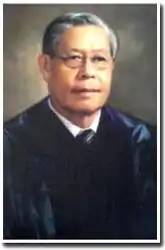
Doctrine of intergenerational responsibility
Despite the fact that the respondents did not take issue with the legal standing of the petitioners, the Court nevertheless addressed the "special and novel element" of the petitioners representing "their generation and generations yet unborn."[10] The Court spoke of the doctrine of intergenerational responsibility, stating:[11]
We find no difficulty in ruling that they can, for themselves, for others of their generation and for the succeeding generations, file a class suit. Their personality to sue in behalf of the succeeding generations can only be based on the concept of intergenerational responsibility insofar as the right to a balanced and healthful ecology is concerned. Such a right, as hereinafter expounded, considers the "rhythm and harmony of nature." Nature means the created world in its entirety. Such rhythm and harmony indispensably include, inter alia, the judicious disposition, utilization, management, renewal and conservation of the country's forest, mineral, land, waters, fisheries, wildlife, off-shore areas and other natural resources to the end that their exploration, development and utilization be equitably accessible to the present as well as future generations. Needless to say, every generation has a responsibility to the next to preserve that rhythm and harmony for the full enjoyment of a balanced and healthful ecology. Put a little differently, the minors' assertion of their right to a sound environment constitutes, at the same time, the performance of their obligation to ensure the protection of that right for the generations to come.[6]
Right to a balanced and healthful ecology
On the merits of the petition, the Court did not agree with the trial court's conclusion that the plaintiffs failed to allege a specific legal right involved in their cause of action. Rather, they recognized the constitutional right to a balanced and healthful ecology under Section 15 and 16 of Article II of the 1987 Constitution as "self-executory and judicially enforceable even in their present form."[12]
It carries with it the duty to refrain from impairing the environment and implies, among many other things, the judicious management and conservation of the country's forests. Section 4 of E.O. 192 expressly mandates the DENR to be the primary government agency responsible for the governing and supervising the exploration, utilization, development and conservation of the country's natural resources. Such policy is also substantially re-stated in the Administrative Code of 1987. Both E.O. 192 and Administrative Code of 1987 have set the objectives which will serve as the bases for policy formation, and have defined the powers and functions of the DENR. Thus, right of the petitioners to a balanced and healthful ecology is as clear as the DENR's duty to protect and advance the said right.
The Court further elicited that every generation has a responsibility to the next to preserve that rhythm and harmony for the full enjoyment of a balanced and healthful ecology.[6]
Aftermath
The petitioners did not pursue a new case after the Supreme Court remanded the case back to the trial court.[13]
After the decision, the Philippine government had inventoried the remnant old growth forests and restricted logging in those areas. [14] The case is recognized in its contribution in the development of international environmental law.[15][16]
Legacy
In 2008, Antonio Oposa, a Filipino Lawyer, was awarded by the Center for International Environmental Law for his contributions to the development and implementation of international environmental law in his native country and internationally.[17]
International environmental law
The case has been used and cited in other national legal jurisdictions in litigation as well as policy formation.[18]
References
 This article incorporates text from Philippine Supreme Court documents, which are in the public domain.
- Bernas 2009, p. 90; [[#CITEREF|]].
- Constitution (1987), Art. II § 16 (Phil.).
- Houck 2010, p. 47.
- Houck 2010, p. 49.
- Allen 1994, p. 715; Houck 2010, p. 51.
- Oposa, et al. v. Factoran, Jr., et al., G.R. No. 101083, 224 S.C.R.A. 792 (July 30, 1993) (Phil.).
- Allen 1994, p. 715–6.
- Houck 2010, p. 51.
- Allen 1994, p. 715.
- Gatmaytan 2003, p. 456–7.
- Gatmaytan 2003, p. 462, 468–72; La Vina 1994, p. 247.
- Bernas 2009, p. 90–1; Luminarias 2012, p. 661; La Vina 1994, p. 248.
- Manguiat & Yu 2003, p. 488; Gatmaytan 2003, p. 467.
- Robinson, Nicholas (Fall 1997). "Attaining Systems for Sustainability through Environmental Law". Natural Resources & Environment. American Bar Association. 12 (2): 86–88, 140–141. JSTOR 40924349.
- Hassan, Parvez (2017). "Role of the South in the Development of International Environmental Law". Chinese Journal of Environmental Law. 1 (2): 133–157. doi:10.1163/24686042-12340011.
- Schrijver, Nico; Weiss, Friedl, eds. (January 2004). International Law And Sustainable Development: Principles And Practice. Martinus Nijhoff Publishers. pp. 660–662. ISBN 9789004141735.
- "Pinoy wins top US environmental law award". ABS-CBN. ABS-CBN News. April 24, 2009. Retrieved March 6, 2018.
- Manguiat & Yu 2003, p. 494.
Sources
- Allen, Ted (1994). "The Philippine Children's Case: Recognizing Legal Standing for Future Generations". Georgetown International Environmental Law Review. 6 (3): 713–42 – via HeinOnline.
- Bernas, Joaquin G. (2009). The 1987 Constitution of the Republic of the Philippines: A Commentary. Manila: Rex Publishing. pp. 90–1. ISBN 978-971-23-5326-0.
- Gatmaytan, Dante B. (2003). "The Illusion of Intergenerational Equity: Oposa v. Factoran as Pyrrhic Victory". Georgetown International Environmental Law Review. 15 (3): 457–86 – via HeinOnline.
- Houck, Oliver A. (2010). Taking Back Eden: Eight Environmental Cases that Changed the World. London: Island Press. pp. 43–61. ISBN 978-1-59726-647-5.
- La Vina, Antonio G. M. (1994). "The Right to a Sound Environment in the Philippines: The Significance of the Minors Oposa Case". Review of European, Comparative & International Environmental Law. 3 (4): 246–52 – via HeinOnline.
- Luminarias, Coleen Claudette R. (2012). "Limit of a Function: Calculating the Implications of Oposa v. Factoran in Saving the Pine Trees". Ateneo Law Journal. 57 (2): 659–84 – via HeinOnline.
- Manguiat, Ma. Socorro Z.; Yu, Vicente B. (2003). "Maximizing the Value of Oposa v. Factoran". Georgetown International Environmental Law Review. 15 (3): 487–96 – via HeinOnline.