Ormon Khan
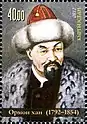
Ormon khan, (1792–1854) was a Kyrgyz Tribal Chief who went on to unify the Kyrgyz Khanate.[1]
Early Life
According to popular legend, his great-grandfather Bolot-biy foretold that one of his descendants would become a khan, unite all the Kyrgyz under his rule and create a unified State. Ormon was said to be ambitious and domineering since childhood, had organizational skills and personal courage. From the age of 17, Ormon took part in battles against other Kyrgyz Tribes.
Rise to Power
At the age of 30, Ormom was actively involved in the management of the Sarybagysh. His natural gift and a ruler were appreciated by many tribes, and his fame spread beyond the Kyrgyz land. In the 19th Century, Central Asia was a patchwork of Independent States and Tribal Confederations that were subject to larger powers. Previously, the Kokand Khanate forced the Kyrgyz chiefs to recognize their vassal dependence. However, this Power began to decline in the 1830s as Kokand fell into a series of Palace coups and Internecine War. In addition, Kokand suffered frequent raids from the Kyrgyz tribes and con from the Bukhara Khanate as well as from the Qing Empire.
In the wake of the decline of Kokand Authority, Ormom stepped in to fill the power vacuumed. By the early 1840s, Ormon ruled the Sayak and Sarbagysh tribes, and spent much of his time uniting the Solto, Cherik, Chonbagysh, Kushchu, Saruu and other northern Kyrgyz tribes. Khan Ormon managed to inflict a series of crushing blows on the troops of the Kokand and the troops of the Qing army, after which his prestige among the Kyrgyz nobility increased sharply.
In the summer of 1842, in the area of Kutmaldy (on the western bank of the Issyk-Kul), Ormon-Manap called a Kurultai, where all the Kyrgyz nobility gathered. There, Ormon, raised the question of Kyrgyz Unitit, Foreign Opression, and afterward proposed the Election of a Khan over all Kyrgyz. The Nobels supported this proposition and elected him Khan.[2] The coronation of the newly elected monarch took place on Kurultai. Observing the ancient rite, Ormon was put on a white felt mat, and a white mare was slaughtered on the "Ai-Tuyak". And instead of a crown, they placed a traditional Tubeteika on his head.
In 1844, Ormon Khan temporarily captured the Kokand fortress of Bishkek, which was the local stronghold of their troops, thereby making it clear that he was now equal to the Kokand ruler Khudoyar Khan.
Kyrgyz-Kazakh war
In 1846, superior forces of Russian troops pushed the last Kazakh khan Kenesary Kasymov from the steppes, forcing him to retreat to Zhetysu in the valleys of the Chu and Ili rivers . Here Kenesary tried to conclude an alliance with the Kyrgyz manaps led by Ormon Khan, urging them to a joint struggle against the Russian Empire and the Kokand Khanate . But Ormont Khan and Kyrgyz Manapov Kenesary rejected the proposal, in consequence of which the Kazakh Khan delivered an ultimatum Kyrgyz "either you agree or I was down and Kyrgyz Aiyly, I will kill all the baatyrs and take the women and children. "Despite the truce between Kenesary-khan and the Kyrgyz, a Kazakh detachment was sent to the territory of modern Kyrgyzstan, which was supposed to recruit fighters for Kenesary's army. The detachment was led by Suryk-batyr, who was killed in a skirmish In response to their actions, Kenesary invaded Kyrgyzstan with a 15,000-strong army in April 1847. This invasion was extremely brutal, after which the Kyrgyz began to prepare for war. But during the battle the sultans Rustem and Sypatay betrayed Kenesary and took away a significant part of the army, Kenesary's army was defeated, he himself was captured and executed.[3]
The defeat of the army of Kenesary Kasymov, his capture by Ormon Khan and execution were received with approval both in Russia and in Kokand. The Russian government was satisfied that it got rid of Kenesary, and awarded Ormon Khan and Zhantai with gold medals and put on their robes embroidered with gold.
Death and Aftermath
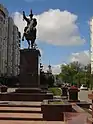
During an expidition against the Bughu tribe in 1854, Ormon was captured and held as an honorary prisoner of war. Borombay wanted to release Ormon on certain conditions, with a promise not to attack his lands again. But one of the Bugin leaders, Balbai-batyr, who was a longtime enemy of the khan, having learned about this, killed Ormon. The death of Ormon Khan in led to the complete fall of the Kyrgyz Khanate.
His body, washed away by a river, was reportedly buried near the village of Semyonovka in the province of Yssykköl.[4]
See also
References
- http://www.worldcat.org/identities/lccn-no2001-53384/
- "Equestrian statue of Ormon in Bishkek Kyrgyzstan". 6 April 2016.
- (en) Turtle Bunbury, 1847 : A Chronicle of Genius, Generosity & Savagery, Gill & Macmillan Ltd, 9 septembre 2016, 384 p. (ISBN 978-0-7171-6843-9, lire en ligne)
- "Life in rural Kyrgyzstan: Ormon Khan's descendants from Kochkor district searching for his tomb".