Orthogonal basis
In mathematics, particularly linear algebra, an orthogonal basis for an inner product space is a basis for whose vectors are mutually orthogonal. If the vectors of an orthogonal basis are normalized, the resulting basis is an orthonormal basis.

As coordinates
Any orthogonal basis can be used to define a system of orthogonal coordinates Orthogonal (not necessarily orthonormal) bases are important due to their appearance from curvilinear orthogonal coordinates in Euclidean spaces, as well as in Riemannian and pseudo-Riemannian manifolds.

In functional analysis
In functional analysis, an orthogonal basis is any basis obtained from an orthonormal basis (or Hilbert basis) using multiplication by nonzero scalars.
Extensions
The concept of an orthogonal (but not of an orthonormal) basis is applicable to a vector space (over any field) equipped with a symmetric bilinear form where orthogonality of two vectors and means For an orthogonal basis


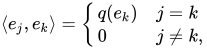
where is a quadratic form associated with (in an inner product space ).


Hence for an orthogonal basis

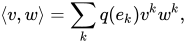
where and are components of and in the basis.


See also
- Basis (linear algebra) – Subset of a vector space that allows defining coordinates
- Orthonormal basis
- Orthonormal frame – Geometric structure that generalizes the Euclidean space
- Schauder basis
- Total set
References
- Lang, Serge (2004), Algebra, Graduate Texts in Mathematics, 211 (Corrected fourth printing, revised third ed.), New York: Springer-Verlag, pp. 572–585, ISBN 978-0-387-95385-4
- Milnor, J.; Husemoller, D. (1973). Symmetric Bilinear Forms. Ergebnisse der Mathematik und ihrer Grenzgebiete. 73. Springer-Verlag. p. 6. ISBN 3-540-06009-X. Zbl 0292.10016.
External links
| Basic concepts |  | |
|---|---|---|
| Matrices | ||
| Bilinear | ||
| Multilinear algebra | ||
| Vector space constructions | ||
| Numerical | ||
| ||


