Outstation (aviation)
In commercial aviation, an outstation refers to a terminal airport that is served by an air carrier but is not a hub, a focus city, nor a crew or maintenance base in that operator's network. Outstations commonly take the form of regional airports located in rural communities handling lower passenger volumes and less-frequent service than hubs. For these reasons, outstations may lack passenger amenities like airport lounges and gates with jet bridges. When an outstation is served by a hub-and-spoke style airline, it is common for those flights to depart early in the morning and arrive late at night due to scheduling patterns directing aircraft to remain-over-night (RON) for maximum fleet utilization.

Background

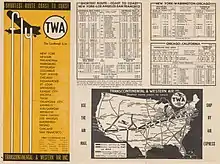
In the early decades of air transportation, passengers and mail were typically transported via point-to-point routes (also known as milk runs.) Point-to-point networks typically operated like railroads; they originated and terminated in major bases but made stops at intermediate points along their way. These intermediate cities sometimes featured additional spur routes (operated by the main airline, its partners, or subsidiaries) connecting them with smaller regional outstations, in the same way that railroads may structure branch lines. Point-to-point service often existed out of necessity; early airliners like the Ford Trimotor and Junkers Ju 52 only featured maximum ranges of around 500–600 nautical miles (930–1,110 km), and early aviation technology was insufficient to provide long-distance navigation and communication capabilities.[1]
In most modern airline networks, outstations function as the 'spokes' of a hub-and-spoke structure. Passengers departing from these remote locations—all having a wide array of final destinations—can be accommodated on consolidated flights. Upon reaching the airline's hub, they are self-sorted onto connecting flights to their final destinations. While the hub-and-spoke model tends to increase overall travel time due to indirect routing and layovers, it provides passengers with great flexibility and a greater choice in destinations.
Considerations
Infrastructure
While air carriers maintain a less-robust presence at outstations than at hubs, an outstation still requires a certain baseline of investment and infrastructure on the carrier's behalf. In other words: air carriers must typically provide for several essential functions in order to reliably serve an airport. These functions include:
- Line maintenance: Aircraft that become inoperable at an outstation must be made airworthy before returning to service. At outstations where the airline does not employ its own aircraft maintenance technicians (AMTs), this is commonly performed by contracted personnel qualified for 'line maintenance' functions, including troubleshooting, basic servicing of aircraft systems, and deferral of equipment in accordance with Minimum Equipment List procedures.
- Ground services: Air carriers may employ their own ramp crew and ground service equipment at outstations, or they may contract third-parties like fixed-base operators (FBOs) to handle fueling, de-icing, baggage handling, cabin cleaning, and catering functions.
Passenger amenities
While a certain level of infrastructure is necessary to support air carrier operations, carriers sometimes offer fewer passenger amenities in relation to the volume of customers served by an outstation. These amenities commonly include:
- Airport lounges
- Jet bridges
- First class (due to smaller flights operated by single-cabin regional airliners)
References
- Mola, Roger. "The Evolution of Airway Lights and Electronic Navigation Aids". www.centennialofflight.net. Centennial of Flight Commission. Retrieved 2021-10-30.
- "Common Airline Jargon – Outstation". Backpacker Travel. Retrieved 2021-11-06.