PRDM1
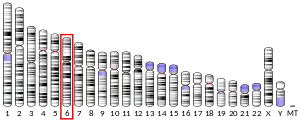
PR domain zinc finger protein 1, or B lymphocyte-induced maturation protein-1 (BLIMP-1), is a protein in humans encoded by the gene PRDM1 located on chromosome 6q21.[5] BLIMP-1 is expressed in both B and T cells and plays a significant role in B cell development and antibody production. In B cells, it is a regulator of plasma cell differentiation. In T cells, it is crucial for most terminal effector cell differentiation in CD 4 and CD8 T cells. BLIMP-1 acts as a repressor of beta-interferon (β-IFN) gene expression. The protein binds specifically to the PRDI (positive regulatory domain I element) of the β-IFN gene promoter. Transcription of this gene increases upon virus induction.[6]




Function
BLIMP-1 is an important regulator of plasma cell differentiation. Except for naïve and memory B cells, all antibody secreting cells express BLIMP-1 regardless of their location and differentiation history. In the absence of BLIMP-1, proliferating B cells are unable to differentiate to plasma cells, resulting in severe reduction in production of all isotypes of immunoglobulin. [5]
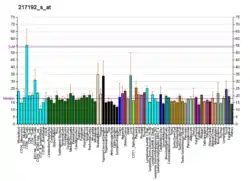
The increased expression of the Blimp-1 protein in B lymphocytes, T lymphocytes, NK cell and other immune system cells leads to an immune response through proliferation and differentiation of antibody secreting plasma cells. Blimp-1 is also considered a 'master regulator' of hematopoietic stem cells.[7][8] Other cells of the immune system such as human peripheral blood monocytes and granulocytes also express BLIMP-1. In a monocytic cell line, over-expression of BLIMP-1 can lead to differentiation into mature macrophages. BLIMP-1 also plays a role in osteoclastogenesis as well as in the modulation of dendritic cells.
As a transcriptional repressor, BLIMP-1 has a critical role in the foundation of the mouse germ cell lineage, as its disruption causes a block early in the process of primordial germ cell formation. BLIMP-1-deficient mutant embryos form a tight cluster of about 20 primordial germ cell-like cells, which fail to show the characteristic migration, proliferation and consistent repression of homeobox genes that normally accompany specification of primordial germ cells. The genetic lineage-tracing experiments indicate that the BLIMP-1-positive cells originating from the proximal posterior epiblast cells are indeed the lineage-restricted primordial germ cell precursors.[9]
B cell development
During B cell development, a B cell can either differentiate into a short-lived plasma cell or into a germinal center B cell after receiving proper activation and co-stimulation. BLIMP-1 acts as a master gene regulating the transcriptional network that regulates B cell terminal differentiation. BLIMP-1 expression is carefully controlled, since premature expression of it in primary B cells results in cell death. Thus, only cells that are ready to initiate transcription driven by BLIMP-1 are able to survive and differentiate.[5][10]
T cell development
BLIMP-1 plays a key role in maintaining normal T cell homeostasis. It regulates T cell responsiveness through repression of IL-2 cytokine in a negative feedback loop. T cell activation results in production of IL-2. IL-2 signaling then leads to PRDM1 transcription and BLIMP-1 feeds back to repress IL-2 gene transcription.[5]
T cell exhaustion
BLIMP-1 helps the production of short-lived effector T cells and clonally exhausted T cells. It also helps with the migration of T cells out of the spleen and lymph nodes into peripheral tissues. However, BLIMP-1 does not promote the production of long-lived effector memory cells. BLIMP-1 allows the production of some longer lived effector memory cells but its absence allows for the generation of long term central memory cells, which are thought to have a higher potential of proliferation on secondary challenge.[11]
Second cancers after radiation treatment
A genome-wide association study has identified two genetic variations near the PRDM1 gene that predict an increased likelihood of developing a second cancer after radiation treatment for Hodgkin lymphoma.[12]
References
- GRCh38: Ensembl release 89: ENSG00000057657 - Ensembl, May 2017
- GRCm38: Ensembl release 89: ENSMUSG00000038151 - Ensembl, May 2017
- "Human PubMed Reference:". National Center for Biotechnology Information, U.S. National Library of Medicine.
- "Mouse PubMed Reference:". National Center for Biotechnology Information, U.S. National Library of Medicine.
- Boi M, Zucca E, Inghirami G, Bertoni F (May 2015). "PRDM1/BLIMP1: a tumor suppressor gene in B and T cell lymphomas". Leukemia & Lymphoma. 56 (5): 1223–8. doi:10.3109/10428194.2014.953155. PMID 25115512.
- "Entrez Gene: PRDM1 PR domain containing 1, with ZNF domain".
- Turner CA, Mack DH, Davis MM (April 1994). "Blimp-1, a novel zinc finger-containing protein that can drive the maturation of B lymphocytes into immunoglobulin-secreting cells". Cell. 77 (2): 297–306. doi:10.1016/0092-8674(94)90321-2. PMID 8168136. S2CID 46200658.
- Sciammas R, Davis MM (May 2004). "Modular nature of Blimp-1 in the regulation of gene expression during B cell maturation". Journal of Immunology. 172 (9): 5427–40. doi:10.4049/jimmunol.172.9.5427. PMID 15100284.
- Ohinata Y, Payer B, O'Carroll D, Ancelin K, Ono Y, Sano M, et al. (July 2005). "Blimp1 is a critical determinant of the germ cell lineage in mice". Nature. 436 (7048): 207–13. Bibcode:2005Natur.436..207O. doi:10.1038/nature03813. PMID 15937476. S2CID 4399840.
- Fu SH, Yeh LT, Chu CC, Yen BL, Sytwu HK (July 2017). "New insights into Blimp-1 in T lymphocytes: a divergent regulator of cell destiny and effector function". Journal of Biomedical Science. 24 (1): 49. doi:10.1186/s12929-017-0354-8. PMC 5520377. PMID 28732506.
- Welsh RM (August 2009). "Blimp hovers over T cell immunity". Immunity. 31 (2): 178–80. doi:10.1016/j.immuni.2009.08.005. PMC 3220184. PMID 19699168.
- Best T, Li D, Skol AD, Kirchhoff T, Jackson SA, Yasui Y, et al. (July 2011). "Variants at 6q21 implicate PRDM1 in the etiology of therapy-induced second malignancies after Hodgkin's lymphoma". Nature Medicine. 17 (8): 941–3. doi:10.1038/nm.2407. PMC 3229923. PMID 21785431. Lay summary – University of Chicago Medical Center.
Further reading
- Huang S (July 1994). "Blimp-1 is the murine homolog of the human transcriptional repressor PRDI-BF1". Cell. 78 (1): 9. doi:10.1016/0092-8674(94)90565-7. PMID 8033216. S2CID 34007883.
- Mock BA, Liu L, LePaslier D, Huang S (October 1996). "The B-lymphocyte maturation promoting transcription factor BLIMP1/PRDI-BF1 maps to D6S447 on human chromosome 6q21-q22.1 and the syntenic region of mouse chromosome 10". Genomics. 37 (1): 24–8. doi:10.1006/geno.1996.0516. PMID 8921366.
- Ren B, Chee KJ, Kim TH, Maniatis T (January 1999). "PRDI-BF1/Blimp-1 repression is mediated by corepressors of the Groucho family of proteins". Genes & Development. 13 (1): 125–37. doi:10.1101/gad.13.1.125. PMC 316372. PMID 9887105.
- Angelin-Duclos C, Cattoretti G, Lin KI, Calame K (November 2000). "Commitment of B lymphocytes to a plasma cell fate is associated with Blimp-1 expression in vivo". Journal of Immunology. 165 (10): 5462–71. doi:10.4049/jimmunol.165.10.5462. PMID 11067898.
- Gupta S, Anthony A, Pernis AB (May 2001). "Stage-specific modulation of IFN-regulatory factor 4 function by Krüppel-type zinc finger proteins". Journal of Immunology. 166 (10): 6104–11. doi:10.4049/jimmunol.166.10.6104. PMID 11342629.
- Medina F, Segundo C, Campos-Caro A, González-García I, Brieva JA (March 2002). "The heterogeneity shown by human plasma cells from tonsil, blood, and bone marrow reveals graded stages of increasing maturity, but local profiles of adhesion molecule expression". Blood. 99 (6): 2154–61. doi:10.1182/blood.V99.6.2154. PMID 11877292.
- Shaffer AL, Lin KI, Kuo TC, Yu X, Hurt EM, Rosenwald A, et al. (July 2002). "Blimp-1 orchestrates plasma cell differentiation by extinguishing the mature B cell gene expression program". Immunity. 17 (1): 51–62. doi:10.1016/S1074-7613(02)00335-7. PMID 12150891.
- Vasanwala FH, Kusam S, Toney LM, Dent AL (August 2002). "Repression of AP-1 function: a mechanism for the regulation of Blimp-1 expression and B lymphocyte differentiation by the B cell lymphoma-6 protooncogene". Journal of Immunology. 169 (4): 1922–9. doi:10.4049/jimmunol.169.4.1922. PMID 12165517.
- Borson ND, Lacy MQ, Wettstein PJ (December 2002). "Altered mRNA expression of Pax5 and Blimp-1 in B cells in multiple myeloma". Blood. 100 (13): 4629–39. doi:10.1182/blood.V100.13.4629. PMID 12453881.
- Györy I, Fejér G, Ghosh N, Seto E, Wright KL (March 2003). "Identification of a functionally impaired positive regulatory domain I binding factor 1 transcription repressor in myeloma cell lines". Journal of Immunology. 170 (6): 3125–33. doi:10.4049/jimmunol.170.6.3125. PMID 12626569.
- Gyory I, Wu J, Fejér G, Seto E, Wright KL (March 2004). "PRDI-BF1 recruits the histone H3 methyltransferase G9a in transcriptional silencing". Nature Immunology. 5 (3): 299–308. doi:10.1038/ni1046. PMID 14985713. S2CID 33178299.
- Lotz C, Mutallib SA, Oehlrich N, Liewer U, Ferreira EA, Moos M, et al. (July 2005). "Targeting positive regulatory domain I-binding factor 1 and X box-binding protein 1 transcription factors by multiple myeloma-reactive CTL". Journal of Immunology. 175 (2): 1301–9. doi:10.4049/jimmunol.175.2.1301. PMID 16002735.
- Tam W, Gomez M, Chadburn A, Lee JW, Chan WC, Knowles DM (May 2006). "Mutational analysis of PRDM1 indicates a tumor-suppressor role in diffuse large B-cell lymphomas". Blood. 107 (10): 4090–100. doi:10.1182/blood-2005-09-3778. PMID 16424392.
- Pasqualucci L, Compagno M, Houldsworth J, Monti S, Grunn A, Nandula SV, et al. (February 2006). "Inactivation of the PRDM1/BLIMP1 gene in diffuse large B cell lymphoma". The Journal of Experimental Medicine. 203 (2): 311–7. doi:10.1084/jem.20052204. PMC 2118216. PMID 16492805.
- González-García I, Ocaña E, Jiménez-Gómez G, Campos-Caro A, Brieva JA (April 2006). "Immunization-induced perturbation of human blood plasma cell pool: progressive maturation, IL-6 responsiveness, and high PRDI-BF1/BLIMP1 expression are critical distinctions between antigen-specific and nonspecific plasma cells". Journal of Immunology. 176 (7): 4042–50. doi:10.4049/jimmunol.176.7.4042. PMID 16547239.
- Garcia JF, Roncador G, García JF, Sánz AI, Maestre L, Lucas E, et al. (April 2006). "PRDM1/BLIMP-1 expression in multiple B and T-cell lymphoma". Haematologica. 91 (4): 467–74. PMID 16585013.
- Lim J, Hao T, Shaw C, Patel AJ, Szabó G, Rual JF, et al. (May 2006). "A protein-protein interaction network for human inherited ataxias and disorders of Purkinje cell degeneration". Cell. 125 (4): 801–14. doi:10.1016/j.cell.2006.03.032. PMID 16713569. S2CID 13709685.
External links
- PRDM1+protein,+human at the US National Library of Medicine Medical Subject Headings (MeSH)
- FactorBook PRDM1
This article incorporates text from the United States National Library of Medicine, which is in the public domain.