Pratt & Whitney Canada PW100
The Pratt & Whitney Canada PW100 aircraft engine family is a series of 1,800 to 5,000 shaft horsepower (1,300 to 3,700 kW) turboprops manufactured by Pratt & Whitney Canada. The engine was first introduced as a technology demonstrator in 1977.[2] The PW100 was first tested in March 1981, made its initial flight in February 1982 on a Vickers Viscount testbed aircraft,[3] and then entered service in December 1984 on a Dash 8 regional aircraft for NorOntair.[1] Pratt & Whitney Canada dominates the turboprops market with 89% of the turboprop regional airliner installed base in 2016, leading GE Aviation and Allison Engine Company.[4]
| PW100 | |
|---|---|
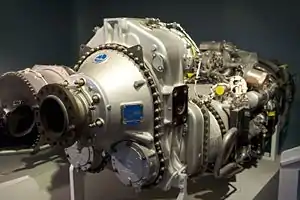 | |
| PW120 in Canada Aviation Museum | |
| Type | Turboprop |
| National origin | Canada |
| Manufacturer | Pratt & Whitney Canada |
| First run | March 1981 |
| Major applications | ATR 42/ATR 72 De Havilland Canada Dash 8 EADS CASA C-295 Embraer EMB 120 Brasilia Fokker 50 Xian MA60 |
| Number built | >8,000 (as of 2014)[1] |
Design
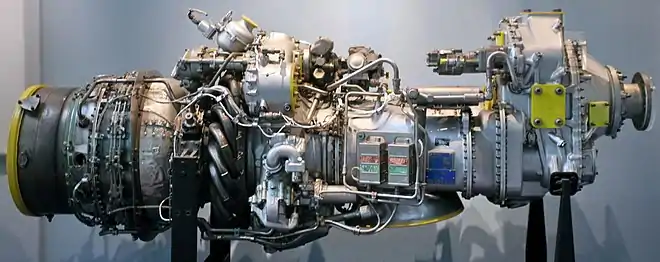
Originally called the PT7, the PW100 uses a relatively unusual three-shaft engine configuration. In the PW100, a centrifugal low-pressure (LP) impeller (except for the PW150, which uses a 3-stage axial LP compressor), driven by a single-stage LP turbine, supercharges a contra-rotating centrifugal high-pressure (HP) impeller, driven by a single-stage HP turbine. Power is delivered to the offset propeller reduction gearbox through a third shaft, connected to a two-stage free (power) turbine. The gearbox has two stages, yielding a reduction ratio between 15.4 and 17.16. The first stage uses double helical gears, followed by a second stage with straight spur gears.[5]
Variants


The last two digits of each variant model number represent the nominal power at takeoff, in hundreds of horsepower.[6]
| Variant | Certification | Rating | Notes |
|---|---|---|---|
| PW115 | 1983-12[6] | 1,500 shp (1,100 kW)[8] | No longer in service. |
| PW118 | 1986-03-11 | 1,892 eshp (1,411 kW) | Can be converted to a PW118A. |
| PW118A | 1987-06-30 | 1,893 eshp (1,412 kW) | Can be converted to a PW118B. |
| PW118B | 1996-02-29 | 1,892 eshp (1,412 kW) | |
| PW119A | 1992-03-04 | 1,948 eshp (1,453 kW) | Can be converted to a PW119B. |
| PW119B | 1993-04-05 | 1,941 eshp (1,448 kW) | Can be converted to a PW119C. |
| PW119C | 1995-04-21 | 1,941 eshp (1,448 kW) | Can be converted to a PW119B. |
| PW120 | 1983-12-16 | 1,787 eshp (1,333 kW) | Can be converted to a PW121. |
| PW120A | 1984-09-18 | 1,892 eshp (1,411 kW) | Can be converted to a PW121. |
| PW121 | 1987-02-18 | 2,044 eshp (1,524 kW) | Can be converted to a PW120. |
| PW121A | 1995-03-24 | 1,992 eshp (1,465 kW) | |
| PW123 | 1987-06-30 | 2,261 eshp (1,687 kW) | Can be converted to a PW123B, C, D, or E. |
| PW123AF | 1989-06-14 | 2,261 eshp (1,686 kW) | Can be converted to PW123. |
| PW123B | 1991-12-20 | 2,262 eshp (1,687 kW) | Can be converted to a PW123. |
| PW123C | 1994-05-13 | 2,054 eshp (1,532 kW) | Can be converted to a PW123 or D. |
| PW123D | 1994-05-13 | 2,054 eshp (1,532 kW) | Can be converted to a PW123 or C. |
| PW123E | 1995-02-13 | 2,261 eshp (1,687 kW) | Can be converted to a PW123. |
| PW124B | 1988-05-25 | 2,522 eshp (1,881 kW) | Can be converted to a PW123 or PW127. |
| PW125B | 1987-05-01 | 2,261 eshp (1,687 kW) | |
| PW126 | 1987-05-01 | 2,323 eshp (1,732 kW) | Can be converted to a PW123 or PW126A. |
| PW126A | 1989-06-14 | 2,493 eshp (1,859 kW) | Can be converted to a PW123 or PW127D. |
| PW127 | 1992-02-04 | 2,619 eshp (1,953 kW) | Can be converted to a PW127C, E, or F. |
| PW127A | 1992-02-10 | 2,620 eshp (1,954 kW) | Can be converted to a PW127B. |
| PW127B | 1992-11-05 | 2,619 eshp (1,953 kW) | |
| PW127C | 1992-10-06 | 2,880 eshp (2,148 kW) | |
| PW127D | 1993-03-31 | 2,880 eshp (2,148 kW) | Can be converted to a PW127B. |
| PW127E | 1994-12-16 | 2,516 eshp (1,876 kW) | Can be converted to a PW127M. |
| PW127F | 1996-08-30 | 2,619 eshp (1,953 kW) | Can be converted to a PW127M. |
| PW127G | 1997-09-19 | 3,058 eshp (2,281 kW) | |
| PW127H | 1998-10-23 | 2,880 eshp (2,148 kW) | |
| PW127J | 1999-01-04 | 2,880 eshp (2,148 kW) | |
| PW127M | 2007-12-07 | 2,619 eshp (1,953 kW) | |
| PW127N | 2014-05-05 | 2,619 eshp (1,953 kW) | |
| PW150A | 1998-06-24 | 5,492 eshp (4,095 kW)[9] | For the Q400 and An-132.[lower-alpha 1] |
Other variants
- PW119
- 1,815 shp (1,353 kW),[11] no longer in service.
- PW124
- 2,400 shp (1,800 kW),[12] no longer in service.
- PW124A
- No longer in service.
- PW125
- No longer in service.
- PW125A
- No longer in service.
- PW127TS
- Turboshaft version that powered the second prototype of the Mil Mi-38 helicopter.[13]
- PW150 Twin Pack
- Proposed powerplant for the Airbus A400M.[14] Two PW150-based engines would be used to drive a single propeller.[15] The powerplant was eliminated from contention by Airbus in early June 1999, since it was short of providing the 9,000 shp (6,700 kW) required to drive the eight-bladed propeller at the time, and its specific fuel consumption (SFC) was excessive.[16]
- PW150B
- Proposed powerplant for the Shaanxi Y-8F-600.[17] Abandoned in December 2008 when the United States government barred a U.S.-based subcontractor from exporting the engine control software for the PW150B.[18]
- PW150C
- Proposed powerplant for the Xian MA700.[19] Includes a third-stage power turbine, larger-diameter propellers, modified reduction gearbox, and optimized low-pressure compressor.[20] Has higher thrust, higher speed, and extended range compared to the PW150A. Blocked from an export license by the Canadian government in 2020.[21]
- ST18M
- Marine application for the PW100.
- ST40M
- Marine application for the PW150A.
Applications
Aircraft
| Application | Variant |
|---|---|
| Antonov An-132D | PW150A |
| Antonov An-140 | PW127A |
| ATR 42-300/320 | PW120/PW121 |
| ATR 42-500/600 | PW127E/M |
| ATR 72-100/200 | PW124B |
| ATR 72-500/600 | PW127F/M |
| BAe ATP | PW126 |
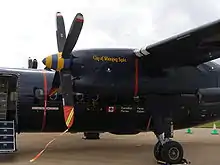
| Canadair CL-215T | PW123AF |
| Canadair CL-415 | PW123AF |
| De Havilland Canada Dash 8-100 | PW120/PW121 |
| De Havilland Canada Dash 8-200/300 | PW123 |
| De Havilland Canada Dash 8-400 | PW150 |
| Dornier 328 | PW119 |
| EADS CASA C-295 | PW127G |
| Embraer EMB 120 Brasilia | PW115/PW118A |
| Fokker 50 | PW125B |
| Fokker 60 | PW127B |
| Ilyushin Il-114 | PW127H |
| Xian MA60 | PW127J |
Other applications
- Bombardier JetTrain
- Skjold-class corvette
Specifications
| Series | Thermo. Power | Mech. Power | Prop. max. RPM | BSFC[lower-alpha 1][23] | Dry weight[23] | Height | Width | Length | Application |
|---|---|---|---|---|---|---|---|---|---|
| PW118 | 2,180 hp 1,630 kW | 1,800 hp 1,300 kW | 1,300 | 0.498 lb/hp/h 303 g/kW/h | 861 lb 391 kg | 31 in 79 cm | 25 in 64 cm | 81 in 210 cm |
Embraer EMB-120 |
| PW120 | 2,400 hp 1,800 kW | 2,100 hp 1,600 kW | 1,200 | 0.485 lb/hp/h 295 g/kW/h | 921 lb 418 kg | 31 in 79 cm | 25 in 64 cm | 84 in 210 cm |
ATR 42-300/320 Dash 8-100 |
| PW123/124 | 3,000 hp 2,200 kW | 2,400 hp 1,800 kW | 1,200 | 0.470 lb/hp/h 286 g/kW/h | 992 lb 450 kg | 33 in 84 cm | 26 in 66 cm | 84 in 210 cm |
Dash 8-200/300 Canadair CL-215T/CL-415 |
| PW127 | 3,200 hp 2,400 kW | 2,750 hp 2,050 kW | 1,200 | 0.459 lb/hp/h 279 g/kW/h | 1,060 lb 480 kg | 33 in 84 cm | 26 in 66 cm | 84 in 210 cm |
An-140, ATR 42-400/500/600, ATR 72-210/500/600 CASA C-295, Il-114-100, Xian MA60 |
| PW150 | 6,200 hp 4,600 kW | 5,000 hp 3,700 kW | 1,020 | 0.433 lb/hp/h 263 g/kW/h[24] | 1,583 lb 718 kg[24] | 44 in 110 cm | 30 in 76 cm | 95 in 240 cm |
Dash 8-400 |
- At sea-level take-off
Data from PW100,[25] PW150[26]
General characteristics
- Type: Three-shaft turboprop
- Length: 2,046–2,130 mm (80.6–83.9 in); PW150: 2,420 mm (95 in)
- Diameter: 635–679 mm (25.0–26.7 in); PW150: 790 mm (31 in)
- Dry weight: 390.5–481.7 kg (861–1,062 lb); PW150: 716.9 kg (1,580 lb)
Components
- Compressor: Two-spool, two-stage centrifugal compressors, PW150: Two-spool, 3-stage axial, single centrifugal[22]
- Combustors: Reverse flow combustor[22]
- Turbine: Single-stage low pressure and high pressure turbines, Two-stage power turbine[22]
- Fuel type: PW150: Kerosene Jet A, A-1/JP8; Wide Cut Jet B/JP4; High Flash JP5/JP1
- Oil system: Self-contained system[27]
Performance
- Maximum power output: 1,342–1,846 kW (1,800–2,476 hp); PW150: 3,415 kW (4,580 hp) + 3.412 kN (767 lbf)
- Overall pressure ratio: PW120, PW127, and PW150: 12.14, 15.77, and 17.97[5]
- Air mass flow: PW120, PW127, and PW150: 6.70, 8.49, and 14.44 kg/s (14.8, 18.7, and 31.8 lb/s)[5]
- Turbine inlet temperature: max. ITT, 750-816°C Normal Take-off (PW150: 880°C), 950°C 5 secs starting (PW150: 920°C)
- Power-to-weight ratio: 3.44–3.83 kW/kg (2.09–2.33 hp/lb); PW150: 4.76 kW/kg (2.90 hp/lb)
See also
Comparable engines
Related lists
References
- Pratt & Whitney Canada (13 May 2014). "Pratt & Whitney Canada celebrates the 30th anniversary of the PW100 turboprop powerhouse". Skies Magazine (Press release).
- Trimble, Stephen (February 28 – March 5, 2012). "Return of the power turboprop: Turboprop engine duel strikes up for 90-seater". Flight International. No. 728. pp. 32–33. ISSN 0015-3710.
- Leyes II & Fleming 1999, p. 489.
- Schonland, Addison (25 Apr 2017). "Pratt & Whitney Canada – The Dominator". Air Insight Group. Retrieved 12 July 2020.
- Hosking, E.; Kenny, D. P.; McCormick, R. I.; Moustapha, S. H.; Sampath, P.; Smailys, A. A. (11–15 May 1998). The PW100 engine: 20 years of gas turbine technology evolution. Design principles and methods for aircraft gas turbine engines. pp. 4–1 to 4–9. ISBN 9789283700050. OCLC 300373932.
- Cook, David L. (16–19 April 1985). Development of the PW100 turboprop engines. General Aviation Aircraft Meeting and Exposition. SAE Transactions. 94 (4). pp. 4.740–4.746. doi:10.4271/850909. ISSN 0096-736X. JSTOR 44729718.CS1 maint: date and year (link)
- Type certificate data sheet (Report). E-19 (48th ed.). Transport Canada. 6 August 2019. Canadian type certificate for PW118–PW127.CS1 maint: postscript (link)
- "Civil Turboshaft/Turboprop Specifications". www.jet-engine.net.
- Type certificate data sheet (Report). E-29 (3rd ed.). Transport Canada. 28 August 2000. Canadian type certificate for PW150.CS1 maint: postscript (link)
- Warwick, Graham (9 September 1998). "Turboprop - and proud of it". Flight International. ISSN 0015-3710.
- "Dornier lands big order". Flying. September 1991. p. 26. ISSN 0015-4806.
- Leyes II & Fleming 1999, p. 491.
- Dubois, Thierry (9 December 2010). "Russian medium twin helo program resumes". AINonline.
- Moxon, Julian (17 March 1999). "CASA chosen for final assembly of Airbus Military transporter". Flight International. Toulouse, France. p. 22. ISSN 0015-3710.
- Norris, Guy (2 June 1999). "European powerhouse: BMW Rolls-Royce is poised for new growth as it enters the commercial engine world with the BR715". Flight International. No. 4679. Berlin, Germany. pp. 38–40. ISSN 0015-3710. OCLC 207200939.
- Cook, Nick (9 June 1999). "Airbus to select A400M engine next month". Jane's Defence Weekly. Vol. 31 no. 23. p. 1. ISSN 0265-3818. OCLC 207398309.
- Chang, Andrei (3 December 2008). "China, Russia still at odds over Il-76 sales deal". United Press International (UPI).
- "PWC pulls out of military Y8-F600". Air Cargo News. 22 December 2008.
- Meszaros, Jennifer (20 January 2020). "Chinese LCC takes its first ARJ21, MA700 set for assembly". AINonline.
- Polek, Gregory (20 June 2017). "Pratt Canada seals deals to power Chinese, Russian turboprops". AINonline.
- "China's MA700 in jeopardy as Canada blocks PW150C exports". ch-aviation. 28 September 2021.
- "PW100/150 Turboprops". Pratt & Whitney Canada.
- Gudmundsson, Snorri (2022). "Table 7-9. Typical T-O power and SFC of selected turboprop engines". General aviation aircraft design: Applied methods and procedures (2nd ed.). Butterworth-Heinemann. p. 227. ISBN 978-0-12-818465-3. OCLC 1272887697.
- National Research Council (2007). "Table 3-1. Comparison of candidate engine characteristics". Improving the efficiency of engines for large nonfighter aircraft. The National Academies Press. p. 29. doi:10.17226/11837. ISBN 978-0-309-10399-2. OCLC 567827788.
- "PW100 Type certificate data sheet" (PDF). EASA. 4 June 2014. Archived from the original (PDF) on 31 January 2017. Retrieved 14 February 2017.
- "PW150 Type certificate data sheet" (PDF). EASA. 19 November 2014.
- ATR 42 72 Aircraft Maintenance Training Manual, chapter 71
Bibliography
- "Pratt & Whitney Canada PW100 Series" (PDF). Forecast International. November 2010.
- Leyes II, Richard A.; Fleming, William A. (1999). The History of North American Small Gas Turbine Aircraft Engines. Washington, DC: Smithsonian Institution. ISBN 1-56347-332-1. OCLC 247550535.
External links
 |
Wikimedia Commons has media related to Pratt & Whitney Canada PW100 family. |