Safety car
In motorsport, a safety car, or a pace car, is an automobile which limits the speed of competing cars or motorcycles on a racetrack in the case of a caution period such as an obstruction on the track or bad weather. The aim of the safety car is to enable the clearance of any obstruction under safer conditions, especially for marshals and/or await more favourable track conditions weather-wise.
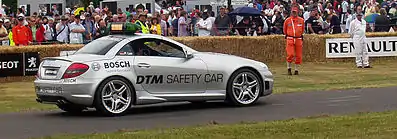
During a caution period the safety car (which generally consists of an aptly modified high-performance production car) enters the track ahead of the leader. Depending on the regulations in effect, competitors are not normally allowed to pass the safety car or other competitors during a caution period, and the safety car leads the field at a pre-determined safe speed, which may vary by series and circuit. At the end of the caution period, the safety car leaves the track and the competitors resume normal racing. The first reliance on this safety measure occurred with the deployment of a pace car during the inaugural Indianapolis 500 in 1911.[1]
Effect
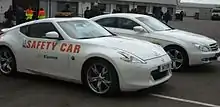
The use of a safety car has the effect of bunching competitors together, such as to eliminate any time and distance advantage that a leading driver may have had over the remaining field of competitors. This effect can make racing more competitive upon full race resumption; conversely, it has also contributed to faster leading drivers being negated just rewards for their efforts prior to the caution period.
Subject to the racing regulations in force, it is not uncommon for drivers to be allowed to make pitstops during safety car periods. This situation may provide a strategic advantage since any scheduled refueling, tire change or maintenance may be carried out while other competitors are lapping at lower speed, and the drivers who pit then simply rejoin a queue of cars all running together. During normal racing conditions, such interventions would typically involve losing significant terrain over those drivers that remain on-track.
Another notable effect of safety car periods is that racing cars consume less fuel until full race resumption, which can allow competitors to run longer distances on a tank of fuel than would otherwise have been possible and/or reduce the number of pitstops required for the duration of the race.
Formula One
Procedure
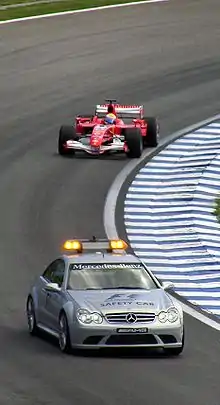
In Formula One if an accident or inclement weather (typically, heavy rain) prevents normal racing from continuing safely, the Race Director will call for a "safety car" period, which would see marshals wave yellow flags and hold "SC" boards, pending the car in question entering the track. From 2007, all Formula One cars must have LEDs and/or displays fitted to the steering wheel or cockpit, which inform the driver which flags are being waved. A yellow LED is illuminated when the safety car is deployed.
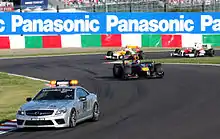
The safety car has both orange and green lights mounted on its roof in the form of a light bar. The green lights are used to signal that it is possible to overtake the safety car; this is only done until the race leader is immediately behind the safety car and at the head of the queue of race cars following.[2]
From 2015, the safety car is not required to wait until all backmarkers have caught back up to the queue. When the safety car is ready to leave the circuit, it will turn off its orange lights to indicate that it will enter the pit lane at the end of the lap. Drivers must continue in formation until they cross the first safety car line, where circuit green lights and flags will indicate they are free to race again.[3]
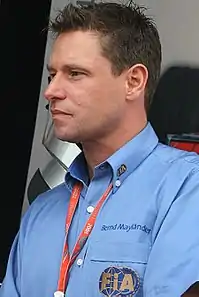
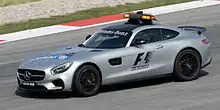
The safety car is piloted by professional drivers (since 2000, by Bernd Mayländer) on-board high-powered modified vehicles supplied by Mercedes-Benz (and Aston Martin starting with the 2021 season),[4] and must maintain a reasonable speed so as to ensure that the competitors' tyres are as close as possible to operating temperature and their engines do not overheat. The driver of the safety car is accompanied by a co-driver to assist with operations and communications.
For incidents during the first three laps, the safety car also has an advantage over the traditional red flag; with a red flag, it would take a minimum of fifteen minutes to restart the race, and the two-hour limit would not start until the cars were ready for a second formation lap. With regards to the time limit, the race is being scored and the time is also counting while the safety car is on the track, and the race resumes.
History
The first use of a safety car in Formula One is reported to have taken place at the 1973 Canadian Grand Prix, where a yellow Porsche 914[5][6] was called for duty following various incidents under treacherous weather conditions. Controversially, on that occasion, it took several hours after the race to figure out the winner and final results since the safety car driver had placed his car in front of the wrong competitor thus causing part of the field to be one lap down incorrectly.[7]
The sport officially introduced safety cars in 1993, after trials were conducted at both the French and British Grands Prix during the preceding 1992 season. Since 1996, as part of promotional arrangements, the main supplier of safety cars has been Mercedes-Benz,[4] with Aston Martin sharing the duties with them from 2021, unlike previous years that have seen cars of different brands being used throughout the season and depending on the track visited (for example, the exotic Lamborghini Countach for the Monaco Grand Prix in the 1980s[6][8] and the Lamborghini Diablo for the 1995 Canadian Grand Prix to the more mundane Fiat Tempra used at the rain-affected 1993 Brazilian Grand Prix[9] and the high performance version of the Opel Vectra used at the infamous 1994 San Marino Grand Prix.
From 2007, new procedures were applied for the first time during the Bahrain Grand Prix. The pit lane was closed immediately upon the deployment of the safety car. No car could enter the pits until all cars on the track had formed up in a line behind the safety car, they passed the pit entrance, and the message "pit lane open" was given. A ten-second stop/go penalty (which must be taken when the race is resumed) was imposed on any driver who entered the pit lane before the pit lane open message is given. However, any car which was in the pit entry or pit lane when the safety car was deployed would not incur a penalty.
From 2009, however, this procedure has been dropped, and replaced by software that calculates where a car is on the track and a minimum lap time it should take the car to get to the pits. Cars that enter the pits before this time limit has expired are penalised.
When the safety car and the drivers behind it are on the start/finish straight, there is a red light at the exit of the pit lane. Drivers who go past the red light are disqualified from the race. This has happened to several drivers during the years, such as Giancarlo Fisichella and Felipe Massa in the 2007 Canadian Grand Prix. At the same race a year later, Lewis Hamilton failed to notice the red light and slammed into the back of the car of Kimi Räikkönen, who was waiting at the end of the pit lane alongside Robert Kubica.
From 2010, once cars were lined up behind the safety car, lapped cars were no longer allowed to unlap themselves before the race was restarted.[10] This rule was abandoned from the 2012 season onwards, with cars now allowed to unlap themselves before the race resumes. However, since 2015, the safety car does not need to wait for the backmarkers to catch up with the leading pack before returning to the pits.
The 2021 Bahrain Grand Prix saw the debut of the Aston Martin Vantage as an official Formula One Safety Car. The 2021 Formula One season will have two official safety cars, both the Aston Martin and the Mercedes-AMG GT R that was already used in previous seasons.[11]
List of safety car deployments in Formula One races
This list is updated as of the 2021 Abu Dhabi Grand Prix (12 December 2021). It does not contain deployments of the Virtual safety car.
.jpg.webp)
.jpg.webp)
.jpg.webp)

.svg.png.webp)



.svg.png.webp)

.svg.png.webp)





















.svg.png.webp)


Statistics
These numbers are updated as of the 2021 Abu Dhabi Grand Prix (12 December 2021).
- The safety car has been deployed a total of 287 times in 199 Formula One Grands Prix. It has led the field of Formula One cars for at least 1.047 full laps.
- Thirteen Grands Prix have started behind the safety car. Eight have finished behind the safety car.
- The average number of laps that the safety car leads the field of cars is 3.5, ignoring very long deployments due to heavy rain.
- The most deployments during a season was 21 in 2010. This number was nearly equalled during the 2020 season, with 20 deployments.
- The most deployments in one race was six during the 2011 Canadian Grand Prix. The previous highest number was five during the 2003 Brazilian Grand Prix.
List of Formula One safety cars
This list is updated as of the 2021 Abu Dhabi Grand Prix (12 December 2021).
Virtual safety car (VSC)
Following an accident at the 2014 Japanese Grand Prix, which saw driver Jules Bianchi suffer a serious head injury which led to his death, the FIA established an "accident panel" to investigate the dynamics of the accident and ways to minimize the risk of a crash during similar circumstances that do not warrant the deployment of a safety car and cannot be simply managed with yellow flags.
The accident panel recommended the implementation of a "virtual safety car", based on the "slow zone" system used in Le Mans racing. Compared to the former, the safety car does not actually appear on the track; however. On top of not being allowed to overtake under yellow flag conditions in the affected sector, a "VSC" icon would appear trackside and on the drivers' steering displays, obliging drivers to not exceed the posted speed limit, thus resulting in a 35% speed reduction. The system was similar to the Electro-PACER lights used in the Indianapolis 500 races from 1972 until 1978, except that engine control units (ECU) were involved and could enforce speed limits under the current system.
The VSC was tested over the course of the final three races of the 2014 season, during parts of free practice sessions.[270][271] The system was evolved taking into account drivers' feedback and was officially introduced for the 2015 season following ratification by the World Motor Sport Council (WMSC).[272] The VSC was officially used for the first time – and for a brief period prior to the deployment of the actual safety car – at the 2015 Monaco Grand Prix, following a 30G crash involving Max Verstappen. The system saw its first extended deployment at the 2015 British Grand Prix after Carlos Sainz Jr.'s power unit failed at Club Corner of the Silverstone Circuit. All drivers must keep their delta times positive at this point.
Formula E
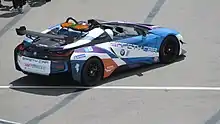
The Full Course Yellow condition is the Formula E version of the Virtual Safety Car. In this condition, all marshal posts will wave yellow flags, accompanied by a sign that says "FCY" with a yellow background. This condition is often decided by the Race Director whether it is appropriate to implement it or not. The fans (if they are watching the race on TV) and drivers can hear the Race Director declare the FCY (mainly saying "Attention all teams, attention all teams this is Race Control, Full Course Yellow in 5, 4, 3, 2, 1, Full Course Yellow, Full Course Yellow). Once the FCY is implemented, all drivers must activate the FCY limiter, which, similar to the pit speed limiter, keeps the car under FCY speeds despite the throttle being flat to the floor. Overtaking is not allowed under FCY conditions, but if a driver does overtake another driver, like when Jean-Éric Vergne overtook António Félix da Costa at the 2019 Rome ePrix, the driver who overtook the other driver can be penalised. For season 6 of Formula E, when there is an FCY period, everyone is no longer allowed to activate Attack Mode. For every minute spent under FCY conditions, 1kWh of energy kept in reserve by the drivers will be subtracted, giving more energy saving tactics to the drivers and teams alike. Like Formula One, Formula E does have a safety car condition, but instead of a Mercedes-AMG GT R as the safety car, from 2014 to 2021, a BMW i8 plug-in hybrid sports car was used.[273] Starting with the 2021 Rome ePrix, a Mini Electric will be used for selected races.
Indianapolis 500
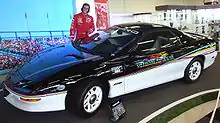
The first use of a pace car in automobile racing was at the inaugural Indy 500 in 1911.[1] The officials at the Indianapolis Motor Speedway have been selecting a pace car and its driver for the Indy 500 each year since that first race. The first pace car was a Stoddard-Dayton driven by Carl G. Fisher. In recent years Chevrolet models have been chosen as the official pace car, owing to the ability for them to be used at both major automobile races at the Speedway (typically Corvette at the 500 and Impala at the 400). The pace car is selected two months before the race runs, allowing the manufacturer of the selected pace car to produce replicas of that year's car, which sell at a marked premium to collectors and race fans. Pace car replicas are often seen on the streets of Indianapolis weeks before the race is actually held, and a celebrity driver is usually used for the start of the race only.
The Indiana Pacers, a professional basketball team located in Indianapolis, Indiana, is named after a pace car. The legacy of racing and the rich history of the Indy 500 both played a major role in the naming process.
Automakers compete for the prestige of having one of their models selected as the year's pace car for the publicity. In 1971, the move backfired as no automakers stepped up to provide a pace car. Instead, local Indianapolis-area Dodge dealers fulfilled the duty. Eldon Palmer, a local dealer, lost control of the Dodge Challenger pace car and crashed into a photography stand, injuring several people. The blame for the crash was never fully determined, as officials realized that an orange cone (or perhaps an orange flag), which was to identify Palmer's braking point, was accidentally removed.
In the last 50 years, the Pontiac Trans Am, Chevrolet Camaro, Chevrolet Corvette, Oldsmobile Cutlass, and Ford Mustang are the only models that have been selected as pace cars three or more times.
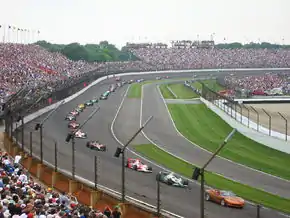
During the IndyCar Series season, however, Johnny Rutherford, Sarah Fisher, and Oriol Servià are the normal drivers of the IRL pace car for all events.[274] The pace car is deployed for debris, collision, or weather reasons. Since 1993, upon the waving of the yellow flag, pit road is closed until the pace car picks up the leader and passes the pit entrance the first time, unless track blockage forces the field to drive through pit lane. Another duty of the pace car is to lead the field around the course on parade laps prior to the start of the race. These increase in speed, allowing for a flying start of the race.
Furthermore, two other rule changes have been implemented. Since 2000, with one lap to go before going back to green, the pace car pulls off the track in turn one rather than in turn four. The current leader of the race is then assigned the task of pacing the field back to the green flag. After much consideration, this rule was added to prevent a situation much like the one that happened in the 1995 Indianapolis 500, when Scott Goodyear passed the pace car going back to green. In 2002, another rule was added. With one lap to go before the green, the pace car waves by all cars (if there are any) between the pace car and the actual leader of the race. This allows for the leader to control the restart without lapped cars being in front of him. It also creates a strategy for cars to gain laps back, loosely resembling the "Lucky dog" rule. However, the cars who get waved around are not allowed to pit until the green flag restarts the race (so they do not get the advantage of getting their lap back AND a free pit stop).
NASCAR
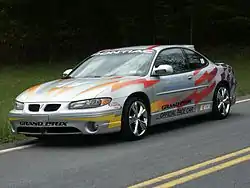
In all NASCAR series, if the caution is out for debris, accident, or inclement weather, the flagman will display the yellow caution flag and the pace car[275] will pull out of the pits and turn on the yellow strobes on top and/or behind the car. When race officials are ready to open pit lane, a green light will come on in the rear window of the safety car. One lap before a green flag, the pace car will shut off its lights to signal drivers to line up double file.
Unlike most series in motorsport, owing to NASCAR's short-track roots, each track usually offers its own safety car, typically from the manufacturer, but in recent years, it has been a local dealer or association of regional dealerships-provided Safety car. Tracks that use Toyota safety cars will use a Toyota Camry Hybrid, while Ford tracks will use a Ford Mustang, while Chevrolet tracks use a Chevrolet Camaro and most Dodge tracks use a Dodge Challenger. If a manufacturer is promoting a new vehicle, they will often use the new car instead of the standard-specification safety car.
For the Truck Series, which races pickup trucks instead of cars, the safety "car" is often a pickup. Tracks affiliated with a local or regional Chevrolet dealership will use a Chevrolet Silverado, while Chrysler dealership-affiliated tracks will use a Ram 1500. Ford-affiliated tracks will often use the F-Series, but Toyota-affiliated tracks are less likely to use the Toyota Tundra, but prefer marketing the Camry Hybrid. However, Ford and Toyota manufacturer sponsored tracks will prefer the Mustang and Camry, respectively, instead of a truck, and occasionally, pickup trucks have been used as pace vehicles for Cup Series and Xfinity races.
Since NASCAR does not allow speedometers or electronic speed limiting devices, the pace car circles the track at pit road speed during the warm-up laps. This allows each driver to note the RPM at which pit road speed is maintained. Drivers exceeding that speed on pit road will be penalized, typically a "drive-through" or "stop and go" penalty, costing them valuable track position.
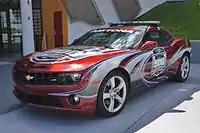
Since mid-2004, NASCAR official Brett Bodine has driven the vehicle during official race functions during Cup Series races. Other famous NASCAR pace car drivers include Robert "Buster" Auton and Elmo Langley.
At many races, NASCAR has an honorary pace car driver that actually drives a car during the parade laps. Depending on the driver's skill, some drivers are allowed to pace the field right up to the dropping of the green flag. Some famous drivers have been Jay Leno, Richard Hammond, Luke Wilson, Rob Gronkowski, Guy Fieri and many others.
The beneficiary rule (informally known as the "lucky dog" rule) states once the safety car is deployed, the first car not on the lead lap will regain a lap. The Beneficiary will regain his lap once pit road opens. Bodine will signal that car to pass him through radio contact between NASCAR and that team. The free pass car must pit with the lapped cars.
In 2009, NASCAR introduced a new "Double-file restart" rule that lines the field two cars on each row on every restart, similar to the start of the race, instead of lead-lap cars on the outside and lapped cars on the inside. Also, the "wave-around" rule, similar to what is enforced in racing series sanctioned by IndyCar, was adopted to ensure the first car on the restart is the leader, and ensure there are no lapped cars ahead of the leader.
Incidents with safety cars and other course cars
2014 Sprint Unlimited
Before the start of the final segment of the Sprint Cup Series' Sprint Unlimited exhibition race at Daytona, the Chevrolet SS pace car caught fire and stopped off the track, delaying the restart. The fire was believed to have started in a trunk-mounted battery pack powering the lights.[276]
2012 Daytona 500
During a safety car situation on Lap 160 of the 2012 Daytona 500, Earnhardt Ganassi Racing driver Juan Pablo Montoya's car had a suspension part failure, and it lost control on turn 3, sharply veering into a safety truck and jet dryer trailer and causing a giant fireball.[277] Sparks were seen emanating from Montoya's car right before its hard collision with the jet dryer trailer and left driver's side of the truck. Montoya was treated at the infield care center and released unhurt. The driver of the Chevrolet Silverado Crew Cab, Duane Barnes, was taken to a local hospital for observation and was resting comfortably. He was an employee at Michigan International Speedway, a sister track of Daytona. The tracks often share jet dryer equipment on race weekends to help in case of rain such as the case on Sunday, the original scheduled start time of the race. The entire incident took about two hours to clean up before the last 40 (later extended to 42 due to a Green-white-checkered finish) laps were able to be completed.[278]
NASCAR subsequently added the use of the second safety car (used during race start situations) to protect the last jet dryer in other safety car situations.
2011 6 Hours of Castellet
The 2011 6 Hours of Castellet got off to a controversial start when the pace car did not return to the pits when the green lights came on. The front running LMPs slowed down but some of the GT cars could not react fast enough, resulting in heavy damage to all three GTE Pro class Porsches which caused them to retire. The GTE Am class IMSA Performance Matmut Porsche and GTE Pro JOTA Aston Martin were also caught up in the carnage.[279]
2009 WTCC Pau
An accident occurred during the 2009 FIA WTCC Race of France in Pau, France. A succession of first-lap accidents caused the safety car to be placed on standby, with yellow flags waving on the start-finish section of the track. The safety car driver then proceeded to drive onto the track at slow speed, without official approval,[280] moving across the pit exit line immediately after exiting the pits, instead of confining to the inside of it until the line ended. Race leader Franz Engstler came through the kink on the start-finish straight and was unable to avoid hitting the side of the pace car.[281] Engstler commented "I saw the safety car coming out from the right and realized that I had no chance to brake... I really do not understand why he was going out of the pits".[282] After this incident, the Portuguese Bruno Correia was appointed as the official safety car driver.[283]
2008 Dutch Supercar Challenge Spa
A safety car caused a crash during the 2008 Dutch Supercar Challenge race at Spa Francorchamps. The Seat Leon was released too late, allowing the leading Marcos LM600 to pass while erroneously identifying the Audi TT DTM in 2nd and Mosler MT900R GT3 in 3rd as 'the leading pack.' Race officials immediately realized their mistake, and the safety car was instructed to slow down and let the entire field pass.
As the safety car was exiting turn 11, an approaching Lamborghini Gallardo GT3 drastically reduced its speed in response to the unusually slow safety car. However, a BMW a few seconds behind came around the blind turn at speed, colliding with the Gallardo and safety car. The collision destroyed the Gallardo and sent the BMW into a number of rolls. The safety car was sent off the track into the Armco safety barrier at great speed. In the chaos, a Marcos LM600 coming around turn 11 locked up its brakes and spun into the wet grass on the inside of the track. Sliding back onto the track, it was hit from the side by a BMW Z3. Furthermore, two E46 BMW M3 GTRs were damaged: one on the outside line hit the rear of the Marcos, and the other, on the inside line, slightly damaged its front right. The second M3 continued around the track, while the first slid into the grass before turn 12. The race was stopped, and there were no serious injuries to any of the drivers.
1999 FirstPlus Financial 200
On lap 57, ARCA driver Joe Cooksey ran into the back of the Pontiac Grand Prix pace car driven by Jack Wallace totaling the pace car, to quote Cooksey: "It might be the first time in history the pace car has been wiped out."[284]
1986 Winston 500
Before the start of the race, a drunken 20-year-old fan named Darren Charles Crowder stole the pace car and drove a lap around the Talladega Superspeedway. Local sheriffs deputies and marshals quickly pursued Crowder around the track, setting up a roadblock at the exit of Turn 4. Crowder was detained by sheriff deputies when he stopped at the roadblock.[285]
1971 Indianapolis 500
The pace car of the 1971 Indianapolis 500, an orange Dodge Challenger driven by local auto dealer Eldon Palmer, crashed at the start of the race. As Palmer drove the car off into the pit lane to let the race cars begin the race, he lost control of the car and crashed into a photographer stand.[286] There were no fatalities, and the number of people reported injured has ranged from 18 to 29.[287]
See also
- Zero cars, similar cars used in rallying to open roads to rally competitors
- Pacemaker (running)
References
- Cavin, Curt (May 16, 2011). "Leaders of the Pack". AutoWeek. Crain Communications Inc. 61 (10): 60–61.
- "Safety car". Archived from the original on 2012-07-30. Retrieved 2010-11-07.
- "F1 RULES & REGULATIONS: What's new for 2019? | Formula 1®".
- "Mercedes-Benz Tells the History of the F1 Safety Car: Video".
- Kathri, Tarun (2012-02-07). "First ever Safety car in Formula 1 : Rewind to 1973". aaFormula1.com. Archived from the original on 2015-04-07. Retrieved 2015-04-03.
- "The F1 Safety Car's Bumpy Ride". 22 December 2007. Retrieved 3 April 2015.
- Lang, Mike (1982). Grand Prix! Vol 2. Haynes Publishing Group. p. 244. ISBN 0-85429-321-3.
- "Holy Ferruccio! A Lamborghini Countach Safety Car". Jalopnik. 2010-07-10. Retrieved 2015-03-03.
- "History of the F1 Safety Car and it's impact on Formula One".
- "Cause and effect - the impact of 2010's new rules". Archived from the original on 2012-07-31. Retrieved 2010-11-07.
- "Check out the new Mercedes and Aston Martin Safety Cars that'll be used in F1 in 2021". Formula1.com. March 8, 2021. Retrieved March 12, 2021.
- "First ever Safety Car in Formula 1 : Rewind to 1973". Archived from the original on 2015-04-07. Retrieved 2021-10-06.
- "The 1993 Brazilian Grand Prix". Retrieved 2021-10-06.
- "F1 - British GP 1993 - Race - Part 2".
- "Formula 1 - San Marino GP 1994 - HRT - Part 1".
- "F1 - Belgian GP 1995 - Race - Part 2".
- "Round 3 - Argentine Grand Prix Report". Retrieved 2021-10-06.
- "F1 1996 GP13 BELGIUM Spa Race BBC".
- "Argentinian Grand Prix Review". Retrieved 2021-10-06.
- "Schumacher capitalises as Williams get it wrong in the rain again". Retrieved 2021-10-06.
- "Canadian Grand Prix Review". Retrieved 2021-10-05.
- "F1 - Canadian GP 1998 - Race - Part 1".
- "British Grand Prix Review". Retrieved 2021-10-05.
- "1998 Austrian GP - Start Chaos". YouTube. Archived from the original on 2021-12-12.
- "Formula 1 - 1998 Spa Belgium Grand Prix".
- "Grand Prix of Australia Review". Retrieved 2021-10-05.
- "Formula 1 Season 1999x01 - Australian Grand Prix Full Race".
- "Grand Prix of Canada Review" (PDF). Archived from the original (PDF) on 2005-03-02. Retrieved 2021-10-05.
- "Grand Prix of France Review". Retrieved 2021-10-05.
- "1999 European Grand Prix (Nurburgring)".
- "2000 Australian Grand Prix". Retrieved 2021-10-05.
- "BULLETIN N°6 RACE FACTS AND INCIDENTS". Archived from the original on 2001-06-18. Retrieved 2021-10-05.
- "BULLETIN N°6 RACE FACTS AND INCIDENTS". Archived from the original on 2001-06-18. Retrieved 2021-10-05.
- "The Belgian GP Review". Archived from the original on 2019-09-09. Retrieved 2021-10-05.
- "2000 Round14 Italy: Monza". Archived from the original on 2001-06-27. Retrieved 2021-10-05.
- "BULLETIN N°6 RACE FACTS AND INCIDENTS". Archived from the original on 2001-06-18. Retrieved 2021-10-05.
- "Australian Grand Prix lapwatch". Archived from the original on 2002-12-17. Retrieved 2021-10-05.
- "2001 Malaysian Grand Prix". Retrieved 2021-10-05.
- "F1 2001 Brazilian Grand Prix Review Highlights". YouTube. Archived from the original on 2021-12-12.
- "2001 Round6 Austria: A1-Ring". Archived from the original on 2001-06-18. Retrieved 2021-10-05.
- "2001 Round 8 Canada: Montreal". Archived from the original on 2001-12-15. Retrieved 2021-10-05.
- "2001 : Spa (Race Commentary)". Archived from the original on 2001-11-10. Retrieved 2021-10-05.
- "2002 Australian Grand Prix". Retrieved 2021-10-05.
- "2002 Austrian Grand Prix". Retrieved 2021-10-05.
- "F1 - Canadian GP 2002 - Race - Part 1".
- "F1 2003 GP01 - AUSTRALIA Melbourne - Race".
- "BULLETIN No4 RACE FACTS AND INCIDENTS". Archived from the original on 2003-05-07. Retrieved 2021-10-05.
- "2003 Austrian Grand Prix". Retrieved 2021-10-05.
- "F1 - British GP 2003 - Race - Part 1".
- "F1 2004 Monaco Grand Prix - Race Highlights BBC". YouTube. Archived from the original on 2021-12-12.
- "2004 United States Grand Prix". Retrieved 2021-10-05.
- "2004 Belgian Grand Prix". Retrieved 2021-10-05.
- "F1 2005 Best of 06. GP von Monaco". Retrieved 2021-10-05.
- "Canadian Grand Prix as it happened". Retrieved 2021-10-05.
- "2005 British Grand Prix". Retrieved 2021-10-05.
- "Belgian Grand Prix as it happened". Retrieved 2021-10-05.
- "2005 Japanese Grand Prix(2005年F1日本グランプリ鈴鹿)". YouTube. Archived from the original on 2021-12-12.
- "F1 2005 GP19 CHINA Shanghai Race ITV".
- "2006 Australian Grand Prix". Retrieved 2021-10-05.
- "F1 2006 3/18 Australien Premiere". YouTube. Archived from the original on 2021-12-12.
- "2006 San Marino Grand Prix". Retrieved 2021-10-05.
- "2006 Monaco Grand Prix". Retrieved 2021-10-05.
- "F1 2006 GP 8 Grobritannien Silverstone Rennen RTL". YouTube. Archived from the original on 2021-12-12.
- "GP Canada 2006 RTL". YouTube. Archived from the original on 2021-12-12.
- "F1 2006 10/18 USA RTL". YouTube. Archived from the original on 2021-12-12.
- "Jenson Button's watches his first F1 win! 🏁 2006 Hungarian GP watchalong". YouTube. Archived from the original on 2021-12-12.
- "As it happened: Turkish GP". 27 August 2006. Retrieved 2021-10-05.
- "Brazilian GP as it happened". 22 October 2006. Retrieved 2021-10-05.
- "Bahrain Grand Prix". 15 April 2007. Retrieved 2021-10-05.
- "2007 Canadian Grand Prix". Retrieved 2021-10-05.
- "F1 2007 GP06 CANADA Montreal Race ITV". 20 October 2014.
- "2007 European Grand Prix". Retrieved 2021-10-05.
- "Italian Grand Prix 2007". 9 September 2007. Retrieved 2021-10-05.
- "Japan Grand Prix". 30 September 2007. Retrieved 2021-10-05.
- "Australian Grand Prix". 16 March 2008. Retrieved 2021-10-05.
- "Spanish Grand Prix". 27 April 2008. Retrieved 2021-10-05.
- "2008 Turkish Grand Prix". Retrieved 2021-10-05.
- "Monaco Grand Prix". 25 May 2008. Retrieved 2021-10-05.
- "2008 Canadian Grand Prix". Retrieved 2021-10-05.
- "F1 2008 GP07 CANADA Montreal Race ITV". 13 August 2014.
- Briggs, Gemma (20 July 2008). "German grand prix - live!". The Guardian. Retrieved 2021-10-05.
- "As it happened: Raceday at Monza". Retrieved 2021-10-05.
- "2008 Singapore Grand Prix". Retrieved 2021-10-05.
- "F1 2008 GP15 SINGAPORE Race ITV".
- Briggs, Gemma (2 November 2008). "Brazilian grand prix - as it happened". The Guardian. Retrieved 2021-10-05.
- "Australian GP as it happened". 29 March 2009. Retrieved 2021-10-05.
- Bandini, Nicky (5 April 2009). "Malaysian grand prix - as it happened!". The Guardian. Retrieved 2021-10-05.
- Gardner, Alan (19 April 2009). "Chinese grand prix - as it happened". The Guardian. Retrieved 2021-10-05.
- "Spanish GP as it happened". 10 May 2009. Retrieved 2021-10-05.
- "2009 Belgian Grand Prix". Retrieved 2021-10-05.
- "2009 Italian Grand Prix". Retrieved 2021-10-05.
- "Singapore GP as it happened". 27 September 2009. Retrieved 2021-10-05.
- "Japanese Grand Prix as it happened". 10 October 2010. Retrieved 2021-10-05.
- "2009 Brazilian Grand Prix". Retrieved 2021-10-05.
- "F1 2009 GP16 BRAZIL Interlagos Race BBC Sport". 24 July 2014.
- "As it happened: Race day at Albert Park". Retrieved 2021-10-04.
- "Chinese Grand Prix as it happened". 18 April 2010. Retrieved 2021-10-04.
- "Monaco GP as it happened". 16 May 2010. Retrieved 2021-10-04.
- "European Grand Prix as it happened". 27 June 2010. Retrieved 2021-10-04.
- "2010 British Grand Prix". Retrieved 2021-10-04.
- "Formula 1 Season 2010x10 British Grand Prix Full Race".
- "Hungarian Grand Prix 2010: Race Report". August 2010. Retrieved 2021-10-04.
- "2010 Belgian Grand Prix". Retrieved 2021-10-04.
- "2010 Singapore Grand Prix". Retrieved 2021-10-04.
- "2010 Japanese Grand Prix". Retrieved 2021-10-04.
- "Korean Grand Prix 2010: Race Report". 24 October 2010. Retrieved 2021-10-04.
- "2010 Korean Grand Prix". Retrieved 2021-10-04.
- "Brazilian Grand Prix 2010: Race Report". 8 November 2010. Retrieved 2021-10-04.
- "2010 Abu Dhabi Grand Prix". Retrieved 2021-10-04.
- "As it happened: The Monaco Grand Prix". Retrieved 2021-10-04.
- "Jenson Button wins stunning Canadian Grand Prix". 12 June 2011. Retrieved 2021-10-04.
- "Canadian GP - Sunday - Race Notes". Archived from the original on 2012-08-20. Retrieved 2021-10-04.
- "2011 Belgian Grand Prix". Retrieved 2021-10-04.
- "F1 - Belgian GP 2011 - BBC - Part 1". 28 April 2015.
- "2011 Italian Grand Prix". Retrieved 2021-10-04.
- "F1 - Italian GP 2011 - BBC - Part 1". 14 February 2015.
- "2011 Singapore Grand Prix". Retrieved 2021-10-04.
- "F1 - Singapore GP 2011 - BBC - Part 2". 22 April 2015.
- "2011 Japanese Grand Prix". Retrieved 2021-10-04.
- "Formula 1 Season 2011x15 Japanese Grand Prix Full Race".
- "2011 Korean Grand Prix". Retrieved 2021-10-04.
- "2012 Australian Grand Prix". Retrieved 2021-10-04.
- "Malaysian Grand Prix: Live Report". Retrieved 2021-10-04.
- "2012 Monaco Grand Prix". Retrieved 2021-10-04.
- "2012 European Grand Prix". Retrieved 2021-10-04.
- "2012 BELGIAN GRAND PRIX - LAP CHART". 13 February 2013. Retrieved 2021-10-04.
- "2012 Singapore Grand Prix". Retrieved 2021-10-04.
- "2012 Japanese Grand Prix". Retrieved 2021-10-04.
- "2012 Abu Dhabi Grand Prix". Retrieved 2021-10-04.
- "2012 Brazilian Grand Prix". Retrieved 2021-10-04.
- "2012 Brazilian Grand Prix: Race Highlights Presented by Pirelli". YouTube. Archived from the original on 2021-12-12.
- McCourt, Ian (26 May 2013). "Monaco Grand Prix – as it happened!". The Guardian. Retrieved 2021-10-04.
- "2013 Monaco Grand Prix lap times and fastest laps". 26 May 2013. Retrieved 2021-11-11.
- "2013 British Grand Prix". Retrieved 2021-10-04.
- "2013 German Grand Prix". Retrieved 2021-10-04.
- "Formula 1 Season 2013x09 German Grand Prix 720p Full Race".
- "2013 Singapore Grand Prix analysis: Where Sunday's race was won and lost". Retrieved 2021-10-04.
- "Formula 1 Season 2013x13 Singapore Grand Prix 720p Full Race".
- "Formula 1 Season 2013x14 Korean Grand Prix 720p Full Race".
- "2013 United States Grand Prix". Retrieved 2021-10-04.
- "2014 Australian Grand Prix". Retrieved 2021-10-04.
- "Formula 1 Season 2014x01 Australian Grand Prix 720p Full Race".
- "2014 Bahrain Grand Prix". Retrieved 2021-10-04.
- Ostlere, Lawrence (25 May 2014). "Monaco Grand Prix: F1 – as it happened". The Guardian. Retrieved 2021-10-04.
- "2014 British Grand Prix". Retrieved 2021-10-04.
- "2014 German Grand Prix". Retrieved 2021-10-04.
- "2014 Hungarian Grand Prix". Retrieved 2021-10-04.
- McVeigh, Niall (21 September 2014). "F1 Singapore GP: Lewis Hamilton wins – as it happened". The Guardian. Retrieved 2021-10-04.
- "As it happened: Sunday - Japanese Grand Prix". Archived from the original on 2014-10-07. Retrieved 2021-10-04.
- "2014 United States Grand Prix". Retrieved 2021-10-04.
- "2015 Australian Grand Prix". Retrieved 2021-10-04.
- "2015 Malaysian Grand Prix". Retrieved 2021-10-04.
- McVeigh, Niall (12 April 2015). "Chinese Grand Prix: F1 2015 – as it happened". The Guardian. Retrieved 2021-10-04.
- "2015 Monaco Grand Prix". Retrieved 2021-10-04.
- "2015 Austrian Grand Prix". Retrieved 2021-10-04.
- McVeigh, Niall (5 July 2015). "F1: Lewis Hamilton wins British Grand Prix – as it happened!". The Guardian. Retrieved 2021-10-04.
- McVeigh, Niall (26 July 2015). "F1: Hungarian Grand Prix – as it happened". The Guardian. Retrieved 2021-10-04.
- Butler, Michael (20 September 2015). "F1: Singapore Grand Prix – as it happened". The Guardian. Retrieved 2021-10-04.
- "2015 Russian Grand Prix". Retrieved 2021-10-04.
- Davies, Tom (25 October 2015). "F1 US Grand Prix – as it happened". The Guardian. Retrieved 2021-10-04.
- Ostlere, Lawrence (November 2015). "F1: Mexico Grand Prix – as it happened". The Guardian. Retrieved 2021-10-04.
- Woolcock, Adam (20 March 2016). "Nico Rosberg takes out the Melbourne Grand Prix for Mercedes - as it happened". The Guardian. Archived from the original on 2016-03-27. Retrieved 2021-10-05.
- McVeigh, Niall (17 April 2016). "F1: Nico Rosberg wins the Chinese Grand Prix – as it happened". The Guardian. Retrieved 2021-10-05.
- Davies, Tom (May 2016). "F1: Russian Grand Prix – as it happened". The Guardian. Retrieved 2021-10-05.
- Roopanarine, Les (29 May 2016). "Lewis Hamilton wins Monaco GP after Red Bull pit-stop agony – as it happened". The Guardian. Retrieved 2021-10-05.
- Fisher, Ben (3 July 2016). "F1: Lewis Hamilton wins Austrian Grand Prix at Red Bull Ring – as it happened". The Guardian. Retrieved 2021-10-05.
- Meagher, Gerard (10 July 2016). "F1: Lewis Hamilton wins British Grand Prix – as it happened". The Guardian. Retrieved 2021-10-05.
- Fisher, Ben (30 October 2016). "F1: Nico Rosberg wins the Singapore Grand Prix – as it happened". The Guardian. Retrieved 2021-10-05.
- Butler, Michael (13 November 2016). "F1: Lewis Hamilton wins Brazilian Grand Prix to force season finale – as it happened". The Guardian. Retrieved 2021-10-05.
- Woolcock, Adam (9 April 2017). "Formula One: Hamilton wins Chinese Grand Prix – as it happened". The Guardian. Retrieved 2021-10-05.
- Butler, Michael (16 April 2017). "F1: Bahrain Grand Prix – as it happened". The Guardian. Retrieved 2021-10-05.
- Davies, Tom (30 April 2017). "F1: Russian Grand Prix – as it happened". The Guardian. Retrieved 2021-10-05.
- Fisher, Ben (28 May 2017). "F1: Sebastian Vettel wins Monaco Grand Prix – as it happened". The Guardian. Retrieved 2021-10-05.
- Fisher, Ben (11 June 2017). "F1: Lewis Hamilton wins Canadian Grand Prix – as it happened". The Guardian. Retrieved 2021-10-05.
- Davies, Tom (25 June 2017). "F1: Ricciardo wins Azerbaijan Grand Prix after Hamilton and Vettel clash – as it happened". The Guardian. Retrieved 2021-10-05.
- Fisher, Ben (16 July 2017). "F1: Lewis Hamilton wins British Grand Prix as Sebastian Vettel finishes seventh – as it happened". The Guardian. Retrieved 2021-10-05.
- Ostlere, Lawrence (30 July 2017). "F1: Sebastian Vettel wins Hungarian Grand Prix – as it happened". The Guardian. Retrieved 2021-10-05.
- Fisher, Ben (27 August 2017). "F1: Lewis Hamilton wins Belgian Grand Prix – as it happened". The Guardian. Retrieved 2021-10-05.
- Harris, Daniel (17 September 2017). "F1: Lewis Hamilton wins Singapore GP after Sebastian Vettel crashes out – as it happened". The Guardian. Retrieved 2021-10-05.
- Woolcock, Adam (8 October 2017). "F1: Lewis Hamilton wins Japanese Grand Prix – as it happened". The Guardian. Retrieved 2021-10-05.
- Fisher, Ben (12 November 2017). "F1: Sebastian Vettel wins Brazil GP as Hamilton storms back for fourth – as it happened". The Guardian. Retrieved 2021-10-05.
- Howcroft, Jonathan; Howcroft, Jonathan (25 March 2018). "Vettel wins Australian Grand Prix – as it happened". The Guardian. Retrieved 2021-10-05.
- Woolcock, Adam (15 April 2018). "F1 2018: Daniel Ricciardo wins Chinese Grand Prix – as it happened". The Guardian. Retrieved 2021-10-05.
- Harris, Daniel (29 April 2018). "Lewis Hamilton wins chaotic Azerbaijan Grand Prix as Red Bulls collide: F1 – as it happened". The Guardian. Retrieved 2021-10-05.
- Bleaney, Rob (13 May 2018). "Lewis Hamilton wins Spanish Grand Prix in Mercedes one-two: F1 – as it happened". The Guardian. Retrieved 2021-10-05.
- "2018 Canadian Grand Prix: Race Highlights". YouTube. Archived from the original on 2021-12-12.
- Unwin, Will (24 June 2018). "Lewis Hamilton wins the French Grand Prix: F1 – as it happened". The Guardian. Retrieved 2021-10-05.
- Fisher, Ben (8 July 2018). "Sebastian Vettel wins the British GP with Hamilton second – as it happened". The Guardian. Retrieved 2021-10-05.
- Harris, Daniel (22 July 2018). "F1: Lewis Hamilton wins dramatic German Grand Prix – as it happened". The Guardian. Retrieved 2021-10-05.
- "Belgian Grand Prix 2018: Sebastian Vettel wins to close gap on Lewis Hamilton - as it happened". Independent.co.uk. 26 August 2018. Retrieved 2021-10-05.
- Piercy, James (2 September 2018). "Lewis Hamilton wins the Italian Grand Prix – as it happened". The Guardian. Retrieved 2021-10-05.
- Fisher, Ben (16 September 2018). "F1: Lewis Hamilton wins the Singapore Grand Prix – as it happened". The Guardian. Retrieved 2021-10-05.
- Collins, Pádraig; Collins, Pádraig (7 October 2018). "Formula One 2018: Lewis Hamilton wins Japan Grand Prix – as it happened". The Guardian. Retrieved 2021-10-05.
- Fisher, Ben (25 November 2018). "Lewis Hamilton wins Abu Dhabi Grand Prix: F1 – as it happened". The Guardian. Retrieved 2021-10-05.
- McVeigh, Niall (31 March 2019). "F1: Lewis Hamilton wins dramatic Bahrain Grand Prix – as it happened". The Guardian. Retrieved 2021-10-05.
- Brewin, John (12 May 2019). "Lewis Hamilton wins Spanish Grand Prix: F1 – as it happened". The Guardian. Retrieved 2021-10-05.
- Brewin, John (26 May 2019). "F1: Lewis Hamilton wins Monaco Grand Prix – as it happened". The Guardian. Retrieved 2021-10-05.
- Burnton, Simon (14 July 2019). "Lewis Hamilton wins the British Grand Prix: F1 – as it happened". The Guardian. Retrieved 2021-10-05.
- Harris, Daniel (28 July 2019). "F1: Verstappen wins German GP, Vettel second and Hamilton 11th – as it happened". The Guardian. Retrieved 2021-10-05.
- "2019 Belgian Grand Prix Live". 2 September 2019. Retrieved 2021-10-05.
- Davies, Tom (22 September 2019). "Sebastian Vettel wins Singapore GP, Hamilton finishes fourth – as it happened". The Guardian. Retrieved 2021-10-05.
- Fisher, Ben (29 September 2019). "Lewis Hamilton wins Russian Grand Prix: F1 – as it happened". The Guardian. Retrieved 2021-10-05.
- Harris, Daniel (17 November 2019). "Brazilian Grand Prix: F1 – as it happened". The Guardian. Retrieved 2021-10-05.
- "THE AUSTRIAN GRAND PRIX AS IT HAPPENED". 5 July 2020. Retrieved 2021-10-05.
- "Hamilton eases to Styrian Grand Prix victory over Bottas as Ferraris collide". Retrieved 2021-10-05.
- Brewin, John (2 August 2020). "Lewis Hamilton wins British Grand Prix 2020: F1 – as it happened". The Guardian. Retrieved 2021-10-05.
- Bleaney, Rob (30 August 2020). "Lewis Hamilton wins Belgian GP on grim day for Ferrari – as it happened". The Guardian. Retrieved 2021-10-05.
- "THE ITALIAN GRAND PRIX AS IT HAPPENED". 6 September 2020. Retrieved 2021-10-05.
- "F1: TUSCAN GRAND PRIX 2020 - AS IT HAPPENED". 13 September 2020. Retrieved 2021-10-05.
- "2020 Russian Grand Prix". Retrieved 2021-10-05.
- "THE RUSSIAN GRAND PRIX AS IT HAPPENED". 27 September 2020. Retrieved 2021-10-06.
- Ashdown, John (11 October 2020). "F1: Lewis Hamilton equals Schumacher wins record by taking Eifel GP – as it happened". The Guardian. Retrieved 2021-10-05.
- "F1 EMILIA ROMAGNA GRAND PRIX AT IMOLA - AS IT HAPPENED". November 2020. Retrieved 2021-10-05.
- Brewin, John (29 November 2020). "Hamilton wins Bahrain Grand Prix after Grosjean survives huge crash - as it happened". The Guardian. Retrieved 2021-10-05.
- Unwin, Will (6 December 2020). "Sergio Pérez wins Sakhir Grand Prix: Formula One – as it happened!". The Guardian. Retrieved 2021-10-05.
- "FORMULA 1 - ABU DHABI GRAND PRIX AS IT HAPPENED - VERSTAPPEN WINS FINAL RACE OF SEASON". 13 December 2020. Retrieved 2021-10-05.
- Hess, Alex (28 March 2021). "Hamilton pips Verstappen amid late drama to win F1's Bahrain GP – as it happened". The Guardian. Retrieved 2021-10-05.
- "F1 AS IT HAPPENED - MAX VERSTAPPEN WINS EMILIA-ROMAGNA GP AS LEWIS HAMILTON FIGHTS BACK TO SECOND". 18 April 2021. Retrieved 2021-10-05.
- Brewin, John (2 May 2021). "Lewis Hamilton wins Portuguese Grand Prix at Portimão: F1 – as it happened". The Guardian. Retrieved 2021-10-05.
- "FORMULA 1 SPANISH GRAND PRIX - LEWIS HAMILTON WINS THIRD RACE OF 2021 SEASON - AS IT HAPPENED". 9 May 2021. Retrieved 2021-10-05.
- Hess, Alex (6 June 2021). "Sergio Pérez wins dramatic Azerbaijan GP after Verstappen crashes: F1 – as it happened". The Guardian. Retrieved 2021-10-05.
- McVeigh, Niall (4 July 2021). "Max Verstappen wins F1's Austrian GP, Lewis Hamilton fourth – as it happened". The Guardian. Retrieved 2021-10-05.
- Davies, Tom (August 2021). "F1 Hungarian GP: Esteban Ocon takes victory after eventful race – as it happened". The Guardian. Retrieved 2021-10-05.
- Hess, Alex (29 August 2021). "Verstappen handed win after Belgian GP ruined by rain – as it happened". The Guardian. Retrieved 2021-10-05.
- Harris, Daniel (12 September 2021). "Ricciardo wins F1 Italian GP after Hamilton and Verstappen crash out – as it happened!". The Guardian. Retrieved 2021-10-05.
- "Verstappen extends championship lead after jumping both Mercedes at the start to win in Mexico". Retrieved 2021-11-08.
- "F1 Live - Formula 1's Brazilian Grand Prix Race LIVE - Hamilton wins and full Drivers' Championship standing". 14 November 2021. Retrieved 2021-11-15.
- "F1 SAUDI ARABIA GRAND PRIX AS IT HAPPENED - TITLE RACE TO GO TO WIRE AFTER MORE HAMILTON-VERSTAPPEN DRAMA". 5 December 2021. Retrieved 2021-12-07.
- "Mercedes protest after Max Verstappen wins F1 world title in Abu Dhabi – as it happened". 12 December 2021. Retrieved 2021-12-13.
- "First ever Safety Car in Formula 1 : Rewind to 1973". Archived from the original on 2015-04-07. Retrieved 2021-10-06.
- "Gallery: History of safety cars in Formula 1".
- "Countach Pace Cars in Monaco".
- "History of the Formula 1 Safety Car". 24 March 2018. Retrieved 2021-10-06.
- "Formula 1 - European Grand Prix (1993)". YouTube. Archived from the original on 2021-12-12.
- "F1 - Spanish GP 1993 - Race - Part 1". 10 December 2013.
- "F1 - French GP 1993 - Race - Part 1". 11 December 2013.
- "F1 - British GP 1993 - Race - Part 2".
- "F1 - Germany 1993. HRT - Part 1". 30 March 2012.
- "F1 - Hungarian GP 1993 - Race - Part 1". 12 December 2013.
- "F1 - Portugal 1993 - Race - Part 1". 25 April 2013.
- "F1 - Brazil 1994 - Race - Part 1". 28 April 2013.
- "F1 - San Marino GP 1993 - Race - Part 1". 9 December 2013.
- "F1 - Pacific GP 1994 Aida - Race - Part 1". May 2013.
- "Five things that stood out re-watching the 1994 Japanese GP". 24 April 2020.
- "When the safety car itself becomes a… danger!". 17 August 2019.
- "Safety Car F1 GP ARGENTINA 1996". YouTube. Archived from the original on 2021-12-12.
- "Gallery: History of safety cars in Formula 1".
- "Race Highlights 2021 Emilia Romagna Grand Prix". YouTube. Archived from the original on 2021-12-12.
- "Race Highlights 2021 Portuguese Grand Prix". YouTube. Archived from the original on 2021-12-12.
- "Race Highlights 2021 Spanish Grand Prix". YouTube. Archived from the original on 2021-12-12.
- "Race Highlights 2021 Azerbaijan Grand Prix". YouTube. Archived from the original on 2021-12-12.
- "Race Highlights 2021 Styrian Grand Prix". YouTube. Archived from the original on 2021-12-12.
- "Race Highlights 2021 Austrian Grand Prix". YouTube. Archived from the original on 2021-12-12.
- "Race Highlights 2021 Hungarian Grand Prix". YouTube. Archived from the original on 2021-12-12.
- "Verstappen Wins Rain-Curtailed Race 2021 Belgian Grand Prix". YouTube. Archived from the original on 2021-12-12.
- "Race Highlights 2021 Italian Grand Prix". YouTube. Archived from the original on 2021-12-12.
- "Race Highlights 2021 United States Grand Prix". YouTube. Archived from the original on 2021-12-12.
- "Look who's back for this weekend's #MexicoGP".
- "Race Highlights 2021 Brazilian Grand Prix". YouTube. Archived from the original on 2021-12-12.
- "Race Highlights 2021 Bahrain Grand Prix". YouTube. Archived from the original on 2021-12-12.
- "Race Highlights 2021 Monaco Grand Prix". YouTube. Archived from the original on 2021-12-12.
- "Race Highlights 2021 French Grand Prix". YouTube. Archived from the original on 2021-12-12.
- "Race Highlights 2021 British Grand Prix". YouTube. Archived from the original on 2021-12-12.
- "Race Highlights 2021 Dutch Grand Prix". YouTube. Archived from the original on 2021-12-12.
- "Race Highlights 2021 Russian Grand Prix". YouTube. Archived from the original on 2021-12-12.
- "Race Highlights 2021 Turkish Grand Prix". YouTube. Archived from the original on 2021-12-12.
- "A First View of the Losail International Circuit 2021 Qatar Grand Prix". YouTube. Archived from the original on 2021-12-12.
- "A Flying Lap of the Jeddah Corniche Circuit 2021 Saudi Arabian Grand Prix". YouTube. Archived from the original on 2021-12-12.
- "Race Highlights 2021 Abu Dhabi Grand Prix". YouTube.
- "Alonso: Still work to be done on VSC". PlanetF1.com. 31 October 2014. Archived from the original on 2 November 2014. Retrieved 2 November 2014.
- "Virtual safety car gets the go-ahead". Planet F1. 3 December 2014. Archived from the original on 8 December 2014.
- Noble, Jonathan (2 December 2014). "F1's virtual safety car system gets green light for 2015 debut". Autosport.
- "The BMW i8: From vision to icon, from bestseller to classic of the future" (Press release). Munich: BMW Group. 2020-03-11. Retrieved 2020-06-11.
- https://www.indycar.com/News/2018/04/04-06-Servia-pace-car-driver Servia pace car driver. Retrieved May 11, 2021
- David Caraviello (2007-10-01). "Rules aren't always what they appear in NASCAR". Nascar.com. Archived from the original on October 3, 2007. Retrieved 2011-04-04.
- "NASCAR Pace Car Catches Fire During Sprint Unlimited at Daytona". Sports Illustrated. 2014-02-16. Archived from the original on 2014-04-08. Retrieved 2014-07-04.
- Mejía, Diego (1 March 2012). "Juan Montoya's fiery crash at Daytona caused by suspension failure". Autosport. Retrieved 12 November 2021.
- Evans, Simon (28 February 2012). "Daytona 500 halted by fire". Reuters. Retrieved 12 November 2021.
- "Start Chaos 2011 Le Mans Series at Le Castellet". YouTube. MT89Motorsport2. 2011-04-03. Archived from the original on April 5, 2011. Retrieved 2011-04-03.
- "Safety car had no permission to exit pits". Touringcartimes.com. Archived from the original on 2011-07-16. Retrieved 2011-04-04.
- "Menu opens account amongst Pau mayhem". Crash.net. 2009-05-17. Retrieved 2011-04-04.
- "Video of the Engstler - Safety Car crash". Touringcartimes.com. Archived from the original on 2012-05-25. Retrieved 2011-04-04.
- "WTCC APPOINTS PERMANENT SAFETY CAR DRIVER". AutoSport. Archived from the original on 16 April 2013. Retrieved 6 March 2013.
- "Crash at ARCA race involves pace car". Greensboro News & Record. Retrieved May 11, 2021.
- "Pace car detour delays Allison victory". The New York Times. 15 May 1986. Retrieved 12 November 2021.
- Doyel, Gregg (26 May 2016). "Doyel: The most infamous pace car in Indy 500 history". Indianapolis Star. Retrieved 20 April 2018.
- Washington, Barry. "1971 Challenger Pace Car Crash at Indy 500". www.hamtramck-historical.com. Retrieved 20 April 2018.
External links
|

Formula One
- Formula1.com: Safety car
- An article on the F1 safety car
- The speed freak in F1's safety car - from BBC Sport: Motorsport
- Mercedes-AMG Petronas Formula One Team: How it Works! The Formula 1 Safety Car Explained on YouTube