Panderodus
Panderodus Is an extinct genus of jawless fish belonging to the order Conodonta. This genus had a long temporal range, surviving from the middle Ordovician to late Devonian.[1] Recently, extremely rare body fossils of Panderodus from the Waukesha Biota were described, and it revealed that Panderodus had a more thick body compared to the more slender bodies of more advanced conodonts.[2] It also revealed that this conodont was a macrophagous predator, meaning it went after large prey.[3]
| Panderodus | |
|---|---|
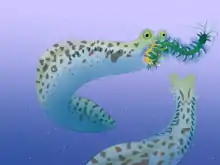 | |
| Two Panderodus fighting over an arthropod called Enalikter | |
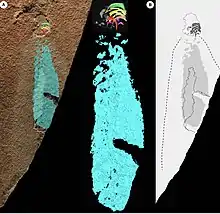 | |
| A body fossil of Panderodus from the Waukesha biota | |
| Scientific classification | |
| Kingdom: | |
| Phylum: | |
| Class: | |
| Order: | |
| Superfamily: | †Distacodontacea |
| Family: | †Distacodontidae |
| Genus: | † Panderodus |
| Type species | |
| †Panderodus denticulatus | |
| Species | |
|
• †Panderodus denticulatus • †Panderodus greenlandensis • †Panderodus rhamphoides • †Panderodus serratus • †Panderodus spasovi • †Panderodus sulcatus • †Panderodus unicostatus | |
Classification
Panderodus is a conodont of the family Distacodontidae. Its closest relative is Curtognathus. This conodont was more primitive then others, unlike other conodonts whose teeth formed into a complex sieve, the teeth of Panderodus were large and shark like. The teeth probably had their own roles, like locking prey into place. Conodonts themselves are an unusual grouping, as for more then an hundred years we only knew of them by their teeth structures.[4] Conodonts are classed in the grouping Agnatha alongside jawless fish like lampreys and hagfish.[5] However their placement is questioned, as a study published found that lampreys and hagfish are more closely related to the each other then to conodonts. The two are now placed in their own grouping, the Cyclostomi. In fact it found that conodonts are more advanced then the two groups mentioned.[6]
Venom
Another study found that some species of Panderodus exhibited body parts that would mean they would be venomous. This makes these conodonts some of the earliest known venomous organisms in the fossil record.[7]
References
- "Panderodus ✝". Mindat.org.
- "Panderodus from the Waukesha Lagerstätte of Wisconsin, USA: a primitive macrophagous vertebrate predator". Wiley online library.com.
- "Panderodus from the Waukesha Lagerstätte of Wisconsin, USA: a primitive macrophagous vertebrate predator". Wileyonlinelibrary.com.
- "Conodonts". Ucl.ac.uk.
- "What are conodonts?". Australian.museum.
- "Solving the Mystery of Endless Life between Conodonts and Lampreys, Plus a Reason for Final Extinction of the Conodonts" (PDF). Longdom.org.
- "The Earliest Known Venomous Animals Recognized Among Conodonts". Bioone.org.