Pandithurai Thevar
Vallal Pon Pandithurai Thevar (21 March 1867 – 2 December 1911), also known as Pandi Durai Thevar, was the Palavanatham Zameendar. Apart from being a ruling Zameendar, Pandithurai Thevar was famous for his immense contribution to the development of the Tamil language. His time came long after the decline of the three Tamil kingdoms - the Chera, Chola and Pandya and the end of the three Tamil Sangam eras, when communities of Tamil poets and literati had dwindled. At this time, old literary texts had disappeared with few to read them; Tamil education was waning. It was in this period that Pandithurai Thevar created a major renaissance for the Tamil language by establishing the Fourth Tamil sangam in Madurai, retrieved rare Tamil texts, presented knowledgeable scholars with prizes, and published the magazine Senthamizh as part of the Fourth Tamil sangam. In this way, he made several contributions to the Tamil Language. His birth name was Ukkira Pandian.[1][2]
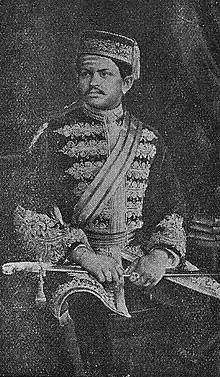
Pandithurai Thevar | |
|---|---|
| Born | Ukkira Pandian 1867 03 21 Ramanathapuram |
| Died | 1911 12 02 aged 44 Ramanathapuram |
| Nationality | Indian |
| Occupation | Zameendhar |
| Known for | Philanthropy |
Notable work | Establishing Madurai 4th Tamil Sangam |
Early life
Pandithurai Thevar was born on 21 March 1867. He was the third son of Ponnusamy Thevar, a minister at Ramanathapuram Samasthanam. When his father died, Pandithurai Thevar was a child. Then the Tamil poet, Azhagar Raju, taught him Tamil and the lawyer, Venkateshwara Shastri taught him English. As Pandithurai Thevar eagerly learnt, he became well-versed in both the languages.[3]
When he attained the age of majority, the properties so far managed by the agent, Seshadri Iyengar, were handed over to him. These properties include Palavanatham Zameen also.[4] During this younger age, he and his cousin, Bhaskara Sethupathi, were brought up together at Ramanathapuram Samasthanam.[5]
Devotion and Benevolence in Tamil development
Tamil scholar, U.V.Swaminatha Iyer searched then for rare Tamil books, found out and printed them. Pandithurai Thevar invited him to Ramanathapuram and honoured. He supported him in printing Manimekalai and Purapporul venbaamaalai.[6] He published ‘Thevarathalaimurai Pathippu’ with the help of his teacher, Gnanasambandha Pillai (Ramasamy Pillai), and ‘Sivagnana Swamigal Prabandha Thirattu.’ In objecting to anti-Shaivite, he published books on Shaivism through Sabapathy Navalar. He aided Chunnakam Kumaraswamypulavar in publishing ‘Thandiyalankaram.’ The appreciation given by Kumaraswamypulavar to the book, ‘Saivamanjari,’ compiled by Pandithurai Thevar reveals his benevolence at the best.[7]
Establishment of the Fourth Tamil Sangam
When Pandithurai Thevar came to Madurai in 1901, he found that Tamil books such as ‘Thirukkural Parimelazhagar Urai’ were not available then even at Madurai, where all the past three Tamil Sangams were established. He felt deeply sad about it. On May 24, 1901, a consultative meeting with eminent poets was convened at Madurai Sethupathi High School under the leadership of Pandithurai Thevar to establish Fourth Tamil Sangam in Madurai.[8]
Then on September 14, 1901, he established the Fourth Madurai Tamil Sangam in Madurai at Sethupathi High school in the presence of Baskara Sethupathy, Zameendhar of Ramnad, and all the Tamil scholars from Tamil Nadu and SriLanka. He assigned the management responsibilities of the Tamil Sangam to Thiru Narayana Iyengar who was a great scholar in Tamil and Sanskrit and had done residential education with him in his early life. ‘Sethupathi Senthamizh Kalaasaalai’ (college), ‘Pandiyan Puthaga Saalai’ (library) and ‘Nool Aaraaichisaalai’ (research centre on books) were also founded on the same day. 'Senthamizh', a monthly Tamil magazine, as a collection of essays by great poets was also launched. It is noteworthy that this magazine has seen its centenary celebration.[9]
Senthamizh magazine helped great poets like U. V. Swaminatha Iyer, Thiru Narayana Iyengar, Ira.Raghava Iyengar, Mu.Raghava Iyengar, Abdul Qadir Rowther, Ettayapuram Sami Iyengar, Parithimarkalaingnar, Arangasamy Iyengar, Chi.Vai.Damodaram Pillai to publish their great works in Tamil [10]
When there was a strong objection for the creation of a Chair for Tamil language at Madras University, Madurai Fourth Tamil Sangam founded by Pandithurai Thevar, created then many Tamil Pundits through its education and examination systems at its college. It is noteworthy that Parithimaarkalaignar found Tamil as the Classical one (‘Semmozhi Tamil’) and did his best to retain Tamil in the Madras University as a Classical one through the Fourth Tamil Sangam. Pandithurai Thevar and Bhaskara Sethupathi supported him well for the cause.[11] Thus this Fourth Tamil Sangam assisted in the creation of a new Tamil renaissance in the early part of 19th century.
Supporting Indigenous Steam Navigation Company
Pandithurai Thevar provided financial assistance and also recruited share-holders for the Swadeshi Steam Navigation Company, started by V.O.Chidhambarampillai in 1906, which operated steamer services between Tuticorin and Colombo, to break the British monopoly in it. He was then made the chairman of the company.[12]
Accolades
Pandithurai Thevar was praised by Baskara Sethupathy, the zameendhar of Ramanathapuram, as 'Marava chief of the West,' as his Palavanatham zameen was present to the west of Ramanathapuram zameen.[13] The first edition of ‘Manimekalai’ printed in 1898 carried in its title the appreciation for Pandithurai Thevar as only with his help that U.V.Swaminatha Iyer had brought out it in prints.[14]
Legacy to Tamil Literature
Pandithurai Thevar had composed poetry works such as ‘Sivagnanapuram Murugan Kavadich Sindhu’, ‘Rettai Manimalai’ that is composed on his guru, Sivagnana Swamigal, ‘Raja Rajeshwari Padhikam’ and many other featured poems.[15]
References
- Passions of the Tongue: Language Devotion in Tamil India, 1891–1970 By Sumathi Ramaswamy (English)
- Tamil Series :Tamil Studies, Volume 1 A. V. Subramania Aiyar (English)
- Sociolinguistics: International Journal of the Sociology of Language, Issues 99-101 (English)
- "Madras Information". Director of Information and Publicity, Government of Madras. September 14, 1967 – via Google Books.
- Literature : History of Indian Literature By Sisir Kumar Das (English)
- Rajesh, V. “Patrons and Networks of Patronage in the Publication of Tamil Classics, c 1800-1920.” Social Scientist, vol. 39, no. 3/4, Social Scientist, 2011, p. 82, http://www.jstor.org/stable/41633794.
- CULTURAL ASPIRATIONS : Essays on the Intellectual History of the Colonial By A. GANGATHARAN (English)
- Sienkewicz, Thomas J. (2002). Encyclopedia of the Ancient World: Overviews, ʻAbd al-Malik-Corinthian War. ISBN 9780893560393.
- "The Cauvery, a Living Museum: 16-17 September 1999, 5-6 March 2001, Seminar Proceedings". 2001.
- "Press and Advertisers Year Book". 1987.
- "Madras Information". 1967.
- Sampath, R. N.; Mani, Pe. Su (30 August 2017). V.O.Chidambaram Pillai. ISBN 9788123025575.
- Price, Pamela G. “Warrior Caste ‘Raja’ and Gentleman ‘Zamindar’: One Person’s Experience in the Late Nineteenth Century.” Modern Asian Studies 17, no. 4 (1983): 568. http://www.jstor.org/stable/312236.
- Rajesh, V. “Patrons and Networks of Patronage in the Publication of Tamil Classics, c 1800-1920.” Social Scientist, vol. 39, no. 3/4, Social Scientist, 2011, p.80, http://www.jstor.org/stable/41633794.
- Gauthaman, Raj; Theodore Baskaran (Translator), S. (December 2020). Dark Interiors: Essays on Caste and Dalit Culture. ISBN 9789381345641.